MCQ
$CuS{O_4}$ reacts with $KCN$ solution and forms
  • A
    $Cu{(CN)_2}$
  • B
    $Cu(CN)$
  • C
    ${K_2}\left[ {Cu{{(CN)}_4}} \right]$
  • ${K_3}\left[ {Cu{{\left( {CN} \right)}_4}} \right]$

Answer

Correct option: D.
${K_3}\left[ {Cu{{\left( {CN} \right)}_4}} \right]$
d
(d)$4KCN + CuS{O_4} \to \mathop {{K_3}[Cu{{(CN)}_4}]\,\,\,\,\,\,\,\,\,\,\,\,\,\,}\limits_{{\rm{Potassium tetracyno cuprate}}} $

Need a full question paper?

Generate a complete, print-ready paper with questions like this in minutes — across 16+ boards, with answer keys.

Start Generating Free

Similar questions

The relative reactivity of $1\,^oH, 2\,^oH$ and $3\,^oH$ in bromination reaction has been found to be $1 : 82 : 1600$ respectively. In the reaction

$\begin{array}{*{20}{c}}
  {C{H_3}\,\,\,\,\,\,\,\,\,\,\,\,\,\,\,\,\,\,\,\,\,\,\,\,\,\,\,\,\,\,\,\,\,\,\,\,\,\,\,\,\,\,\,} \\ 
  {|\,\,\,\,\,\,\,\,\,\,\,\,\,\,\,\,\,\,\,\,\,\,\,\,\,\,\,\,\,\,\,\,\,\,\,\,\,\,\,\,\,\,\,\,\,\,\,\,\,} \\ 
  {C{H_3} - CH - C{H_3}(excess) + B{r_2}\xrightarrow{{hv}}} 
\end{array}$ $\mathop {\begin{array}{*{20}{c}}
  {\,\,\,\,\,C{H_3}} \\ 
  | \\ 
  {C{H_3} - C - C{H_3}} \\ 
  | \\ 
  {\,\,Br} 
\end{array}}\limits_{(A)} $   +   $\mathop {\begin{array}{*{20}{c}}
  {C{H_3}\,\,\,\,\,\,\,\,\,\,} \\ 
  {\,\,|\,\,\,\,\,\,\,\,\,\,\,\,\,\,\,\,\,\,\,} \\ 
  {C{H_3} - CH - C{H_2} - Br} 
\end{array}}\limits_{(B)} $ 

the percentage yields of the products $(A)$ and $(B)$ are expected to be
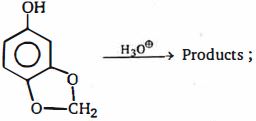
Product of the reaction is/are
Tertiary alkyl halides are practically inert to substitution by ${S_N}^2$ mechanism because of

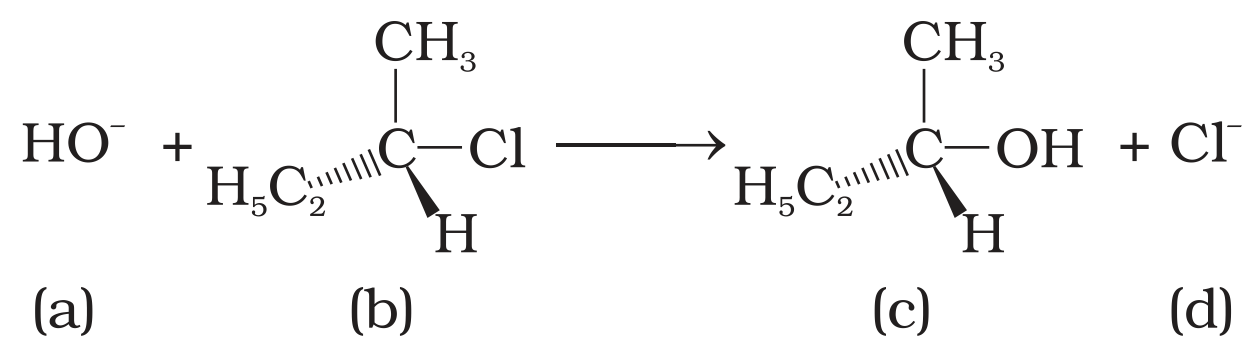
Which of the following statements are correct about the kinetics of this reaction?
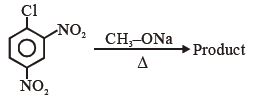
Product will be
Which of the following enzymes is not useful in the digestion of proteins
The molecular mass of acetic acid dissolved in water is $60$  and when dissolved in benzene it is  $120.$ This difference in behaviour of $C{H_3}COOH$ is because
For saturated solution of $CaF_2$, choose the correct relationship-
The species that can have a trans-isomer is: (en $=$ ethane $-1,2-$ diamine, $ox =$ oxalate)
What are the products formed in the reaction or xenon hexafluoride with silicon dioxide ?