MCQ
D-block elements form complexes because they have:
  • A
    Vacant orbitals.
  • B
    Small sizes.
  • C
    Higher nuclear charge.
  • D
    All of the above.

Answer

  1. All of the above.

Explanation:

Transition metals  has incompletely filled d orbital. They have vacant orbitals to accept coordination bond. Complex compounbs are those in which the metal ion bind a number of anions or neutral molecules giving complex species with characteristics properties. The transition metals form a large no. of complex compounds.

This is due to the comparatively smaller size of the metal ions,their high ionic charges and the availability of d orbitals for bond formation.

Need a full question paper?

Generate a complete, print-ready paper with questions like this in minutes — across 16+ boards, with answer keys.
Start Generating Free

Similar questions

The IUPAC name of the following compound is:
Which of the following is the correct sequence of atomic weights of given elements
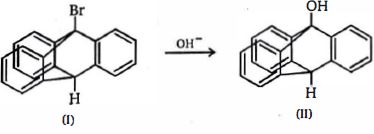
Conversion of $I$ to $II$
Glycerol $\xrightarrow{{KHS{O_4}}}A\xrightarrow{{LiAl{H_4}}}B$

$A$ and $B$ are :

The most stable oxidation state of $Cr$ in aq. medium is
Apoenzyme is a:
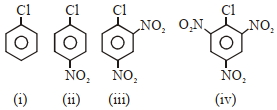
The correct order of the following compounds showing increasing tendency towards nucleophilic substitution reaction is :-
$\underset{(A)}{\mathop{\begin{matrix}
   \,\,\,\,\,Ph\,\,\,\,C{{H}_{3}}  \\
   |\,\,\,\,\,\,\,\,\,\,|\,\,  \\
   Ph-C-C-C{{H}_{3}}  \\
   |\,\,\,\,\,\,\,\,\,\,|\,\,\,  \\
   \,OH\,\,\,OH  \\
\end{matrix}}}\,+\underset{(B)}{\mathop{\begin{matrix}
   \,\,\,\,Ph\,\,\,Et  \\
   \,\,|\,\,\,\,\,\,\,\,\,|  \\
   Ph-C-C-Et  \\
   \,\,|\,\,\,\,\,\,\,\,\,|  \\
   \,\,\,\,\,OH\,\,OH  \\
\end{matrix}}}\,\xrightarrow{{{H}_{2}}S{{O}_{4}}}$


$(p)$ $\begin{matrix}
   Ph\,\,\,\,\,O\,  \\
   |\,\,\,\,\,\,\,\,||\,\,  \\
   Ph-C-C-C{{H}_{3}}  \\
   |\,\,\,\,\,\,\,\,\,\,\,\,  \\
   C{{H}_{3}}\,\,\,\,\,\,\,\,  \\
\end{matrix}$                                $(q)$ $\begin{matrix}
   \,Ph\,\,\,\,\,O\,  \\
   \,\,|\,\,\,\,\,\,\,\,||  \\
   Ph-C-C-Et  \\
   |\,\,\,\,\,\,\,\,\,\,  \\
   Et\,\,\,\,\,\,\,\,\,\,  \\
\end{matrix}$

$(r)$ $\begin{matrix}
   \,Ph\,\,\,\,\,O\,  \\
   |\,\,\,\,\,\,\,\,\,\,||\,  \\
   Ph-C-C-C{{H}_{3}}  \\
   |\,\,\,\,\,\,\,\,\,\,\,\,\,\,  \\
   Et\,\,\,\,\,\,\,\,\,\,\,\,\,  \\
\end{matrix}$                             $(s)$ $\begin{matrix}
   \,\,\,Ph\,\,\,\,\,O\,  \\
   \,\,|\,\,\,\,\,\,\,\,||  \\
   Ph-C-C-Et  \\
   |\,\,\,\,\,\,\,\,\,\,  \\
   C{{H}_{3}}\,\,\,\,  \\
\end{matrix}$

When $(A)$ and $(B)$ reacts with $H_2SO_4$ products obtained are

Number of compounds from the following which will not produce orange red precipitate with Benedict solution is $..............$.  Glucose, maltose, sucrose, ribose,$2-$deoxyribose, amylose, lactose.
For the reaction $A \to B$, the rate law expression is : Rate $ = \,k\,[A]$ Which of the following statements is incorrect