Question
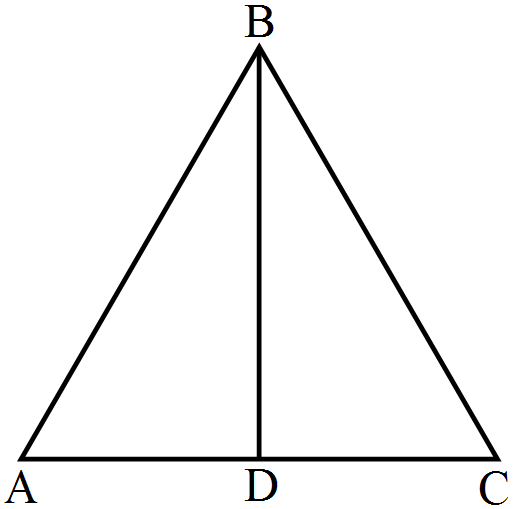
D is any point on the side AC of $\triangle\text{ABC}$ with AB = AC. Show that CD < BD.
Answer

Given: In $\triangle\text{ABC, AB = AC}$ To prove: $\text{CD < BD}$ proof: In $\triangle\text{ABC},$ Since, $\text{AB = AC}$ (Given) so, $\angle\text{ABC}=\angle\text{ACB}...(\text{i})$ In $\triangle\text{ABC}$ and $\triangle\text{DBC},$$\angle\text{ABC}>\angle\text{DBC}$
$\Rightarrow\text{ACB}>\angle\text{DBC}$ [from (i)]
$\Rightarrow\text{BD > CD}$ (Side opposite to greater angle is longer.)
$\therefore\text{CD < BD}$

Need a full question paper?

Generate a complete, print-ready paper with questions like this in minutes — across 16+ boards, with answer keys.
Start Generating Free

Similar questions

A cuboidal vessel is $10\ m$ long and $8\ m$ wide. How high must it be made to hold $380$ cubic meters of a liquid?
If $\text{x}=3+\sqrt8,$ find the value of $\text{x}^2+\frac{1}{\text{x}^2}.$
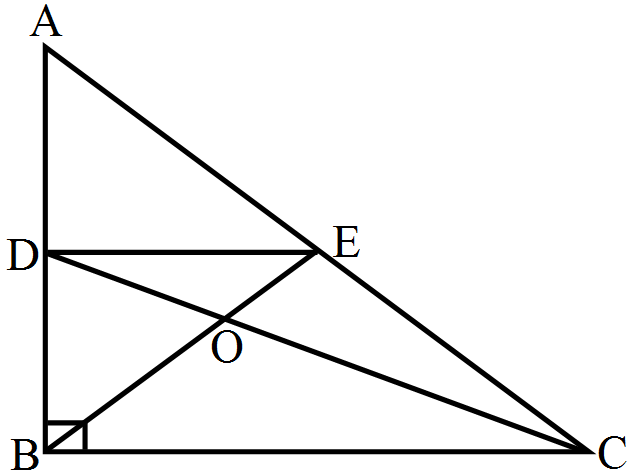
In figure, Triangle ABC is a right angled triangle at B. Given that AB = 9cm, AC = 15cm and D, E are the mid-points of the sides AB and AC respectively, calculate
  1. The length of BC
  2. The area of $\triangle\text{ADE}.$
Draw, in the same diagram, a histogram and a frequency polygon to represent the following data which shows the monthly cost of living index of a city in a period of 2 years:
Cost of living inex: 440-460 460-480 480-500 500-520 520-540 540-560 560-580 580-600
No.of months: 2 4 3 5 3 2 1 4
Define complementary angles.
The marks scored by 55 students in a test are given below:
Marks
0-5
5-10
10-15
15-20
20-25
25-30
30-35
No. of students
2
6
13
17
11
4
2
Prepare a cumulative frequency table.
BD and CE are bisectors of $\angle\text{B}$ and $\angle\text{C}$ of an isosceles $\triangle\text{ABC}$ with $\text{AB}=\text{AC}.$ Prove that $\text{BD}=\text{CE}.$
A well with 10m inside diameter is dug 8.4m deep. Earth taken out of it is spread all around it to a width of 7.5m to form an embankment. Find the height of the embankment.
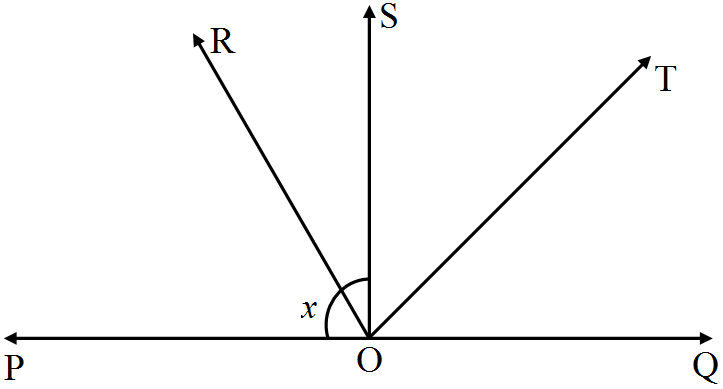
In figure, ray OS stand on a line POQ. Ray OR and ray OT are angle bisectors of $\angle\text{POS}$ and $\angle\text{SOQ}$ respectively. If $\angle\text{POS}=\text{x},$ find $\angle\text{ROT}.$
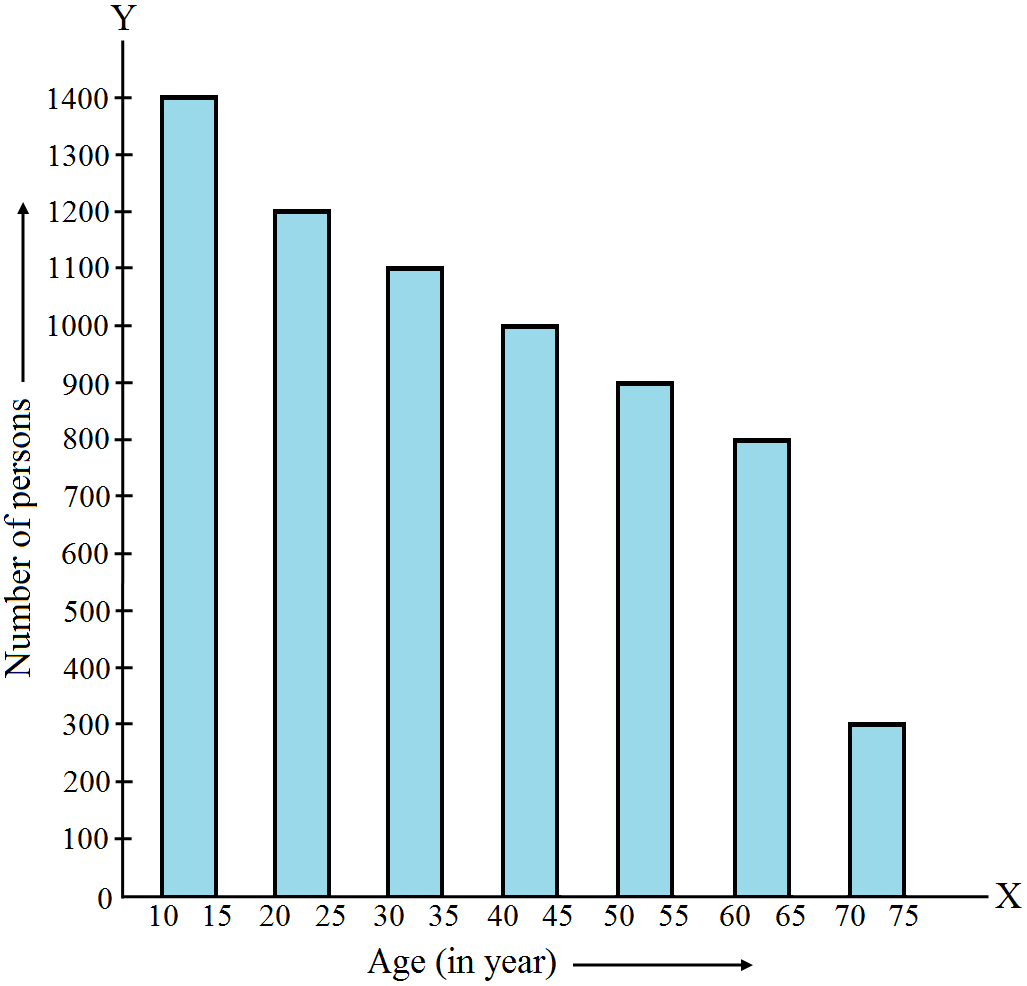
Study the bar graph representing the number of persons in various age groups in a town shown in figure Observe the bar graph and answer the following questions:
  1. What is the percentage of the youngest age-group persons over those in the oldest age group?
  2. What is the total population of the town?
  3. What is the number of persons in the age-group 60–65?
  4. How many persons are more in the age-group 10–15 than in the age group 30–35?
  5. What is the age-group of exactly 1200 persons living in the town?
  6. What is the total number of persons living in the town in the age-group 50–55?
  7. What is the total number of persons living in the town in the age-groups 10 – 15 and 60 – 65?
  1. Whether the population in general increases, decreases or remains constant with the increase in the age-group.