MCQ
${d \over {dx}}{({x^2} + \cos x)^4} = $
  • A
    $4({x^2} + \cos x)(2x - \sin x)$
  • B
    $4{({x^2} - \cos x)^3}(2x - \sin x)$
  • $4{({x^2} + \cos x)^3}(2x - \sin x)$
  • D
    $4{({x^2} + \cos x)^3}(2x + \sin x)$

Answer

Correct option: C.
$4{({x^2} + \cos x)^3}(2x - \sin x)$
c
(c) $\frac{d}{{dx}}{[{x^2} + \cos x]^4} = 4{[{x^2} + \cos x]^3}[2x - \sin x]$.

Need a full question paper?

Generate a complete, print-ready paper with questions like this in minutes — across 16+ boards, with answer keys.
Start Generating Free

Similar questions

Let $f\left( x \right) = \frac{{{x^2} - x}}{{{x^2} + 2x}}\,x \ne 0, - 2$. Then $\frac{d}{{dx}}\left[ {{f^{ - 1}}\left( x \right)} \right]$ (wherever it is defined) is equal to
If $P = \left( {\begin{array}{*{20}{c}}i&0&{ - i}\\0&{ - i}&i\\{ - i}&i&0\end{array}} \right)$ and $Q = \left( {\begin{array}{*{20}{c}}{ - i}&i\\0&0\\i&{ - i}\end{array}} \right)$,then $PQ$ is equal to
If $\omega \ne 1$ is cube root of unity and $H = \left[ {\begin{array}{*{20}{c}}\omega &0\\0&\omega \end{array}} \right]$ then ${H^{70}}$ is equal to 
Find the projection of the vector $\hat{i}+3 \hat{j}+7 \hat{k}$ on the vector $2 \hat{i}-3 \hat{j}+6 \hat{k}$.
A dice is thrown $(2n + 1)$ times. The probability of getting $1, 3$ or $4$ at most $n$ times, is
If $\vec{\text{a}}\text{ and }\vec{\text{b}}$ are two collinear vectors, then which of the follwoing are incorrect?
  1. $\vec{\text{b}}=\lambda\vec{\text{a}}$ for some scalar $\lambda$
  2. $\vec{\text{a}}=\pm\vec{\text{b}}$
  3. The respective components of $\vec{\text{a}}\text{ and }\vec{\text{b}}$ are proportional.
  4. Both the vectors ​​​​​​​$\vec{\text{a}}\text{ and }\vec{\text{b}}$ have the same direction but different magnitudes.
$\int\limits_{\frac{1}{2}}^{3\frac{1}{2}} {\left\{ {\frac{1}{2}\,\left( {|x - 3|\, + \,|1 - x|\, - 4} \right)} \right\}\,\,dx} $ equals:  Where $ \{*\}$ denotes the fractional part function.
If A is a matrix of order m × n and B is a matrix such that ABand BA are both defined, then the order of matrix B is:
  1. m × m
  2. n × n
  3. n × m
  4. m × n
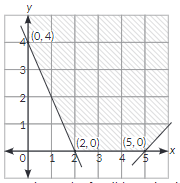
A linear programming problem (LPP) along with the graph of its constraints is shown below. The corresponding objective function is
Minimize: $Z=3 x+2 y$. The minimum value of the objective function is obtained at the corner point ( 2 , 0).
The optimal solution of the above linear programming problem $\qquad$
Image
$2{x^3} - 6x + 5$ is an increasing function if