MCQ 11 Mark
If the function $f(x) = \left\{ \begin{array}{l}\frac{{k\cos x}}{{\pi - 2x}},{\rm{when }}x \ne \frac{\pi }{2}\\3,\;\;\;\;\;\;\;\;\;{\rm{when }}x = \frac{\pi }{2}\end{array} \right.$ be continuous at $x = \frac{\pi }{2}$, then $ k =$
Answerb
(b) $f\,(\pi /2) = 3$. Since $f(x)$ is continuous at $x = \pi /2$
$ \Rightarrow \,\mathop {\lim }\limits_{x \to \pi /2} \,\left( {\frac{{k\cos x}}{{\pi - 2x}}} \right) = f\left( {\frac{\pi }{2}} \right)\,\, $
$\Rightarrow \,\,\frac{k}{2} = 3\,\, \Rightarrow \,\,k = 6.$
View full question & answer→MCQ 21 Mark
In order that the function $f(x) = {(x + 1)^{1/x}}$ is continuous at $x = 0$, $f(0)$ must be defined as
- A
$f(0) = 0$
- ✓
$f(0) = e$
- C
$f(0) = 1/e$
- D
$f(0) = 1$
AnswerCorrect option: B. $f(0) = e$
b
(b) $\mathop {\lim }\limits_{x \to 0} \,f(x) = f(0) = \mathop {\lim }\limits_{x \to 0} \,\,{(1 + x)^{1/x}} = e.$
View full question & answer→MCQ 31 Mark
The value of $k$ so that the function $f(x) = \left\{ \begin{array}{l}k(2x - {x^2}),\;\;\;{\rm{when\,}}\,x < 0\\\,\,\,\,\,\,\,\,\,\cos x,\,\,\,\,\,\,{\rm{when\,}}\,x \ge {\rm{0}}\end{array} \right.$ is continuous at $x = 0$, is
Answerd
(d) $f(0 - ) = \mathop {\lim }\limits_{x \to 0 - } \,k(2x - {x^2}) = 0$;
$f(0 + ) = \mathop {\lim }\limits_{x \to 0 + } \,\cos x = 1$
$\therefore \,\,\,f(0) = \cos x = 1$
Hence no value of $k$ can make $f(0 - ) = 1.$
View full question & answer→MCQ 41 Mark
If $f(x) = \left\{ \begin{array}{l}\frac{x}{{{e^{1/x}} + 1}},\,\,{\rm{when\,\,}}\,\,x \ne 0\\\,\,\,\,\,\,\,\,\,\,\,\,\,\,0,\,\,{\rm{when \,\,}}x = 0\end{array} \right.$, then
- A
$\mathop {\lim }\limits_{x \to 0 + } f(x) = 1$
- B
$\mathop {\lim }\limits_{x \to 0 - } f(x) = 1$
- ✓
$f(x)$ is continuous at $x = 0$
- D
AnswerCorrect option: C. $f(x)$ is continuous at $x = 0$
c
(c) $f(0) = 0$; $f(0 - ) = \mathop {\lim }\limits_{h \to 0} \,\frac{{ - h}}{{{e^{ - 1/h}} + 1}} = \mathop {\lim }\limits_{h \to 0} \,\frac{{ - h}}{{1 + \frac{1}{{{e^{1/h}}}}}} = 0$
$f(0 + ) = \mathop {\lim }\limits_{h \to 0} \,\frac{h}{{{e^{1/h}} + 1}} = 0.$
View full question & answer→MCQ 51 Mark
If $f(x) = \left\{ \begin{array}{l}{(1 + 2x)^{1/x}},\,{\rm{for\,\, }}x \ne 0\\\,\,\,\,\,\,\,\,\,\,\,\,\,\,\,\,\,\,{e^2},\,{\rm{for\,\, }}x = 0\,\,\,\end{array} \right.$, then
- A
$\mathop {\lim }\limits_{x \to 0 + } f(x) = e$
- ✓
$\mathop {\lim }\limits_{x \to 0 - } f(x) = {e^2}$
- C
$f(x)$ is discontinuous at $x = 0$
- D
AnswerCorrect option: B. $\mathop {\lim }\limits_{x \to 0 - } f(x) = {e^2}$
b
(b) $\mathop {\lim }\limits_{x \to 0 - } f(x) = \mathop {\lim }\limits_{x \to 0} \,\,{\left[ {{{(1 + 2x)}^{1/2x}}} \right]^2} = {e^2}.$
View full question & answer→MCQ 61 Mark
Let $f(x) = \left\{ \begin{array}{l}\frac{{x - 4}}{{|x - 4|}} + a,\;x < 4\\\,\,\,\,\,\,\,\,\,\,\,\,a + b,\,x = 4\\\frac{{x - 4}}{{|x - 4|}} + b,\,x > 4\end{array} \right.$. Then $f(x)$ is continuous at $x = 4$ when
- A
$a = 0,\;b = 0$
- B
$a = 1,\;b = 1$
- C
$a = - 1,\;b = 1$
- ✓
$a = 1,\;b = - 1$
AnswerCorrect option: D. $a = 1,\;b = - 1$
d
(d) $\mathop {\lim }\limits_{x \to 4 - } f(x) = \mathop {\lim }\limits_{h \to 0} f(4 - h) = \mathop {\lim }\limits_{h \to 0} \,\,\frac{{4 - h - 4}}{{|4 - h - 4|}} + a$
$ = \mathop {\lim }\limits_{h \to 0} - \frac{h}{h} + a = a - 1.$
$ = \mathop {\lim }\limits_{x \to 4 + } f(x) = \mathop {\lim }\limits_{h \to 0} \,\,f(4 + h) = \mathop {\lim }\limits_{h \to 0} \,\frac{{4 + h - 4}}{{|4 + h - 4|}} + b = b + 1$
and $f(4) = a + b$
Since $f(x)$ is continuous at $x = 4$
Therefore $\mathop {\lim }\limits_{x \to 4 - } f(x) = f(4) = \mathop {\lim }\limits_{x \to 4 + } f(x)$
$ \Rightarrow \,\,a - 1 = a + b = b + 1\,\, \Rightarrow \,\,b = - 1$ and $a = 1.$
View full question & answer→MCQ 71 Mark
The value of $f(0)$, so that the function $f(x) = \frac{{{{(27 - 2x)}^{1/3}} - 3}}{{9 - 3{{(243 + 5x)}^{1/5}}}},\,(x \ne 0)$ is continuous, is given by
Answerc
(c) Since $f(x)$ is continuous at $x = 0,$ therefore
$f(0) = \mathop {\lim }\limits_{x \to 0} \,f(x) = \mathop {\lim }\limits_{x \to 0} \,\frac{{{{(27 - 2x)}^{1/3}} - 3}}{{9 - 3\,{{(243 + 5x)}^{1/5}}}}\,$, $\left( {{\rm{Form}} \,\, \frac{{\rm{0}}}{{\rm{0}}}} \right)$
$ = \mathop {\lim }\limits_{x \to 0} \,\,\frac{{\frac{1}{3}\,{{(27 - 2x)}^{ - 2/3}}( - 2)}}{{ - \frac{3}{5}\,{{(243 + 5x)}^{ - 4/5}}(5)}} = 2.$
View full question & answer→MCQ 81 Mark
If the function $f(x) = \left\{ \begin{array}{l}{(\cos x)^{1/x}},\;x \ne 0\\\,\,\,\,\,\,\,\,\,\,\,\,\,\,\,k,\,x = 0\end{array} \right.$ is continuous at $x = 0$, then the value of $k$ is
Answera
(a) $\mathop {\lim }\limits_{x \to 0} \,\,{(\cos x)^{1/x}} = k\,\, \Rightarrow \,\,\mathop {\lim }\limits_{x \to 0} \frac{1}{x}\log \,(\cos x) = \log k$
$ \Rightarrow \,\,\mathop {\lim }\limits_{x \to 0} \,\,\frac{1}{x}\,\,\mathop {\lim }\limits_{x \to 0} \,\,\log \,\cos x = \log k$
$ \Rightarrow \,\,\,\mathop {\lim }\limits_{x \to 0} \,\,\frac{1}{x} \times 0 = {\log _e}k\,\, \Rightarrow \,k = 1$ .
View full question & answer→MCQ 91 Mark
If the function $f(x) = \left\{ \begin{array}{l}1 + \sin \frac{{\pi x}}{2}\,\,,\,{\rm{\,\,for}}\,\, - \infty < x \le 1\\\,\,\,\,\,\,\,\,ax + b,\,{\rm{\,\,for}}\,\,1 < x < 3\\\,\,\,\,6\tan \frac{{x\pi }}{{12}},\,{\rm{\,\,for\,\,}}3 \le x < 6\end{array} \right.$ is continuous in the interval $( - \infty ,\,6)$, then the values of $a$ and $b$ are respectively
- A
$0, 2$
- B
$1, 1$
- ✓
$2, 0$
- D
$2, 1$
AnswerCorrect option: C. $2, 0$
c
(c) Given function is continuous at all point in $( - \,\infty ,\,\,6)$ and at $x = 1,\,\,x = 3$ function is continuous.
If function $f(x)$ is continuous at $x = 1,$ then
$\mathop {\lim }\limits_{x \to {1^ - }} \,f(x) = \mathop {\lim }\limits_{x \to {1^ + }} \,f(x)$
$ \Rightarrow \,\,\,1 + \sin \frac{\pi }{2} = a + b$
$\therefore \,\,\,a + b = 2$.....$(i)$
If at $x = 3,$ function is continuous, then
$\mathop {\lim }\limits_{x \to {3^ - }} \,f(3) = \mathop {\lim }\limits_{x \to {3^ + }} \,f(x)$ $ \Rightarrow \,\,3a + b = 6\tan \frac{{3\pi }}{{12}}$
$\therefore \,\,\,3a + b = 6$.....$(ii)$
From $(i)$ and $(ii),$ $a = 2,\,\,b = 0$ .
View full question & answer→MCQ 101 Mark
If $f(x) = \left\{ \begin{array}{l}\,\,\,\,\,\,\,\frac{{\sin [x]}}{{[x] + 1}},\,\,{\rm{for}}\,\,x > 0\\\frac{{\cos \frac{\pi }{2}[x]}}{{[x]}},\,\,{\rm{for}}\,\,x < 0\\\,\,\,\,\,\,\,\,\,\,\,\,\,\,\,\,k,\,\,{\rm{at}}\,x = 0\end{array} \right.$; where $[x]$ denotes the greatest integer less than or equal to $x$, then in order that $f$ be continuous at $x = 0$, the value of $k$ is
- ✓
Equal to $ 0$
- B
Equal to $1$
- C
Equal to $-1$
- D
AnswerCorrect option: A. Equal to $ 0$
a
(a) If $f$ is continuous at $x = 0$, then
$\mathop {\lim }\limits_{x \to {0^ - }} f(x) = \mathop {\lim }\limits_{x \to {0^ + }} f(x) = f(0)$
$ \Rightarrow \,f(0) = \,\mathop {\lim }\limits_{x \to {0^ - }} f(x)$
$k = \mathop {\lim }\limits_{h \to 0} f(0 - h) = \mathop {\lim }\limits_{h \to 0} \,\frac{{\cos \frac{\pi }{2}\,[0 - h]}}{{[0 - h]}}$
$k = \mathop {\lim }\limits_{h \to 0} \,\frac{{\cos \frac{\pi }{2}\,[ - h]}}{{[ - h]}} = \mathop {\lim }\limits_{h \to 0} \,\frac{{\cos \frac{\pi }{2}\,[ - h - 1]}}{{[ - h - 1]}}$
$k = \mathop {\lim }\limits_{h \to 0} \,\frac{{\cos \,\left( { - \frac{\pi }{2}} \right)}}{{ - 1}}$; $k = 0$.
View full question & answer→MCQ 111 Mark
If the function $f(x) = \,\left\{ {\begin{array}{*{20}{c}}{5x - 4}&,&{{\rm{if}}}&{0 < x \le 1}\\{4{x^2} + 3bx}&,&{{\rm{if}}}&{1 < x < 2}\end{array}} \right.$ is continuous at every point of its domain, then the value of $b$ is
Answera
(a) $f(x)$ is continuous at every point of its domain,
==>$\mathop {\lim }\limits_{x \to {1^ - }} f(x) = \mathop {\lim }\limits_{x \to {1^ + }} f(x) = f(1)$
==> $5 \times 1 - 4 = 4 \times 1 + 3 \times b \times 1$
==> $1 = 4 + 3b$ ==> $3b = - 3$ ==> $b = - 1$.
View full question & answer→MCQ 121 Mark
The values of $A$ and $B$ such that the function $f(x) = \left\{ {\begin{array}{*{20}{c}}{ - 2\sin x,}&{x \le - \frac{\pi }{2}}\\{A\sin x + B,}&{ - \frac{\pi }{2} < x < \frac{\pi }{2}}\\{\cos x,}&{x \ge \frac{\pi }{2}}\end{array}} \right.$, is continuous everywhere are
- A
$A = 0,\,B = 1$
- B
$A = 1,\,B = 1$
- ✓
$A = - 1,\,B = 1$
- D
$A = - 1,\,B = 0$
AnswerCorrect option: C. $A = - 1,\,B = 1$
c
(c) For continuity at all $x \in R,$ we must have
$f\left( { - \frac{\pi }{2}} \right) = \mathop {{\rm{lim}}}\limits_{x \to {{( - \pi /2)}^ - }} ( - 2\sin x)$
$ = \mathop {{\rm{lim}}}\limits_{x \to {{( - \pi /2)}^ + }} (A\sin x + B)$
==> $2 = - A + B$ .....$(i)$
and $f\left( {\frac{\pi }{2}} \right) = \mathop {\lim }\limits_{x \to {{(\pi /2)}^ - }} (A\sin x + B)$
$ = \mathop {{\rm{lim}}}\limits_{x \to {{(\pi /2)}^ + }} (\cos x)$
==> $0 = A + B$.....$(ii)$
From $(i)$ and $(ii),$ $A = - 1$ and $B = 1$.
View full question & answer→MCQ 131 Mark
In order that the function $f(x) = {(x + 1)^{\cot \,x}}$ is continuous at $x = 0 , f(0)$ must be defined as
- A
$f(0) = \frac{1}{e}$
- B
$f(0) = 0$
- ✓
$f(0) = e$
- D
AnswerCorrect option: C. $f(0) = e$
c
(c) For continuity at $x = 0$, we must have $f(0) = \mathop {{\rm{lim}}}\limits_{x \to 0} f(x)$
$\mathop {\lim }\limits_{x \to \alpha } \,\frac{{1 - \cos \,(a{x^2} + bx + c)}}{{{{(x - \alpha )}^2}}}$
$ = \mathop {{\rm{lim}}}\limits_{x \to 0} {\left\{ {{{(1 + x)}^{\frac{1}{x}}}} \right\}^{x\cot x}}$
$ = \mathop {{\rm{lim}}}\limits_{x \to 0} {\left\{ {{{(1 + x)}^{\frac{1}{x}}}} \right\}^{\mathop {{\rm{lim}}}\limits_{x \to 0} \,\left( {\frac{x}{{\tan x}}} \right)}}$ $ = {e^1} = e$.
View full question & answer→MCQ 141 Mark
If function $f(x) = \left\{ {\begin{array}{*{20}{c}}{x\,\,\,\,\,,}&{{\rm{if}}\,x\,{\rm{\,\,is\,\, rational\,\,}}}\\{1 - x,}&{{\rm{if}}\,x\,{\rm{\,is\,\, irrational\,}}}\end{array},} \right.$ then $f(x)$ is continuous at ...... number of points
Answerc
(c) At no point, function is continuous.
View full question & answer→MCQ 151 Mark
The function defined by $f(x)\, = \,\left\{ {\begin{array}{*{20}{c}}{{{\left( {{x^2} + {e^{\frac{1}{{2 - x}}}}} \right)}^{ - 1}}}&,&{x \ne 2}\\k&,&{x = 2}\end{array}} \right.$, is continuous from right at the point $x = 2$, then $k$ is equal to
AnswerCorrect option: B. $\frac{1}{4}$
b
(b) $f(x) = {\left[ {{x^2} + {e^{\frac{1}{{2 - x}}}}} \right]^{ - 1}}$ and $f(2) = k$
If $f(x)$ is continuous from right at $x = 2$ then $\mathop {\lim }\limits_{x \to {2^ + }} f(x) = f(2) = k$
==> $\mathop {\lim }\limits_{x \to {2^ + }} {\left[ {{x^2} + {e^{\frac{1}{{2 - x}}}}} \right]^{ - 1}} = k$
==> $k = \mathop {\lim }\limits_{h \to 0} f(2 + h)$
==> $k = \mathop {\lim }\limits_{h \to 0} \,{\left[ {{{(2 + h)}^2} + {e^{\frac{1}{{2 - (2 + h)}}}}} \right]^{\, - 1}}$
==> $k = \mathop {\lim }\limits_{h \to 0} \,{\left[ {\,4 + {h^2} + 4h + {e^{ - 1/h}}\,} \right]^{\, - 1}}$
==> $k = {[4 + 0 + 0 + {e^{ - \infty }}]^{\, - 1}}$
==> $k = \frac{1}{4}$.
View full question & answer→MCQ 161 Mark
The function $f(x) = \frac{{1 - \sin x + \cos x}}{{1 + \sin x + \cos x}}$ is not defined at $x = \pi .$ The value of $f(\pi ),$ so that $f(x)$ is continuous at $x = \pi $, is
- A
$ - \frac{1}{2}$
- B
$\frac{1}{2}$
- ✓
$-1$
- D
$1$
Answerc
(c) $f(x) = \frac{{2{{\cos }^2}\frac{x}{2} - 2\sin \frac{x}{2}\cos \frac{x}{2}}}{{2{{\cos }^2}\frac{x}{2} + 2\sin \frac{x}{2}\cos \frac{x}{2}}} = \frac{{\cos \frac{x}{2} - \sin \frac{x}{2}}}{{\cos \frac{x}{2} + \sin \frac{x}{2}}}$
$ = \tan \left( {\frac{\pi }{4} - \frac{x}{2}} \right)$ at $x = \pi $, $f(\pi ) = - \tan \frac{\pi }{4} = - 1$.
View full question & answer→MCQ 171 Mark
For the function $f(x) = \left\{ \begin{array}{l}\frac{{{e^{1/x}} - 1}}{{{e^{1/x}} + 1}},\,\,x \ne 0\\0\,\,\,\,\,\,\,\,\,\,\,\,\,\,\,\,,\,\,x = 0\end{array} \right.$, which of the following is correct
- A
$\mathop {\lim }\limits_{x \to 0} f(x)$ does not exist
- B
$f(x)$ is continuous at $x = 0$
- C
$\mathop {\lim }\limits_{x \to 0} f(x) = 1$
- ✓
$\mathop {\lim }\limits_{x \to 0} f(x)$ exists but $f(x)$ is not continuous at $x = 0$
AnswerCorrect option: D. $\mathop {\lim }\limits_{x \to 0} f(x)$ exists but $f(x)$ is not continuous at $x = 0$
d
(d) Given $f(x) = \left\{ \begin{array}{l}\frac{{{e^{\frac{1}{x}}} - 1}}{{{e^{\frac{1}{x}}} + 1}}\,\,,\,\,x \ne 0\\0\,\,\,\,\,\,\,\,\,\,\,\,\,,\,x = 0\end{array} \right.$
==> $\mathop {\lim }\limits_{x \to {0^ + }} \frac{{{e^{\frac{1}{x}}} - 1}}{{{e^{\frac{1}{x}}} + 1}} = \frac{{{e^\infty } - 1}}{{{e^\infty } + 1}} = - 1$
==> $\mathop {\lim }\limits_{x \to {0^ - }} \frac{{{e^{\frac{1}{x}}} - 1}}{{{e^{\frac{1}{x}}} + 1}} = \frac{{1 - {e^{ - \frac{1}{x}}}}}{{1 + {e^{\frac{1}{x}}}}} = \frac{{1 - {e^{ - \infty }}}}{{1 + {e^\infty }}} = 1$
So, $\mathop {\lim }\limits_{x \to 0} f(x)$ exists at $x = 0$, but at $x = 0$ it is not continuous.
View full question & answer→MCQ 181 Mark
Find the relationship be $a$ and $b$ so that the function $f$ defined by $f(x) = \left\{ {\begin{array}{*{20}{l}}
{ax + 1,{\rm{ if }}\,x\, \le \,3}\\
{bx + 3,{\rm{ if }}\,x\, > \,3}
\end{array}} \right.$ is continous at $x=3.$
- A
$a=b+\frac{1}{3}$
- B
$a=b-\frac{2}{3}$
- C
$a=b+\frac{2}{5}$
- ✓
$a=b+\frac{2}{3}$
AnswerCorrect option: D. $a=b+\frac{2}{3}$
d
The given function $f$ is $f(x)=\left\{\begin{array}{l}
a x+1, \text { if } x \leq 3 \\
b x+3, \text { if } x>3
\end{array}\right.$
If $f$ is continuous at $x=3,$ then
$\mathop {\lim }\limits_{x \to {3^ - }} f(x) = \mathop {\lim }\limits_{x \to {3^ - }} f(x) = f(3)$ ............. $(1)$
Also, $\mathop {\lim }\limits_{x \to {3^ - }} f(x) = \mathop {\lim }\limits_{x \to {3^ - }} f(ax + 1) = 3a + 1$
$\mathop {\lim }\limits_{x \to {3^ + }} f(x) = \mathop {\lim }\limits_{x \to {3^ + }} f(bx + 1) = 3b + 3$
$f(3)=3 a+1$
Therefore, from $(1),$ we obtain
$3 a+1=3 b+3=3 a+1$
$\Rightarrow 3 a+1=3 b+3$
$\Rightarrow 3 a=3 b+2$
$\Rightarrow a=b+\frac{2}{3}$
Therefore, the required relationship is given by, $a=b+\frac{2}{3}$
View full question & answer→MCQ 191 Mark
Find the values of $k$ so that the function $f$ is continuous at the indicated point.
$f(x) = \left\{ {\begin{array}{*{20}{l}}
{\frac{{k\cos x}}{{\pi - 2x}},}&{{\rm{ if }}\,x\, \ne \,\frac{\pi }{2}}\\
{3,}&{{\rm{ if }}\,x\, = \,\frac{\pi }{2}}
\end{array}} \right.$ at $x = \frac{\pi }{2}$
Answera
The given function $f$ is $f(x)\left\{ {\begin{array}{*{20}{l}}
{\frac{{k\cos x}}{{\pi - 2x}},}&{{\rm{ if }}\,x\, \ne \,\frac{\pi }{2}}\\
{3,}&{{\rm{ if }}\,x\, = \,\frac{\pi }{2}}
\end{array}} \right.$
The given function $f$ is continuous at $x=\frac{\pi}{2},$ it is defined at $x=\frac{\pi}{2}$ and if the value of the $f$ at $x=\frac{\pi}{2}$ equals the limit of $f$ at $x=\frac{\pi}{2}$
It is evident that $f$ is defined at $x=\frac{\pi}{2}$ and $f\left(\frac{\pi}{2}\right)=3$
$\mathop {\lim }\limits_{x \to 2} \frac{\pi }{2}f(x) = \mathop {\lim }\limits_{x \to \frac{\pi }{2}} \frac{{k\cos x}}{{\pi - 2x}}$
Put $x=\frac{\pi}{2}+h$
Then, $x \rightarrow \frac{\pi}{2} \Rightarrow h \rightarrow 0$
$\therefore \mathop {\lim }\limits_{x \to \frac{\pi }{2}} f(x) = \mathop {\lim }\limits_{x \to \frac{\pi }{2}} \frac{{k\cos x}}{{\pi - 2x}} = \mathop {\lim }\limits_{h \to 0} \frac{{k\cos \left( {\frac{\pi }{2} + h} \right)}}{{\pi - 2\left( {\frac{\pi }{2} + h} \right)}}$
$ = k\mathop {\lim }\limits_{h \to 0} \frac{{ - \sin \,h}}{{ - 2h}} = \frac{k}{2}\mathop {\lim }\limits_{h \to 0} \frac{{\sin \,h}}{h} = \frac{k}{2} \cdot 1 = \frac{k}{2}$
$\therefore \mathop {\lim }\limits_{x \to \frac{\pi }{2}} f(x) = f\left( {\frac{\pi }{2}} \right)$
$\Rightarrow \frac{k}{2}=3$
$\Rightarrow k=6$
Therefore, the required value of $k$ is $6.$
View full question & answer→MCQ 201 Mark
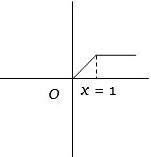
The function $f(x) = \left\{ \begin{array}{l}x,\,\,{\rm{if \,\,0}} \le x \le {\rm{1}}\\{\rm{1,\,\,}}\,{\rm{ if}}\,1 < x \le 2\end{array} \right.$ is
- ✓
Continuous at all $x$, $0 \le x \le 2$ and differentiable at all $x$, except $1$ in the interval $(0,2)$
- B
Continuous and differentiable at all $x$ in $[0,2]$
- C
Not continuous at any point in $[0,2]$
- D
Not differentiable at any point $[0,2]$
AnswerCorrect option: A. Continuous at all $x$, $0 \le x \le 2$ and differentiable at all $x$, except $1$ in the interval $(0,2)$
a
(a) $f(x) = \left\{ {\begin{array}{*{20}{l}}{x{\rm{ ,}}}&{0 \le x \le 1}\\{1{\rm{ ,}}}&{1 < x \le 2}\end{array}} \right.$
$\mathop {\lim }\limits_{x \to {1^ - }} f(x) = \mathop {\lim }\limits_{h \to 0} f(1 - h)$
$ = \mathop {\lim }\limits_{h \to 0} \,\,(1 - h) = 1$
$\mathop {\lim }\limits_{x \to {1^ + }} f(x) = \mathop {\lim }\limits_{h \to 0} \,f(1 + h) = 1$
Hence function is continuous in $(0, 2).$
Now $\mathop {\lim }\limits_{x \to {0^ + }} f(x) = \mathop {\lim }\limits_{h \to 0} \,(0 + h) = 0 = f(0)$
$\mathop {\lim }\limits_{x \to {2^ - }} f(x) = \mathop {\lim }\limits_{h \to 0} \,(2 - h) = 1 = f(2)$
Hence function is continuous in $[0, 2]$
Clearly, from graph it is not differentiable at $x = 1.$
View full question & answer→MCQ 211 Mark
At the point $x = 1$, the given function $f(x) = \left\{ \begin{array}{l}{x^3} - 1;\,\,1 < x < \infty \\x - 1;\,\, - \infty < x \le 1\end{array} \right.$ is
- A
Continuous and differentiable
- ✓
Continuous and not differentiable
- C
Discontinuous and differentiable
- D
Discontinuous and not differentiable
AnswerCorrect option: B. Continuous and not differentiable
b
(b) We have $Rf'(1) = \mathop {\lim }\limits_{h \to 0} \,\,\frac{{f(1 + h) - f(1)}}{h}$
$ = \mathop {\lim }\limits_{h \to 0} \,\,\frac{{\left\{ {{{(1 + h)}^3} - 1} \right\} - 0}}{h} = 3$
$Lf'(1) = \mathop {\lim }\limits_{h \to 0} \,\,\frac{{f(1 - h) - f(1)}}{{ - h}}$
$ = \mathop {\lim }\limits_{h \to 0} \,\,\frac{{\left\{ {(1 - h) - 1} \right\} - 0}}{{ - h}} = 1$
$\therefore \,\,\,Rf'(1) \ne Lf'(1)$ $ \Rightarrow \,\,f(x)$ is not differentiable at $x = 1.$
Now, $f(1 + 0) = \mathop {\lim }\limits_{h \to 0} \,f(1 + h) = 0$
and $f(1 - 0) = \mathop {\lim }\limits_{h \to 0} \,f(1 - h) = 0$
$\therefore \,\,\,f(1 + 0) = f(1 - 0) = f(0)$
$ \Rightarrow \,\,f(x)$ is continuous at $x = 1.$
Hence at $x = 1,\,\,\,f(x)$ is continuous and not differentiable.
View full question & answer→MCQ 221 Mark
If $f(x) = \left\{ {\begin{array}{*{20}{c}}{{e^x} + ax,}&{x < 0}\\{b{{(x - 1)}^2},}&{x \ge 0}\end{array}} \right.$ is differentiable at $x = 0,$ then $(a,\,b)$ is
- A
$( - 3,\, - 1)$
- ✓
$( - 3,\,\,1)$
- C
$(3,\,\,1)$
- D
$(3,\, - 1)$
AnswerCorrect option: B. $( - 3,\,\,1)$
b
(b) Given $f(x)$ is differentiable at $x = 0$.
Hence, $f(x)$ will be continuous at $x = 0$.
$\mathop {{\rm{lim}}}\limits_{x \to {0^ - }} ({e^x} + ax) = \mathop {{\rm{lim}}}\limits_{x \to {0^ + }} b{(x - 1)^2}$
==> ${e^0} + a \times 0 = b{(0 - 1)^2}$ ==> $b = 1$….. $(i)$
But $f(x)$ is differentiable at $x = 0$, then
$Lf'(x) = Rf'(x)$ ==> $\frac{d}{{dx}}({e^x} + ax) = \frac{d}{{dx}}b{(x - 1)^2}$
==> ${e^x} + a = 2b(x - 1)$
At $x = 0,$ ${e^0} + a = - 2b$ ==> $a + 1 = - 2b$ ==> $a = - 3$
==> $(a,\,\,b) = ( - 3,\,\,1)$.
View full question & answer→MCQ 231 Mark
The function $y = {e^{ - |x|}}$ is
- A
Continuous and differentiable at $x = 0$
- B
Neither continuous nor differentiable at $x = 0$
- ✓
Continuous but not differentiable at $x = 0$
- D
Not continuous but differentiable at $x = 0$
AnswerCorrect option: C. Continuous but not differentiable at $x = 0$
c
(c) We have, $f(x) = \left\{ {\begin{array}{*{20}{c}}{{e^{ - x}},}&{x \ge 0}\\{{e^x},}&{x < 0}\end{array}} \right.$
Clearly, $f(x)$ is continuous and differentiable for all non zero $x.$
Now $\mathop {\lim }\limits_{x \to 0 - } f(x) = \mathop {\lim }\limits_{x \to 0} {e^x} = 1$,
$\mathop {\lim }\limits_{x \to {0^ + }} f(x) = \mathop {\lim }\limits_{x \to {0^ + }} f(x){e^{ - x}} = 1$
Also, $f(0) = {e^0} = 1$. So, $f(x)$ is continuous for all $x$.
($LHD $ at $x = 0)$ $ = {\left( {\frac{d}{{dx}}({e^x})} \right)_{x = 0}} = 1$
( $RHD $ at $x = 0)$ $ = {\left( {\frac{d}{{dx}}({e^{-x}})} \right)_{x = 0}} = 1$
So, $\mathop {\lim }\limits_{x \to 7} \frac{{2 - \sqrt {x - 3} }}{{{x^2} - 49}}$ is not differentiable at $L\,f'\,(1) = \mathop {\lim }\limits_{h \to 0} \,\,\frac{{f(1 - h) - f(1)}}{{ - h}}$.
Hence $f(x) = {e^{ - \,|\,x\,|}}$ is everywhere continuous but not differentiable at $x = 0$.
View full question & answer→MCQ 241 Mark
The function $f(x) = \left\{ {\begin{array}{*{20}{c}}{{e^{2x}} - 1}&,&{x \le 0}\\{ax + \frac{{b{x^2}}}{2} - 1}&,&{x > 0}\end{array}} \right.$ is continuous and differentiable for
- A
$a = 1,\,b = 2$
- B
$a = 2,\,b = 4$
- ✓
$a = 2,\,$ any $b$
- D
Any $a,\,\,\,b = 4$
AnswerCorrect option: C. $a = 2,\,$ any $b$
c
(c) $f$ is continuous at $x = 0$, $f({0^ - }) = f({0^ + }) = f(0) = - 1$
Also $Lf'(0) = Rf'(0)$
==> $\mathop {\lim }\limits_{h \to 0} \frac{{f(0 - h) - f(0)}}{{ - h}} = \mathop {\lim }\limits_{h \to 0} \frac{{f(0 + h) - f(0)}}{h}$
==> $\mathop {\lim }\limits_{h \to 0} \left( {\frac{{{e^{ - 2h}} - 1 + 1}}{{ - h}}} \right) = \mathop {\lim }\limits_{h \to 0} \left( {\frac{{ah + \frac{{b{h^2}}}{2} - 1 + 1}}{h}} \right)$
==> $\mathop {\lim }\limits_{h \to 0} \left( {\frac{{ - 2{e^{ - 2h}}}}{{ - 1}}} \right) = \mathop {\lim }\limits_{h \to 0} \left( {a + \frac{{bh}}{2}} \right)$
==> $2 = a + 0$ ==> $a = 2,\,\,b$ any number.
View full question & answer→MCQ 251 Mark
The function $f(x) = {x^2}\,\,\sin \frac{1}{x},\,x \ne \,0,\,\,f(0)\, = 0$ at $x = 0$
- A
Is continuous but not differentiable
- B
- C
Is having continuous derivative
- ✓
Is continuous and differentiable
AnswerCorrect option: D. Is continuous and differentiable
d
(d) $\mathop {\lim }\limits_{x \to 0} f(x) = {x^2}\sin \left( {\frac{1}{x}} \right)$,
but $ - 1 \le \sin \left( {\frac{1}{x}} \right) \le 1$ and $x \to 0$
$\therefore $ $\mathop {\lim }\limits_{x \to {0^ + }} f(x) = 0 = \mathop {\lim }\limits_{x \to {0^ - }} f(x) = f(0)$
Therefore $f(x)$ is continuous at $x = 0$.
Also, the function $f(x) = {x^2}\sin \frac{1}{x}$ is differentiable because
$Rf'(x) = \mathop {\lim }\limits_{h \to 0} \frac{{{h^2}\sin \frac{1}{h} - 0}}{h} = 0$,
$Lf'(x) = \mathop {\lim }\limits_{h \to 0} \frac{{{h^2}\sin (1/ - h)}}{{ - h}} = 0$.
View full question & answer→MCQ 261 Mark
The value of $m$ for which the function $f(x) = \left\{ \begin{array}{l}m{x^2},\,x \le 1\\\,\,\,\,2x,\,x > 1\end{array} \right.$ is differentiable at $x = 1$, is
Answerd
(d) $L\,f'\,(1) = \mathop {\lim }\limits_{h \to 0} \,\,\frac{{f(1 - h) - f(1)}}{{ - h}}$
$ = \mathop {\lim }\limits_{h \to 0} \,\,\frac{{m\,{{(1 - h)}^2} - m}}{{ - h}}$
$ = \mathop {\lim }\limits_{h \to 0} \,\,\frac{{m\,[1 + {h^2} - 2h - 1]}}{{ - h}}$
$ = \mathop {\lim }\limits_{h \to 0} \,m\,(2 - h) = 2m$ and $R\,f'\,(1) = \mathop {\lim }\limits_{h \to 0} \,\,\frac{{f\,(1 + h) - f(1)}}{h}$
$ = \mathop {\lim }\limits_{h \to 0} \,\frac{{2\,(1 + h) - m}}{h}$.
For differentiability, $L\,f'(1) = R\,f'\,(1)$.
But for any value of $m,\,\,R\,\,f'\,(1) = L\,f'(1)$ not possible.
View full question & answer→MCQ 271 Mark
Let $f$ be continuous on $[1, 5]$ and differentiable in $(1, 5).$ If $f(1)=-3$ and $f'(x) \ge 9$ for all $x \in (1,\;5)$, then
- A
$f(5) \ge 33$
- ✓
$f(5) \ge 36$
- C
$f(5) \le 36$
- D
$f(5) \ge 9$
AnswerCorrect option: B. $f(5) \ge 36$
b
(b) $f(1) = - 3$; $f'(x) \ge 9$ for all $x \in (1,5)$; $f(5) \ge 36$.
View full question & answer→MCQ 281 Mark
Let $f(x + y) = f(x) + f(y)$and $f(x) = {x^2}g(x)$ for all $x,y \in R$, where $g(x)$ is continuous function. Then $f'(x)$ is equal to
- A
$g'(x)$
- B
$g(0)$
- C
$g(0) + g'(x)$
- ✓
$0$
Answerd
(d) We have $f'(x) = \mathop {\lim }\limits_{h \to 0} \frac{{f(x + h) - f(x)}}{h}$$ = \mathop {\lim }\limits_{h \to 0} \frac{{f(x) + f(h) - f(x)}}{h}$
$\left[ \because f(x+y)=f(x)+f(y) \right]$
$ = \mathop {\lim }\limits_{h \to 0} \frac{{f(h)}}{h} = \mathop {\lim }\limits_{h \to 0} \frac{{{h^2}g(h)}}{h} = 0.g(0) = 0$
$[ \because g $ is continuous therefore $\mathop {\lim }\limits_{h \to 0} g(h) = g(0)]$.
View full question & answer→MCQ 291 Mark
The function $f(x)\, = \,|x| + |x - 1|$ is
- ✓
Continuous at $x = 1,$ but not differentiable at $x = 1$
- B
Both continuous and differentiable at $x = 1$
- C
Not continuous at $x = 1$
- D
Not differentiable at $x = 1$
AnswerCorrect option: A. Continuous at $x = 1,$ but not differentiable at $x = 1$
a
(a) We have, $f(x) = |x| + |x - 1|$
$ = \left\{ {\begin{array}{*{20}{c}}{ - 2x + 1,}&{x < 0}&{}\\{x - x + 1,}&{0 \le x < 1}& = \\{x + x - 1,}&{x \ge 1}&{}\end{array}} \right.\left\{ {\begin{array}{*{20}{c}}{ - 2x + 1,}&{x < 0}\\1&{0 \le x < 1}\\{2x - 1,}&{x \ge 1}\end{array}} \right.$
Clearly, $\mathop {\lim }\limits_{x \to {0^ - }} f(x) = 1,\,\,\mathop {\lim }\limits_{x \to {0^ + }} f(x) = 1,\,\,\mathop {\lim }\limits_{x \to {1^ - }} f(x) = 1$
and $\mathop {\lim }\limits_{x \to {1^ + }} f(x) = 1$.
So, $f(x)$ is continuous at $x = 0,\,\,1.$
Now $f'(x) = \left\{ {\begin{array}{*{20}{l}}{ - 2,\,\,\,\,x < 0}\\{\,\,0,\,\,\,\,\,0 \le x < 1}\\{\,\,2,\,\,\,\,\,x \ge 1}\end{array}} \right.$
Here $x = 0$, $f'({0^ + }) = 0$ while $f'({0^ - }) = - 2$
and at $x = 1$, $f'({1^ + }) = 2$ while $f'({1^ - }) = 0$
Thus, $f(x)$ is not differentiable at $x = 0$ and $1.$
View full question & answer→MCQ 301 Mark
The differential coefficient of the function $|x - 1| + |x - 3|$ at the point $x = 2$ is
Answerb
(b) $f(x) = |x - 1| + |x - 3|$
$f(x) = \left\{ {\begin{array}{*{20}{c}}{ - (x - 1) - (x - 3),}&{x < 1}\\{(x - 1) - (x - 3),}&{x > 1}\\{(x - 1) - (x - 3),}&{x < 3}\\{(x - 1) + (x - 3),}&{x > 3}\end{array}} \right.$
$ = \left\{ {\begin{array}{*{20}{c}}{4 - 2x,}&{x < 1}\\{2\,\,\,\,\,\,\,\,\,,}&{1 < x < 3}\\{2x - 4,}&{x > 3}\end{array}} \right.$
At $x = 2$, $f(x) = $ $2$ .
Hence $\,f'(x) = 0$.
View full question & answer→MCQ 311 Mark
If $f(x) = \left[ \begin{gathered}
{e^x} + a\,\,\,for\,\,\,x\, < \,0 \hfill \\
x - 3\,\,\,\,\,for\,\,\,x\, \geqslant \,0 \hfill \\
\end{gathered} \right.\,,\,$ is differentiable at $x = 0$ , then $'a'$ equals to
Answerc
For continuity at $x=0$
$\mathop {\lim }\limits_{h \to 0} f\left( {0 + h} \right) = \mathop {\lim }\limits_{h \to 0} f\left( {0 - h} \right) = f\left( 0 \right)$
$ \Rightarrow \quad \mathop {\lim }\limits_{h \to 0} {e^{ - h}} + a = - 3\quad \Rightarrow a = - 4$
For the value of $a, f$ is diff at $x=0$
View full question & answer→MCQ 321 Mark
If $y = {1 \over {a - z}},$ then ${{dz} \over {dy}} = $
- ✓
${(z - a)^2}$
- B
$ - {(z - a)^2}$
- C
${(z + a)^2}$
- D
$ - {(z + a)^2}$
AnswerCorrect option: A. ${(z - a)^2}$
a
(a) Here $z = a - \frac{1}{y}$ ==> $\frac{{dz}}{{dy}} = \frac{1}{{{y^2}}} = {(a - z)^2}$
View full question & answer→MCQ 331 Mark
${d \over {dx}}\log |x|{\rm{ }} = ......,(x \ne 0)$
- ✓
${1 \over x}$
- B
$ - {1 \over x}$
- C
$x$
- D
$ - x$
AnswerCorrect option: A. ${1 \over x}$
a
(a) $\log |x|\, = \log x$, if $x > 0$$ = \log ( - x)$, if $x < 0$
Hence $\frac{d}{{dx}}\left\{ {\log |x|} \right\} = \frac{1}{x}$, if $x > 0$
$ = \left( {\frac{1}{{ - x}}} \right)( - 1) = \frac{1}{x}$, if $x < 0$
Thus $\frac{d}{{dx}}\left\{ {\log |x|} \right\} = \frac{1}{x}$, if $x \ne 0$.
View full question & answer→MCQ 341 Mark
If $y = a\sin x + b\cos x,$ then ${y^2} + {\left( {{{dy} \over {dx}}} \right)^2}$ is a
- A
Function of $x$
- B
Function of $y$
- C
Function of $ x$ and $y$
- ✓
Answerd
(d) $y = a\sin x + b\cos x$
Differentiating with respect to $ x$, we get
$\frac{{dy}}{{dx}} = a\cos x - b\sin x$
Now ${\left( {\frac{{dy}}{{dx}}} \right)^2} = {(a\cos x - b\sin x)^2}$
$ = {a^2}{\cos ^2}x + {b^2}{\sin ^2}x - 2ab\sin x\cos x$
and ${y^2} = {(a\sin x + b\cos x)^2}$
$ = {a^2}{\sin ^2}x + {b^2}{\cos ^2}x + 2ab\sin x\cos x$
So, ${\left( {\frac{{dy}}{{dx}}} \right)^2} + {y^2} = {a^2}({\sin ^2}x + {\cos ^2}x) + {b^2}({\sin ^2}x + {\cos ^2}x)$
Hence ${\left( {\frac{{dy}}{{dx}}} \right)^2} + {y^2} = ({a^2} + {b^2}) =$ constant.
View full question & answer→MCQ 351 Mark
$f(x) = {x^2} - 3x$, then the points at which $f(x) = f'(x)$ are
Answerd
(d) $f(x) = {x^2} - 3x$ and $f'(x) = 2x - 3$
But $f(x) = f'(x) \Rightarrow {x^2} - 3x = 2x - 3$
==> ${x^2} - 5x + 3 = 0$
$\therefore x = \frac{{5 \pm \sqrt {25 - 12} }}{2} = \frac{{5 \pm \sqrt {13} }}{2}$.
View full question & answer→MCQ 361 Mark
If $y = x{\rm{ }}\left[ {\left( {\cos {x \over 2} + \sin {x \over 2}} \right){\rm{ }}\left( {\cos {x \over 2} - \sin {x \over 2}} \right) + \sin x} \right] + {1 \over {2\sqrt x }}$, then ${{dy} \over {dx}} = $
- ✓
$(1 + x)\cos x + (1 - x)\sin x - {1 \over {4x\sqrt x }}$
- B
$(1 - x)\cos x + (1 + x)\sin x + {1 \over {4x\sqrt x }}$
- C
$(1 + x)\cos x + (1 + x)\sin x - {1 \over {4x\sqrt x }}$
- D
AnswerCorrect option: A. $(1 + x)\cos x + (1 - x)\sin x - {1 \over {4x\sqrt x }}$
a
(a) $y = x\,\left[ {\left( {\cos \frac{x}{2} + \sin \frac{x}{2}} \right)\,\left( {\cos \frac{x}{2} - \sin \frac{x}{2}} \right) + \sin x} \right]$$ + \frac{1}{{2\sqrt x }}$
==>$y = x(\cos x + \sin x) + \frac{1}{{2\sqrt x }}$
Differentiating w.r.t. $x$, we have
$\frac{{dy}}{{dx}} = x\frac{d}{{dx}}(\cos x + \sin x) + (\cos x + \sin x) - \frac{1}{4}{x^{ - 3/2}}$
==>$\frac{dy}{dx}=$ $(1+x)\cos x+(1-x)\sin x-\frac{1}{4x\sqrt{x}}$
View full question & answer→MCQ 371 Mark
If $y = \sqrt {(1 - x)(1 + x)} $, then
- A
$(1 - {x^2}){{dy} \over {dx}} - xy = 0$
- ✓
$(1 - {x^2}){{dy} \over {dx}} + xy = 0$
- C
$(1 - {x^2}){{dy} \over {dx}} - 2xy = 0$
- D
$(1 - {x^2}){{dy} \over {dx}} + 2xy = 0$
AnswerCorrect option: B. $(1 - {x^2}){{dy} \over {dx}} + xy = 0$
b
(b) ${y^2} = (1 - {x^2})$ ==>$2y\frac{{dy}}{{dx}} = - 2x$ or
$\frac{{dy}}{{dx}} = \frac{{ - x}}{y} = \frac{{ - xy}}{{(1 - {x^2})}}$ or
$(1 - {x^2})\frac{{dy}}{{dx}} + xy = 0$.
View full question & answer→MCQ 381 Mark
${d \over {dx}}\left( {{{{{\cot }^2}x - 1} \over {{{\cot }^2}x + 1}}} \right) = $
- A
$ - \sin 2x$
- B
$2\sin 2x$
- C
$2\cos 2x$
- ✓
$ - 2\sin 2x$
AnswerCorrect option: D. $ - 2\sin 2x$
d
(d) $\frac{d}{{dx}}\left[ {\frac{{{{\cot }^2}x - 1}}{{{{\cot }^2}x + 1}}} \right] = \frac{d}{{dx}}\left[ {\frac{{{{\cos }^2}x - {{\sin }^2}x}}{{{{\cos }^2}x + {{\sin }^2}x}}} \right]$
$ = \frac{d}{{dx}}[\cos 2x] = - 2\sin 2x$.
View full question & answer→MCQ 391 Mark
If $y = {\tan ^{ - 1}}{{4x} \over {1 + 5{x^2}}} + {\tan ^{ - 1}}{{2 + 3x} \over {3 - 2x}}$, then ${{dy} \over {dx}} = $
- A
${1 \over {1 + 25{x^2}}} + {2 \over {1 + {x^2}}}$
- B
${5 \over {1 + 25{x^2}}} + {2 \over {1 + {x^2}}}$
- ✓
${5 \over {1 + 25{x^2}}}$
- D
${1 \over {1 + 25{x^2}}}$
AnswerCorrect option: C. ${5 \over {1 + 25{x^2}}}$
c
(c) $y={{\tan }^{-1}}\frac{4x}{1+5{{x}^{2}}}+{{\tan }^{-1}}\frac{2+3x}{3-2x}$
$ = {\tan ^{ - 1}}\frac{{5x - x}}{{1 + 5x.x}} + {\tan ^{ - 1}}\frac{{\frac{2}{3} + x}}{{1 - \frac{2}{3}.x}}$
=> $\frac{{dy}}{{dx}} = \frac{5}{{1 + 25{x^2}}}$.
==> $\frac{{dy}}{{dx}} = \frac{5}{{1 + 25{x^2}}}$.
View full question & answer→MCQ 401 Mark
${d \over {dx}}{\cos ^{ - 1}}\sqrt {\cos x} = $
AnswerCorrect option: A. ${1 \over 2}\sqrt {1 + \sec x} $
a
(a) $\frac{d}{{dx}}{\cos ^{ - 1}}\sqrt {\cos x} = \frac{{\sin x}}{{2\sqrt {\cos x} \sqrt {1 - \cos x} }}$
$ = \frac{{\sqrt {1 - {{\cos }^2}x} }}{{2\sqrt {\cos x} \sqrt {1 - \cos x} }} = \frac{1}{2}\sqrt {\frac{{1 + \cos x}}{{\cos x}}} $.
View full question & answer→MCQ 411 Mark
If $y = {{\sqrt {a + x} - \sqrt {a - x} } \over {\sqrt {a + x} + \sqrt {a - x} }}$, then ${{dy} \over {dx}} = $
- ✓
${{ay} \over {x\sqrt {{a^2} - {x^2}} }}$
- B
${{ay} \over {\sqrt {{a^2} - {x^2}} }}$
- C
${{ay} \over {x\sqrt {{x^2} - {a^2}} }}$
- D
AnswerCorrect option: A. ${{ay} \over {x\sqrt {{a^2} - {x^2}} }}$
a
(a) $y = \frac{{\sqrt {a + x} - \sqrt {a - x} }}{{\sqrt {a + x} + \sqrt {a - x} }} $
$\Rightarrow y = \frac{{{{(\sqrt {a + x} - \sqrt {a - x} )}^2}}}{{(a + x) - (a - x)}}$
$ \Rightarrow y = \frac{{(a + x) + (a - x) - 2(\sqrt {{a^2} - {x^2}} )}}{{2x}}$
$ = \frac{{2a - 2\sqrt {{a^2} - {x^2}} }}{{2x}}$ or $y = \frac{{a - \sqrt {{a^2} - {x^2}} }}{x}…..(i)$
Differentiating w.r.t. $ x $ of $ y,$ we get
$\frac{{dy}}{{dx}} = \frac{{x\left[ { - \frac{1}{{2\sqrt {{a^2} - {x^2}} }}( - 2x)} \right] - (a - \sqrt {{a^2} - {x^2}} )}}{{{x^2}}}$
$ = \frac{{{x^2} - a\sqrt {{a^2} - {x^2}} + {a^2} - {x^2}}}{{{x^2}\sqrt {{a^2} - {x^2}} }} = \frac{{a(a - \sqrt {{a^2} - {x^2}} )}}{{{x^2}\sqrt {{a^2} - {x^2}} }}$
$ = \frac{a}{{x\sqrt {{a^2} - {x^2}} }}\left[ {\frac{{a - \sqrt {{a^2} - {x^2}} }}{x}} \right] = \frac{{ay}}{{x\sqrt {{a^2} - {x^2}} }}$ [By $(i)$]
View full question & answer→MCQ 421 Mark
If $y = {(x{\cot ^3}x)^{3/2}},$ then ${{dy} \over {dx}} = $
- ✓
${3 \over 2}{(x{\cot ^3}x)^{1/2}}[{\cot ^3}x - 3x{\cot ^2}x\cos {\rm{e}}{{\rm{c}}^2}x]$
- B
${3 \over 2}{(x{\cot ^3}x)^{1/2}}[{\cot ^2}x - 3x{\cot ^2}x\,{\rm{cose}}{{\rm{c}}^2}x]$
- C
${3 \over 2}{(x{\cot ^3}x)^{1/3}}[{\cot ^3}x - 3x\,{\rm{cos}}{\rm{e}}{{\rm{c}}^2}x]$
- D
${3 \over 2}{(x{\cot ^3}x)^{3/2}}[{\cot ^3}x - 3x\,{\rm{cos}}{\rm{e}}{{\rm{c}}^2}x]$
AnswerCorrect option: A. ${3 \over 2}{(x{\cot ^3}x)^{1/2}}[{\cot ^3}x - 3x{\cot ^2}x\cos {\rm{e}}{{\rm{c}}^2}x]$
a
(a) $y = {(x{\cot ^3}x)^{3/2}}$
$\therefore \frac{{dy}}{{dx}} = \frac{3}{2}{(x{\cot ^3}x)^{1/2}}[{\cot ^3}x + 3x{\cot ^2}x( - {\rm{cose}}{{\rm{c}}^2}x)]$
$ = \frac{3}{2}{(x{\cot ^3}x)^{1/2}}[{\cot ^3}x - 3x{\cot ^2}x\,{\rm{cose}}{{\rm{c}}^2}x]$.
View full question & answer→MCQ 431 Mark
If $y = \sin (\sqrt {\sin x + \cos x} )$, then ${{dy} \over {dx}} = $
- A
${1 \over 2}{{\cos \sqrt {\sin x + \cos x} } \over {\sqrt {\sin x + \cos x} }}$
- B
${{\cos \sqrt {\sin x + \cos x} } \over {\sqrt {\sin x + \cos x} }}$
- ✓
${1 \over 2}{{\cos \sqrt {\sin x + \cos x} } \over {\sqrt {\sin x + \cos x} }}.(\cos x - \sin x)$
- D
AnswerCorrect option: C. ${1 \over 2}{{\cos \sqrt {\sin x + \cos x} } \over {\sqrt {\sin x + \cos x} }}.(\cos x - \sin x)$
c
(c) $y = \sin (\sqrt {\sin x + \cos x} )$
$\frac{{dy}}{{dx}} = \frac{1}{2}\frac{{\cos (\sqrt {\sin x + \cos x} )}}{{\sqrt {\sin x + \cos x} }}(\cos x - \sin x)$.
View full question & answer→MCQ 441 Mark
If $y = \sin \left( {{{1 + {x^2}} \over {1 - {x^2}}}} \right)$, then ${{dy} \over {dx}} = $
- A
${{4x} \over {1 - {x^2}}}.\cos \left( {{{1 + {x^2}} \over {1 - {x^2}}}} \right)$
- B
${x \over {{{(1 - {x^2})}^2}}}.\cos \left( {{{1 + {x^2}} \over {1 - {x^2}}}} \right)$
- C
${x \over {(1 - {x^2})}}.\cos \left( {{{1 + {x^2}} \over {1 - {x^2}}}} \right)$
- ✓
${{4x} \over {{{(1 - {x^2})}^2}}}.\cos \left( {{{1 + {x^2}} \over {1 - {x^2}}}} \right)$
AnswerCorrect option: D. ${{4x} \over {{{(1 - {x^2})}^2}}}.\cos \left( {{{1 + {x^2}} \over {1 - {x^2}}}} \right)$
d
(d) $\frac{{dy}}{{dx}} = \cos \left( {\frac{{1 + {x^2}}}{{1 - {x^2}}}} \right){\rm{ }}\left[ {\frac{{(1 - {x^2})2x + (1 + {x^2})2x}}{{{{(1 - {x^2})}^2}}}} \right]$
$ = \frac{{4x}}{{{{(1 - {x^2})}^2}}}\cos \left( {\frac{{1 + {x^2}}}{{1 - {x^2}}}} \right)$.
View full question & answer→MCQ 451 Mark
If $y = \sqrt {{{1 + \tan x} \over {1 - \tan x}}} $, then ${{dy} \over {dx}} = $
- ✓
${1 \over 2}\sqrt {{{1 - \tan x} \over {1 + \tan x}}} .{\sec ^2}\left( {{\pi \over 4} + x} \right)$
- B
$\sqrt {{{1 - \tan x} \over {1 + \tan x}}} .{\sec ^2}\left( {{\pi \over 4} + x} \right)$
- C
${1 \over 2}\sqrt {{{1 - \tan x} \over {1 + \tan x}}} .\sec \left( {{\pi \over 4} + x} \right)$
- D
AnswerCorrect option: A. ${1 \over 2}\sqrt {{{1 - \tan x} \over {1 + \tan x}}} .{\sec ^2}\left( {{\pi \over 4} + x} \right)$
a
(a) $y = \sqrt {\left( {\frac{{1 + \tan x}}{{1 - \tan x}}} \right)} $ or $y = \sqrt {\tan \left( {\frac{\pi }{4} + x} \right)} $
$\frac{{dy}}{{dx}} = \frac{1}{{2\sqrt {\tan \left( {\frac{\pi }{4} + x} \right)} }}{\sec ^2}\left( {\frac{\pi }{4} + x} \right)$
$ = \frac{1}{2}\sqrt {\left[ {\frac{{1 - \tan x}}{{1 + \tan x}}} \right]} {\sec ^2}\left( {\frac{\pi }{4} + x} \right)$.
View full question & answer→MCQ 461 Mark
${d \over {dx}}\sqrt {{{\sec }^2}x + {\rm{cose}}{{\rm{c}}^2}x} = $
- A
$4\cos {\rm{ec 2}}x.\cot 2x$
- ✓
$ - 4\cos {\rm{ec 2}}x.\cot 2x$
- C
$ - 4\cos {\rm{ec }}x.\cot 2x$
- D
AnswerCorrect option: B. $ - 4\cos {\rm{ec 2}}x.\cot 2x$
b
(b) $\frac{d}{{dx}}[\sqrt {{{\sec }^2}x + {\rm{cose}}{{\rm{c}}^2}x} ] = \frac{d}{{dx}}\left[ {\sqrt {\left( {\frac{1}{{{{\cos }^2}x}} + \frac{1}{{{{\sin }^2}x}}} \right)} } \right]$
$ = \frac{d}{{dx}}[2\,{\rm{cosec}}2x] = - 4\,{\rm{cosec}}2x\cot 2x$.
View full question & answer→MCQ 471 Mark
If $y = {\sin ^{ - 1}}\sqrt {(1 - x)} + {\cos ^{ - 1}}\sqrt x $, then ${{dy} \over {dx}} = $
- A
${1 \over {\sqrt {x(1 - x)} }}$
- ✓
${{ - 1} \over {\sqrt {x(1 - x)} }}$
- C
${1 \over {\sqrt {x(1 + x)} }}$
- D
AnswerCorrect option: B. ${{ - 1} \over {\sqrt {x(1 - x)} }}$
b
(b) ${\sin ^{ - 1}}\sqrt {1 - x} = {\sin ^{ - 1}}\sqrt {1 - {{(\sqrt x )}^2}} = {\cos ^{ - 1}}\sqrt x $
$\therefore y = 2{\cos ^{ - 1}}\sqrt x $ or
$\frac{{dy}}{{dx}} = 2.\frac{{ - 1}}{{\sqrt {1 - x} }}.\frac{1}{{2\sqrt x }} \,\,etc.$
Aliter: $y = {\sin ^{ - 1}}\sqrt {1 - x} + {\cos ^{ - 1}}\sqrt x $
==> $\frac{{dy}}{{dx}} = \frac{1}{{\sqrt {1 - 1 + x} }}.\frac{{ - 1}}{{2\sqrt {1 - x} }} - \frac{1}{{\sqrt {1 - x} }}.\frac{1}{{2\sqrt x }}$
$ = \frac{{ - 2}}{{2\sqrt x \sqrt {1 - x} }} = \frac{{ - 1}}{{\sqrt x \sqrt {1 - x} }}$.
View full question & answer→MCQ 481 Mark
If $y = {\cot ^{ - 1}}\left[ {{{\sqrt {1 + \sin x} + \sqrt {1 - \sin x} } \over {\sqrt {1 + \sin x} - \sqrt {1 - \sin x} }}} \right]$, then ${{dy} \over {dx}} = $
- ✓
${1 \over 2}$
- B
${2 \over 3}$
- C
$3$
- D
$1$
AnswerCorrect option: A. ${1 \over 2}$
a
(a) $y = {\cot ^{ - 1}}\left[ {\frac{{\sqrt {1 + \sin x} + \sqrt {1 - \sin x} }}{{\sqrt {1 + \sin x} - \sqrt {1 - \sin x} }}} \right]$
$ = {\cot ^{ - 1}}\left[ {\frac{{2 + 2\cos x}}{{2\sin x}}} \right] = {\cot ^{ - 1}}\left[ {\frac{{1 + \cos x}}{{\sin x}}} \right]$
$ = {\cot ^{ - 1}}\left[ {\cot \frac{x}{2}} \right] = \frac{x}{2}$
$\therefore \frac{{dy}}{{dx}} = \frac{1}{2}$ .
View full question & answer→MCQ 491 Mark
If $f(x) = {1 \over {\sqrt {{x^2} + {a^2}} + \sqrt {{x^2} + {b^2}} }}$, then $f'(x)$ is equal to
- ✓
${x \over {({a^2} - {b^2})}}\left[ {{1 \over {\sqrt {{x^2} + {a^2}} }} - {1 \over {\sqrt {{x^2} + {b^2}} }}} \right]$
- B
${x \over {({a^2} + {b^2})}}\left[ {{1 \over {\sqrt {{x^2} + {a^2}} }} - {2 \over {\sqrt {{x^2} + {b^2}} }}} \right]$
- C
${x \over {({a^2} - {b^2})}}\left[ {{1 \over {\sqrt {{x^2} + {a^2}} }} + {1 \over {\sqrt {{x^2} + {b^2}} }}} \right]$
- D
$({a^2} + {b^2})\left[ {{1 \over {\sqrt {{x^2} + {a^2}} }} - {2 \over {\sqrt {{x^2} + {b^2}} }}} \right]$
AnswerCorrect option: A. ${x \over {({a^2} - {b^2})}}\left[ {{1 \over {\sqrt {{x^2} + {a^2}} }} - {1 \over {\sqrt {{x^2} + {b^2}} }}} \right]$
a
(a) $f(x) = \frac{1}{{\sqrt {{x^2} + {a^2}} + \sqrt {{x^2} + {b^2}} }}$
$f(x) = \frac{1}{{\sqrt {{x^2} + {a^2}} + \sqrt {{x^2} + {b^2}} }}.\frac{{\sqrt {{x^2} + {a^2}} - \sqrt {{x^2} + {b^2}} }}{{\sqrt {{x^2} + {a^2}} - \sqrt {{x^2} + {b^2}} }}$
$f(x) = \frac{1}{{{a^2} - {b^2}}}\left[ {\sqrt {{x^2} + {a^2}} - \sqrt {{x^2} + {b^2}} } \right]$
$f'(x) = \frac{1}{{{a^2} - {b^2}}}\left[ {\frac{{2x}}{{2\sqrt {{x^2} + {a^2}} }} - \frac{{2x}}{{2\sqrt {{x^2} + {b^2}} }}} \right]$
$f'(x) = \frac{x}{{{a^2} - {b^2}}}\left[ {\frac{1}{{\sqrt {{x^2} + {a^2}} }} - \frac{1}{{\sqrt {{x^2} + {b^2}} }}} \right]$.
View full question & answer→MCQ 501 Mark
The value of ${d \over {dx}}[|x - 1| + |x - 5|]$ at $x = 3$ is
Answerb
(b) $f(x) = |x - 1| + |x - 5|$
$f(x) = \left\{ \begin{array}{l} - (x - 1) - (x - 5),\,\,\,x < 1\\\,\,\,\,(x - 1) - (x - 5),\,\,\,1 < x < 5\\\,\,\,\,\,\,\,x - 1 + x - 5,\,\,\,\,x > 5\end{array} \right.$
$f(x) = \left\{ {\begin{array}{*{20}{c}}{6 - 2x,}&{x < 1}\\{4\,\,\,\,\,\,,}&{1 < x < 5}\\{2x - 6,}&{x > 5}\end{array}} \right.$
$\because$ $x = 3 \in (1,\,5)$,
For $x = 3, $ $ f(x) = 4,\;\;f'(x) = 0$.
View full question & answer→