MCQ
Day and night settings for rearview mirrors uses
  • A
    Thin mirrors
  • Thick wedge shaped mirrors
  • C
    Convex mirrors
  • D
    Concave mirrors

Answer

Correct option: B.
Thick wedge shaped mirrors
b
(b)

Day and night settings for rear view mirrors.

Need a full question paper?

Generate a complete, print-ready paper with questions like this in minutes — across 16+ boards, with answer keys.

Start Generating Free

Similar questions

A truth table is given below. Which of the following has this type of truth table

$A\,\, 0\,\, 1\,\, 0\,\, 1$

$B \,\,0\,\, 0\,\, 1 \,\,1$

$y \,\,1\,\, 0\,\, 0\,\, 0$
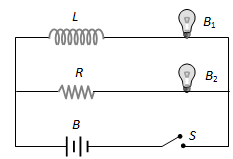
An inductor, L a resistance R and two identical bulbs, $B_1$ and $B_2$ are connected to a battery through a switch S as shown in the figure. The resistance R is the same as that of the coil that makes L. Which of the following statements gives the correct description of the happenings when the switch S is closed
When the convergent nature of a convex lens will be less as compared with air
The dimensions of capacitance are:
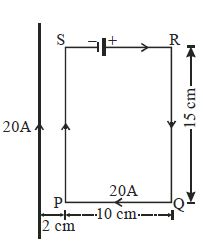
The resultant force on the current loop $PQRS$ due to a long current carrying conductor will be
A beam of light consisting of two wavelengths $7000\; \mathring A$ and $5500 \;\mathring A$ is used to obtain interference pattern in Young's double slit experiment. The distance between the slits is $2.5\,mm$ and the distance between the plane of slits and the screen is $150\,cm$. The least distance from the central fringe, where the bright fringes due to both the wavelengths coincide, is $n \times 10^{-5}\,m$. The value of $n$ is .............
An α -particle is accelerated through a potential difference of 200V. The increase in its kinetic energy is
The coefficient of self inductance of a solenoid is $0.18\, mH$. If a crode of soft iron of relative permeability $900$ is inserted, then the coefficient of self inductance will become nearly.....$mH$
Of the following pairs of species which one will have the same electronic configuration for both members?
The work functions of metals $A$ and $B$ are in the ratio $1 : 2$. If light of frequencies $f$ and $2f$ are incident on the surfaces of $A$ and $B$ respectively, the ratio of the maximum kinetic energies of photoelectrons emitted is (f is greater than threshold frequency of $A, 2f$ is greater than threshold frequency of $B$)