MCQ
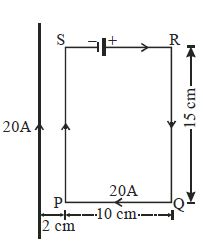
The resultant force on the current loop $PQRS$ due to a long current carrying conductor will be
- A$10^{-4}\,N$
- B$3.6 \times {10^{ - 4}}\,N$
- C$1.8 \times {10^{ - 4}}\,N$
- ✓$5 \times {10^{ - 4}}\,N$
$\mathrm{F}=\frac{\mu_{0}}{2 \pi} \frac{\mathrm{I}_{1} \mathrm{I}_{2} \ell}{\mathrm{r}}$
Where,
$\mathrm{r}=$ distance between two parallel conductors
$F_{R} =\frac{\mu_{0} I_{1} I_{2}}{2 \pi}\left(\frac{1}{2}-\frac{1}{12}\right) \times \frac{1}{10^{-2}} \times 15 \times 10^{-2}$
$=2 \times 10^{-7} \times 20 \times 20 \times \frac{5}{12} \times 15$
$=5 \times 10^{-4} \,\mathrm{N}$
Generate a complete, print-ready paper with questions like this in minutes — across 16+ boards, with answer keys.
Reason : Heavy water absorbs neutrons more efficiently than normal water.
| List-$I$ | List-$II$ |
| ($P$) ${ }_{92}^{238} U \rightarrow{ }_{91}^{234} \mathrm{~Pa}$ | ($1$) one $\alpha$ particle and one $\beta^{+}$particle |
| ($Q$) ${ }_{82}^{214} \mathrm{~Pb} \rightarrow{ }_{82}^{210} \mathrm{~Pb}$ | ($2$) three $\beta^{-}$particles and one $\alpha$ particle |
| ($R$) ${ }_{81}^{210} \mathrm{Tl} \rightarrow{ }_{82}^{206} \mathrm{~Pb}$ | ($3$) two $\beta^{-}$particles and one $\alpha$ particle |
| ($S$) ${ }_{91}^{228} \mathrm{~Pa} \rightarrow{ }_{88}^{224} \mathrm{Ra}$ | ($4$) one $\alpha$ particle and one $\beta^{-}$particle |
| ($5$) one $\alpha$ particle and two $\beta^{+}$particles |