Question
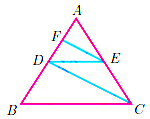
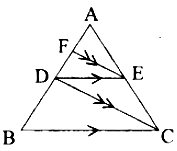
$D E \| B C$ and $C D \| E E$ Prove that $A D^2=A B \times A F$
Answer

Given: In $\triangle A B C, D E \| B C$ and $C D \| E F$

To Prove: $A D^2=A B \times A F$

By basic proportionality theorem
$
\frac{ AB }{ AD }=\frac{ AC }{ AE }
$

By basic Proportionality theorem
$
\frac{ AD }{ AF }=\frac{ AC }{ AE }
$

From (1) and (2) we get
$
\begin{aligned}
& \frac{ AB }{ AD }=\frac{ AD }{ AF } \\
& AD ^2= AB \times AF
\end{aligned}
$

Hence it is proved

Need a full question paper?

Generate a complete, print-ready paper with questions like this in minutes — across 16+ boards, with answer keys.

Start Generating Free

Similar questions

The ratio of $6^{\text {th }}$ and $8^{\text {th }}$ term of an A.P. is $7: 9$. Find the ratio of $9^{\text {th }}$ term to $13^{\text {th }}$ term
The perpendicular PS on the base $Q R$ of a $\triangle P Q R$ intersects $Q R$ at $S$, such that $Q S=3 S R$. Prove that $2 P Q^2=2 P R^2+Q R^2$
Given the LCM and GCD of the two polynomials p(x) and q(x) find the unknown polynomial in the following table
LCM GCD p(x) q(x)
$\left(x^4-y^4\right)\left(x^4+x^2 y^2+y^2\right)$ $\left(x^2-y^2\right)$   $\left(x^4-y^4\right)\left(x^2+y^2-x y\right)$
Find the non-zero values of $x$ satisfying the matrix equation
$
x\left[\begin{array}{cc}
2 x & 2 \\
3 & x
\end{array}\right]+2\left[\begin{array}{cc}
8 & 5 x \\
4 & 4 x
\end{array}\right]=2\left[\begin{array}{cc}
x^2+8 & 24 \\
10 & 6 x
\end{array}\right]
$
Find the G.C.D. of the given polynomials
$3 x^4+6 x^3-12 x^2-24 x, 4 x^4+14 x^3+8 x^2-8 x$
If $a, b, c$ is three consecutive terms of an A.P. and $x, y, z$ are three consecutive terms of a G.P. then prove that $x^{b-c} \times y^{c-a} \times z^{a-b}$ $=1$
The area of a triangle is 5 sq. units. Two of its vertices are (2, 1) and (3, −2). The third vertex is (x, y) where y = x + 3. Find the coordinates of the third vertex.
Identify rational expression should be subtracted from $\frac{x^2+6 x+8}{x^3+8}$ to get $\frac{3}{x^2-2 x+4}$
In a three-digit number, when the tens and the hundreds digit are interchanged the new number is 54 more than three times the original number. If 198 is added to the number, the digits are reversed. The tens digit exceeds the hundreds digit by twice as that of the tens digit exceeds the unit digit. Find the original number
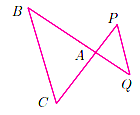
In the adjacent figure, ∆ACB ~ ∆APQ. If BC = 8 cm, PQ = 4 cm, BA = 6.5 cm and AP = 2.8 cm, find CA and AQ