Questions · Page 1 of 2

[5 Mark Questions]

🎯

Test yourself on this topic

50 questions · timed · auto-graded

Question 15 Marks
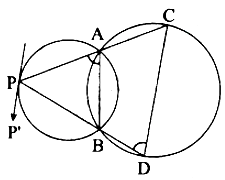
Two circles intersect at A and B. From a point, P on one of the circles lines PAC and PBD are drawn intersecting the second circle at C and D. Prove that CD is parallel to the tangent at P.
Answer
Proof:

A and B are the points intersecting the circles. Join AB.
∠P’PB = ∠PAB ...(Alternate segment theorem)
∠PAB + ∠BAC = 180° ...(1) ...(PAC is a straight line)
∠BAC + ∠BDC = 180° ...(2)
ABDC is a cyclic quadrilateral.
From (1) and (2) we get
∠P’PB = ∠PAB = ∠BDC
P’P and DC are straight lines.
PD is a transversal alternate angles are equal.
∴ P’P || DC.
View full question & answer
Question 25 Marks
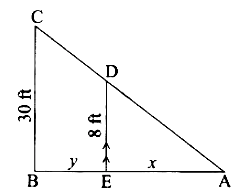
An Emu which is 8 feet tall is standing at the foot of a pillar which is 30 feet high. It walks away from the pillar. The shadow of the Emu falls beyond Emu. What is the relation between the length of the shadow and the distance from the Emu to the pillar?
Answer
Let the shadow of the emu AE be “x” and BE be “y” ED || BC

By basic proportionality theorem
$
\begin{aligned}
& \frac{ AE }{ AB }=\frac{ ED }{ BC } \\
& \frac{x}{x+y}=\frac{8}{30} \\
& 30 x =8 x +8 y \\
& 22 x -8 y =0 \\
& 11 x -4 y =0 \quad \ldots(\div \text { by } 2) \\
& 11 x =4 y \\
& x =\frac{4}{11} \times y \\
& x =\frac{4}{11} \times \text { distance from the pillar to emu }
\end{aligned}
$
Length of $=\frac{4}{11} \times$ distance from the shadow the pillar to emu
View full question & answer
Question 35 Marks
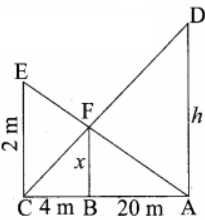
A man whose eye-level is 2 m above the ground wishes to find the height of a tree. He places a mirror horizontally on the ground 20 m from the tree and finds that if he stands at a point C which is 4 m from the mirror B, he can see the reflection of the top of the tree. How height is the tree?
Answer
Let the height of the tree AD be “h”.
Image
In $\triangle A C D$ and $\triangle B C F$,
$
\angle A=\angle B=90^{\circ}
$
$\angle C$ is common
$\triangle ACD \sim \triangle BCF$ by $AA$ similarity
$
\begin{aligned}
& \frac{ AD }{ BF }=\frac{ AC }{ BC } \\
& \frac{ h }{x}=\frac{24}{2}=6 \\
& h =6 x . .(1)
\end{aligned}
$

In $\triangle A C E$ and $\triangle A B F$,
$
\angle C=\angle B=90^{\circ}
$
$\angle A$ is common
$\therefore \triangle ACE \sim \triangle ABF$

$
\begin{aligned}
& \frac{2}{x}=\frac{24}{20} \\
& 24 x=20 \times 2 \\
& x=\frac{20 \times 2}{24}=\frac{5 \times 2}{6}=\frac{10}{6} \\
& x=\frac{5}{3}
\end{aligned}
$
Substitute the value of $x$ in (1)
$
h =6 \times \frac{5}{3}=10 m
$
$\therefore$ Height of the tree is $10 m$
View full question & answer
Question 45 Marks
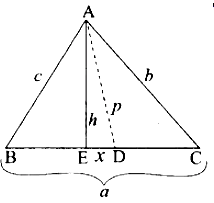
$D$ is the mid point of side $B C$ and $A E \perp B C$. If $B C=a, A C=b, A B=c, E D=x, A D=p$ and $A E=$ h, prove that $b^2=p^2+a x+\frac{a^2}{4}$
Answer
Given $\angle AED =90^{\circ}$

$E D=x, D C=\frac{a}{2} \quad \ldots(D$ is the mid point of $B C)$
$
\therefore EC =x+\frac{ a }{2}, BE =\frac{ a }{2}-x
$
$\therefore$ In the right $\triangle AED$
$
\begin{aligned}
& A D^2=A E^2+E D^2 \\
& p^2=h^2+x^2
\end{aligned}
$

In the right $\triangle AEC$,
$
\begin{aligned}
& AC ^2= AE ^2+ EC ^2 \\
& b ^2= h ^2+\left(x+\frac{ a }{2}\right)^2 \\
& = h ^2+x^2+\frac{ a ^2}{4}+2 \times x \times \frac{ a }{2} \\
& b ^2= p ^2+\frac{ a ^2}{4}+ a x
\end{aligned}
$
$b^2=p^2+a x+\frac{1}{4} a^2$
View full question & answer
Question 55 Marks
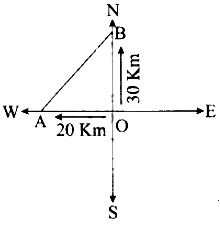
Two trains leave a railway station at the same time. The first train travels due west and the second train due north. The first train travels at a speed of $\frac{20 km }{ hr }$ and the second train travels at $\frac{30 km }{ hr }$. After 2 hours, what is the distance between them?
Answer
A is the position of the $1^{ st }$ train.
B is the position of the $2^{\text {nd }}$ train.

Distance Covered in 2 hours
OA = 2 × 20 = 40 km
OB = 2 × 30 = 60 km
Distance between the train after 2 hours
$
\begin{aligned}
& A B=\sqrt{ OA ^2+ OB ^2} \\
& =\sqrt{40^2+60^2} \\
& =\sqrt{1600+3600} \\
& =\sqrt{5200} \text { or } \sqrt{52 \times 100} \\
& =10 \sqrt{4 \times 13} \\
& =20 \sqrt{13} \\
& =72.11 km
\end{aligned}
$
Distance between the two train $=72.11 km$ or $20 \sqrt{13} km$
View full question & answer
Question 65 Marks
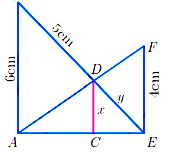
In the given figure AB || CD || EF. If AB = 6 cm, CD = x cm, EF = 4 cm, BD = 5 cm and DE = y cm. Find x and y.
Answer
In the given diagram $\triangle A E F$ and $\triangle A C D$
$
\angle AEF =\angle ACD =90^{\circ}
$
$\angle A$ is common

By AA - Similarity.
$\therefore \triangle AEF \sim \triangle ACD$
$
\frac{ AE }{ AC }=\frac{ AF }{ AD }=\frac{ EF }{ CD }
$
$
\frac{ AE }{ AC }=\frac{ EF }{ CD }
$
$
\frac{ AE }{ AC }=\frac{4}{x}
$
$
AC =\frac{ AE \times x}{4}
$

In $\triangle E A B$ and $\triangle E C D$,
$
\angle EAB =\angle ECD =90^{\circ}
$
$\angle E$ is common

$\triangle ECD \sim \triangle EAB$
$\frac{ EC }{ EA }=\frac{ ED }{ EB }=\frac{ CD }{ AB }$
$\frac{ EC }{ EA }=\frac{x}{6}$
$EC =\frac{ EA \times x}{6}$ $\cdots(2)$

In $\triangle A E B, C D \| A B$

By Basic Proportionality Theorem
$
\begin{aligned}
& \frac{ AB }{ CD }=\frac{ EB }{ ED } \\
& \frac{6}{x}=\frac{5+y}{y} \\
& x =\frac{6 y}{y+5} \quad \ldots( EC = x ) \cdots(3)
\end{aligned}
$

Add (1) and (2) we get
$
AC + EC =\frac{ AE \times x}{4}+\frac{x \times EA }{6}
$

$
\begin{aligned}
& AE = AE \left(\frac{x}{4}+\frac{x}{6}\right) \\
& AE = AE \left(\frac{3 x+2 x}{12}\right) \\
& AE = AE \times\left(\frac{5 x}{12}\right) \\
& \therefore 1=\frac{5 x}{12} \\
& \Rightarrow 5 x =12 \\
& x=\frac{12}{5} \\
& =2.4 cm
\end{aligned}
$

Substitute the value of $x=2.4$ in (3)
$
2.4=\frac{6 y}{y+5}
$
$6 y=2.4 y+12$
$6 y-2.4 y=12$

$
\begin{aligned}
& \Rightarrow 3.6 y=12 \\
& y=\frac{12}{3.6}=\frac{120}{36}=\frac{10}{3}=3.3 cm
\end{aligned}
$

The value of $x=\frac{12}{5}$ or $2.4 cm$ and $y=\frac{10}{3}$ or $3.3 cm$
View full question & answer
Question 75 Marks
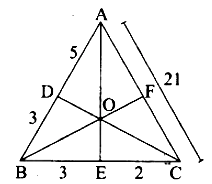
Let ABC be a triangle and D, E, F are points on the respective sides AB, BC, AC or their extensions. Let AD : DB = 5 : 3, BE : EC = 3 : 2 and AC = 21 . Find the length of the line segment CF
Answer

$
\frac{ AD }{ DB }=\frac{5}{3}, \frac{ BE }{ EC }=\frac{3}{2}, AC =21
$

By Ceva's theorem
$
\begin{aligned}
& \frac{ BE }{ EC } \times \frac{ CF }{ FA } \times \frac{ AD }{ DB }=1 \\
& \frac{3}{\frac{3}{2} \times \frac{ CF }{21- CF } \times \frac{5}{3}}=1 \\
& \frac{5 CF }{2(21- CF )}=1 \\
& \frac{ CF }{21- CF }=\frac{2}{5} \\
& 5 CF =42-2 CF \\
& 7 CF =42 \\
& CF =\frac{42}{7}=6
\end{aligned}
$
Length of the line segment $C F=6$ units
View full question & answer
Question 85 Marks
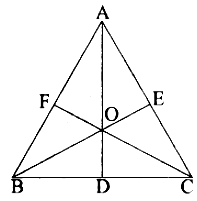
Show that the angle bisectors of a triangle are concurrent
Answer
Given: ABC is a triangle. AD, BE and CF are the angle bisector of ∠A, ∠B, and ∠C.
To Prove: Bisector AD, BE and CF intersect
Proof: The angle bisectors AD and BE meet at O.
Assume CF does not pass through O. By angle bisector theorem.
AD is the angle bisector of ∠A
$\frac{ BD }{ DC }=\frac{ AB }{ AC } \ldots(1)$
$BE$ is the angle bisector of $\angle B$

$
\frac{C E}{E A}=\frac{B C}{A B}
$
$C F$ is the angle bisector $\angle C$
$
\frac{ AF }{ FB }=\frac{ AC }{ BC } \ldots(3)
$

Multiply (1) (2) and (3)
$
\frac{ BD }{ DC } \times \frac{ CE }{ EA } \times \frac{ AF }{ FB }=\frac{ AB }{ AC } \times \frac{ BC }{ AB } \times \frac{ AC }{ BC }
$

So by Ceva's theorem.
The bisector $A D, B E$ and $C F$ are concurrent.
View full question & answer
Question 95 Marks
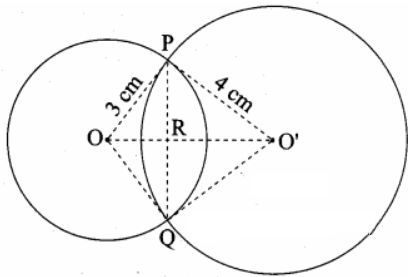
Two circles with centres O and O’ of radii 3 cm and 4 cm, respectively intersect at two points P and Q, such that OP and O’P are tangents to the two circles. Find the length of the common chord PQ.
Answer
$\begin{aligned} & \ln \triangle O O^{\prime} P \\ & \left(O^{\prime} O\right)^2=O P^2+O^{\prime} P^2 \\ & =3^2+4^2\end{aligned}$
Image
$=9+16$
$\left(O O^{\prime}\right)^2=25$
$\therefore O O^{\prime}=5 cm$
Since the line joining the centres of two intersecting circles is perpendicular bisector of their common chord.
$OR \perp PQ$ and $PR = RQ$
Let $O R$ be $x$, then $O^{\prime} R=5-x$ again Let $P R=R Q=y cm$
In $\triangle O R P$,
$O P^2=O R^2+P R^2$
$9=x^2+y^2 \ldots(1)$
In $\triangle O^{\prime} R P$,
$O^{\prime} P^2=O^{\prime} R^2+P R^2$
$16=(5-x)^2+y^2$
$16=25+x^2-10 x+y^2$
$16=x^2+y^2+25-10 x$
$16=9+25-10 x \ldots[\text { From (1)] }$
$16=34-10 x$
$10 x=34-16=18$

$
x=\frac{18}{10}=1.8 cm
$

Substitute the value of $x=1.8$ in (1)
$
\begin{aligned}
& 9=(1.8)^2+y^2 \\
& y^2=9-3.24 \\
& y^2=5.76 \\
& y=\sqrt{5.76}=2.4 cm
\end{aligned}
$

Hence $P Q=2(2.4)=4.8 cm$
Length of the common chord $P Q=4.8 cm$
View full question & answer
Question 105 Marks
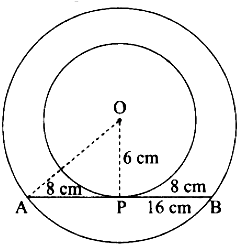
In two concentric circles, a chord of length 16 cm of larger circle becomes a tangent to the smaller circle whose radius is 6 cm. Find the radius of the larger circle
Answer
$\begin{aligned} & \text { Here } AP = PB =8 cm \\ & \text { In } \triangle OPA \\ & OA ^2= OP ^2+ AP ^2\end{aligned}$

$
\begin{aligned}
& =6^2+8^2 \\
& =36+64 \\
& =100 \\
& O A=\sqrt{100}=10 cm
\end{aligned}
$
Radius of the larger circle $=10 cm$
View full question & answer
Question 115 Marks
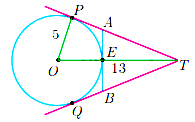
O is the centre of the circle with radius 5 cm. T is a point such that OT = 13 cm and OT intersects the circle E, if AB is the tangent to the circle at E, find the length of AB.
Answer
$
\begin{aligned}
& \text { In the right } \triangle O T P, \\
& PT ^2= OT ^2- OP ^2 \\
& =13^2-5^2 \\
& =169-25 \\
& =144 \\
& PT =\sqrt{144}=12 cm
\end{aligned}
$

Since lengths of tangent drawn from a point to circle are equal.
$
\begin{aligned}
& \therefore A P=A E=x \\
& A T=P T-A P \\
& =(12-x) c m
\end{aligned}
$


Since $A B$ is the tangent to the circle $E$.
$\therefore OE \perp AB$
$
\begin{aligned}
& \angle O E A=90^{\circ} \\
& \angle A E T=90^{\circ}
\end{aligned}
$

In $\triangle AET , A T ^2=A E^2+E T^2$

In the right $\triangle A E T$,
$
\begin{aligned}
& A T^2=A E^2+E T^2 \\
& (12-x)^2=x^2+(13-5)^2 \\
& 144-24 x+x^2=x^2+64 \\
& 24 x=80 \Rightarrow x=\frac{80}{24}=\frac{20}{6}=\frac{10}{3} \\
& B E=\frac{10}{3} c m \\
& A B=A E+B E
\end{aligned}
$

$
=\frac{10}{3}+\frac{10}{3}=\frac{20}{3}
$

Length of $A B=\frac{20}{3} cm$
View full question & answer
Question 125 Marks
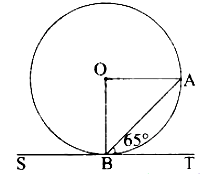
A tangent ST to a circle touches it at B. AB is a chord such that ∠ABT = 65°. Find ∠AOB, where “O” is the centre of the circle.
Answer
Given ∠ABT = 65°
∠OBT = 90° ...(TB is the tangent of the circle)
∠ABO = 90° – 65° = 25°
∠ABO + ∠BOA + ∠OAB = 180°
25° + x + 25° = 180° ...(Sum of the angles of a ∆)

OA and OB are the radius of the circle.
∴ ∠ABO = ∠BAO = 25°
x + 50 = 180°
x = 180° – 50° = 130°
∴ ∠BOA = 130°
View full question & answer
Question 135 Marks
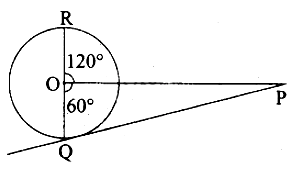
PQ is a tangent drawn from a point P to a circle with centre O and QOR is a diameter of the circle such that ∠POR = 120°. Find ∠OPQ.
Answer
∠POQ = 180° – 120° = 60°
In ∆OPQ, we know

∠POQ + ∠OQP + ∠OPQ = 180° ...(Sum of the angles of a ∆ is 180°)
60° + 90° + ∠OPQ = 180°
∠OPQ = 180° – 150° = 30°
∠OPQ = 30°
View full question & answer
Question 145 Marks
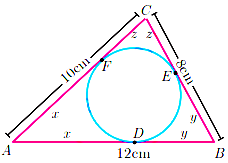
A circle is inscribed in ∆ABC having sides 8 cm, 10 cm and 12 cm as shown in the figure, Find AD, BE and CF.
Answer
$\begin{aligned} & A D=A F=x \quad \ldots(\text { Tangent of the circle }) \\ & B D=B E=y \quad \ldots(\text { Tangent of the circle }) \\ & C E=C F=z \quad \ldots(\text { Tangent of the circle }) \\ & A B=A D+D B \\ & x+y=12 \quad \ldots(1) \\ & B C=B E+E C \\ & y+z=8 \\ & A C=A F+F C \\ & x+z=10 \\ & \text { Add (1), (2) and (3) } \\ & 2 x+2 y+2 z=12+8+10 \\ & x+y+z=\frac{30}{2}=15 \ldots(4) \\ & \text { By } x+y=12 \text { in (4) } \\ & \end{aligned}$
$
z=3
$
$
y+z=8 \text { in (4) }
$
$
x=7
$
$
x+z=10 \text { in (4) }
$
$
y=5
$
$A D=7 cm , B E=5 cm$ and $C F=3 cm$
View full question & answer
Question 155 Marks
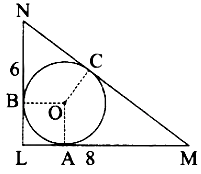
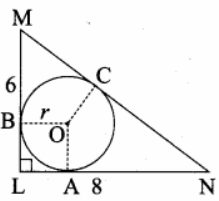
∆LMN is a right angled triangle with ∠L = 90°. A circle is inscribed in it. The lengths of the sides containing the right angle are 6 cm and 8 cm. Find the radius of the circle.
Answer
$\begin{aligned} & LN =6 ; ML =8 \\ & \text { In the right } \triangle LMN , \\ & MN ^2= LN ^2+ LM ^2 \\ & =6^2+8^2=36+64=100 \\ & MN =\sqrt{100}=10\end{aligned}$

OA = OB = OC = r
AN = CN ...(Tangent of the circle)
LN – AL = CN
LN – r = CN
8 – r = CN ...(1)
MC = MB ...(Tangent of the circle)
MC = ML – LB
MC = 6 – r ...(2)
Image
Add (1) and (2)
$
\begin{aligned}
& M C+C N=(6-r)+(8-r) \\
& M N=14-2 r \\
& 10=14-2 r \\
& 2 r=14-10=4 \\
& r=\frac{4}{2}=2 cm
\end{aligned}
$
$
\text { radius of the circle }=2 cm
$
View full question & answer
Question 165 Marks
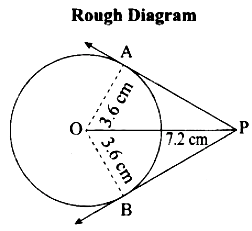
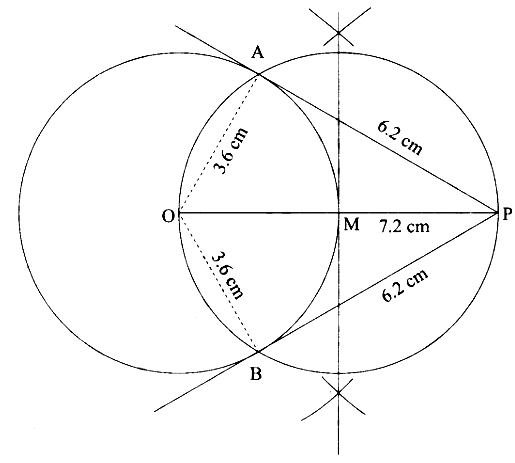
Draw a tangent to the circle from the point P having radius 3.6 cm, and centre at O. Point P is at a distance 7.2 cm from the centre.
Answer
Radius = 3.6, Distance = 7.2 cm.


Steps of construction:
1. With O as centre, draw a circle of radius 3.6 cm.
2. Draw a line OP = 7.2 cm.
3. Draw a perpendicular bisector of OP which cuts OP at M.
4. With M as centre and MO as radius draw a circle which cuts the previous circle at A and B.
5. Join AP and BP, AP and BP are the required tangents.
Length of the tangents PA = PB = 6.26 cm

Verification: In the right triangle ∆OAP
$
\begin{aligned}
& P^2=O P^2-O A^2 \\
& =7.2^2-3.6^2 \\
& =(7.2+3.6)(7.2-3.6) \\
& P A^2=10.8 \times 3.6 \\
& =\sqrt{38.38} \\
& P A=6.2 cm
\end{aligned}
$
Length of the tangent $=6.2 cm$
View full question & answer
Question 175 Marks
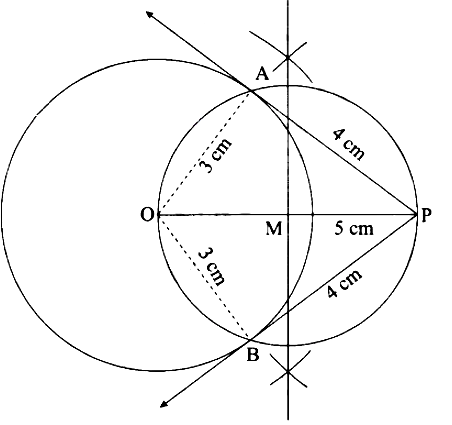
Draw the two tangents from a point which is 5 cm away from the centre of a circle of diameter 6 cm. Also, measure the lengths of the tangents.
Answer

Steps of construction:

1. With O as centre, draw a circle of radius 3 cm.
2. Draw a line OP = 5 cm.
3. Draw a perpendicular bisector of OP, which cuts OP at M.
4. With M as centre and MO as radius draw a circle which cuts previous circles at A and B.
5. Join AP and BP, AP and BP are the required tangents.
The length of the tangent PA = PB = 4 cm
Verification: In the right angle triangle OAP
$PA^2=O P^2-O A^2$
$=5^2-3^2$
$=25-9$
$=16$

$
\begin{aligned}
& PA =\sqrt{16} \\
& =4 cm
\end{aligned}
$

Length of the tangent $=4 cm$
View full question & answer
Question 185 Marks
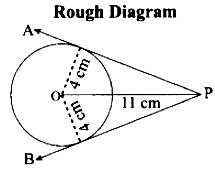
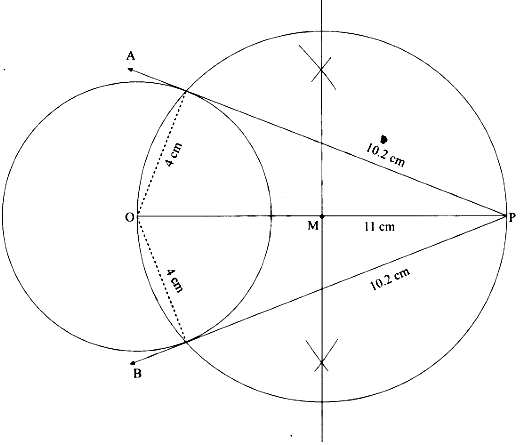
Take a point which is 11 cm away from the centre of a circle of radius 4 cm and draw the two tangents to the circle from that point.
Answer
Radius = 4 cm, Distance = 11 cm


Steps of construction:
1. With $O$ as centre, draw a circle of radius $4 cm$.
2. Draw a line $O P=11 cm$.
3. Draw a perpendicular bisector of $O P$, which cuts $O P$ at $M$.
4. With $M$ as centre and $M O$ as radius, draw a circle which cuts the previous circles $A$ and $B$.
5. Join $A P$ and $B P$. AP and $B P$ are the required tangents.

This the length of the tangents $P A=P B=10.2 cm$

Verification: In the right angle triangle OAP
$
\begin{aligned}
& P^2=O P^2-O A^2 \\
& =11^2-4^2 \\
& =121-16 \\
& =105 \\
& P A=\sqrt{105} \\
& =10.2 cm
\end{aligned}
$
Length of the tangents = 10.2 cm
View full question & answer
Question 195 Marks
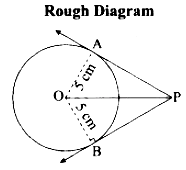
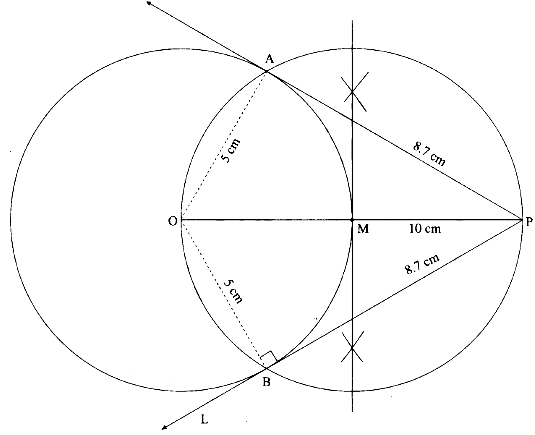
Draw the two tangents from a point which is 10 cm away from the centre of a circle of radius 5 cm. Also, measure the lengths of the tangents.
Answer
Radius = 5 cm, Distance = 10 cm


Steps of construction:
1. With $O$ as centre, draw a circle of radius $5 cm$.
2. Draw a line $O P=10 cm$.
3. Draw a perpendicular bisector of $O P$, which cuts $O P$ at $M$.
4. With $M$ as centre and $MO$ as radius draw a circle which cuts the previous circle at $A$ and $B$.
5. Join AP and BP. AP and BP are the required tangents.

Verification: In the right $\triangle O A P$
$
\begin{aligned}
& P A^2=O P^2-O A^2 \\
& =10^2-5^2 \\
& =\sqrt{100-25} \\
& =\sqrt{75} \\
& =8.7 cm
\end{aligned}
$

Length of the tangent is $=8.7 cm$
View full question & answer
Question 205 Marks
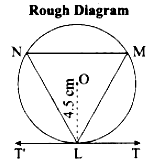
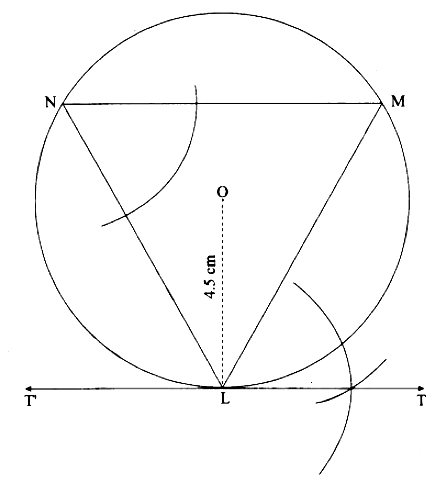
Draw a circle of radius 4.5 cm. Take a point on the circle. Draw the tangent at that point using the alternate segment theorem
Answer
Radius of the circle = 4.5 cm


Steps of construction:
1. With O as centre, draw a circle of radius 4.5 cm.
2. Take a point L on the circle. Through L draw any chord LM.
3. Take a point M distinct from L and N on the circle, so that L, M, N are in anti-clockwise direction. Join LN and NM.
4. Through “L” draw tangent TT’such that ∠TLM = ∠MNL
5. TT’ is the required tangent.
View full question & answer
Question 215 Marks
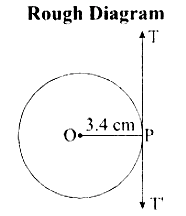
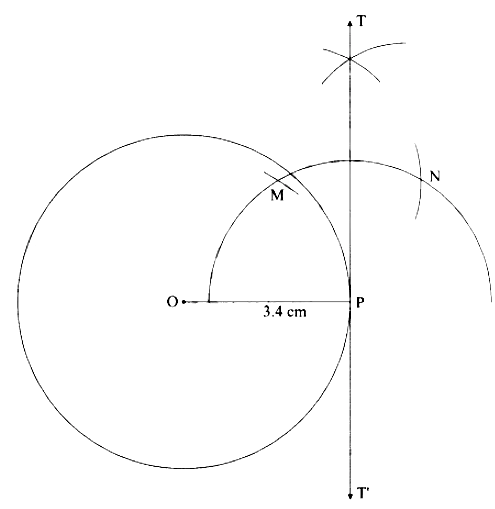
Draw a tangent at any point R on the circle of radius 3.4 cm and centre at P?
Answer
Given Radius = 3.4 cm


Steps of construction:
1. Draw a circle with centre “O” of radius 3.4 cm.
2. Take a point P on the circle Join OP.
3. Draw a perpendicular line TT’ to OP which passes through P.
4. TT’ is the required tangent.
View full question & answer
Question 225 Marks
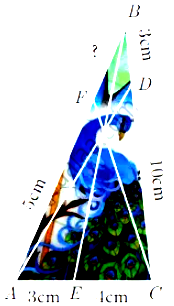
An artist has created a triangular stained glass window and has one strip of small length left before completing the window. She needs to figure out the length of left out portion based on the lengths of the other sides as shown in the figure
Answer
Given that $A E=3 cm , E C=4 cm , C D=10 cm , D B=3 cm , A F=5 cm$.
Let $FB$ be $x$

Using Ceva's theorem we have
$
\begin{aligned}
& \frac{ AE }{ EC } \times \frac{ CD }{ DB } \times \frac{ BF }{ AF }=1 \\
& \frac{3}{4} \times \frac{10}{3} \times \frac{x}{5}=1 \\
& \frac{2 x}{4}=1 \\
& 2 x =4 \Rightarrow x =\frac{4}{2}=2
\end{aligned}
$
The value of $B F=2$
View full question & answer
Question 235 Marks
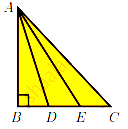
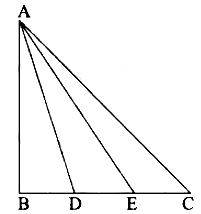
In the adjacent figure, $A B C$ is a right angled triangle with right angle at $B$ and points $D, E$ trisect $B C$. Prove that $8 A E^2$ $=3 A C^2+5 A D^2$
Answer
Since Points D, E trisect BC.
BD = DE = CE
Let BD = DE = CE = x
BE = 2x and BC = 3x

In the right $\triangle A B D$,
$A D^2=A B^2+B D^2$
$A D^2=A B^2+x^2 \ldots(1)$
In the right $\triangle A B E$,
$A E^2=A B^2+2 B E^2$
$A E^2=A B^2+4 x^2 \ldots(2) \ldots(B E=2 x)$
In the right $\triangle A B C$
$A C^2=A B^2+B C^2$
$A C^2=A B^2+9 x^2 \ldots(3) \ldots(B C=3 x)$
$\text { R.H.S. }=3 A C^2+5 A D^2$
$=3\left[A B^2+9 x^2\right]+5\left[A B^2+x^2\right] \ldots[\text { From (1) and (3)] }$
$=3 A B^2+27 x^2+5 A B^2+5 x^2$
$=8 A B^2+32 x^2$
$=8\left(A B^2+4 x^2\right)$
$=8 A E^2 \ldots[\text { From (2)] }$
$=\text { R.H.S. }$
$\therefore 8 A E^2=3 A C^2+5 A D^2$
View full question & answer
Question 245 Marks
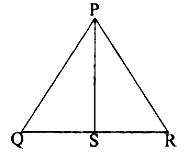
The perpendicular PS on the base $Q R$ of a $\triangle P Q R$ intersects $Q R$ at $S$, such that $Q S=3 S R$. Prove that $2 P Q^2=2 P R^2+Q R^2$
Answer
$\begin{aligned} & \text { Given } Q S=3 S R \\ & Q R=Q S+S R \\ & =3 S R+S R=4 S R \\ & S R=\frac{1}{4} Q R \ldots(1) \\ & Q S=3 S R \\ & S R=\frac{Q S}{3} \ldots(2)\end{aligned}$

From (1) and (2) we get
$ />\begin{aligned}
& \frac{1}{4} QR =\frac{ QS }{3} \\
& \therefore QS =\frac{3}{4} QR .
\end{aligned}
$

In the right $\triangle P Q S$,
$
P Q^2=P S^2+Q S^2
$

Similarly in $\triangle P S R$
$
P R^2=P S^2+S R^2
$

Subtract (4) and (5)
$
\begin{aligned}
& P Q^2-P R^2=P S^2+Q S^2-P S^2-S R^2 \\
& =Q S^2-S R^2
\end{aligned}
$

$
PQ ^2- PR ^2=\left[\frac{3}{4} QR \right]^2-\left[\frac{ QR }{4}\right]^2
$

From (3) and (1)
$
\begin{aligned}
& =\frac{9 QR ^2}{16}-\frac{ QR ^2}{16} \\
& =\frac{8 QR ^2}{16} \\
& PQ ^2- PR ^2=\frac{1}{2} QR ^2 \\
& 2 PQ ^2-2 PR ^2= QR ^2 \\
& 2 PQ ^2=2 PR ^2+ QR ^2
\end{aligned}
$

Hence the proved.
View full question & answer
Question 255 Marks
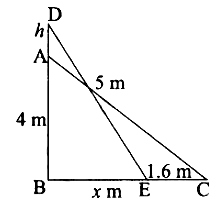
5 m long ladder is placed leaning towards a vertical wall such that it reaches the wall at a point 4 m high. If the foot of the ladder is moved 1.6 m towards the wall, then find the distance by which the top of the ladder would slide upwards on the wall.
Answer
" $C$ " is the position of the foot of the ladder " $A$ " is the position of the top of the ladder.

In the right $\triangle ABC$,
$
\begin{aligned}
& B C^2=A C^2-A B^2 \\
& =5^2-4^2 \\
& =25-16 \\
& =9 \\
& B C=\sqrt{9}=3 m
\end{aligned}
$

When the foot of the ladder moved $1.6 m$ toward the wall.

The distance between the foot of the ladder to the ground is
$
B E=3-1.6 m=1.4 m
$


Let the distance moved upward on the wall be " $h$ " $m$

The ladder touch the wall at $(4+h) M$

In the right $\triangle B E D$,
$
\begin{aligned}
& E D^2=A B^2+B E^2 \\
& 5^2=(4+h)^2+(1.4)^2 \\
& 25-1.96=(4+h)^2 \\
& \therefore 4+h=\sqrt{23.04} \\
& 4+h=4.8 m \\
& h=4.8-4 \\
& =0.8 m
\end{aligned}
$

Distance moved upward on the wall $=0.8 m$
View full question & answer
Question 265 Marks
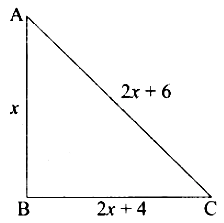
The hypotenuse of a right triangle is 6 m more than twice of the shortest side. If the third side is 2 m less than the hypotenuse, find the sides of the triangle
Answer
Let the shortest side of the right triangle be x.
∴ Hypotenuse = 6 + 2x
Third side = 2x + 6 – 2
= 2x + 4

In the right triangle ABC,
$A C^2=A B^2+B C^2$
$(2 x+6)^2=x^2+(2 x+4)^2$
$4 x^2+36+24 x=x^2+4 x^2+16+16 x$
$0=x^2-24 x+16 x-36+16$
$\therefore x^2-8 x-20=0$
$(x-10)(x+2)=0$
$x-10=0 \text { or } x+2=0$

x = 10 or x = – 2 ...(Negative value will be omitted)
The side AB = 10 m
The side BC = 2(10) + 4 = 24 m
Hypotenuse AC = 2(10) + 6 = 26 m
View full question & answer
Question 275 Marks
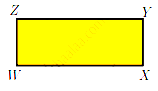
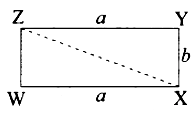
In the rectangle WXYZ, XY + YZ = 17 cm, and XZ + YW = 26 cm. Calculate the length and breadth of the rectangle?
Answer
Let the length of the rectangle be “a” and the breadth of the rectangle be “b”.
$X Y+Y Z=17 cm$
$b+a=17 \ldots(1)$
$\text { In the right } \Delta W X Z_I />X Z^2=W X^2+W Z^2$
$(X Z)^2=a^2+b^2$

$
x Z=\sqrt{a^2+b^2}
$

Similarly $W Y=\sqrt{a^2+b^2} \Rightarrow X Z+W Y=26$
$
2 \sqrt{a^2+b^2}=26 \Rightarrow \sqrt{a^2+b^2}=13
$

Squaring on both sides
$
\begin{aligned}
& a^2+b^2=169 \\
& (a+b)^2-2 a b=169 \\
& 17^2-2 a b=169 \Rightarrow 289-169=2 a b \\
& 120=2 a b \Rightarrow \therefore a b=60 \\
& a=\frac{60}{b} \ldots(2)
\end{aligned}
$

Substituting the value of $a=\frac{60}{b}$ in (1)
$
\frac{60}{b}+b=17
$

$b_2$– 17b + 60 = 0
(b – 2) (b – 5) = 0
b = 12 or b = 5

If b = 12 ⇒ a = 5
If b = 6 ⇒ a = 12
Length = 12 m and breadth = 5 m
View full question & answer
Question 285 Marks
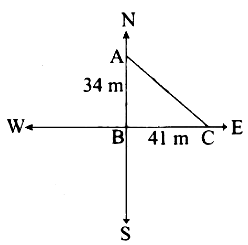
To get from point A to point B you must avoid walking through a pond. You must walk 34 m south and 41 m east. To the nearest meter, how many meters would be saved if it were possible to make a way through the pond?
Answer
In the right $\triangle A B C$,

By Pythagoras theorem
$
\begin{aligned}
& A C^2=A B^2+B C^2 \\
& =34^2+41^2 \\
& =1156+1681 \\
& =2837 \\
& A C=\sqrt{2837} \\
& =53.26 m
\end{aligned}
$

A one must walk (34m + 41m) 75m to reach C.
The difference in Distance = 75 – 53.26
= 21.74 m
View full question & answer
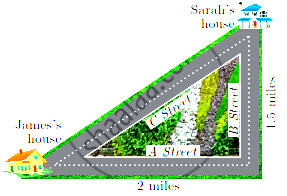
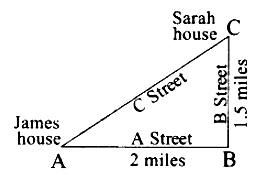
Question 295 Marks
There are two paths that one can choose to go from Sarah’s house to James's house. One way is to take C street, and the other way requires to take B street and then A street. How much shorter is the direct path along C street?
Answer
Distance between Sarah's House and James's House using "C street".
$
\begin{aligned}
& A C^2=A B^2+B C^2 \\
& =2^2+1.5^2 \\
& =4+2.25 \\
& =6.25 \\
& A C=\sqrt{6.25} \\
& A C=2.5 \text { miles }
\end{aligned}
$

Distance covered by using “A Street” and “B Street”
= (2 + 1.5) miles
= 3.5 miles
Difference in distance = 3.5 miles – 2.5 miles = 1 mile
View full question & answer
Question 305 Marks
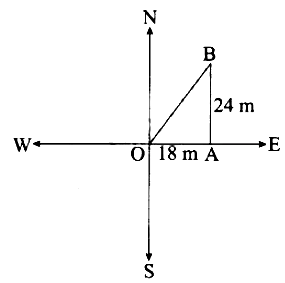
A man goes 18 m due east and then 24 m due north. Find the distance of his current position from the starting point?
Answer
Let the initial position of the man be “O” and his final position be “B”.
By Pythagoras theorem
In the right ∆OAB,

$
\begin{aligned}
& O B^2=O A^2+A B^2 \\
& =18^2+24^2 \\
& =324+576=900 \\
& O B=\sqrt{900}=30
\end{aligned}
$<br />
The distance of his current position is $30 m$
View full question & answer
Question 315 Marks
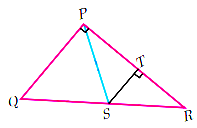
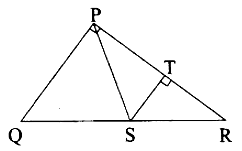
∠QPR = 90°, PS is its bisector. If ST ⊥ PR, prove that ST × (PQ + PR) = PQ × PR
Answer
Given: ∠QPR = 90°; PS is the bisector of ∠P. ST ⊥ ∠PR

To prove: ST × (PQ + PR) = PQ × PR
Proof: In ∆PQR, PS is the bisector of ∠P.

$
\therefore \frac{ PQ }{ QR }=\frac{ QS }{ SR }
$
Adding (1) on both side
$
\begin{aligned}
& 1+\frac{ PQ }{ QR }=1+\frac{ QS }{ SR } \\
& \frac{ PR + PQ }{ PR }=\frac{ SR + QS }{ SR } \\
& \frac{ PQ + PR }{ PR }=\frac{ QR }{ SR } \ldots(1)
\end{aligned}
$

In $\triangle R S T$ And $\triangle R Q P$
$
\angle SRT =\angle QRP =\angle R \quad \ldots(\text { Common })
$
$
\therefore \angle QRP =\angle STR =90^{\circ}
$
$\triangle R S T \sim R Q P \quad \ldots($ By AA similarity $)$

$\begin{aligned} & \frac{ SR }{ QR }=\frac{ ST }{ PQ } \\ & \frac{ QR }{ SR }=\frac{ PQ }{ ST } \ldots \text { (2) } \\ & \text { From (1) and (2) we get } \\ & \frac{ PQ + PR }{ PR }=\frac{ PQ }{ ST } \\ & ST \times( PQ + PR )= PQ \times PR \end{aligned}$
View full question & answer
Question 325 Marks
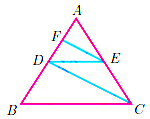
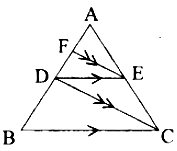
$D E \| B C$ and $C D \| E E$ Prove that $A D^2=A B \times A F$
Answer
Given: In $\triangle A B C, D E \| B C$ and $C D \| E F$

To Prove: $A D^2=A B \times A F$

By basic proportionality theorem
$
\frac{ AB }{ AD }=\frac{ AC }{ AE }
$

By basic Proportionality theorem
$
\frac{ AD }{ AF }=\frac{ AC }{ AE }
$

From (1) and (2) we get
$
\begin{aligned}
& \frac{ AB }{ AD }=\frac{ AD }{ AF } \\
& AD ^2= AB \times AF
\end{aligned}
$

Hence it is proved
View full question & answer
Question 335 Marks
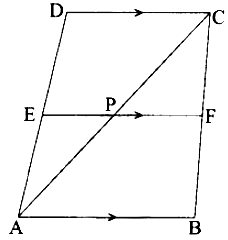
In trapezium $A B C D, A B \| D C, E$ and $F$ are points on non-parallel sides $A D$ and $B C$ respectively, such that $E F \| A B$. Show that $=\frac{A E}{E D}=\frac{B F}{F C}$
Answer
Given: $A B C D$ is a trapezium $A B \| D C$
$E$ and $F$ are the points on the side of $A D$ and $B C$ $E F \| A B$
To Prove: $\frac{ AE }{ ED }=\frac{ BF }{ FC }$

Construction: Join $A C$ intersecting $A C$ at $P$
Proof:

In $\triangle A B C, P F \| A B \quad \ldots($ Given)

By basic proportionality theorem
$
\frac{ AP }{ PC }=\frac{ BF }{ FC }
$

In the $\triangle A C D, P E \| C D \quad \ldots$ (Given)

By basic Proportionality theorem
$
\frac{ AP }{ PC }=\frac{ AE }{ ED }
$

From (1) and (2) we get
$
\frac{ AE }{ ED }=\frac{ BF }{ FC }
$
View full question & answer
Question 345 Marks
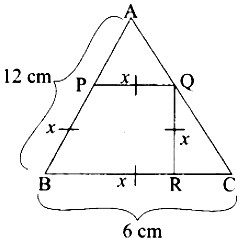
Rhombus PQRB is inscribed in ΔABC such that ∠B is one of its angle. P, Q and R lie on AB, AC and BC respectively. If AB = 12 cm and BC = 6 cm, find the sides PQ, RB of the rhombus.
Answer
Let the side of the rhombus be " $x$ ". Since $P Q R B$ is a Rhombus PQ || BC By basic proportionality theorem

$
\begin{aligned}
& \frac{ AP }{ AB }=\frac{ PQ }{ BC } \Rightarrow \frac{12-x}{ BC }=\frac{x}{6} \\
& 12 x =6(12- x ) \\
& 12 x =72-6 x \\
& 12 x +6 x =72 \\
& 18 x =72 \Rightarrow x =\frac{72}{18}=4
\end{aligned}
$

Side of a rhombus $=4 cm$
$
P Q=R B=4 cm
$
View full question & answer
Question 355 Marks
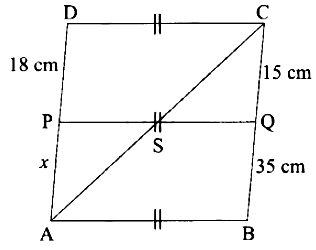
ABCD is a trapezium in which AB || DC and P, Q are points on AD and BC respectively, such that PQ || DC if PD = 18 cm, BQ = 35 cm and QC = 15 cm, find AD
Answer
Join AC intersecting PQ at S.
Let AP be x
∴ AD = x + 18
In the ∆ABC, QS || AB
By basic proportionality theorem.


$
\begin{aligned}
& \frac{ AS }{ SC }=\frac{ BQ }{ QC } \\
& \frac{ AS }{ SC }=\frac{35}{15}
\end{aligned}
$

In the $\triangle A C D ; P S|| D C$

By basic proportionality theorem.
$
\begin{aligned}
& \frac{ AS }{ SC }=\frac{ AP }{ PD } \\
& \frac{ AS }{ SC }=\frac{x}{18} .
\end{aligned}
$

From (1) and (2) we get
$
\begin{aligned}
& \frac{35}{15}=\frac{x}{18} \\
& 15 x=35 \times 18 \Rightarrow x =\frac{35 \times 18}{15}=42 \\
& A D=A P+P D \\
& =42+18=60
\end{aligned}
$

The value of $A D=60 cm$
View full question & answer
Question 365 Marks
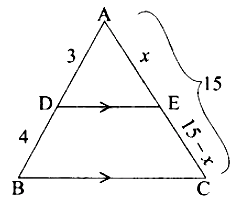
In $\triangle A B C, D$ and $E$ are points on the sides $A B$ and $A C$ respectively such that $D E \| B C$ If $\frac{ AD }{ DB }=\frac{3}{4}$ and $AC =15 cm$ find $AE$
Answer
Let $A E$ be $x$
$\therefore EC =15- x$

In $\triangle ABC$ we have $DE \| BC$
By Basic proportionality theorem, we have

$
\begin{aligned}
& \frac{ AD }{ DB }=\frac{ AE }{ EC } \\
& \frac{3}{4}=\frac{x}{15-x} \\
& 4 x =3(15- x ) \\
& 4 x =45-3 x \\
& 7 x =45 \\
& \Rightarrow x =\frac{45}{7} \\
& =6.43
\end{aligned}
$

The value of $x=6.43$
View full question & answer
Question 375 Marks
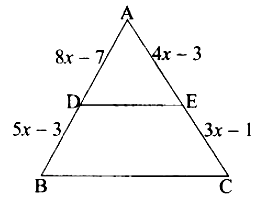
In ∆ABC, D and E are points on the sides AB and AC respectively such that DE || BC
If AD = 8x – 7, DB = 5x – 3, AE = 4x – 3 and EC = 3x – 1, find the value of x
Answer
Given $A D=8 x-7 ; B D=5 x-3 ; A E=4 x-3 ; E C=3 x-1$

In $\triangle A B C$ we have $D E \| B C$

By Basic proportionality theorem
$
\begin{aligned}
& \frac{ AD }{ DB }=\frac{ AE }{ EC } \\
& \frac{8 x-7}{5 x-3}=\frac{4 x-3}{3 x-1}
\end{aligned}
$


$(8 x-7)(3 x-1)=(4 x-3)(5 x-3)$
$24 x^2-8 x-21 x+7=20 x^2-12 x-15 x+9$
$24 x^2-20 x^2-29 x+27 x+7-9=0$
$4 x^2-2 x-2=0$
$2 x^2-x-1=0 \ldots(\text { Divided by } 2)$


$2x^2 – 2x + x – 1 = 0$
2x(x – 1) + 1 (x – 1) = 0
(x – 1) (2x + 1) = 0
x – 1 = 0 or 2x + 1 = 0

$x=1$ or $2 x=-1 \Rightarrow x=-\frac{1}{2} \ldots($ Negative value will be omitted $)$ The value of $x=1$
View full question & answer
Question 385 Marks
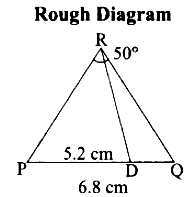
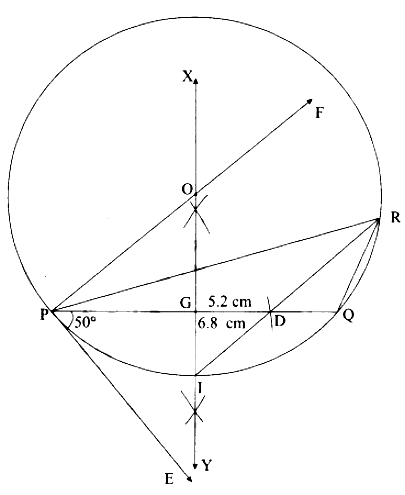
Draw ∆PQR such that PQ = 6.8 cm, vertical angle is 50° and the bisector of the vertical angle meets the base at D where PD = 5.2 cm
Answer


Steps of construction:
1. Draw a line segment PQ = 6.8 cm.
2. At P draw PE such that ∠QPE = 50°.
3. At P draw PF such that ∠EPF = 90°.
4. Draw the perpendicular bisector to PQ which intersects PF at O and PQ at G.
5. With O as centre and OP as radius draw a circle.
6. From P mark an arc of 5.2 cm on PQ at D.
7. The perpendicular bisector intersects the circle at I. Join ID.
8. ID produced meets the circle at A. Now Joint PR and QR. This ∆PQR is the required triangle.
View full question & answer
Question 395 Marks
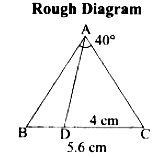
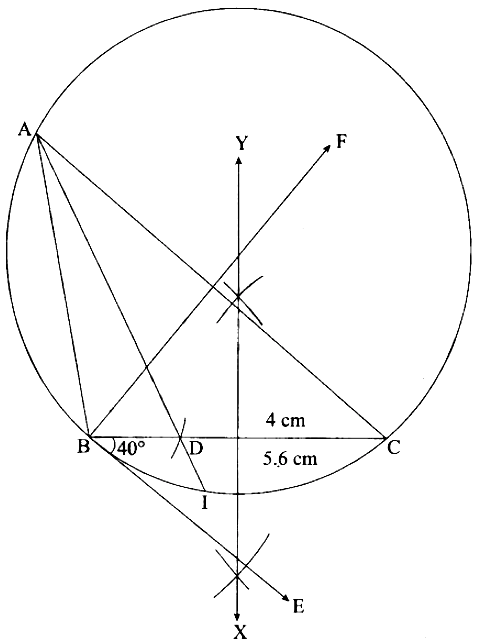
Draw a triangle ABC of base BC = 5.6 cm, ∠A = 40° and the bisector of ∠A meets BC at D such that CD = 4 cm
Answer


Steps of construction:
1. Draw a line segment BC = 5.6 cm.
2. At B draw BE such that ∠CBE = 40°.
3. At B draw BF such that ∠EBF = 90°.
4. Draw the perpendicular bisector to BC which intersects BF at O and BC at G.
5. With O as centre and OB as radius draw a circle.
6. From C mark an arc of 4 cm on CB at D.
7. The perpendicular bisector intersects the circle at I. Joint ID.
8. ID produced meets the circle at A. Now Join AB and AC.
This ∆ABC is the required triangle.
View full question & answer
Question 405 Marks
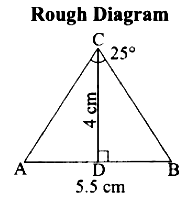
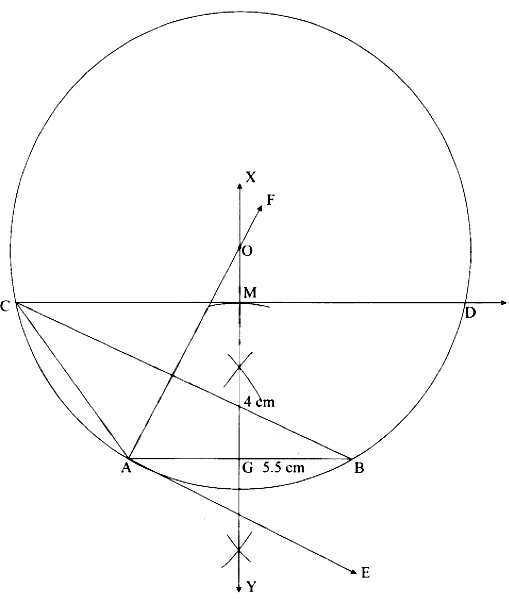
Construct a ∆ABC such that AB = 5.5 cm, ∠C = 25° and the altitude from C to AB is 4 cm
Answer


Steps of construction:
1. Draw a line segment AB = 5.5 cm.
2. At A draw AE such that ∠BAE = 25°.
3. At A draw AF such that ∠EAF = 90°.
4. Draw the perpendicular bisector of AB which intersects AF at O and AB at G.
5. With O as centre and OB as radius draw a circle.
6. XY intersects AB at G. On XY, from G mark an arc at M. Such that GM = 4 cm.
7. Through M draw a line parallel to AB intersect the circle at C and D.
8. Join AC and BC.
9. ∆ABC is the required triangle.
View full question & answer
Question 415 Marks
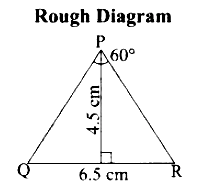
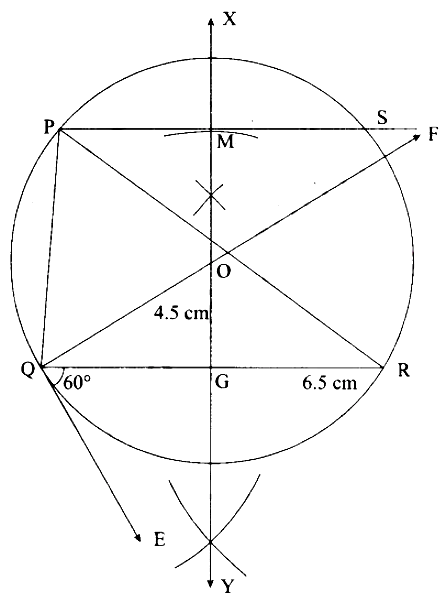
Construct a ∆PQR such that QR = 6.5 cm, ∠P = 60° and the altitude from P to QR is of length 4.5 cm
Answer


Steps of construction:
1. Draw a line segment QR = 6.5 cm.
2. At Q draw QE such that ∠RQE = 60°.
3. At Q, draw QF such that ∠EQF = 90°.
4. Draw the perpendicular of QR which intersects QF at O and QR at G.
5. With O as centre and OQ as radius draw a circle.
6. XY intersects QR at G. On XY, from G mark an arc at M. Such that GM = 4.5 cm.
7. Draw AB through M which is parallel to QR.
8. AB Meets the circle at P and S.
9. Join QP and RP.
10. ∆PQR is the required triangle.
View full question & answer
Question 425 Marks
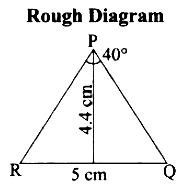
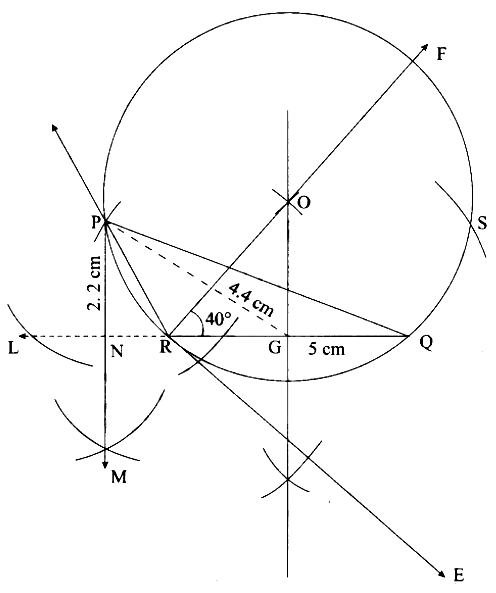
Construct a ∆PQR in which QR = 5 cm, ∠P = 40° and the median PG from P to QR is 4.4 cm. Find the length of the altitude from P to QR.
Answer


Steps of construction:
1. Draw a line segment RQ = 5 cm.
2. At R draw RE such that ∠QRE = 40°
3. At R, draw RF such that ∠ERF = 90°
4. Draw the perpendicular bisector to RQ, which intersects RF at O and RQ at G.
5. With O as centre and OP as radius draw a circle.
6. From G mark arcs of radius 4.4 cm on the circle. Mark them as P and S.
7. Join PR and PQ. Then ∆PQR is the required triangle.
8. From P draw a line PN which is perpendicular to RQ it meets at N.
9. Measure the altitude PN.
PN = 2.2 cm.
View full question & answer
Question 435 Marks
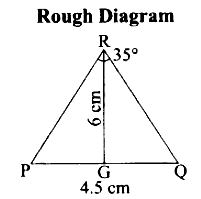
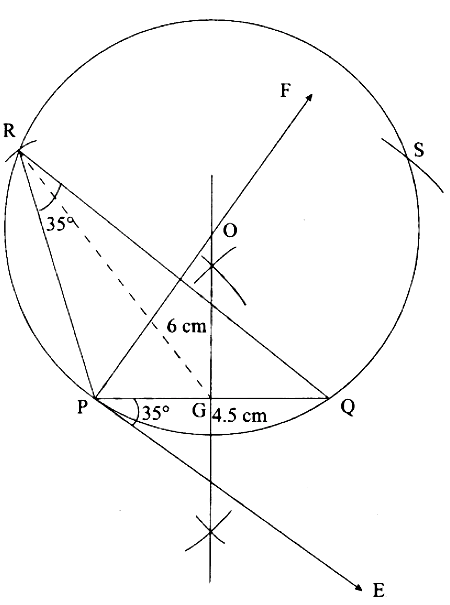
Construct a ∆PQR in which the base PQ = 4.5 cm, ∠R = 35° and the median from R to RG is 6 cm.
Answer


Steps of construction:
1. Draw a line segment PQ = 4.5 cm
2. At P, draw PE such that ∠QPE = 60°
3. At P, draw PF such that ∠EPF = 90°
4. Draw the perpendicular bisect to PQ, which intersects PF at O and PQ at G.
5. With O as centre and OP as radius draw a circle.
6. From G mark arcs of radius 5.8 cm on the circle. Mark them at R and S
7. Join PR and RQ.
8. PQR is the required triangle.
View full question & answer
Question 445 Marks
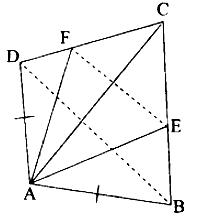
ABCD is a quadrilateral in which AB = AD, the bisector of ∠BAC and ∠CAD intersect the sides BC and CD at the points E and F respectively. Prove that EF || BD.
Answer
ABCD is a quadrilateral. AB = AD.
AE and AF are the internal bisector of ∠BAC and ∠DAC

To prove: $E F|| B D$.
Construction: Join EF and BD

Proof: In $\triangle A B C, A E$ is the internal bisector of $\angle B A C$.

By Angle bisector theorem, we have,
$
\therefore \frac{ AB }{ AC }=\frac{ BE }{ EC } \ldots(1)
$

In $\triangle A D C, A F$ is the internal bisector of $\angle D A C$

By Angle bisector theorem, we have,
$
\frac{ AD }{ AC }=\frac{ DF }{ FC }
$
$\therefore \frac{ AB }{ AC }=\frac{ DF }{ FC } \ldots( AB = AD$ given $) \ldots(2)$

From (1) and (2), we get,
$
\frac{ BE }{ EC }=\frac{ DF }{ FC }
$

Hence in $\triangle B C D$,
$B D \| E F$...(by converse of BPT)
View full question & answer
Question 455 Marks
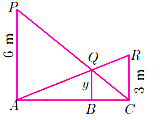
Two vertical poles of heights 6 m and 3 m are erected above a horizontal ground AC. Find the value of y
Answer
In the $\triangle P A C$ and $\triangle B Q C$
$
\begin{aligned}
& \angle PAC =\angle QBC =90^{\circ} \\
& \angle C \text { is common } \\
& \triangle PAC \sim QBC \\
& \frac{ AP }{ BQ }=\frac{ AC }{ BC } \\
& \frac{6}{y}=\frac{ AC }{ BC } \\
& \therefore \frac{ BC }{ AC }=\frac{y}{6} \ldots(1)
\end{aligned}
$

In the $\triangle A C R$ and $\triangle Q B C$
$
\angle ACR =\angle QBC =90^{\circ}
$
$\angle A$ is common
$
\triangle ACR \sim ABQ
$
$
\frac{ RC }{ QB }=\frac{ AC }{ AB }
$

$
\begin{aligned}
& \frac{3}{y}=\frac{ AC }{ AB } \\
& \frac{ AB }{ AC }=\frac{y}{3}
\end{aligned}
$

By adding (1) and (2)
$
\begin{aligned}
& \frac{ BC }{ AC }+\frac{ AB }{ AC }=\frac{y}{6}+\frac{y}{3} \\
& 1=\frac{3 y+6 y}{18} \\
& 9 y =18 \Rightarrow y =\frac{18}{9}=2
\end{aligned}
$

The Value of $y=2 m$
View full question & answer
Question 465 Marks
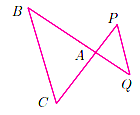
In the adjacent figure, ∆ACB ~ ∆APQ. If BC = 8 cm, PQ = 4 cm, BA = 6.5 cm and AP = 2.8 cm, find CA and AQ
Answer
Given $\triangle ACB \sim \triangle APQ$
$
\begin{aligned}
& \frac{ AC }{ AP }=\frac{ BC }{ PQ }=\frac{ AB }{ AQ } \\
& \frac{ AC }{2.8}=\frac{8}{4}=\frac{6.5}{ AQ }
\end{aligned}
$

Consider $\frac{ AC }{2.8}=\frac{8}{4}$
$
\begin{aligned}
& 4 A C=8 \times 2.8 \\
& A C=\frac{8 \times 2.8}{4}=5.6 cm
\end{aligned}
$

Consider $\frac{8}{4}=\frac{6.5}{ AQ }$
$
\begin{aligned}
& 8 AQ =4 \times 6.5 \\
& AQ =\frac{4 \times 6.5}{8}=3.25 cm
\end{aligned}
$

Length of $A C=5.6 cm$, Length of $A Q=3.25 cm$
View full question & answer
Question 475 Marks
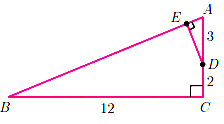
In the adjacent figure, ∆ABC is right angled at C and DE ⊥ AB. Prove that ∆ABC ~ ∆ADE and hence find the lengths of AE and DE
Answer
$\begin{aligned} & \text { In } \triangle ABC \text { and } \triangle ADE \\ & \angle ACB =\angle AED =90^{\circ} \\ & \angle A =\angle A \ldots \text { (common) } \\ & \therefore \triangle ABC \sim \triangle ADE \ldots \text { (By AA similarity) } \\ & \frac{ BC }{ DE }=\frac{ AB }{ AD }=\frac{ AC }{ AE } \\ & \frac{12}{ DE }=\frac{13}{3}=\frac{5}{ AE }\end{aligned}$

$
\begin{aligned}
& \ln \triangle A B C, A B^2=B C^2+A C^2 \\
& =122+52 \\
& =144+25 \\
& =169 \\
& A B=\sqrt{169}=13
\end{aligned}
$

Consider, $\frac{13}{3}=\frac{5}{ AE }$
$
\begin{aligned}
& \therefore A E=\frac{5 \times 3}{13}=\frac{15}{13} \\
& A E=\frac{15}{13} \text { and } D E=\frac{36}{13}
\end{aligned}
$

Consider, $\frac{12}{ DE }=\frac{13}{3}$
$
DE =\frac{12 \times 3}{13}=\frac{36}{13}
$
View full question & answer
Question 485 Marks
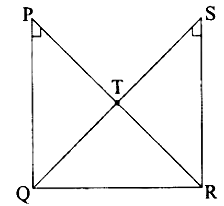
Two triangles QPR and QSR, right angled at P and S respectively are drawn on the same base QR and on the same side of QR. If PR and SQ intersect at T, prove that PT × TR = ST × TQ
Answer
In ∆PQT and ∆STR we have
∠P = ∠S = 90° ...(Given)
∠PTQ = ∠STR ...(Vertically opposite angle)

By AA similarity $\triangle PTQ \sim \triangle STR$ we get
$
\frac{ PT }{ ST }=\frac{ TQ }{ TR }
$
$PT \times TR = ST \times TQ$

Hence it is proved.
View full question & answer
Question 495 Marks
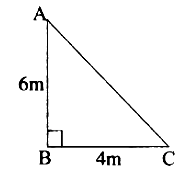
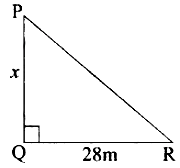
A vertical stick of length 6 m casts a shadow 400 cm long on the ground and at the same time a tower casts a shadow 28 m long. Using similarity, find the height of the tower
Answer
In ∆ABC and ∆PQR,
∠ABC = ∠PQR = 90° ...(Vertical Stick)
∠ACB = ∠PRQ ...(Same time casts shadow)
∆BCA ~ ∆QRP


$
\begin{aligned}
& \frac{ AB }{ PQ }=\frac{ NC }{ QR } \\
& \frac{6}{x}=\frac{4}{28} \\
& 4 x =6 \times 28 \\
& \Rightarrow x =\frac{6 \times 28}{4}=42
\end{aligned}
$

Length of the lamp post $=42 m$
View full question & answer
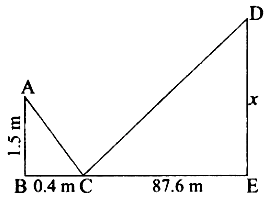
Question 505 Marks
A girl looks the reflection of the top of the lamp post on the mirror which is 6.6 m away from the foot of the lamppost. The girl whose height is 1.25 m is standing 2.5 m away from the mirror. Assuming the mirror is placed on the ground facing the sky and the girl, mirror and the lamppost are in the same line, find the height of the lamp post.
Answer
Let the height of the tower ED be " $x$ " $m$.

In $\triangle A B C$ and $\triangle E D C$.
$
\begin{aligned}
& \angle ABC =\angle CED =90^{\circ} \ldots(\text { vertical Pole }) \\
& \angle ACB =\angle ECD \ldots(\text { Laws of reflection }) \\
& \triangle ABC \sim \triangle DEC \\
& \frac{ AB }{ DE }=\frac{ BC }{ EC } \\
& \frac{1.5}{x}=\frac{0.4}{87.6}
\end{aligned}
$


$
\begin{aligned}
& x=\frac{1.5 \times 87.6}{0.4} \\
& =\frac{1.5 \times 876}{4} \\
& =1.5 \times 219 \\
& =328.5
\end{aligned}
$

The height of the Lamp Post $=328.5 m$
View full question & answer
[5 Mark Questions] - MATHS STD 10 Questions - Vidyadip