MCQ
Decibel is unit of
  • A
    Intensity of light
  • B
    $X-rays$ radiation capacity
  • Sound loudness
  • D
    Energy of radiation

Answer

Correct option: C.
Sound loudness
c
Decibel $(dB)$, unit for expressing the ratio between two physical quantities, usually amounts of acoustic or electric power, or for measuring the relative loudness of sounds

Need a full question paper?

Generate a complete, print-ready paper with questions like this in minutes — across 16+ boards, with answer keys.

Start Generating Free

Similar questions

Two sine waves travel in the same direction in a medium. The amplitude of each wave is $A$ and the phase difference between the two waves is $120^\circ$ . The resultant amplitude will be:
A cubic vessel $($with face horizontal $+$ vertical$)$ contains an ideal gas at $\text{NTP.}$ The vessel is being carried by a rocket which is moving at a speed of $500\ ms^{-1}$ in vertical direction. The pressure of the gas inside the vessel as observed by us on the ground:
A chef, on finding his stove out of order, decides to boil the water for his wife's coffee by shaking it in a thermos flask. Suppose that he uses tap water at $15^{\circ} C$ and that the water falls 30 cm each shake, the chef makes 30 shakes each minute. Neglecting any loss of thermal energy by the flask, how long must he shake the flask until the water reaches $100^{\circ} C$ ?
A body of mass $1 \,\, kg$ is acted upon by a force $\vec F = 2\sin 3\pi t\,\hat i + 3\cos 3\pi t\,\hat j$ find its position at $t = 1 \,\, sec$ if at $t = 0$ it is at rest at origin. 
An athlete completes one round of a circular track of radius $10\, m$ in $40\, sec$. The distance covered by him in $2 \,min$ $20 \,sec$ is ........ $m$
When a train approaches a stationary observer, the apparent frequency of the whistle is $n'$  and when the same train recedes away from the observer, the apparent frequency is $n''.$  Then, the apparent frequency $n$  when the observer moves with the train is
$second^{-1}$ is unit of 
The mass and volume of a body are $4.237g$ and $2.5 \mathrm{~cm}^3$, respectively. The density of the material of the body in correct significant figures is:
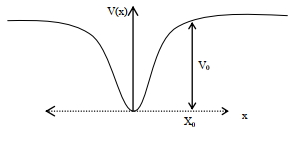
When a particle of mass $m$ moves on the $x$-axis in a potential of the form $V(x)=\mathrm{kx}^2$ it performs simple harmonic motion. The corresponding time period is proportional to $\sqrt{\frac{\mathrm{m}}{\mathrm{k}}}$, as can be seen easily using dimensional analysis. However, the motion of a particle can be periodic even when its potential energy increases on both sides of $\mathrm{x}=0$ in a way different from $\mathrm{kx}^2$ and its total energy is such that the particle does not escape to infinity. Consider a particle of mass $\mathrm{m}$ moving on the $x$-axis. Its potential energy is $V(x)=\alpha x^4(\alpha>0)$ for $|x|$ near the origin and becomes a constant equal to $\mathrm{V}_0$ for $|x| \geq X_0$ (see figure). $Image$

$1.$ If the total energy of the particle is $E$, it will perform periodic motion only if

$(A)$ $E$ $<0$ $(B)$ $E$ $>0$ $(C)$ $\mathrm{V}_0 > \mathrm{E}>0$ $(D)$ $E > V_0$

$2.$ For periodic motion of small amplitude $\mathrm{A}$, the time period $\mathrm{T}$ of this particle is proportional to

$(A)$ $\mathrm{A} \sqrt{\frac{\mathrm{m}}{\alpha}}$ $(B)$ $\frac{1}{\mathrm{~A}} \sqrt{\frac{\mathrm{m}}{\alpha}}$ $(C)$ $\mathrm{A} \sqrt{\frac{\alpha}{\mathrm{m}}}$ $(D)$ $\mathrm{A} \sqrt{\frac{\alpha}{\mathrm{m}}}$

$3.$ The acceleration of this particle for $|\mathrm{x}|>\mathrm{X}_0$ is

$(A)$ proportional to $\mathrm{V}_0$

$(B)$ proportional to $\frac{\mathrm{V}_0}{\mathrm{mX}_0}$

$(C)$ proportional to $\sqrt{\frac{\mathrm{V}_0}{\mathrm{mX}_0}}$

$(D)$ zero

Give the answer qustion $1,2$ and $3.$
At which temperature the speed of sound in hydrogen will be same as that of speed of sound in oxygen at $100\,^oC$  ..... $^oC$