MCQ
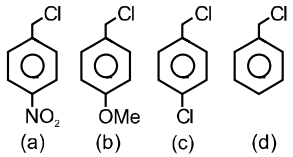
Decreasing order towards $S_N I$ reaction for the following compounds is:
Image
  • A
    a $>$ c $>$ d $>$ b
  • B
    a $>$ b $>$ c $>$ d
  • C
    b $>$ d $>$ c $>$ a
  • D
    d $>$ b $>$ c $>$ a

Need a full question paper?

Generate a complete, print-ready paper with questions like this in minutes — across 16+ boards, with answer keys.

Start Generating Free

Similar questions

$\begin{array}{*{20}{c}}
  {C{O_2}H} \\ 
  {|\,\,\,\,\,\,\,\,\,\,\,\,} \\ 
  {C{O_2}H} 
\end{array} + \begin{array}{*{20}{c}}
  {C{H_2} - \mathop {OH}\limits^{18} } \\ 
  {|\,\,\,\,\,\,\,\,\,\,\,\,\,\,\,\,\,\,\,\,\,\,\,\,\,\,} \\ 
  {C{H_2} - \mathop {OH}\limits^{18} } 
\end{array}\xrightarrow[\Delta ]{{{H^ + }}}$ $(A)$ ;

Product $(A)$ is

Consider the following reaction $\mathrm{A}+\mathrm{B} \rightarrow \mathrm{C}$

The time taken for $A$ to become $1 / 4^{\text {th }}$ of its inital concentration is twice the time taken to become $1 / 2$ of the same. Also, when the change of concentration of $B$ is plotted against time, the resulting graph gives a straight line with a negative slope and a positive intercept on the concentration axis. The overall order of the reaction is . . . . .

How many moles of magnesium phosphate, $Mg_3(PO_4)_2$ will contain $0.25$ mole of oxygen atoms ?
Which of the following has largest size
$CH_3 -CH_2 -CH_2 -Cl$ $\xrightarrow[{Na}]{{Dry\,\,ether}}$ $P$ $\xrightarrow[\Delta ]{{{V_2}{O_5},A{l_2}{O_3}}}$ $Q$, $Q$ is
What is the entropy change (in $J\,{K^{ - 1}}\,mo{l^{ - 1}}$) when one mole of ice is converted into water at ${0\,^o}C$ (The enthalpy change for the conversion of ice to liquid water is $6.0\,\, kJ$ $mo{l^{ - 1}}$ at ${0\,^o}C$)
Which nitrogen trihalides is least basic
With reference to concept of ionisation potential, which one of the following sets are correct
For the reaction

$X_2O_4(g) \to 2XO_2(g)$

$\Delta U = 2.1\, kcal, \Delta S = 20\, cal\,  K^{-1}$ at $300\, K$.

Hence $\Delta G$ is ....$kcal$
જ્યારે $C{H_2} = CH - COOH$ is reduced with $LiAl{H_4}$, the compound obtained will be