Question
Deduce the expression for the electrostatic energy stored in a capacitor of capacitance 'C' and having charge 'Q'.
How will the (i) energy stored and (ii) the electric field inside the capacitor be affected when it is completely filled with a dielectric material of dielectric constant 'K'?
Answer

Potential difference between the plates of capacitor
V = q/C
Work done to add additional charge dq on the capacitor
dw = V x dq= (q/C) x dq
 $\therefore$Total energy stored in the capacitor
$\text{U} = \int\text{dw} = \int_{0}^{Q}\frac{\text{q}}{\text{c}}\text{dq} = \frac{1}{2}\frac{\text{Q}^{2}}{\text{c}}$
When battery is disconnected:
  1. Energy stored will be decreased or energy stored = 1/K times the initial energy.
  2. Electric field would decrease or E’ = E/K.
Alternate Answer
When battery is connected:
  1. Energy stored will increase or become K times the initial energy.
  2. Electric field will not change.

Need a full question paper?

Generate a complete, print-ready paper with questions like this in minutes — across 16+ boards, with answer keys.

Start Generating Free

Similar questions

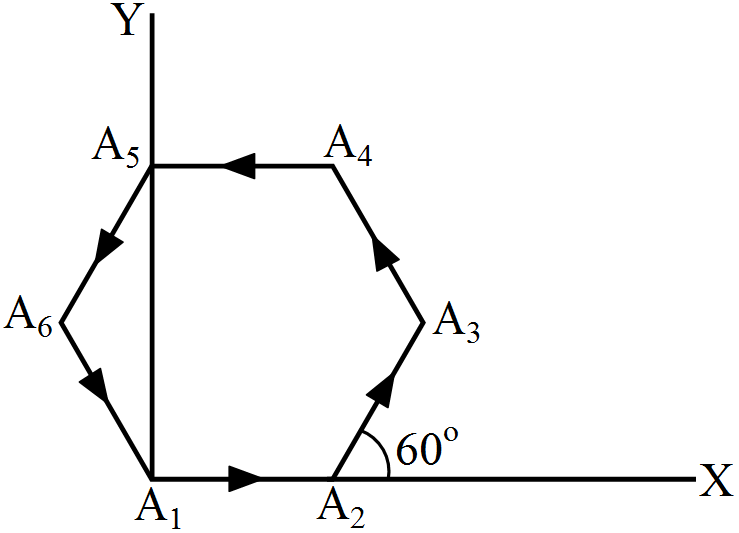
Let $A_{1 }A_{2 }A_3 A_4 A_5 A_6 A_1$ be a regular hexagon. Write the $x-$ components of the vectors represented by the six sides taken in order. Use the fact that the resultant of these six vectors is zero, to prove that$\cos0+\cos\frac{\pi}{3}+\cos\frac{2\pi}{3}+\cos\frac{3\pi}{3}+\cos\frac{4\pi}{3}+\cos\frac{5\pi}{3}=0.$
Use the known cosine values to verify the result.
A number of identical cells, n, each of emf E, internal resistance r connected in series are charged by a d.c. source of emf E', using a resistor R.
  1. Draw the circuit arrangement.
  2. Deduce the expressions for (a) the charging current and (b) the potential difference across the combination of the cells.
Find the magnetic field B due to a semicircular wire of radius 10.0cm carrying a current of 5.0A at its centre of curvature.
The magnifying power of a simple microscope is given by $1+\frac{\text{D}}{\text{f}},$ where D is the least distance for clear vision. For farsighted persons, D is greater than the usual. Does it mean that the magnifying power of a simple microscope is greater for a farsighted person as compared to a normal person? Does it mean that a farsighted person can see an insect more clearly under a microscope than a normal person?
The moon takes about $27.3$ days to revolve round the earth in a nearly circular orbit of radius $3.84 \times 10^5\ km.$ Calculate the mass of the earth from these data.
Obtain the magnification by lens after giving the definition.
Consider a thin target $\left(10^{-2} m\right.$ square, $10^{-3} m$ thickness $)$ of sodium, which produces a photocurrent of $100 \mu A$ when a light of intensity $100 W / m ^2(\lambda=660 nm)$ falls on it. Find the probability that a photoelectron is produced when a photon strikes a sodium atom. $[$Take density of $Na =0.97 \ kg / m ^3 ].$
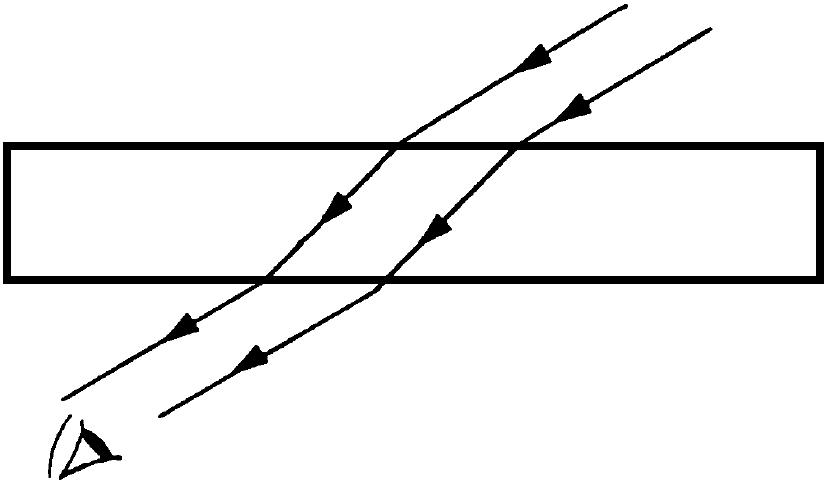
A narrow beam of light passes through a slab obliquely and is then received by an eye. The index of refraction of the material in the slab fluctuates slowly with time. How will it appear to the eye? The twinkling of stars has a similar explanation.
A ball is given a speed v on a rough horizontal surface. The ball travels through a distance l on the surface and stops.
  1. What are the initial and final kinetic energies of the ball?
  2. What is the work done by the kinetic friction?
Is $\text{p}=\frac{\text{E}}{\text{c}}$ valid for electrons?