Question
Is $\text{p}=\frac{\text{E}}{\text{c}}$ valid for electrons?

Answer

From Einstein's mass$-$energy equation, $\text{E}=\text{mc}^2$
$\Rightarrow\text{E}=\frac{\text{m}_0\text{c}^2}{\sqrt{1\frac{\text{v}^2}{\text{c}^2}}}$
Relativistic momentum,
$\text{p}=\text{mv}$
$\Rightarrow\text{p}=\frac{\text{m}_0\text{c}^2}{\sqrt{1\frac{\text{v}^2}{\text{c}^2}}}$
Combining the above equations, we get:
$\text{E}^2=\text{m}_0{}^2\text{c}^ 4+\text{p}^2\text{c}^2$
From the above equation, it is clear that for $\text{p}=\frac{\text{E}}{\text{c}}$ to be valid, the rest mass of the body should be zero.
As electrons do not have zero rest mass, this equation is not valid for electrons.

Need a full question paper?

Generate a complete, print-ready paper with questions like this in minutes — across 16+ boards, with answer keys.
Start Generating Free

Similar questions

A capacitance C charged to a potential difference V is discharged by connecting its plates through a resistance R. Find the heat dissipated in one time constant after the connections are made. Do this by calculating $\int\text{i}^2\text{R}$ dt and also by finding the decrease in the energy stored in the capacitor.
How are em waves produced by oscillating charges? Draw a sketch of linearly polarised em waves propagating in the Z-direction. Indicate the directions of the oscillating electric and magnetic fields.
  1. If one of two identical slits producing interference in Young’s experiment is covered with glass, so that the light intensity passing through it is reduced to 50%, find the ratio of the maximum and minimum intensity of the fringe in the interference pattern.
  2. What kind of fringes do you expect to observe if white light is used instead of monochromatic light?
Obtain the formula for the electric field due to a long thin wire of uniform linear charge density λ without using Gauss’s law.
[Hint: Use Coulomb’s law directly and evaluate the necessary integral.]
  1. How are electromagnetic waves produced? Explain.
  2. A plane electromagnetic wave is travelling through a medium along the +ve z-direction. Depict the electromagnetic wave showing the directions of the oscillating electric and magnetic fields.
Two particles have equal masses of $5.0g$ each and opposite charges of $+4.0 \times 10^{-5} C$ and $-4.0 \times 10^{-5}C.$ They are released from rest with a separation of $1.0m$ between them. Find the speeds of the particles when the separation is reduced to $50\ cm.$
A cubical box of volume $216\ cm^3$ is made up of $0.1\ cm$ thick wood. The inside is heated electrically by a $100W$ heater. It is found that the temperature difference between the inside and the outside surface is $5^\circ C$ in steady state. Assuming that the entire electrical energy spent appears as heat, find the thermal conductivity of the material of the box.
A metallic rod of length ‘l’ is rotated with a frequency v with one end hinged at the centre and the other end at the circumference of a circular metallic ring of radius r, about an axis passing through the centre and perpendicular to the plane of the rinig. A constant uniform magnetic field B parallel to the axis is present every where. Using Lorentz force, explain how emf is induced between the centre and the metallic ring and hence obtain the expression for it.
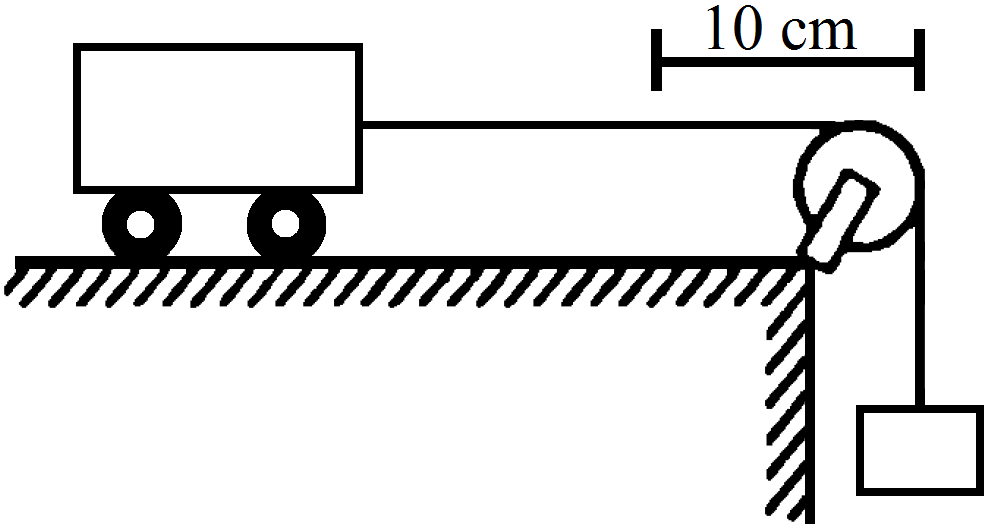
A heavy string is tied at one end to a movable support and to a light thread at the other end as shown in figure, The thread goes over a fixed pulley and supports a weight to produce a tension. The lowest frequency with which the heavy string resonates is 120Hz. If the movable support is pushed to the right by 10cm so that the joint is placed on the pulley, what will be the minimum frequency at which the heavy string can resonate?
Does a nucleus lose mass when it suffers gamma decay?