Question
Define a coordinate bond and give the conditions for its formation.

Answer

The bond formed between two atoms by sharing a pair of electrons, provided entirely by one of the combining atoms but shared by both is called a coordinate bond. It is represented by an arrow starting from the donor atoms and ending in the acceptor atom.
Conditions:
1. One of the two atoms must have at least one lone pair of electrons.
2. Another atom should be short of at least a lone pair of electrons.
The two lone pair of electrons in the oxygen atom of water is used to form coordinate bond with the hydrogen ion which is short of an electron resulting in the formation of the hydronium ion.
$H_2O + H^+ \rightarrow H_3O^+$
Over here the hydrogen ion accepts one lone pair of electrons of the oxygen atom of water molecule leading to the formation of a coordinate covalent bond.

Need a full question paper?

Generate a complete, print-ready paper with questions like this in minutes — across 16+ boards, with answer keys.

Start Generating Free

Similar questions

Salts A, B, C, D, and E undergo reactions (i) to (v) respectively. Identify the anion present in these salts on the basis of these reactions.
(a) When silver nitrate solution is added to a solution of A, a white precipitate, insoluble in dilute nitric acid, is formed.
(b) The addition of dilute hydrochloric acid to B produces a gas which turns lead acetate black paper.
(c) When a freshly prepared solution of ferrous sulphate is added to a solution of C and concentrated sulphuric acid is gently poured from the side of the test-tube, a brown ring is formed.
(d) When dilute sulphuric acid is added to D, a gas is produced which turns acidified potassium dichromate solution from orange to green.
(e) The addition of dilute hydrochloric acid to E produces effervescence. The gas produced turns lime water milky but does not affect acidified potassium dichromate solution.
Complete the table giving (i) ions present (ii) products at electrodes during electrolysis.
SubstanceIons presentProduct at
CathodeAnode
Molten lead bromide
Copper sulphate solution using copper electrodes.
State two chemical properties each with equations for (i) a solution containing H+(aq) ions (ii) a solution containing OH- ions.
Find the percentage of oxygen in magnesium nitrate crystals $[Mg (NO_3) 6H_2O]$.
With the help of equations, give an outline for the manufacture of sulphuric acid by the contact process.
In the Halls process for extraction of aluminium, Sate the location of cathode and anode and explain what occurs at each electrode.
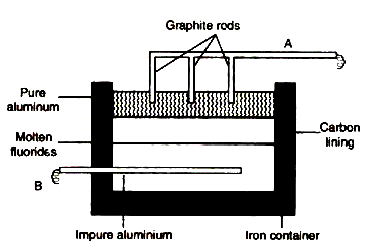
The sketch below illustrates the refin ing of aluminium by Hoopes process

(a) Which of A and B is th e cathode and which one is the anode?
(b) What is the electroly te in the tank?
( c) What material is used for th e cathode?
From the given list :
NaCl, NaOH, $H_2O$ (pure), $NH_4OH$, urea, dil.$H_2SO_4$, glucose, acetic acid, $H_2CO_{3.}$
Select :
a) Substances which will behave as strong electrolytes.
b) Substances which will behave as weak electrolytes.
c) Substances which are non-elctrolytes.
A gas cylinder contain $12 \times 10^{24}$ molecules of oxygen gas
If Avogadro's number is $6 \times 10^{23},$​​​​​​​
calculate :
$(i)$ The mass of oxygen present in the cylinder.
$(ii)$ The volume of oxygen at $\text{STP}$ present in the Cylinder $[O=16]$
The equations given below relate to the manufacture of sodium carbonate $($Molecular weight of $Na_2CO_3 = 106).$
$NaCl + NH_3 + CO_2 + H_2O \rightarrow NaHCO_3 + NH_4Cl$
$2NaHCO_3\rightarrow Na_2CO_3 + H_2O + CO_2$​​​​​​​
What mass of sodium hydrogen carbonate must be heated to give $21.2g$ of sodium carbonate? based on the production of $21.2g$ of sodium carbonate.