Questions

[3 Mark Question Answer]

🎯

Test yourself on this topic

14 questions · timed · auto-graded

Question 13 Marks
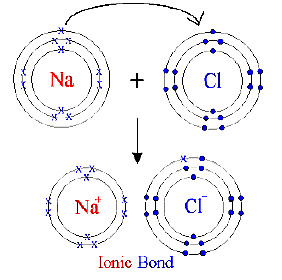
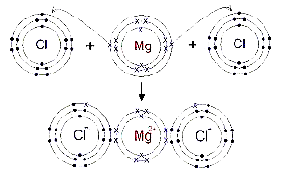
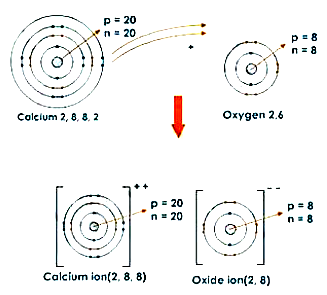
Draw orbit structure and electron dot diagram of $NaCI, MgCl_2$ and $CaO$.
Answer
Orbit structure and electron dot diagram of $NaCl$:
Orbit structure and electron dot diagram of $MgCl2$:
Orbit structure and electron dot diagram of $CaO$:
View full question & answer
Question 23 Marks
Give the characteristic properties of covalent compounds.
Answer
Properties of Covalent Compounds:
1. The covalent compounds exist as gases or liquids or soft solids.
2. The melting and boiling points of covalent compounds are generally low.
3. Covalent compounds are insoluble in water but dissolve in organic solvents.
4. They are non-conductors of electricity in solid, molten or aqueous state.
View full question & answer
Question 33 Marks
Give the characteristic properties of electrovalent compounds.
Answer
Properties of Ionic Compounds:
1. Ionic compounds usually exist in the form of crystalline solids.
2. Ionic compounds have high melting and boiling points.
3. Ionic compounds are generally soluble in water but insoluble in organic solvents.
4. They are good conductors of electricity in the fused or in aqueous solution state.
View full question & answer
Question 43 Marks
A solid is crystalline, has a high melting point and is water soluble. Describe the nature of the solid.
Answer
The crystalline solid is ionic in nature. It has strong electrostatic forces of attraction between its ions, which cannot be separated easily.
Crystalline solids have high melting and boiling points, and a large amount of energy is required to break the strong bonding force between ions.
Water is a polar compound, so it decreases the electrostatic forces of attraction in the crystalline solid, resulting in free ions in the aqueous solution. Hence, the solid dissolves.
View full question & answer
Question 53 Marks
What is the difference between :
Ionic compounds and covalent compounds
Answer
Ionic compounds, made up of ions, are generally crystalline solids with high melting and boiling points.
They are soluble in water and good conductors of electricity in aqueous solution and molten state.
Covalent compounds, made up of molecules, can exist as soft solids or liquids or gases with low melting and boiling points. They are generally insoluble in water and poor conductors of electricity.
View full question & answer
Question 63 Marks
What are the conditions for the formation of an electrovalent bond?
Answer
Conditions for formation of Ionic bond are:
(i) The atom which changes into cation should possess 1, 2 or 3 valency electrons. The other atom which changes into anion should possess 5, 6 or 7 electrons in the valence shell.
(ii) A high difference of electronegativity of the two atoms is necessary for the formation of an Ionic bond.
(iii) There must be an overall decrease in energy i.e., energy must be released. For this an atom should have low value of Ionisation potential and the other atom should have high value of electron affinity.
(iv) Higher the lattice energy, greater will be the case of forming an ionic compound.
View full question & answer
Question 73 Marks
What do you understand by redox reactions? Explain oxidation and reduction in terms of loss or gain of electrons.
Answer
Transfer of electron(s) is involved in the formation of an electrovalent bond. The electropositive atom undergoes oxidation, while the electronegative atom undergoes reduction. This is known as a redox process.
Oxidation: In the electronic concept, oxidation is a process in which an atom or ion loses electron(s).
$Zn → Zn^{2+}+ 2e^-$
Reduction: In the electronic concept, the reduction is a process in which an atom or ion accepts electron(s).
$Cu^{2+} + 2e^-→ Cu$
View full question & answer
Question 83 Marks
Explain the following :
Water is a polar covalent molecule ? 
Answer
This means that in the water molecule, one side is positively charged and the other side is negatively charged.
Explanation:
View full question & answer
Question 93 Marks
Explain the following:
Electrovalent compounds have a high melting point and boiling point while covalent compounds have low melting and boiling points.
Answer
Electrovalent compounds have a strong force of attraction between the oppositely charged ions, so a large amount of energy is required to break the strong bonding force between ions. So, they have high boiling and melting points.
Covalent compounds have weak forces of attraction between the binding molecules, thus less energy is required to break the force of binding. So, they have low boiling and melting points.
View full question & answer
Question 103 Marks
Compare:
chlorine atom and chloride ion, with respect to
(i) atomic structure
(ii) electrical state
(iii) chemical action
(iv) toxicity
Answer
Chlorine atom and chlorine ion
(i) Chlorine atom has 7 electrons in its M shell while Chloride ion has 8 electrons in the same shell.
(ii) Chlorine atom is neutral while chloride ion is negatively charged.
(iii) Chlorine atom is highly reactive while its ion is inert.
iv) Chlorine gas is poisonous while chloride ion is non-poisonous.
View full question & answer
Question 113 Marks
Compare:
sodium atom and sodium ion
(i) atomic structure
(ii) electrical state
(iii) chemical action
(iv) toxicity
Answer
Sodium atom and sodium ion
(i) Sodium atom has one electron in M shell while sodium ion has 8 electrons in L shell.
(ii) Sodium atom is neutral while sodium ion is positively charged.
(iii) Sodium atom is highly reactive while its ion is inert.
(iv) Sodium atom is poisonous while sodium ion is non-poisonous.
View full question & answer
Question 123 Marks
How many electrons are required or released by each atom mentioned in (a) to attain the nearest noble gas configuration ?
Answer
Ca - will donate two electrons
O - will accept two electrons
Cl - will accept one electron, so two Cl atoms will share an electron pair.
C - will accept four electrons by sharing electrons pairs with hydrogen forming covalent bonds.
H - will donate one electron by sharing an electron pair with carbon.
View full question & answer
Question 133 Marks
Complete the following:
  Sodium Phosphorus carbon
Formula of chloride      
Nature of bonding      
Physical state of chloride      
Answer
  Sodium Phosphorus carbon
Formula of chloride NaCl $PCl_5$ $CCl_4$
Nature of bonding Ionic Covalent Covalent
Physical state of chloride Solid Solid Liquid
View full question & answer
Question 143 Marks
Define a coordinate bond and give the conditions for its formation.
Answer
The bond formed between two atoms by sharing a pair of electrons, provided entirely by one of the combining atoms but shared by both is called a coordinate bond. It is represented by an arrow starting from the donor atoms and ending in the acceptor atom.
Conditions:
1. One of the two atoms must have at least one lone pair of electrons.
2. Another atom should be short of at least a lone pair of electrons.
The two lone pair of electrons in the oxygen atom of water is used to form coordinate bond with the hydrogen ion which is short of an electron resulting in the formation of the hydronium ion.
$H_2O + H^+ \rightarrow H_3O^+$
Over here the hydrogen ion accepts one lone pair of electrons of the oxygen atom of water molecule leading to the formation of a coordinate covalent bond.
View full question & answer
[3 Mark Question Answer] - Chemistry STD 10 Questions - Vidyadip