Question
Define a functional group and give the structural formula of the following functional group:
(a) Ketons
(b) Alcohols\
(c) Aldehydes
Answer

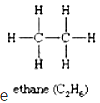
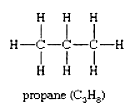
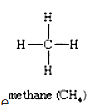
The names and the structural formula of first three members of the homologous series of alkane are:
(i) $CH_4$ Methane

(ii) $C_2H_6$ ​​​​​​​Ethane

(iii) $C_3H_8$​​​​​​​ Propane

Need a full question paper?

Generate a complete, print-ready paper with questions like this in minutes — across 16+ boards, with answer keys.

Start Generating Free

Similar questions

Write equations for the laboratory preparation of :
(i) Methane from sodium ethanoate.
(ii) Ethene from ethanol.
(iii) Ethyne from calcium carbide.
How is an acid prepared from a non metal and a base from a metal? Give equation.
A solution of hydrogen chloride in water is prepared. The following substances are added to separate portions of the solution :
S.NO. Substance added Gas evolved Odour
1 Calcium carbonate _________ _________
2 Magnesium ribbon _________ _________
3 Manganese (IV) oxide with heating _________ _________
4 Sodium sulphide _________ _________
Carbonic acid gives an acid salt but hydrochloric acid does not. Explain.
Zinc metal and aluminium metal are amphoteric in nature. What do you understand by the statement? Support your answer by writing fully balanced chemical equations.
A student performs an experiment to identify an unknown cation present in a solution. The student adds a few drops of sodium hydroxide (NaOH) to the solution and observes the formation of a chalky white precipitate. When an excess of NaOH is added, the precipitate dissolves, forming a clear solution.
(a) Identify the cation.
(b) Write the balanced chemical equation for the reaction that leads to the formation of the white precipitate.
(c) What happens to the white precipitate when an excess of NH4OH is added?
Write observations: Ammonia gas is passed over heated copper (ll) oxide.
Write the physical properties of ethene.
What is the formula for liquid ammonia? Account for the basic nature of this compound.
The electron affinity of an element A is less than that of element B.
(i) How is the electronegativity of A likely to compare with that of B?
(ii) How is the oxidising power of A likely to compare with that of B?
(iii) What would be the position of A with respect to B?