Question
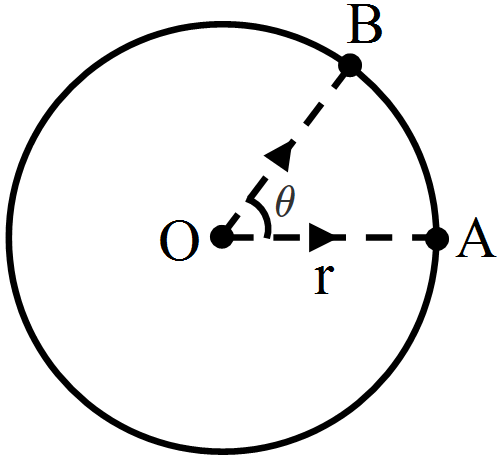
Define a uniform circular motion. For uniform circular motion, prove that:
Linear velocity $\text{v}=\text{r}\omega.$
Answer

If the speed of the particle in circular path remains constant, the motion is uniform circular motion. We know, the arc length x covered with an angular displacement $\theta$ is $\text{x}=\text{r}\theta.$

Differentiating,

$\frac{\text{dx}}{\text{dt}}=\text{r}\frac{\text{d}\theta}{\text{dt}}$

$\because$ r is constant,

$\therefore\ \text{v}=\text{r}\omega.$

Need a full question paper?

Generate a complete, print-ready paper with questions like this in minutes — across 16+ boards, with answer keys.
Start Generating Free

Similar questions

The photograph of a house occupies an area of 1.75cm2 on a 35mm slide. The slide is projected on to a screen, and the area of the house on the screen is 1.55m2. What is the linear magnification of the projector-screen arrangement.
Figure shows a cart. Complete the table shown.
It is a common observation that rain clouds can be at about a kilometre altitude above the ground.
Estimate the order of magnitude force on umbrella. Typical lateral separation between two rain drops is 5cm. (Assume that umbrella is circular and has a diameter of 1m and cloth is not pierced through !!)
Taking the moon's orbit around earth to be r and mass of earth 81 times the mass of the moon. Find the position of the point from the earth, where the net gravitational field is zero.
A flask contains argon and chlorine in the ratio of $2: 1$ by mass. The temperature of the mixture is $27 C$. Obtain the ratio of (i) average kinetic energy per molecule, and (ii) root mean square speed $V_{\text {rms }}$ of the molecules of the two gases. Atomic mass of argon $=39.9 u$; Molecular mass of chlorine $=70.9 u$.
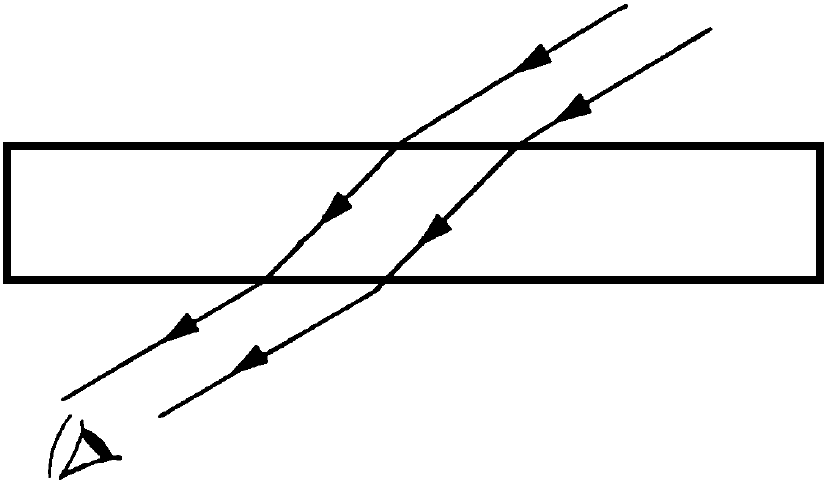
A narrow beam of light passes through a slab obliquely and is then received by an eye. The index of refraction of the material in the slab fluctuates slowly with time. How will it appear to the eye? The twinkling of stars has a similar explanation.

Considering a nearly circular orbit, prove that the square of time period of a planet is proportional to the cube of its radius.
An engine is attached to a wagon through a shock absorber of length 1.5m. The system with a total mass of 50,000kg is moving with a speed of 36km h-1 when the brakes are applied to bring it to rest. In the process of the system being brought to rest, the spring of the shock absorber gets compressed by 1.0m. If 90% of energy of the wagon is lost due to friction, calculate the spring constant.
Two equal and opposite forces act on a rigid body. Under what conditions will the body (i) rotate (ii) not rotate?
A woman pushes a trunk on a railway platform which has a rough surface. She applies a force of 100 N over a distance of 10 m. Thereafter, she gets progressively tired and her applied force reduces linearly with distance to 50 N. The total distance through which the trunk has been moved is 20 m. Plot the force applied by the woman and the frictional force, which is 50 N versus displacement. Calculate the work done by the two forces over 20 m.