Question
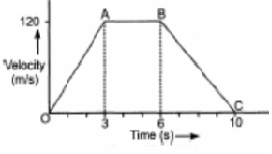
Define acceleration and state its SI unit. For motion along a straight line, when do we consider the acceleration to be:
  1. Positive.
  2. Negative? Give an example of a body in uniform acceleration.
Answer

  1. Acceleration is the rate of the measure of the change in the velocity of the moving object per unit time. Si unit is ms-2 = m/s2
  1. If the object moving along the line is positive. same direction.
  2. If the object is moving in the opposite way it is negative. opposite direction.
  1. The motion of a freely moving body is the example of uniform acceleration.

Need a full question paper?

Generate a complete, print-ready paper with questions like this in minutes — across 16+ boards, with answer keys.

Start Generating Free

Similar questions

A $60\ g$ bullet fired from a $5\ kg$ gun leaves with a speed of $500\ m/s.$ Find the speed $($velocity$)$ with which the gun recoils $($jerks backwards$).$
The velocity-time graph of an object of mass m = 50 g is shown in the figure. Observe the graph carefully and answer the following questions.
i. Calculate the force on the object in time interval 0 to 35.
ii. Calculate the force on the object in the time interval 6 to 10 s.
iii. Is there any time interval in which no force acts on the object? Justify your answer
Image
$i.$ Which characteristic of sound helps to identify your friend by his voice while sitting with others in a dark room?
$ii.$ State the relationship between frequency and time period of a wave. The wavelength of vibrations produced on the surface of the water is $4 \ cm.$ If the wave velocity is $20\ m/s$ find the frequency and Time period.
A gold sample contains $90\%$ of gold and the rest copper. How many atoms of gold are present in one gram of this sample of gold?
Give three functions of blood.
Why whales are not grouped in the fishes?
List one function for each of following: osteoblast, chondroblast, goblet cell, neuron, muscle cell.
Fill in the blanks: $A, B,$ and $C$.
A $8000kg$ engine pulls a train of $5$ wagons, each of $2000kg$, along a horizontal track. If the engine exerts a force of $40000N$ and the track offers a friction force of $5000N$, then calculate:
  1. The net accelerating force and
  2. The acceleration of the train.
Why burns caused by the steam are much more severe than boiling water?