Question 13 Marks
Two stones are thrown vertically upwards simultaneously with their initial velocities $u_1$ and $u_2$ respectively. Prove that the heights reached by them would be in the ratio of $\text{u}_1^2:\text{u}_2^1$ (Assume upward acceleration is –g and downward acceleration to be +g).
AnswerWe know for upward motion, $\text{v}^2=\text{u}^2-2\text{gh}$ or $\text{h}=\frac{\text{u}^2-\text{v}^2}{2\text{g}}$ But at highest point $\text{v}=0$ Therefore, $\text{h}=\frac{\text{u}^2}{\text{g}}$
For first ball, $\text{h}_1=\text{u}_1\frac{2}{2\text{g}}$ And for second ball, $\text{h}_2=\frac{\text{u}^2_2}{2\text{g}}$
Thus, $\frac{\text{h}_1}{\text{h}_2}=\frac{\text{u}_1^2/2\text{g}}{\text{u}_2^2/2\text{g}}=\frac{\text{u}_1^1}{\text{u}_2^2}$ or $\text{h}_1:\text{h}_2=\text{u}_1^2:\text{u}_2^2$
View full question & answer→Question 23 Marks
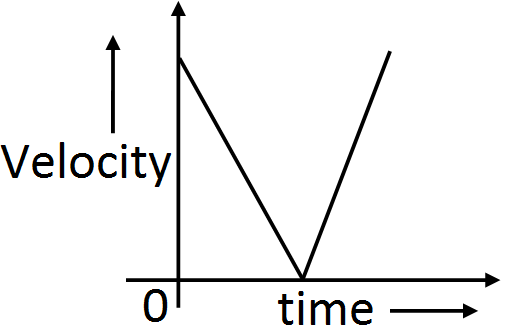
Draw a velocity versus time graph of a stone thrown vertically upwards and then coming downwards after attaining the maximum height.
AnswerWhen a stone is thrown upward, its velocity is at maximum. The velocity begins to drops as the stone attains height. Once the stone attains the maximum height, velocity becomes zero. After that, stone begins to fall down. At this points, velocity beings to rise. Velocity is at its maximum when the stone hits the ground.
View full question & answer→Question 33 Marks
Abdul, while driving to school, computes the average speed for his trip to be $20km\ h^{−1}$. On his return trip along the same route, there is less traffic and the average speed is $30km\ h^{−1}$. What is the average speed for Abdul’s trip?
AnswerCase I: While driving to school Average speed of Abdul’s trip $= 20km/ h$
Average speed = $\frac{\text{Total distance}}{\text{Total time taken}}$
Total distance = Distance travelled to reach school $= d$
Let total time taken = $t_1$$\therefore20=\frac{\text{d}}{\text{t}_1}$
$\text{t}_1=\frac{\text{d}}{20}\ ....(1)$
Case II: While returning from school Total distance = Distance travelled while returning from school $= d$
Now, total time taken = $t_2$$30=\frac{\text{d}}{\text{t}_2}$
$\text{t}_2=\frac{\text{d}}{30}\ ....(2)$
Average speed for Abdul's trip $=\frac{\text{Total distance coverd in the trip}}{\text{Total time taken}}$ Where, Total distance covered in the trip $= d + d = 2d$
Total time taken, $t =$
Time taken to go to school + Time taken to return to school = $t_1 + t_2$
$\therefore$ Average speed $=\frac{2\text{d}}{\text{t}_1+\text{t}_2}$
From equations $(1)$ and $(2),$ Average speed $=\frac{2\text{d}}{\frac{\text{d}}{20}+\frac{\text{d}}{30}}=\frac{2}{\frac{3+2}{60}}$ Average speed $=\frac{120}{5}=24\text{m/s}$
Hence, the average speed for Abdul's trip is $24m/ s.$
View full question & answer→Question 43 Marks
A motorcyclist drives from place $A$ to $B$ with a uniform speed of $30km h^{-1}$ and returns from place $B$ to $A$ with a uniform speed of $20km h^{-1}$. Find his average speed.
AnswerSpeed from $A$ to $B = 30km/h.$
Let the distance from $A$ and $B$ be $D.$
Time taken to travel from $A$ to $B$, $\text{T}_1=\frac{\text{Distance travelled}}{\text{Speed}}$
$\text{T}_1=\frac{\text{D}}{30}$
Speed taken $B$ to $A = 20km/h$
Time taken to travel from $B$ to $A,$ $\text{T}_2=\frac{\text{Distance travelled}}{\text{Speed}}=\frac{\text{D}}{20}$
Total time taken, $T = T_1 + T_2$_ $=\frac{\text{D}}{30}+\frac{\text{D}}{20}=\frac{\text{D}}{12}$
Total distance from $A$ to $B$ and from $B$ to $A = 2D$
Average speed $=\frac{\text{Total distance travelled}}{\text{Total time taken}}=\frac{2\text{D}}{\frac{\text{D}}{12}}=24\text{km/h}$
View full question & answer→Question 53 Marks
What is meant by the term ‘acceleration’ State the $SI$ unit of acceleration.
AnswerAcceleration of a body is defined as the rate of change of its velocity with respect to time. It is a vector quantity. The $S.I$. unit of acceleration is $\left(\mathrm{m} / \mathrm{s}^2\right)$.
View full question & answer→Question 63 Marks
A body travels a distance of $3\ km$ towards East, then $4\ km$ towards North and finally $9\ km$ towards East.
- What is the total distance travelled?
- What is the resultant displacement?
Answer
- Total distance travelled $= 3 + 4 + 9 = 16\ km$
- The body travels a total distance of $12\ km$ in east direction i.e. towards $x-$axis. And it travels a distance of $4\ km$ in North direction, i.e. towards $y-$axis.
Hence, resultant displacement is:
$=\sqrt{12^2+4^2}$
$=\sqrt{144+16}=\sqrt{160}=12.6\text{km}$ View full question & answer→Question 73 Marks
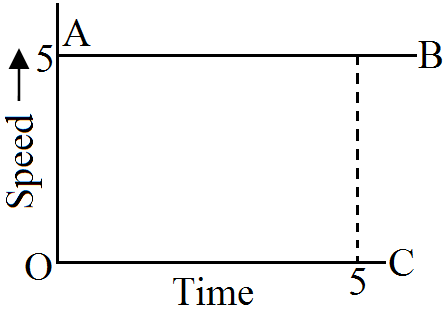
A body is moving uniformly in a straight line with a velocity of $5m/s.$ Find graphically the distance covered by it in $5$ seconds.
AnswerWe have to calculate the distance travelled by the moving body whose speed time graph is given to us. Distance travelled = Area of rectangle $OABC$ So, distance travelled, $= (OA) \times (OC)= (5) \times (5)m = 25m$
View full question & answer→Question 83 Marks
A motorboat starting from rest on a lake accelerates in a straight line at a constant rate of $3.0m/ s^{−2}$ for $8.0s$. How far does the boat travel during this time?
AnswerInitial velocity, $u = 0$ (since the motor boat is initially at rest)
Acceleration of the motorboat, $a = 3m/ s^2$
Time taken, $t = 8s$
According to the second equation of motion: $\text{s}=\text{ut}+\frac{1}{2}\text{at}^2$
Distance covered by the motorboat, s $\text{s}=0+\frac{1}{2}3\times(8)^2=96\text{m}$
Hence, the boat travels a distance of $96m$.
View full question & answer→Question 93 Marks
A bus is moving with a speed $72km/h$ can be stopped by brakes after at least $10m$. What will be the minimum stopping distance, if the same bus is moving at a speed of $144km/h$?
AnswerWe have $v^2= u^2+ 2$ as Where, v is final velocity which is when the vehicle has stopped hence $v = 0\ m/s$ u is initial velocity which is $72\ km/h$ or $20m/s$ s is $10\ m$ Therefore, the acceleration on the bus here is $-20m/s$ which means it’s slowing down at that rate. If we assume that the breaking force is constant and the mass of the bus is unchanged, this is the maximum deceleration the bus can produce, regardless of speed. We look back at the equation of motion again, $v^2= u^2+ 2$ as where, $v = 0m/s u = 144km/h$ or $40m/s a = -20m/s$ Hence s which is the braking distance is 40m.
View full question & answer→Question 103 Marks
If a sprinter runs a distance of $100$ metres in $9.83$ seconds, calculate his average speed in $km/h.$
AnswerTotal distance travelled $= 100m$
Total time taken $= 9.83$
sec Average speed $= \frac{\text{Total distance travelled}}{\text{ Total time taken}}$$=\frac{100}{9.83} =10.172\text{m/s}$
Averge speed in km/h: $10.172\times\Big(\frac{3600}{1000}\Big)=36.62\text{km/h}$
View full question & answer→Question 113 Marks
A cyclist is moving with a speed of $14m/s$. He starts accelerating with a rate of $6m/s^2$ and acquired the speed of $18m/s$. Calculate, what distance did he move in acquiring that speed?
Answer$V^2 = u^2+ 2as\ V$ = final velocity $U =$ initial velocity $2 = 2 A$ = acceleration $S =$
distance (the missing value)
Substitute in values: $18^2 = 14^2 + 2 \times 6 \times s$
Calculate: $324 = 196 + 12s$
Rearrange:$12\text{s}=324-196$
$\text{S}=\frac{128}{12}$
$\text{S}=10.66\text{m}$
View full question & answer→Question 123 Marks
A ball is gently dropped from a height of $20m$. If its velocity increases uniformly at the rate of $10m/ s^{-2}$, with what velocity will it strike the ground? After what time will it strike the ground?
AnswerDistance covered by the ball, $s=20 \mathrm{~m}$
Acceleration, $a=10 \mathrm{~m} / \mathrm{s}^2$ Initially, velocity, $\mathrm{u}=0$ (since the ball was initially at rest)
Final velocity of the ball with which it strikes the ground, $v$
According to the third equation of motion: $v^2=u^2+$ 2 as $v^2=0+2(10)(20) v=20 \mathrm{~m} / \mathrm{s}$
According to the first equation of motion: $v=u+$ at
Where, Time, $t$ taken by the ball to strike the ground is, $20=0+10(\mathrm{t}) \mathrm{t}=2 \mathrm{~s}$
Hence, the ball strikes the ground after $2$ s with a velocity of $20 \mathrm{~m} / \mathrm{s}$.
View full question & answer→Question 133 Marks
Write the formula to calculate the speed of a body moving along a circular path. Give the meaning of each symbol which occurs in it.
AnswerThe speed of a body moving along a circular path is given by the formula: $\text{v}=\frac{2\pi\text{r}}{\text{t}}$ where, $v =$ speed$\pi=3.14$ ( it is a constant)
$r =$ radius of circular path $t =$ time taken for one round of circular path.
View full question & answer→Question 143 Marks
Write three equations of uniformly accelerated motion. Also, state the symbols used
AnswerUniform acceleration: The motion is said to be uniformly accelerated motion if acceleration is constant. The equations of uniform accelerated motion are given by:$\text{v}=\text{u}+\text{at}$
$\text{S}=\text{ut}+\frac{1}{2\text{at}^{2}}$
$\text{v}^{2}+\text{u}^{2}=2\text{as}$
Where: $U$ is initial velocity $V$ is final velocity $S$ is displacement a is uniform acceleration t is time.
View full question & answer→Question 153 Marks
What is the difference between speed and velocity?
Answer
- Speed is a scalar quantity, whereas velocity is a vector quantity.
- Speed of a body is the distance travelled by it per unit time, whereas the velocity of a body is the distance travelled by it per unit time in a given direction.
- Speed is always positive, while velocity can be both positive and negative, depending upon the direction.
View full question & answer→Question 163 Marks
An athlete completes one round of a circular track of diameter $200\ m$ in $40s$. What will be the distance covered and the displacement at the end of $2$ minutes $20s?$
AnswerDiameter of circular track $(D) = 200m$
+Radius of circular track $(r) =\frac{200}{2} = 100\text{m}$
Time taken by the athlete for one round $(t) = 40s$
Distance covered by athlete in one round $(s) = 2\pi\text{r}= 2 × \Big(\frac{22}{7}\Big) × 100$
Speed of the athlete $(v) =$ Distance/Time$=\frac{(2 × 2200)}{(7 × 40)}$
$=\frac{4400}{7} × 40$
Therefore, Distance covered in $140 s =$ Speed $(s) \times $ Time(t)$= \frac{4400}{(7 × 40)}×(2×60+20)$
$= \frac{4400}{( 7 × 40) }× 140$
$= 4400 × \frac{140}{7} \times 40$
$= 2200\text{m}$
Number of round in $40s =1$ round Number of round in $140s =\frac{140}{40}=3\frac{1}{2}$
After taking start from position $X$,the athlete will be at postion $Y$ after $3\frac{1}{2}$ rounds as shown in figure. 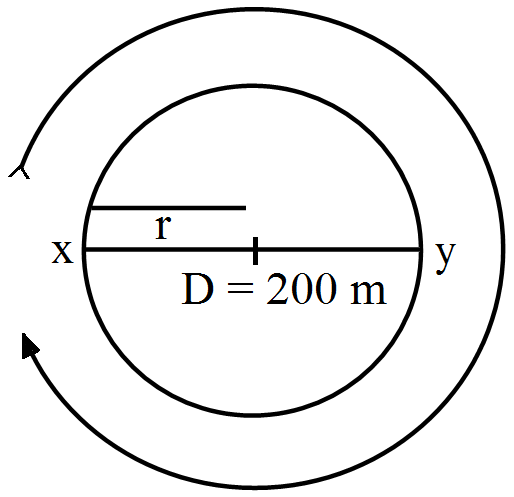
Hence, Displacement of the athlete with respect to initial position at, $x = xy =$ Diameter of circular track $= 200m.$ View full question & answer→Question 173 Marks
Given below is the velocity-time graph for the motion of the car. What does the nature of the graph show? Also, find the acceleration of the car.
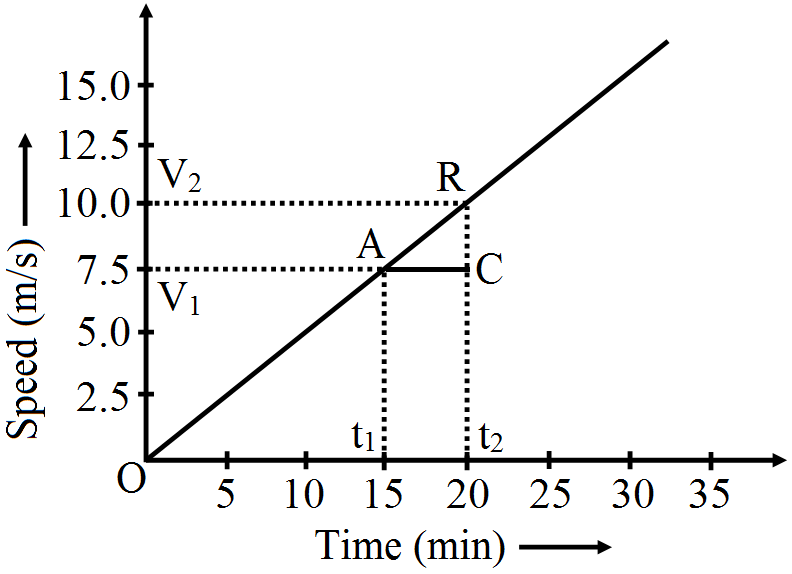
AnswerThe nature of the graph shows that velocity changes by equal amounts in equal intervals of time. For
a uniformly accelerated motion, velocity-time graph is always a straight line.
As we know, acceleration is equal to the slope of the graph.$\text{a}=\frac{\text{AB}}{\text{AC}}$
$\text{a}=\frac{\text{v}_{2}-\text{v}_{2}}{\text{t}_{2}-\text{t}_{1}}$
$\therefore\ \text{a}=\frac{(10.0-7.5)\text{ms}^{-1}}{(20-15)\text{s}}$
$\text{a}=\frac{25\text{ms}^{-1}}{5\text{s}}$
$\text{a}=0.5\text{ms}^{-2}$
View full question & answer→Question 183 Marks
Derive the formula: $\text{s}=\text{ut}+\frac{1}{2}\text{at}^2,$ where the symbols have usual meanings.
AnswerSuppose a body has an initial velocity '$u'$ and a uniform acceleration'$ a'$ for time '$t'$ so that its final velocity becomes '$v'$. Let the distance travelled by the body in this time be '$s'$. The distance travelled by a moving body in time '$t'$ can be found out by considering its average velocity. Since the initial velocity of the body is '$u'$ and its final velocity is '$v'$, the average velocity is given by.
View full question & answer→Question 193 Marks
A car starts from rest and moves along the x-axis with constant acceleration $5m s^{–2}$ for $8$ seconds. If it then continues with constant velocity, what distance will the car cover in $12$ seconds since it started from the rest?
AnswerThe distance travelled in first 8s, $\text{x}_1=0+\frac{1}{2}(5)(8)^2=160\text{m}.$
At this point the velocity $\text{v}=\text{u}+\text{at}=0+(5\times8)=40\text{m s}^{-1}$
Therefore, the distance covered in last four seconds, $\text{x}_2=(40\times4)\text{m}=160\text{m}$
Thus, the total distance $\text{x}=\text{x}_1+\text{x}_2=(160+160)\text{m}=320\text{m}$
View full question & answer→Question 203 Marks
A train travelling at $20 ms^{-1}$ accelerates at $0.5 ms^{-2}$ for $30 s$ . How far will it travel in this time?
AnswerInitial velocity, $u =20 m / s$ Time, $t =30 s$ Acceleration, $a =0.5 m / s ^2$
Distance travelled is:s $= ut +\frac{1}{2} at ^2$
$\text{s}=20\times30+\frac{1}{2}\times0.5\times30\times30$
$\text{s}=600+225=825\text{m}$
View full question & answer→Question 213 Marks
Find the total displacement of the body from the following graph:
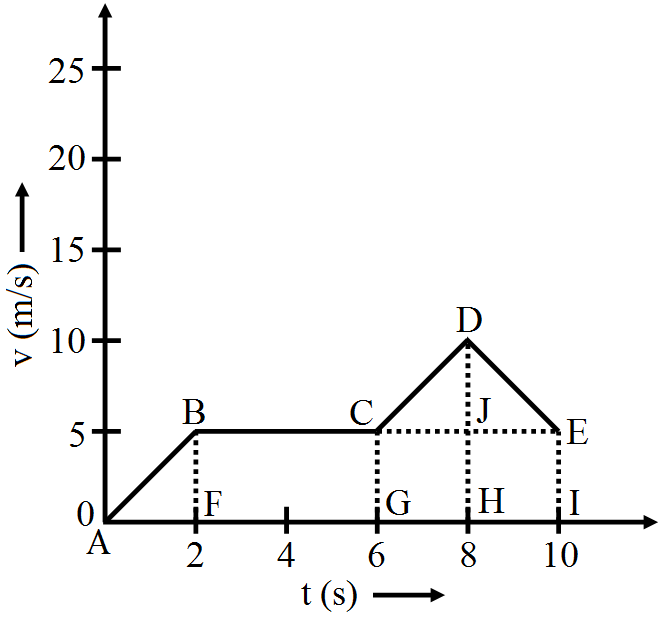
AnswerThe given graph is velocity time graph so its area will give displacement of object. from $0$ to $2,$
displacement $=\frac{1}2{}\times2\times5 = 5m$ from $2$ to $6s,$
displacement $= 4 × 5 = 20m$ from $6$ to $8s$,
displacement $=2\times5+\frac{1}{2}\times2\times5 = 15m$
Since area from 8 to $10s$ is same
so, displacement $= 15m$
Total displacement $= 5 + 20 + 15 + 15 = 55m$
View full question & answer→Question 223 Marks
A cyclist is travelling at $15ms^{-1}. $She applies brakes so that she does not collide with a wall $18\ m$ away. What deceleration must she have?
AnswerInitial velocity, $u =15 m / s$ Final velocity, $v=0 m / s$ Distance, $s =18 m$ Acceleration, $a=$ ?
using relation, $\text{v}^2-\text{u}^2=2\text{as}$
$0^2-(15)^2=2\text{a}\times18$
$-225=36\text{a}$
$\text{a}=\frac{-225}{36}=-6.25\text{m/s}^2$
So, deceleration is $6.25m/s^2.$
View full question & answer→Question 233 Marks
Given alongside is the velocity-tine graph for a moving body:
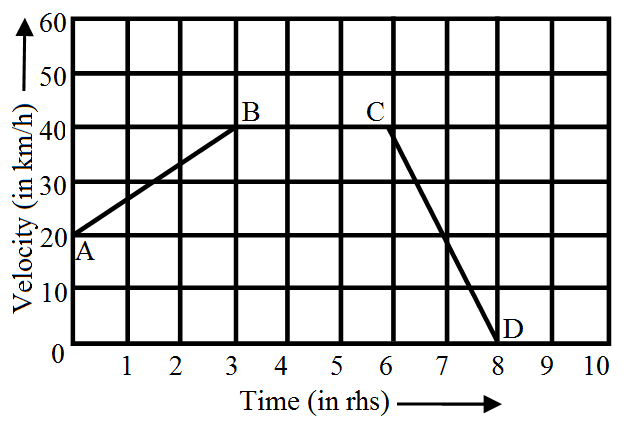
Find:
- Velocity of the body at point $C.$
- Acceleration acting on the body between $A$ and $B.$
- Acceleration acting on the body between $B$ and $C.$
Answer
- BC represents uniform velocity. So velocity of the body at point $C$ is $40\ km.$
- Acceleration = Slope of line $AB$
$=\frac{(40-20)}{3-0}\text{km/hr}^2$
$=6.66\text{km/hr}^2$
- $BC$ represents uniform velocity, so, acceleration acting on the body is zero.
View full question & answer→Question 243 Marks
An ant travels a distance of 8cm from $P$ to $Q$ and then moves a distance of 6cm at right angles to $PQ$. Find its resultant displacement.
AnswerWe have to find the resultant displacement from the given diagram:
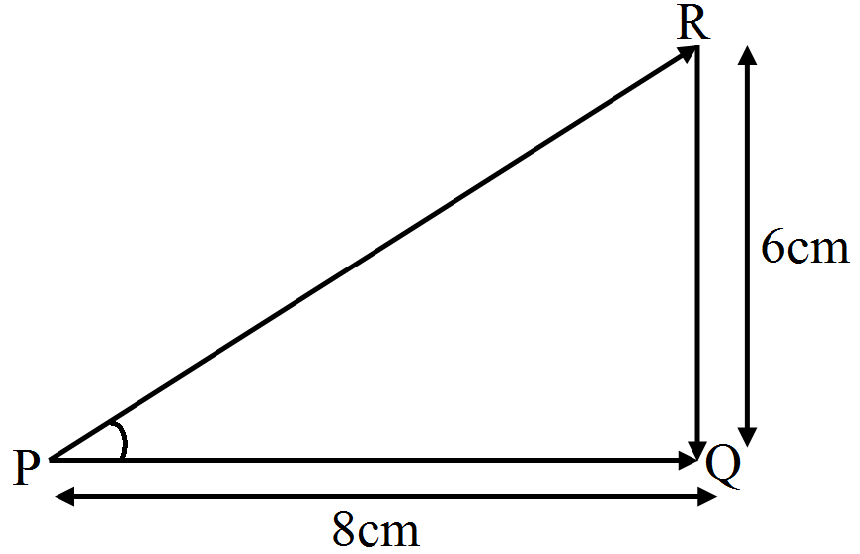
we have: $PQ = 8cm$ and $QR = 6cm$ Resultant displacement:$\text{PR}=\sqrt{\text{PQ}^2+\text{QR}^2}$
$=\sqrt{64+36}$
$=\sqrt{100}$
$=10\text{cm}$
The direction of this displacement is from $P$ to $R$. f If $\theta$ is the angle made by $PR$ with $PQ$ then,$\tan\theta=\frac{\text{RQ}}{\text{PQ}}$
$\Rightarrow\tan\theta^{-1}0.5625$
$\Rightarrow\theta=29.36^\circ$
This is the angle made by the resultant with $PQ.$ View full question & answer→Question 253 Marks
Derive the formula: $v = u +$ at, where the symbols have usual meanings.
AnswerConsider a body having initial velocity $'u'$. Suppose it is subjected to a uniform acceleration $'a'$ so that after time $'t'$ its final velocity becomes $'v'$.
Now, from the definition of acceleration we know that: Acceleration $=\frac{\text{Change in velocity}}{\text{Time taken}}$ Or Acceleration $=\frac{\text{Final velocity-Initial velocity}}{\text{time taken}}$
So, $\text{a}=\frac{\text{v-u}}{\text{t}}$$\text{at}=\text{v-u}$
and, $\text{v}=\text{u+at}$
Where, $v =$ final velocity of the body
$u =$ intial velocity of the body
$a =$ acceleration and
$t =$ time taken
View full question & answer→Question 263 Marks
Describe the motion of a body which is accelerating at a constant rate of $10ms^{-2}.$ If the body starts from rest, how much distance will it cover in $2s?$
AnswerThe velocity of this body is increasing at a rate of $’10$ metres per second’ every second. Initial velocity,
$u = 0m/s$ Time,$ t = 2s$
Acceleration, $a = 10m/s^2$
Using, $\text{s}=\text{ut}+\frac{1}{2}\text{at}^2$
$=0\times2+\frac{1}{2}\times10\times2\times2$
$=0+20=20\text{m}$
View full question & answer→Question 273 Marks
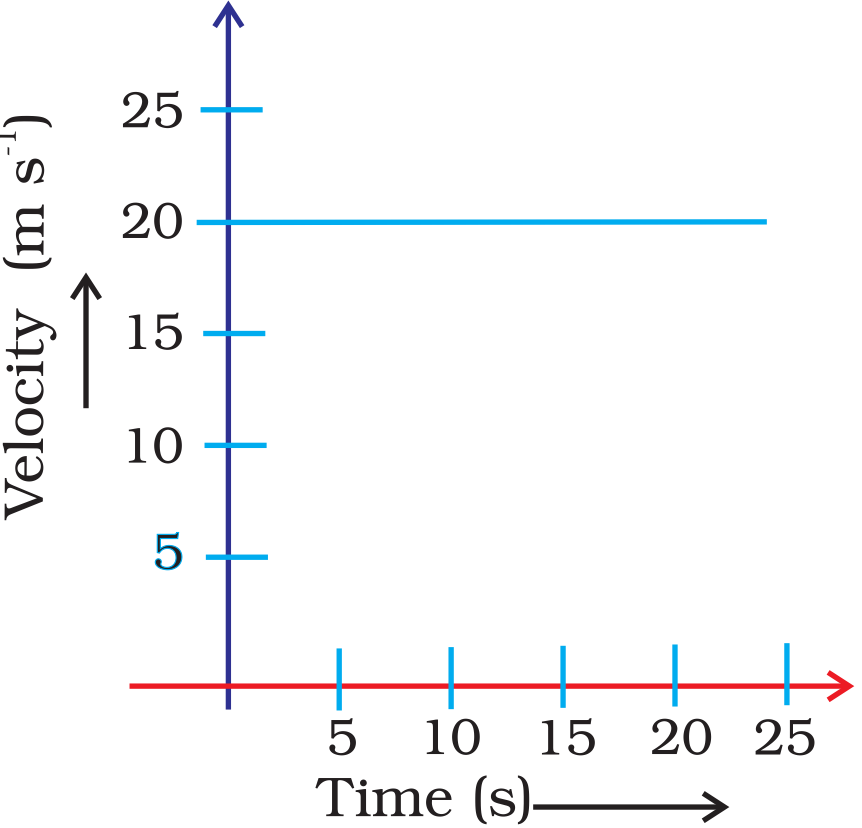
The velocity-time graph shows the motion of a cyclist. Find
- Its acceleration
- Its velocity and
- The distance covered by the cyclist in $15$ seconds.
Answer
- From the graph, it is clear that velocity is not changing with time i.e., acceleration is zero. $(\text{As}\ \text{a}=\frac{\text{dv}}{\text{dt}}+\text{dv}=0)$
- Again from the graph, we can see that there is no change in the velocity with time, so velocity after $15$s will remain same as $20ms^{_1}$
- Distance covered in $15s =$ velocity $\times $ Time $= 20 \times 15 = 300m$ $\because\text{Time}=\frac{\text{Distence}}{\text{Speed}}$
View full question & answer→Question 283 Marks
An object starting from rest travels $20\ m$ in the first $2s$ and $160\ m$ in next $4s$. What will be the velocity after $7s$ from the start?
AnswerAccording to question find the velocity Given, object starts from rest, $u = 0, t = 2s$ and $s = 20m$ From second equation of motion,$\text{s}=\text{ut}+\frac{1}{2}\text{at}^{2}$
On putting $u = 0$ in above equation$20=0\times2+\frac{1}{2}\times\text{a}(2)^{2}$
$=0+\frac{1}{2}\times\text{a}\times4$
$20=2\text{a}$
$\Rightarrow\text{a}\frac{20}{2}$
$\Rightarrow\text{a}=10\text{m/s}^{2}$
Now, from first equation of motion, velocity after $7s$ from the start $v = u +$ at $= 0 + 10 \times 7 = m/s.$
View full question & answer→Question 293 Marks
Find the initial velocity of a car which is stopped in $10$ seconds by applying brakes. The retardation due to brakes is $2.5m/s^2$.
AnswerInitial velocity, $u = ?$ Final velocity, $v = 0m/s$ (car is stopped) Retardation, $a = -2.5m/s^2$ Time, $t = 10s v = u +$ at $0 = u + (-2.5) \times 10 u = 25m/s$
View full question & answer→Question 303 Marks
The speed-time graph of an ascending passenger lift is given alongside.
What is the acceleration of the lift:
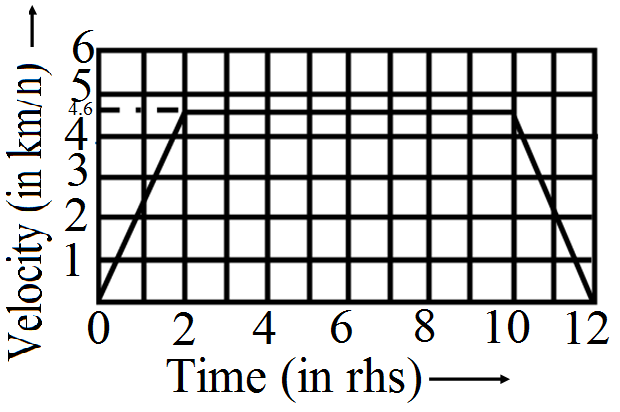
- During the first two seconds?
- Detween second and tenth second?
- During the last two seconds?
Answer
- We have to find the acceleration from the given graph.
Acceleration = slope of line $AB$
$=\frac{(4.6-0)}{(2-0)}\text{m/s}^2$
$=2.3\text{m/s}^2$
- Between second and tenth second, it represents uniform speed, so, acceleration acting on the lift is zero.
- During the last two seconds, it represents retardation of the lift, so its acceleration is $(-2.3m/s^2)$.
View full question & answer→Question 313 Marks
A cheetah starts from rest, and accelerates at $2m/s^2$ for $10$ seconds. Calculate: The final velocity.
AnswerIntial velocity, $\mathrm{u}=0 \mathrm{~m} / \mathrm{s}$
Final velocity, $\mathrm{v}= ?$
Acceleration, $a=2 \mathrm{~m} / \mathrm{s}^2$
Time, $\mathrm{t}=10 \mathrm{~s}$
Using, $\mathrm{v}=\mathrm{u}+$ at $\mathrm{v}=0+2 \times 10=$
$20 \mathrm{~m} / \mathrm{s}$.
View full question & answer→Question 323 Marks
Define acceleration and state its $SI$ unit. For motion along a straight line, when do we consider the acceleration to be:
- Positive.
- Negative? Give an example of a body in uniform acceleration.
Answer
- Acceleration is the rate of the measure of the change in the velocity of the moving object per unit time. Si unit is $ms^{-2} = m/s^2$
- If the object moving along the line is positive. same direction.
- If the object is moving in the opposite way it is negative. opposite direction.
- The motion of a freely moving body is the example of uniform acceleration.
View full question & answer→Question 333 Marks
A driver of a car travelling at $52km/ h^{−1}$ applies the brakes and accelerates uniformly in the opposite direction. The car stops in $5s$. Another driver going at $3km/ h^{−1}$ in another car applies his brakes slowly and stops in $10s$. On the same graph paper, plot the speed versus time graphs for the two cars. Which of the two cars travelled farther after the brakes were applied?
AnswerAs given in the figure below $PR$ and $SQ$ are the Speed-time graph for given two cars with initial speeds $52km/ h^{−1}$ and $3 km/ h^{−1}$ respectively.
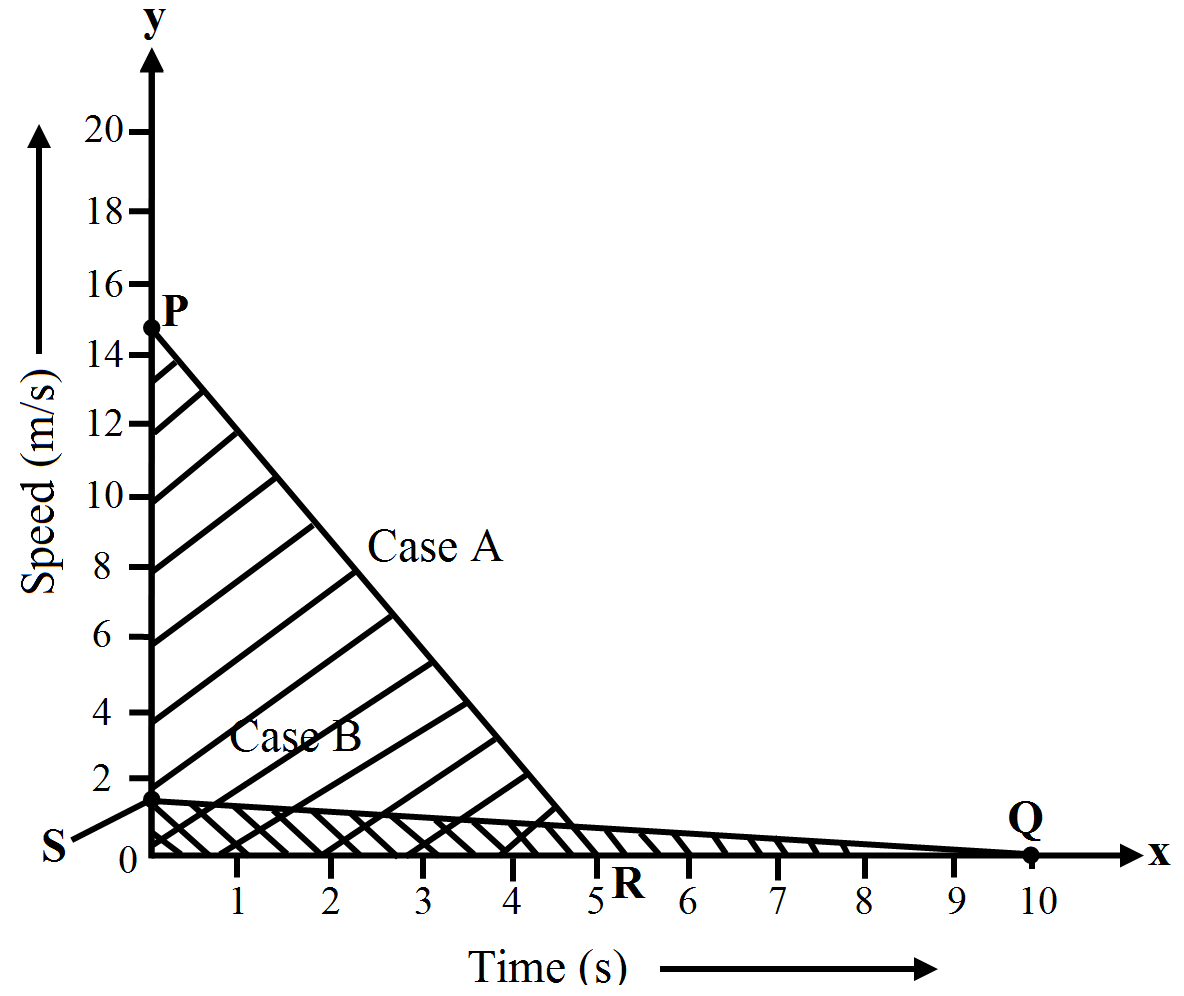
Distance Travelled by first car before coming to rest = Area of $\triangle\text{OPR}$
$= \Big(\frac{1}{2}\Big) × \text{OR} × \text{OP}$
$= \Big(\frac{1}{2}\Big) × 5\text{s} × 52\text{ km/ h}^{−1}$
$= \Big(\frac{1}{2}\Big) × 5\text{} ×\Big(\frac{52\times1000}{3600}\Big)\text{m}$
$= \Big(\frac{1}{2}\Big) × 5\text{} ×\Big(\frac{130}{9}\Big)\text{m}$
$=\frac{325}{9}\text{m}$
$= 36.11\text{m}$
Distance Travelled by second car before coming to rest = Area of $\triangle\text{OSQ}$
$= \Big(\frac{1}{2}\Big) × \text{OQ} × \text{OS}$
$= \Big(\frac{1}{2}\Big) × 10\text{s} × 3\text{ km/ h}^{−1}$
$= \Big(\frac{1}{2}\Big) × 10\text{} ×\Big(\frac{3\times1000}{3600}\Big)\text{m}$
$= \Big(\frac{1}{2}\Big) × 10\text{} ×\Big(\frac{5}{6}\Big)\text{m}$
$= 5 × \Big(\frac{5}{6}\Big)\text{m}$
$=\frac{25}{6}\text{m}$
$= 4.16\text{m}$ View full question & answer→Question 343 Marks
A motorcyclist drives from $A$ to $B$ with a uniform speed of $30 \mathrm{~km} \mathrm{~h}^{-1}$ and returns back with a speed of $20 \mathrm{~km} \mathrm{~h}^{-1}$. Find its average speed.
AnswerLet $\text{AB}=\text{x},$
so $\text{t}_1=\frac{\text{x}}{30}$ and $\text{t}_2=\frac{\text{x}}{20}$
Total time $=\text{t}_1+\text{t}_2=\frac{5\text{x}}{60}\text{h}.$
Average speed for entire journey $=\frac{\text{Total distance}}{\text{Total tome}}=\frac{2\text{x}}{\frac{5\text{x}}{60}}=24\text{km}\ \text{h}^{-1}$
View full question & answer→Question 353 Marks
If a car travels 50m distance in 4s with a acceleration of $5m/s^2,$ then what was its initial speed?
AnswerSimple method would be to use $\text{S}=\text{ut}+\frac{1}{2}\text{at}^{2}$$\text{a}=\frac{(\text{v}-\text{u})}{\text{t}}$
$5=\frac{(\text{v}-\text{u})}{4}$
$(\text{v}-\text{u})=20\dots({1})$
third equation of motion, $v^2 = u^2 + 2as v^2 - u^2 = 2as (v + u)(v - u) = 2 \times 5 \times 50 (v + u) \times 20 = 10 \times 50$
(using eq $1) v + u = 25 …(2)$
subtract $eq2-eq1, v + u - v + u = 25 - 20 2u = 5 u = 2.5$
Thus intial velocity is 2.5m/s it would be wise to use this method when calculations is lengthy or we have to find intial and final velocity.
View full question & answer→Question 363 Marks
Define the term ‘uniform acceleration’. Give one example of a uniformly accelerated motion.
AnswerA body has uniform acceleration if it travels in a straight line and its velocity increases by equal amounts in equal intervals of time. For example: A freely falling body has uniform acceleration.
View full question & answer→Question 373 Marks
A car is moving on a straight road with uniform acceleration. The speed of the car varies with time as follows:
| Time (s) |
$0$ |
$2$ |
$4$ |
$6$ |
$8$ |
$10$ |
| Speed (m/s) |
$4$ |
$8$ |
$12$ |
$16$ |
$20$ |
$24$ |
Draw the speed-time graph by choosing a convenient scale. From this graph:
- Calculate the acceleration of the car.
- Calculate the distance travelled by the car in $10$ seconds.
AnswerWe have a velocity-time graph of a moving particle.
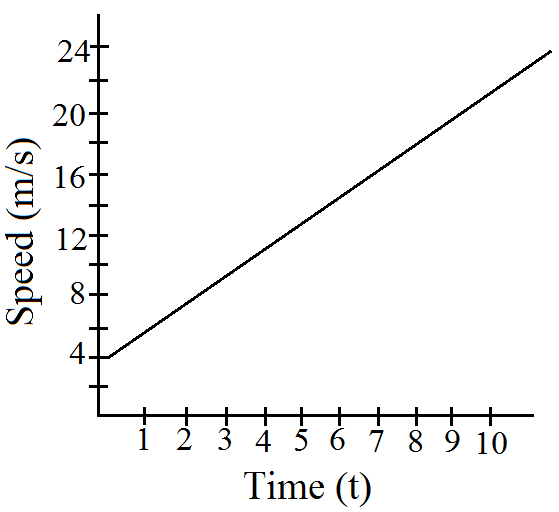
- We have to find the acceleration from the given graph.
Acceleration = slope of line
$=\frac{(12-4)}{4-0}\text{m/s}^2=2\text{m/s}^2$
- Distance travelled by the car is given by the area enclosed by the curve.
$\text{s}=\frac{(\text{Sum of parallel sides})(\text{Height})}{2}$
$=\frac{(4+24)(10)}{2}\text{m}$
$=140\text{m}$ View full question & answer→Question 383 Marks
What is the value of acceleration in the following graph:
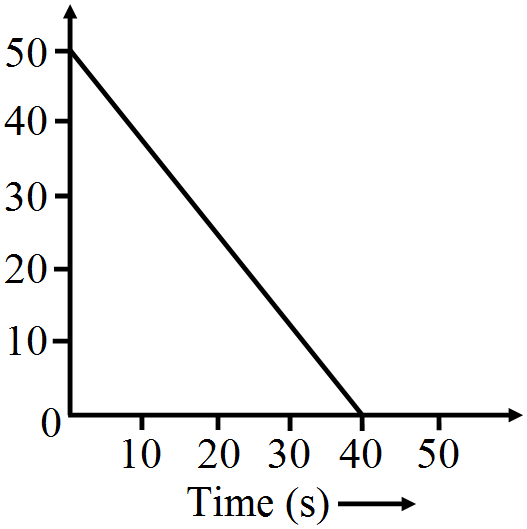
AnswerAccording to the graph the object is in a non-uniform motion as it is continuously retarding. In this graph time $= 40sec$
initial velocity $= u = 50m/s$
final velocity $= v = 0m/s$ so acceleration
$=\text{a}=\frac{(\text{v}-\text{u})}{\text{t}}$
$=\frac{(0-5)}{40}$
$=-\frac{50}{40}$
$=-\frac{5}{4}=1.25\text{m/s}^{2}$
View full question & answer→Question 393 Marks
A bus was moving with a speed of $54\ km/h$. On applying brakes it stopped in $8$ seconds. Calculate the acceleration.
AnswerInitial velocity, $u = 54km/h = 15m/s$
Final velocity,$ v = 0m/s$
Time,$ t = 8s$
Acceleration, $a = ?$
$\text{a}=\frac{\text{v-u}}{\text{t}}$
$=\frac{0-15}{8}=\frac{-15}{8}\text{m/s}^2=-1.875\text{m/s}^2$
View full question & answer→Question 403 Marks
A cheetah starts from rest, and accelerates at $2m/s^2$ for $10$ seconds. Calculate: The distance travelled.
AnswerIntial velocity, $u = 0m/s$ Final velocity,
$v = ?$
Acceleration, $a = 2m/s^2$
Time, t = 10s Distance travelled is:$\text{s}=\text{ut}+\frac{1}{2}\text{at}^2$
$\text{s}=0\times10+\frac{1}{2}\times2\times10\times10$
$\text{s}=0+100=100\text{m}$
View full question & answer→Question 413 Marks
A car acquires a velocity of 72km per hour in 10 seconds starting from rest. Find:
- The acceleration.
- The average velocity.
- The distance travelled in this time.
AnswerInitial velocity, $u = 0m/s$ Final velocity, $v = 72km/h = 20m/s$ Time, $t = 10s$
- Acceleration $=\frac{\text{Final velocity-Initial velocity}}{\text{time taken}}$
So, $\text{a}=\frac{\text{v-u}}{\text{t}}$
$=\frac{20-0}{10}=\frac{20}{10}\text{m/s}^2=2\text{m/s}^2$
- Average velocity $=\frac{\text{ Initial velocity+Final velocity}}{2}$
Average velocity $=\frac{0+20}{2}=\frac{20}{2}\text{m/s}=10\text{m/s}$
- Distance travelled = Average velocity $\times $ Time
$= 10m/s \times 10s = 100m$ View full question & answer→Question 423 Marks
Fig shows the distance-time graph of three objects $A, B$ and $C$. Study the graph and answer the following questions: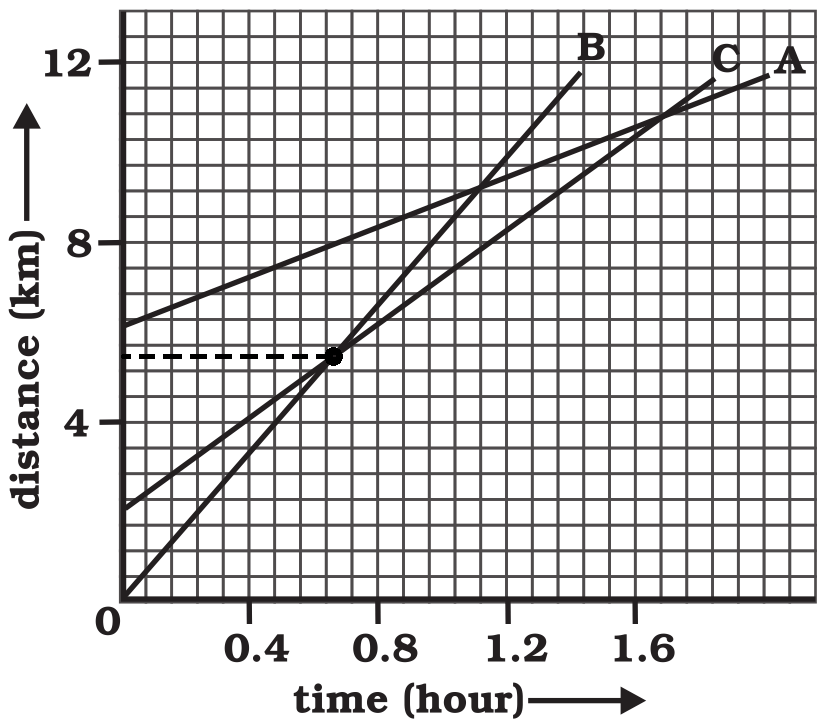
- Which of the three is travelling the fastest?
- Are all three ever at the same point on the road?
- How far has $C$ travelled when $B$ passes $A?$
- How far has $B$ travelled by the time it passes $C?$
Answer
- Object $B$
- No
- $5.714km$
- $5.143km$
- Speed $=\frac{\text{Distance}}{\text{Time}}$
Slope of graph $=\frac{\text{y-axis}}{\text{x-axis}}=\frac{\text{Distance}}{\text{Time}}$
Therefore, Speed = slope of the graph.
Since slope of object B is greater than objects $A$ and $C$, it is travelling the fastest.
- All three objects $A, B$ and $C$ never meet at a single point. Thus, they were never at the same point on road.
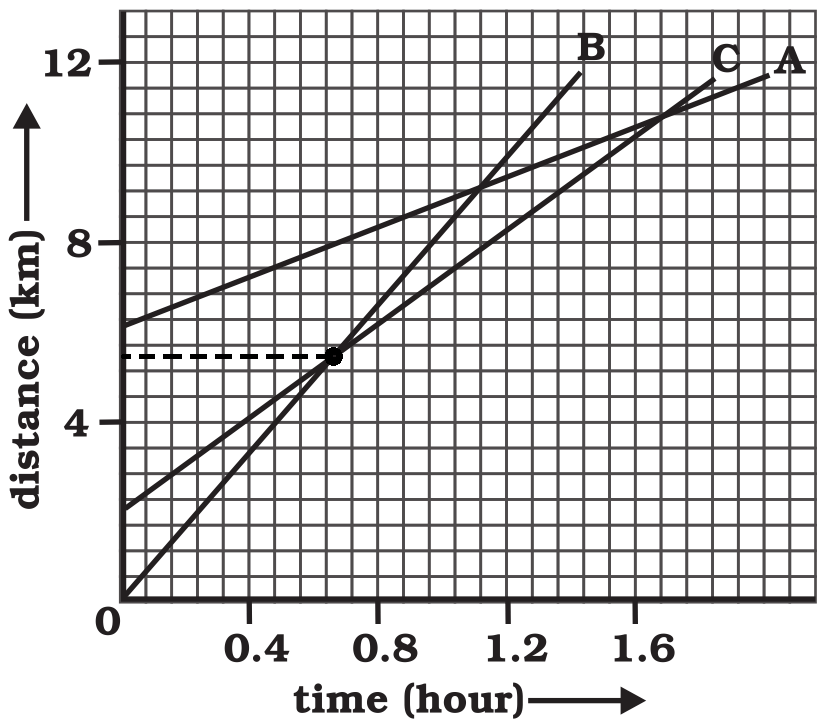
$7$ square box $= 4km$
$\therefore$ $1$ square box $=\frac{4}{7}\text{km}$
$C$ is $4$ blocks away from origin therefore initial distance of $C$ from origin
Distance of $C$ from origin when $B$ passes $A = 8km$
Thus, Distance travelled by $C$ when $B$ passes $A$
$= 8 - \frac{16}{7 }$
$=\frac{(56 - 16)}{7 }$
$=\frac{40}{7}= 5.714\text{km}$
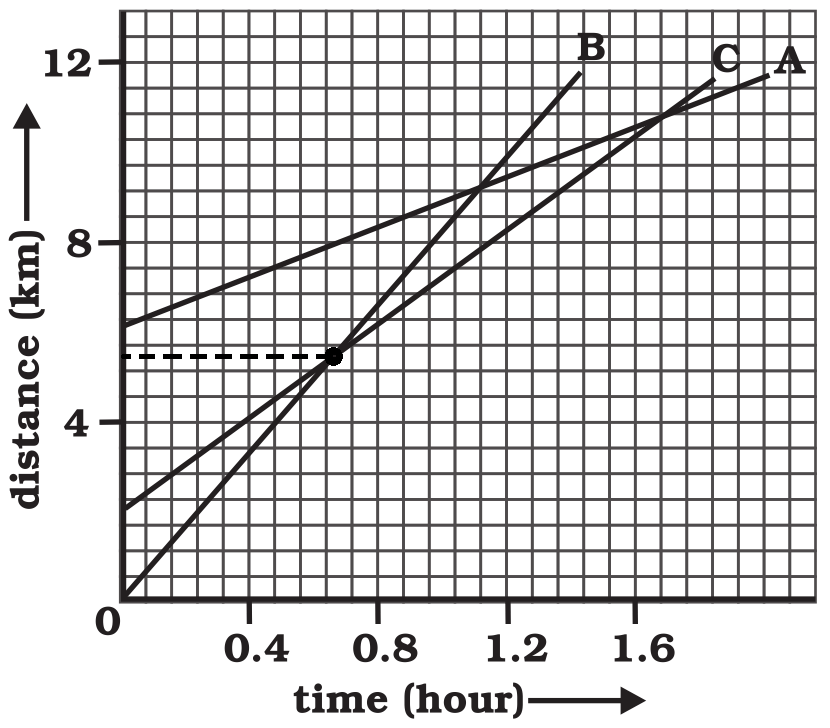
- Distance travelled by B by the time it passes $C = 9$ square boxes
$9×\frac{4}{7} =\frac{36}{7}= 5.143\text{km}$ View full question & answer→Question 433 Marks
The displacement of a moving object in a given interval of time is zero. Would the distance travelled by the object also be zero? Justify you answer.
AnswerWhen the displacement is zero, it does not mean that distance is also zero. Displacement can be zero when the moving object comes back to its original position. Displacement is either equal to or less than distance but distance travelled is always more than zero.
View full question & answer→Question 443 Marks
Look at the figure below and answer the following questions:
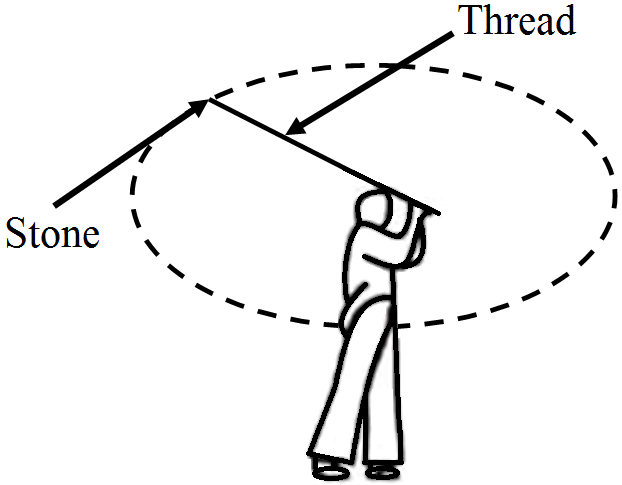
- Name the kind of motion of the stone.
- It this an example of accelerated motion? Why?
- Name the force that keeps the stone in its path.
- What is the direction of this force? Draw it in your answer sheet.
Answer
- The motion is circular motion.
- Because the direction of velocity keeps on changing that is why the motion have acceleration but a constant one. So the motion is uniformly accelerated motion.
- Centripetal force.
- The direction of the centripetal acceleration is towards the centre.
View full question & answer→Question 453 Marks
Write three equations of uniformly accelerated motion. Also, state the symbols used
AnswerUniform acceleration: The motion is said to be uniformly accelerated motion if acceleration is constant. The equations of uniform accelerated motion are given by: $\text{v}=\text{u}+\text{at}$
$\text{S}=\text{ut}+\frac{1}{2\text{at}^{2}}$
$\text{v}^{2}+\text{u}^{2}=2\text{as}$
Where: U is initial velocity V is final velocity S is displacement a is uniform acceleration t is time. View full question & answer→Question 463 Marks
Write the formula to calculate the speed of a body moving along a circular path. Give the meaning of each symbol which occurs in it.
AnswerThe speed of a body moving along a circular path is given by the formula: $\text{v}=\frac{2\pi\text{r}}{\text{t}}$ where, v = speed $\pi=3.14$ ( it is a constant)
r = radius of circular path t = time taken for one round of circular path. View full question & answer→Question 473 Marks
What is the value of acceleration in the following graph:
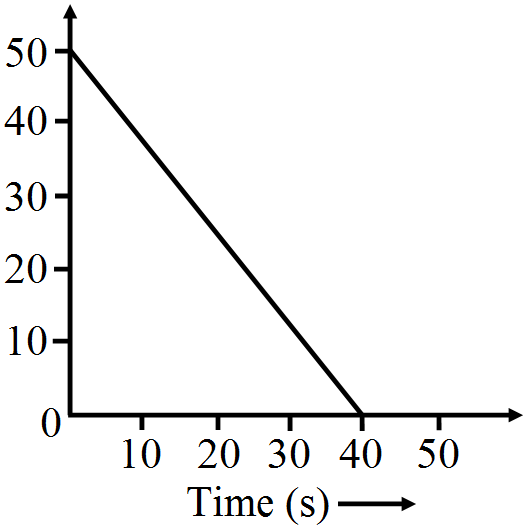
AnswerAccording to the graph the object is in a non-uniform motion as it is continuously retarding. In this graph time = 40sec initial velocity = u = 50m/s final velocity = v = 0m/s so acceleration $=\text{a}=\frac{(\text{v}-\text{u})}{\text{t}}$ $=\frac{(0-5)}{40}$
$=-\frac{50}{40}$
$=-\frac{5}{4}=1.25\text{m/s}^{2}$
View full question & answer→Question 483 Marks
What is the difference between speed and velocity?
Answer - Speed is a scalar quantity, whereas velocity is a vector quantity.
- Speed of a body is the distance travelled by it per unit time, whereas the velocity of a body is the distance travelled by it per unit time in a given direction.
- Speed is always positive, while velocity can be both positive and negative, depending upon the direction.
View full question & answer→Question 493 Marks
What is meant by the term ‘acceleration’ State the SI unit of acceleration.
AnswerAcceleration of a body is defined as the rate of change of its velocity with respect to time. It is a vector quantity. The S.I. unit of acceleration is (m/s2).
View full question & answer→Question 503 Marks
Two stones are thrown vertically upwards simultaneously with their initial velocities u1 and u2 respectively. Prove that the heights reached by them would be in the ratio of $\text{u}_1^2:\text{u}_2^1$ (Assume upward acceleration is –g and downward acceleration to be +g).
AnswerWe know for upward motion, $\text{v}^2=\text{u}^2-2\text{gh}$ or $\text{h}=\frac{\text{u}^2-\text{v}^2}{2\text{g}}$
But at highest point $\text{v}=0$
Therefore, $\text{h}=\frac{\text{u}^2}{\text{g}}$
For first ball, $\text{h}_1=\text{u}_1\frac{2}{2\text{g}}$
And for second ball, $\text{h}_2=\frac{\text{u}^2_2}{2\text{g}}$
Thus, $\frac{\text{h}_1}{\text{h}_2}=\frac{\text{u}_1^2/2\text{g}}{\text{u}_2^2/2\text{g}}=\frac{\text{u}_1^1}{\text{u}_2^2}$ or $\text{h}_1:\text{h}_2=\text{u}_1^2:\text{u}_2^2$
View full question & answer→