Question
  1. Define ‘activity’ of a radioactive material and write its $S.I.$ unit.
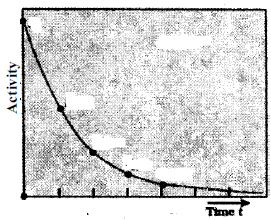
  2. Plot a graph showing variation of activity of a given radioactive sample with time.
  3. The sequence of stepwise decay of a radioactive nucleus is

If the atomic number and mass number of $D_2$ are $71$ and $176$ respectively, what are their corresponding values for $D$?
Answer

  1. The total decay rate $($of a sample$)$ at the given instant, i.e., the number of radionuclides disintegrating per unit time is called the activity of that sample. The $SI$ unit for activity is becquerel $(Bq)$.
  2. Graph:
  1. $72$ and $180$.

Need a full question paper?

Generate a complete, print-ready paper with questions like this in minutes — across 16+ boards, with answer keys.

Start Generating Free

Similar questions

If one of the two electrons of a $H_2$ molecule is removed, we get a hydrogen molecular ion $\text{H}^+_2​.$ In the ground state of an $\text{H}^+_2​,$ the two protons are separated by roughly $1.5 \mathring A ,$ and the electron is roughly $1 \mathring A$ from each proton. Determine the potential energy of the system. Specify your choice of the zero of potential energy.
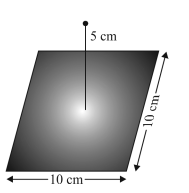
A point charge +10 µC is at a of distance 5 cm directly above the centre of a square of side 10 cm, as shown in Fig. What is the magnitude of the electric flux through the square? (Hint: Think of the square as one face of a cube with edge 10 cm.)
Image
Would the Bohr formula for the $H-$ atom remain unchanged if proton had a charge $(+4/3)e$ and electron a charge $(-3/4)e$, where $e = 1.6 \times 10^{-19}C$. Give reasons for your answer?
Are matter waves electromagnetic?
An ideal gas is taken through a process in which the pressure and the volume are changed according to the equation p = kV. Show that the molar heat capacity of R the gas for the process is given by $\text{C}=\text{C}_\text{v}+\frac{\text{R}}{2}.$
A short bar magnet placed in a horizontal plane has its axis aligned along the magnetic north$-$south direction. Null points are found on the axis of the magnet at $14 \ cm$ from the centre of the magnet. The earth’s magnetic field at the place is $0.36\ G$ and the angle of dip is zero. What is the total magnetic field on the normal bisector of the magnet at the same distance as the null$–$point $($i.e., $14 \ cm)$ from the centre of the magnet? $($At null points, field due to a magnet is equal and opposite to the horizontal component of earth’s magnetic field.$)$
Explain how $p-n$ junction is formed.
Two equal charges are placed at a separation of 1.0m. What should be the magnitude of the charges so that the force between them equals the weight of a 50kg person?
In a periodic table the average atomic mass of magnesium is given as 24.312 u. The average value is based on their relative natural abundance on earth. The three isotopes and their masses are $^{24}_{12}\text{Mg }23.98504\text{u}),^{25}_{12}\text{Mg }(24.98584\text{u})\text{ and }^{26}_{12}\text{Mg }(25.98259\text{u}).$ The natural abundance of $^{24}_{12}\text{Mg}\text{ is }78.99\%$ by mass. Calculate the abundances of other two isotopes.
Consider the situation of the previous question from a frame moving with a speed v0 parallel to the initial velocity of the block.
  1. What are the initial and final kinetic energies?
  2. What is the work done by the kinetic friction?