Question
  1. Define ‘activity’ of a radioactive material and write its S.I. unit.
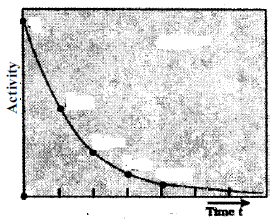
  2. Plot a graph showing variation of activity of a given radioactive sample with time.
  3. The sequence of stepwise decay of a radioactive nucleus is


If the atomic number and mass number of $D_2$ are 71 and 176 respectively, what are their corresponding values for D?
Answer

  1. The total decay rate (of a sample)at the given instant, i.e., the number of radionuclides disintegrating per unit time is called the activity of that sample. The SI unit for activity is becquerel (Bq).
  2. Graph:
  1. 72 and 180.

Need a full question paper?

Generate a complete, print-ready paper with questions like this in minutes — across 16+ boards, with answer keys.

Start Generating Free

Similar questions

By how much would the stopping potential for a given photosensitive surface go up if the frequency of the incident radiations were to be increased from $4 \times 10^{15}\ Hz$ to $8 \times 10^{15} Hz?$
Given $h = 6.4 \times 10^{-34}$ J-s, e$ = 1.6 \times 10^{-19}C$ and $c = 3 \times 10^8 ms^{-1}.$
Define the term “cut off frequency” in photoelectric emission. The threshold frequency of a metal is f. When the light of frequency 2f is incident on the metal plate, the maximum velocity of photo-electrons is $v_1$. When the frequency of the incident radiation is increased to 5f, the maximum velocity of photo-electrons is $v_2$. Find the ratio $v_1 : v_2.$
  1. Mention two properties of soft iron due to which it is preferred for making an electromagnet.
  2. State Gauss's law in magnetism. How is it different from Gauss's law in electrostatics and why?
A rectangular wire loop of sides 8cm and 2cm with a small cut is moving out of a region of uniform magnetic field of magnitude 0.3T directed normal to the loop. What is the emf developed across the cut if the velocity of the loop is $1\ cms^{–1}$ in a direction normal to the:
  1. Longer side,
  2. shorter side of the loop?
For how long does the induced voltage last in each case?
A concave mirror having a radius of curvature 40cm is placed in front of an illuminated point source at a distance of 30cm from it. Find the location of the image.
What length of a copper wire of cross-sectional area $0.01mm^2$ will be needed to prepare a resistance of $1\text{k}\Omega?$ Resistivity of copper $=1.7\times10^{-8}\Omega\text{-m}.$
Energy of electron in hydrogen atom expressed by the following formula :
$E _n=-\left(\frac{13.6 eV}{n^2}\right) ; $ Where $,  n=1,2,3, \ldots$ by using this formula, proved that :
$(a)$ The energy of electron $-6.8 eV$ cannot be in $H -$ atom.
$(b)$ The distance of attached lines in spectrum of hydrogen.
Consider the situation of the previous problem. Define displacement resistance $\text{R}_\text{d}=\frac{\text{V}}{\text{i}_\text{d}}$ of the space between the plates, where V is the potential difference between the plates and $i_d$ is the displacement current. Show that $R_d$ varies with time as $\text{R}_\text{d}=\text{R}\big(\text{e}^{\text{t}/\tau}-1\big)$
(a) In Example 3.1, the electron drift speed is estimated to be only a few $mm s ^{-1}$ for currents in the range of a few amperes? How then is current established almost the instant a circuit is closed?
(b) The electron drift arises due to the force experienced by electrons in the electric field inside the conductor. But force should cause acceleration. Why then do the electrons acquire a steady average drift speed?
(c) If the electron drift speed is so small, and the electron's charge is small, how can we still obtain large amounts of current in a conductor?
(d) When electrons drift in a metal from lower to higher potential, does it mean that all the 'free' electrons of the metal are moving in the same direction?
(e) Are the paths of electrons straight lines between successive collisions (with the positive ions of the metal) in the (i) absence of electric field, (ii) presence of electric field?
A wheel rotating with uniform angular acceleration covers 50 revolutions in the first five seconds after the start. Find the angular acceleration and the angular velocity at the end of five seconds.