Question
Consider the situation of the previous problem. Define displacement resistance $\text{R}_\text{d}=\frac{\text{V}}{\text{i}_\text{d}}$ of the space between the plates, where V is the potential difference between the plates and $i_d$ is the displacement current. Show that $R_d$ varies with time as $\text{R}_\text{d}=\text{R}\big(\text{e}^{\text{t}/\tau}-1\big)$
Answer

$\text{E}=\frac{\text{Q}}{\in_0\text{A}}$ (Electric field)$\phi=\text{E.A.}=\frac{\text{Q}}{\in_0\text{A}}\frac{\text{A}}{2}=\frac{\text{Q}}{\in_02}$
$\text{i}_0=\in_0\frac{\text{d}\phi_\text{E}}{\text{dt}}=\in_0\frac{\text{d}}{\text{dt}}\Big(\frac{\text{Q}}{\in_02}\Big)$
$=\frac{1}{2}\Big(\frac{\text{dQ}}{\text{dt}}\Big)$

Need a full question paper?

Generate a complete, print-ready paper with questions like this in minutes — across 16+ boards, with answer keys.

Start Generating Free

Similar questions

Explain the experiment which represents the total internal reflection.
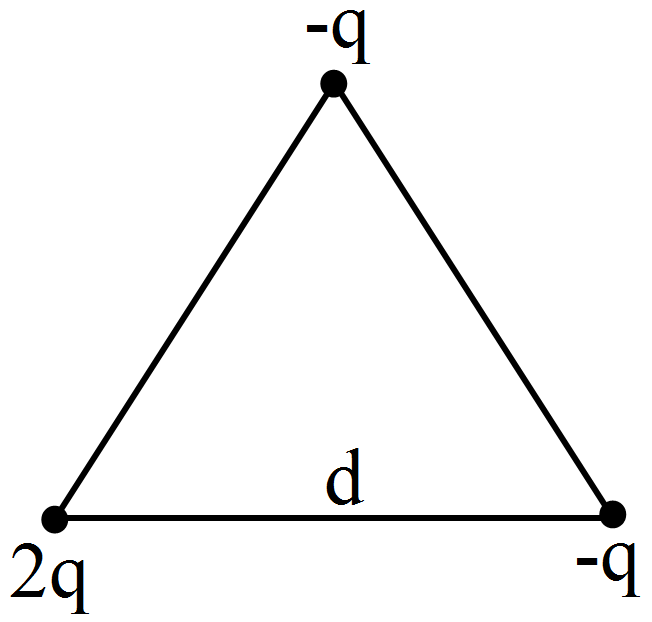
Three charges are arranged on the vertices of an equilateral triangle as shown in figure. Find the dipole moment of the combination.
With the help of a simple diagram, explain the working of a silicon solar cell, giving all three basic processes involved. Draw its I-V characteristic.
Find the binding energy per nucleon of $\text{ }^{197}_{79}\text{Au}$ if its atomic mass is 196.96u.
Why is it not possible to make permanent magnets from paramagnetic materials?
At what temperature the mean speed of the molecules of hydrogen gas equals the escape epeed from the earth?
In a Wheatstone bridge, $P =1 \Omega, Q =2 \Omega, R =2 \Omega, S=3 \Omega$ and $R _{ g }=4 \Omega$. Find the current through the galvanometer in the unbalanced position of the bridge, when a battery of 2 V and internal resistance $2 \Omega$ is used.
A 660Hz tuning fork sets up vibration in a string clamped at both ends. The wave speed for a transverse wave on this string is 220m/s and the string vibrates in three loops.
  1. Find the length of the string.
  2. If the maximum amplitude of a particle is 0.5cm, write a suitable equation describing the motion.
Derive the equation of the missing term in the Ampere circuital law $\text{OR}$ Derive the equation of displacement current and write its unit and definition.
For sound waves, the Doppler formula for frequency shift differs slightly between the two situations: (i) source at rest; observer moving, and (ii) source moving; observer at rest. The exact Doppler formulas for the case of light waves in vacuum are, however, strictly identical for these situations. Explain why this should be so. Would you expect the formulas to be strictly identical for the two situations in case of light travelling in a medium?