Question
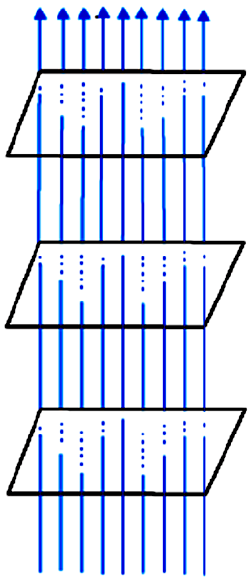
Define an equipotential surface. Draw equipotential surface:
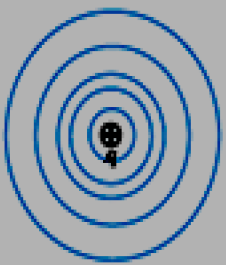
  1. In the case of a single point charge and,
  2. In a constant electric field in Z-direction.
Why the equipotential surfaces about a single charge are not equidistant?
  1. Can electric field exist tangential to an equipotential surface? Give reason.
Answer

Surface with a constant value of potential at all points on the surface.
  1.  

  1. $\text{V} \propto\frac{1}{\text{r}}/$
  1. No If the field lines are tangential, work will be done in moving a charge on the surface which goes against the definition of equipotential surface.

Need a full question paper?

Generate a complete, print-ready paper with questions like this in minutes — across 16+ boards, with answer keys.

Start Generating Free

Similar questions

On the basis of the charging of capacitor, clarify that there is something missing in the Ampere circuital law.
A point charge is moving along a straight line with a constant velocity u. Consider a small area A perpendicular to the direction of motion of the charge (El). Calculate the displacement current through the area when its distance from the charge is x. The value of x is not large so that the electric field at any instant is essentially given by Coulomb's law.
A rod is inserted as the core in the current-carrying solenoid of the previous problem.
  1. What is the magnetic intensity H at the centre?
  2. If the magnetization I of the core is found to be 0.12Nm, find the susceptibility of the material of the rod.
  3. Is the material paramagnetic, diamagnetic or ferromagnetic?
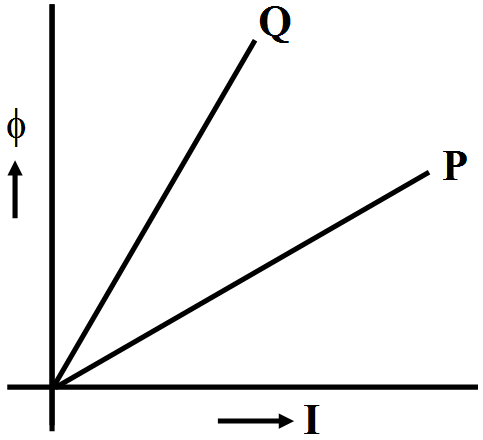
The given graph shows a plot of magnetic flux $(\phi)$ and the electric current (I) flowing through two inductors P and Q. Which of the two inductors has smaller value of self-inductance?
Explain the behaviour of non polar molecule and polar molecule in uniform electric field.
State the underlying principle of a cyclotron. Explain its working with the help of a schematic diagram. Obtain the expression for cyclotron frequency.
A spring stores 5J of energy when stretched by 25cm. It is kept vertical with the lower end fixed. A block fastened to its other end is made to undergo small oscillations. If the block makes 5 oscillations each second, what is the mass of the block?
Figure shows a smooth track, a part of which is a circle of radius R. A block of mass m is pushed against a spring of spring constant k fixed at the left end and is then released. Find the initial compression of the spring so that the block presses the track with a force mg when it reaches the point P, where the radius of the track is horizontal.
A radioactive material is reduced to $\frac{1}{16}$ of its original amount in 4 days. How much material should one begin with so that $4 × 10^{-3}kg$ of the material is left after 6 days?
The luminous flux of a 1W sodium vapour lamp is more than that of a 10kW source of ultraviolet radiation. Comment.