Question
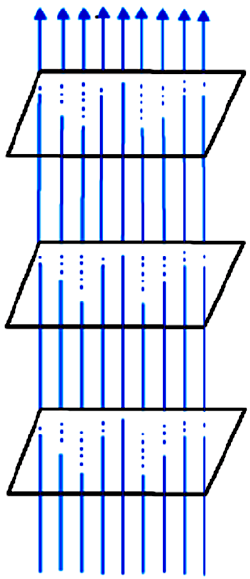
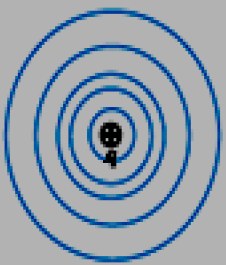
Define an equipotential surface. Draw equipotential surface:

  1. In the case of a single point charge and,
  2. In a constant electric field in Z-direction.

Why the equipotential surfaces about a single charge are not equidistant?

  1. Can electric field exist tangential to an equipotential surface? Give reason.
Answer

Surface with a constant value of potential at all points on the surface.

  1.  

  1. $\text{V} \propto\frac{1}{\text{r}}/$
  1. No If the field lines are tangential, work will be done in moving a charge on the surface which goes against the definition of equipotential surface.

Need a full question paper?

Generate a complete, print-ready paper with questions like this in minutes — across 16+ boards, with answer keys.

Start Generating Free

Similar questions

A small block of mass 100g is pressed against a horizontal spring fixed at one end to compress the spring through 5.0cm (figure). The spring constant is 100N/m. When released, the block moves horizontally till it leaves the spring. Where will it hit the ground 2m below the spring?

  1. Describe the working principle of a solar cell. Mention three basic processes involved in the generation of emf.
  2. Why are Si and GaAs preferred materials for solar cells?
In a Young’s double-slit experiment, the slits are separated by 0.28 mm and the screen is placed 1.4 m away. The distance between the central bright fringe and the fourth bright fringe is measured to be 1.2 cm. Determine the wavelength of light used in the experiment.
Distinguish between isotopes and isobars. Give one example for each of the species.
A hypothetical magnetic field existing in a region is given by $\overrightarrow{\text{B}}=\text{B}_0\overrightarrow{\text{e}}_\text{r},$ where $\overrightarrow{\text{e}}_\text{r}$ denotes the unit vector along the radial direction. A circular loop of radius a, carrying a current i, is placed with its plane parallel to the x-y plane and the centre at (0, 0, d). Find the magnitude of the magnetic force acting on the loop.
5g of a gas is contained in a rigid container and is heated from 15°C to 25°C. Specific heat capacity of the gas at constant volume is 0.172cal-g-1°C-1 and the mechanical equivalent of heat is 4.2J-cal-1. Calculate the change in the internal energy of the gas.
What do you mean by colour code of carbon resistance ?
A 40cm wire having a mass of 3.2g is stretched between two fixed supports 40.05cm apart. In its fundamental mode, the wire vibrates at 220Hz. If the area of cross-section of the wire is 1.0mm2, find its Young's modulus.
Write and explain principle of superposition for stationary electric forces.
If the horizontal force needed for the turn in the previous problem is to be supplied by the normal force by the road, what should be the proper angle of banking?