Question
Define angular dispersion for a prism. Obtain its expression for a thin prism. Relate it with the refractive indices of the material of the prism for corresponding colours.

Answer

i. If a polychromatic beam is incident upon a prism, the emergent beam consists of all the individual colours angularly separated. This phenomenon is known as angular dispersion for a prism.ii. For any two component colours, angular dispersion is given by,
$δ_{21} = δ_2 – δ_1$
iii. For white light, we consider two extreme colours viz., red and violet.
$\therefore δ_{VR} = δ_V – δ_R$
iv. For thin prism,
$δ = A(n – 1)$
$δ_{21} = δ_2 – δ_1$
$= A(n_2 – 1) – A(n_1 – 1) = A(n_2 – n_1)$
where $n_1$ and $n_2$​​​​​​​ are refractive indices for the two colours.
v. For white light,
$δ_{VR} = δ_V – δ_R$
$= A(n_V – 1) – A(n_R – 1) = A(n_V – n​​​​​​​_R).$

Need a full question paper?

Generate a complete, print-ready paper with questions like this in minutes — across 16+ boards, with answer keys.
Start Generating Free

Similar questions

What are electric lines of force?
Ten identical masses (m each) are connected one below the other with $10$ strings. Holding the topmost string, the system is accelerated upwards with acceleration $g/2$. What is the tension in the 6th string from the top (Topmost string being the first string)? [Ans: $6\ mg$]
Explain spherical aberration for spherical mirrors. How can it be minimized? Can it be eliminated by some curved mirrors?
State the main characteristics of EM waves.
Explain applications of semiconductors.
If $n$ identical cells, each of emf $E$ and internal resistance $r,$ are connected in series, write an expression for the terminal $p.d$. of the combination and hence show that this is nearly $n$ times that of a single cell.
Give expressions for variation of resistivity and resistance with temperature. Represent graphically the temperature dependence of resistivity of copper.
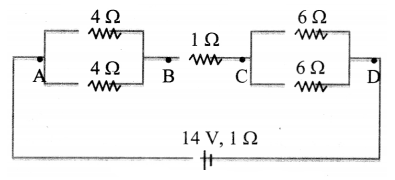
A network of resistors is connected to a $14 V$ battery with internal resistance $1 Q$ as shown in the circuit diagram.
$i.$ Calculate the equivalent resistance,
$ii.$ Current in each resistor,
$iii.$ Voltage drops $V_{A B}, V_{B C}$ and $V_{D C}$.
Image
Explain formation of energy bands in solid sodium with neat labelled energy band diagrams.
Give the magnitude and direction of the net force acting on$:3$
$1.$ a drop of rain falling down with a constant speed.
$2.$ a cork of mass $10 g$ floating on water.
$3.$ a kite skilfully held stationary in the sky.
$4.$ a car moving with a constant velocity of $30 \ kmh^{-1}$ on a rough road.
$5.$ a high speed electron in space far from all gravitating objects, and free of electric and magnetic fields.