Question
Define atomic mass unit.

Answer

Atomic Mass Unit : The mass of nuclear particle proton, neutron is so low that when expressed in kilogram units, they are of the order $10^{-27} kg$. It is not very convenient to use such small quantities. Therefore the masses of nuclei are expressed in a smaller unit. It is called atomic mass unit (a.m.u.). Considering the mass of ${ }_6 C ^{12}$ as standard, its 12 th part is equal to 1 a.m.u.
$\begin{aligned}
\text { That is, } 1 \text { a.m.u. } & =\frac{\text { Mass of } C^{12} \text { atom }}{12} \\
& =1.660565 \times 10^{-27} kg
\end{aligned}$

Need a full question paper?

Generate a complete, print-ready paper with questions like this in minutes — across 16+ boards, with answer keys.
Start Generating Free

Similar questions

A 12.5 eV electron beam is used to bombard gaseous hydrogen at room temperature. Upto which energy level the hydrogen atoms would be excited? Calculate the wavelengths of the first member of Lyman and first member of Balmer series.
An inductor-coil, a capacitor and an AC source of rms voltage 24V are connected in series. When the frequency of the source is varied, a maximum rms current of 6.0A is observed. If this inductor coil is connected to a battery of emf 12V and internal resistance $4.0\Omega,$ what will be the current?
What are the dimensions of:
  1. Volume of a cube of edge a.
  2. Volume of a sphere of radius a.
  3. The ratio of the volume of a cube of edge a to the volume of a sphere of radius a?
Average lifetime of a hydrogen atom excited to n = 2 state is 10-8s. Find the number of revolutions made by the electron on the average before it jumps to the ground state.
The magnetic intensity Hat the centre of a long solenoid carrying a current of 2.0A, is found to be 1500A/m. Find the number of turns per centimetre of the solenoid.
Potential at an instant $t$ in an ac circuit is $E=200 \sin 157 t . \cos 157 t$ volts and current is $I=\sin \left(314 t+\frac{\pi}{3}\right) \quad$ Amperes. In this condition calculate :
(a) frequency
(b) root mean square value of voltage
(c) impedance of the circuit
(d) power factor.
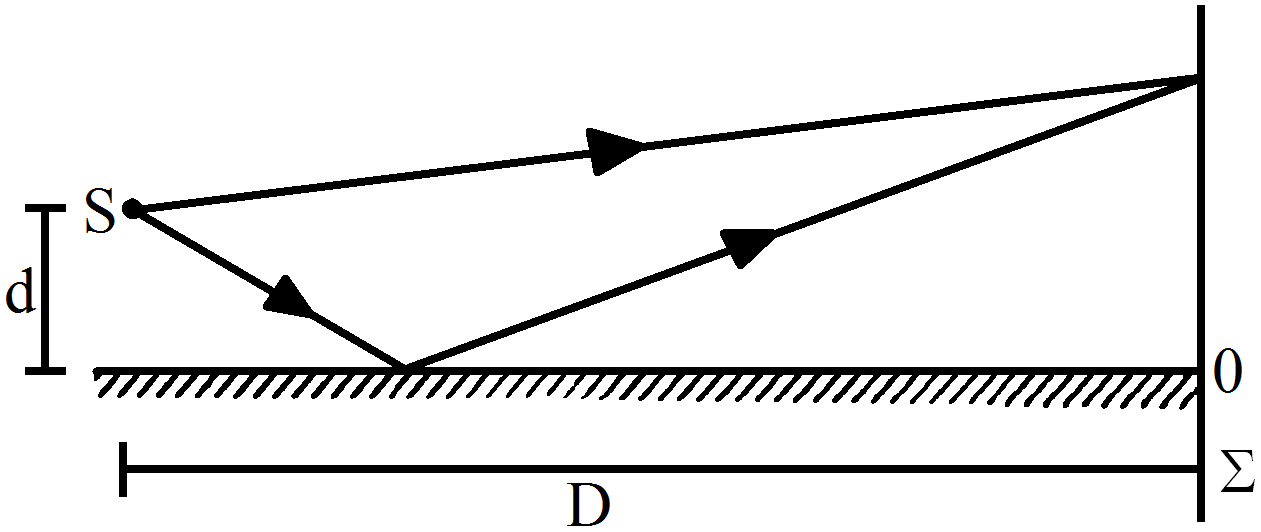
A narrow slit S transmitting light of wavelength $\lambda$ is placed a distance d above a large plane mirror as shown in figure (17-E1). The light coming directly from the slit and that coming after the reflection interfere at a screen $\sum$ placed at a distance D from the slit.

  1. What will be the intensity at a point just above the mirror, i.e., just above O?
  2. At what distance from 0 does the first maximum occur?
The length of a brass rod is found to be smaller less on a hot summer day than on a cold winter day as measured by the same aluminium scale. Do we conclude that brass shrinks on heating?
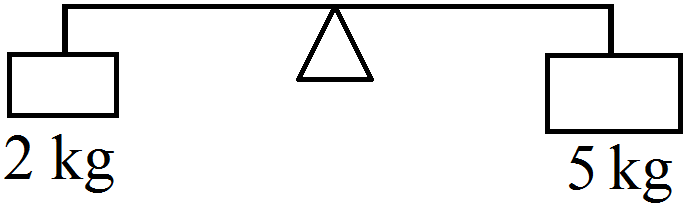
A light rod of length 1m is pivoted at its centre and two masses of 5kg and 2kg are hung from the ends as shown in figure. Find the initial angular acceleration of the rod assuming that it was horizontal in the beginning.

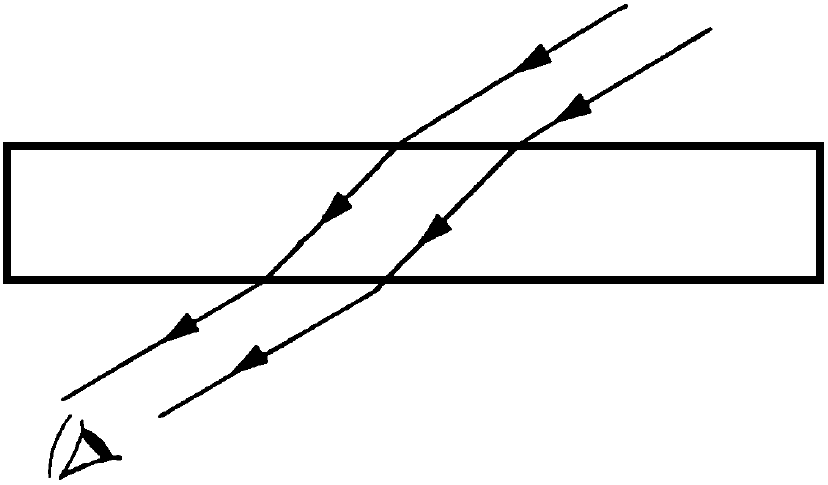
A narrow beam of light passes through a slab obliquely and is then received by an eye. The index of refraction of the material in the slab fluctuates slowly with time. How will it appear to the eye? The twinkling of stars has a similar explanation.