Question
Define conductivity and molar conductivity for the solution of an electrolyte.
Discuss their variation with concentration.
Answer

Conductivity: The reciprocal of resistance of an electrolyte in aqueous solution is known as its conductivity. It is equal to $\frac{1}{\text{R}}$
Molar Conductivity: Molar conductivity of a solution is defined as the conductance of all ions present in one mole of electrolyte in the solution. If M is the molar concentration in mol $L^{–1}$, then.

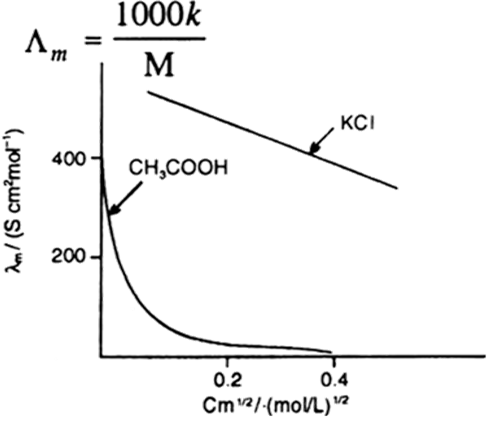
Fig: Molar conductivity versus $C^{1/2}$ for acetic acid (week electrolyte) and potassium chloride (strong electrolyte in aqueous solutions)
The curve shown below gives the change in conductance against square root of concentrations. We observe that for strong electrolytes like KCl, the conductance does not change much with decrease in \sqrtC; whereas in the case of weak electrolyte like acetic acid $(CH_3COOH)$ it increases much with decrease in √C.

Need a full question paper?

Generate a complete, print-ready paper with questions like this in minutes — across 16+ boards, with answer keys.
Start Generating Free

Similar questions

a. Give the structure of all the possible dipeptides formed when the following two amino acids form a peptide bond.
Image
b. Keratin, insulin, and myosin are a few examples of proteins present in the human body. Identify which type of protein is keratin and insulin and differentiate between them based on their physical properties.
Vapour pressure of water at $293$ K is $17.535$ mm Hg. Calculate the vapour pressure of water at $293$ K when $25$ g of glucose is dissolved in $450$ g of water.
  1. Differentiate between adsorbtion and absorption.
  2. Out of $MgCl_2$ and $AlCl_3,$ which one is more effective in causing coagulation of negatively charged sol and why?
  3. Out of sulphur sol and proteins, which one forms multimolecular colloids?
  1. The cell in which the following reaction occurs:
$2 Fe^{3+} (aq) + 2 I^- (aq) \longrightarrow 2 Fe^{2+}(aq) + I_2 (s)$

has $\text{E}^0_{\text{cell}}$ = 0·236 V at 298 K. Calculate the standard Gibbs energy of the cell reaction. (Given : $1 F = 96,500 C mol^{-1}$)
  1. How many electrons flow through a metallic wire if a current of 0·5 A is passed for 2 hours? (Given : $1 F = 96,500 C mol^{-1}$)
The following data were obtained during the first order thermal decomposition of $SO_2Cl_2$ at a constant volume:
$SO_2Cl_2(g) \rightarrow SO_2(g) + Cl_2(g)$
Experiment
Time/s$^{-1}$
Total pressure/atm
$1$
$2$
$0$
$100$
$0.4$
$0.7$
Calculate the rate constant.
$($Given$: \log 4 = 0.6021, \log  2 = 0.3010)$
Answer the following questions: Explain why the dipole moment of chlorobenzene is lower than that of cyclohexyl chloride.
How would you bring about the following conversions?
i. Propanal to butanone
ii. Benzaldehyde to benzophenone
iii. Benzoyl chloride to benzonitrile
  1.  
  1.  
  1. $\text{CH}_{3}-\text{CH}_{2}-\text{ Br}\xrightarrow{\text{AgCN } } ?$
What chemical principle is involved in choosing a reducing agent for getting the metal from its oxide ore? Consider the metal oxides, $Al_2O_3$ and $Fe_2O_3,$ and justify the choice of reducing agent in each case.
How can phenol be converted to aspirin?