Question
Define depreciation. State any two reasons for providing depreciation.

Answer

In every business there are certain assets of a fixed nature that are needed for the conduct of business operations. Some examples of such assets are Building, Plant and Machinery, Motor Vehicles, Furniture, Office equipments etc. These assets have a definite span of life after the expiry of which the assets will lose their usefulness for the business operations. Fall in the value and utility of such assets due to their constant use and expiry of tine is termed as depreciation. In other words, the process of allocation of the cost of a fixed asset over its useful life is known as depreciation.
The causes (reasons) of Depreciation are:
  1. Use of Asset: Use of asset leads to its wear and tear and thus fall in its value.
  2. Obsolescence: If a better and cost effective machine becomes available, old machine may have to be discarded even though it is capable of being used. Thus, it leads to reduction of useful life of the asset.
  3. Accidents: Accidental loss may be permanent but is not continuing and gradual.

Need a full question paper?

Generate a complete, print-ready paper with questions like this in minutes — across 16+ boards, with answer keys.

Start Generating Free

Similar questions

Record the following transactions in the Sales Book of Ganesh & Co. of Jaipur (Rajasthan), who deal in Furniture. Assume CGST @ 6% and SGST @ 6%.
2017
 
June 4
Sold to Gupta Furniture House, Agra (U.P.)
120 Chairs @ ₹ 2,500 per Chair
25 Tables @ ₹ 8,000 per Table
Less: 5%
June 8
Sold to Raja Furniture House, Ahmedabad (Gujarat)
8 Almirahs @ ₹ 15,000 each
9 Steel Cabinets @ ₹ 20,000 each
Less: Trade discount of 10%
June 12
Sold old Computer for ₹ 1,500 to Mohan & Co. on Credit.
June 20
Sold 4 Sofa sets @ ₹ 25,000 each to Varun & Co. for cash
June 25
Sold to New Furniture House, Jaipur
5 Sofa sets @ ₹ 20,000 each
10 Tables @ ₹ 8,000 each
June 28
Purchased from Ram Lal & Co. Jaipur on credit
50 chairs @ ₹ 2,000 each
Jouranlise the following transactions in the books of Harpreet Bros:
  1. ₹ 1,000 due from Rohit are now bad debts.
  2. Goods worth ₹ 2,000 were used by the proprietor.
  3. Charge depreciation @ 10% p.a for two month on machine costing ₹ 30,000.
  4. Provide interest on capital of ₹ 1,50,000 at 6% p.a. for 9 months.
  5. Rahul become insolvent, who owed is ₹ 2,000 a final dividend of 60 paise in a rupee is received from his estate.
Prepare accounting equation on the basis of the following:
  1. Harsha started business with cash ₹ 2,00,000
  2. Purchased goods from Naman for cash ₹ 40,000
  3. Sold goods to Bhanu costing ₹ 10,000/- ₹ 12,000
  4. Bought furniture on credit ₹ 7,000
On which side of the Trial Balance, the following Ledger balances will appear:-
  1. Purchases Return
  2. Furniture
  3. Bank Loan
  4. Discount allowed
  5. Capital
  6. Drawings
  7. Return Inwards
  8. Bills Receivable
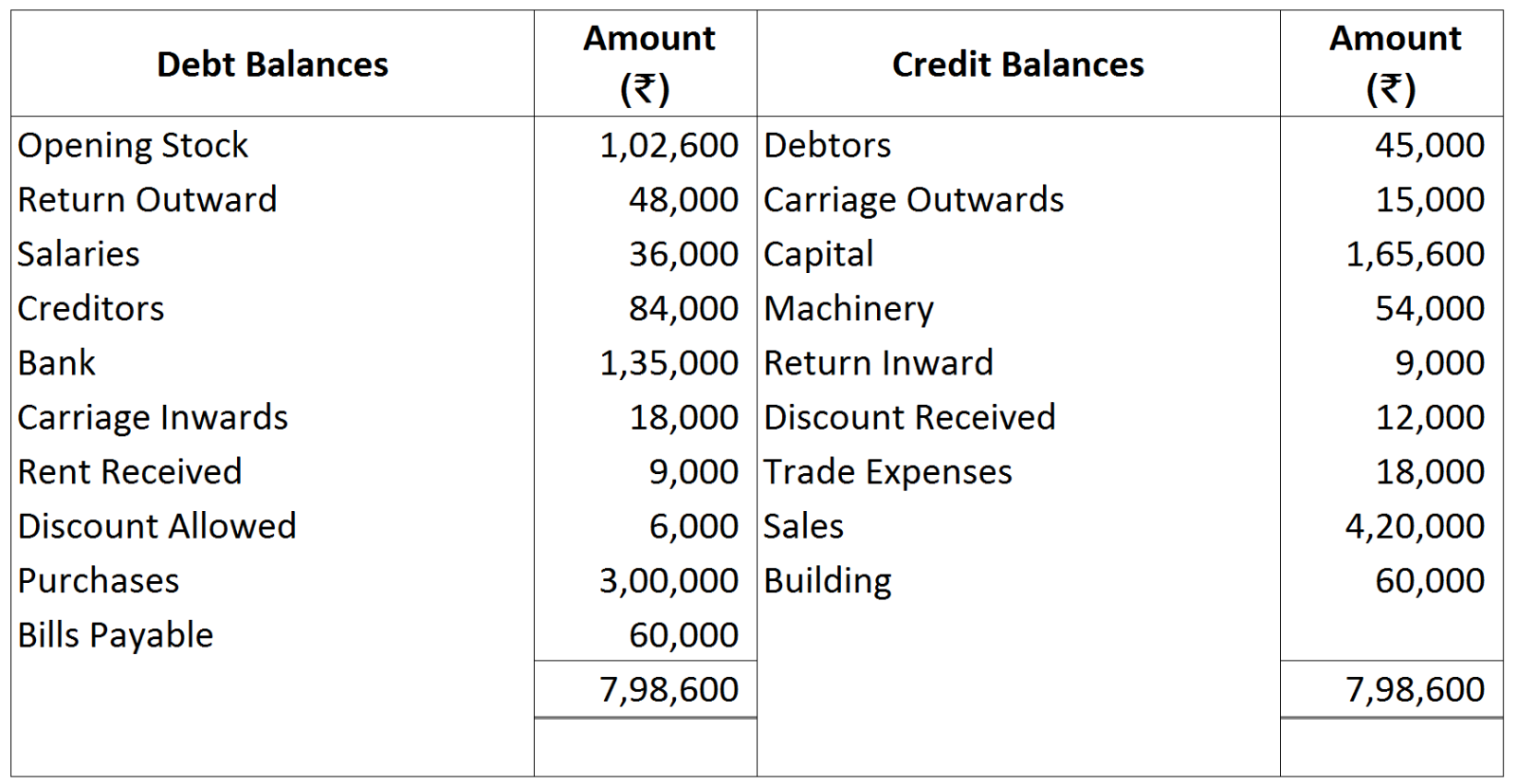
Correct the following Trial Balance:
State whether the balance of the following accounts should be placed in the debit (or) the credit columns of the Trial Balance:
  1. Plant and Machinery
  2. Discount Allowed
  3. Bank Overdraft
  4. Sales
  5. Interest Paid
  6. Bad Debts
State three advantages of Sub-Division of Journal.
What is a Trial Balance? State any four functions of a Trial Balance.
Pass Journal entry for purchase of goods by Amrit, Delhi from Add Gel Pens, Delhi for ₹ 15,000 less Trade Discount 10% and Cash Discount 3%. CGST and SGST is levied @ 6% each. Assume payment is made at the time of purchase.
Show the Accounting Equation for the following transactions:
S.no  
(i) Gopinath started business with cash 25,000
(ii) Purchased goods from Shyam 10,000
(iii) Sold goods to Sohan costing ₹ 1,800 1,500
(iv) Gopinath withdrew from business 5,000