Questions

4 Marks Question

🎯

Test yourself on this topic

8 questions · timed · auto-graded

Question 14 Marks
Define depreciation. State any two reasons for providing depreciation.
Answer
In every business there are certain assets of a fixed nature that are needed for the conduct of business operations. Some examples of such assets are Building, Plant and Machinery, Motor Vehicles, Furniture, Office equipments etc. These assets have a definite span of life after the expiry of which the assets will lose their usefulness for the business operations. Fall in the value and utility of such assets due to their constant use and expiry of tine is termed as depreciation. In other words, the process of allocation of the cost of a fixed asset over its useful life is known as depreciation.
The causes (reasons) of Depreciation are:
  1. Use of Asset: Use of asset leads to its wear and tear and thus fall in its value.
  2. Obsolescence: If a better and cost effective machine becomes available, old machine may have to be discarded even though it is capable of being used. Thus, it leads to reduction of useful life of the asset.
  3. Accidents: Accidental loss may be permanent but is not continuing and gradual.
View full question & answer
Question 24 Marks
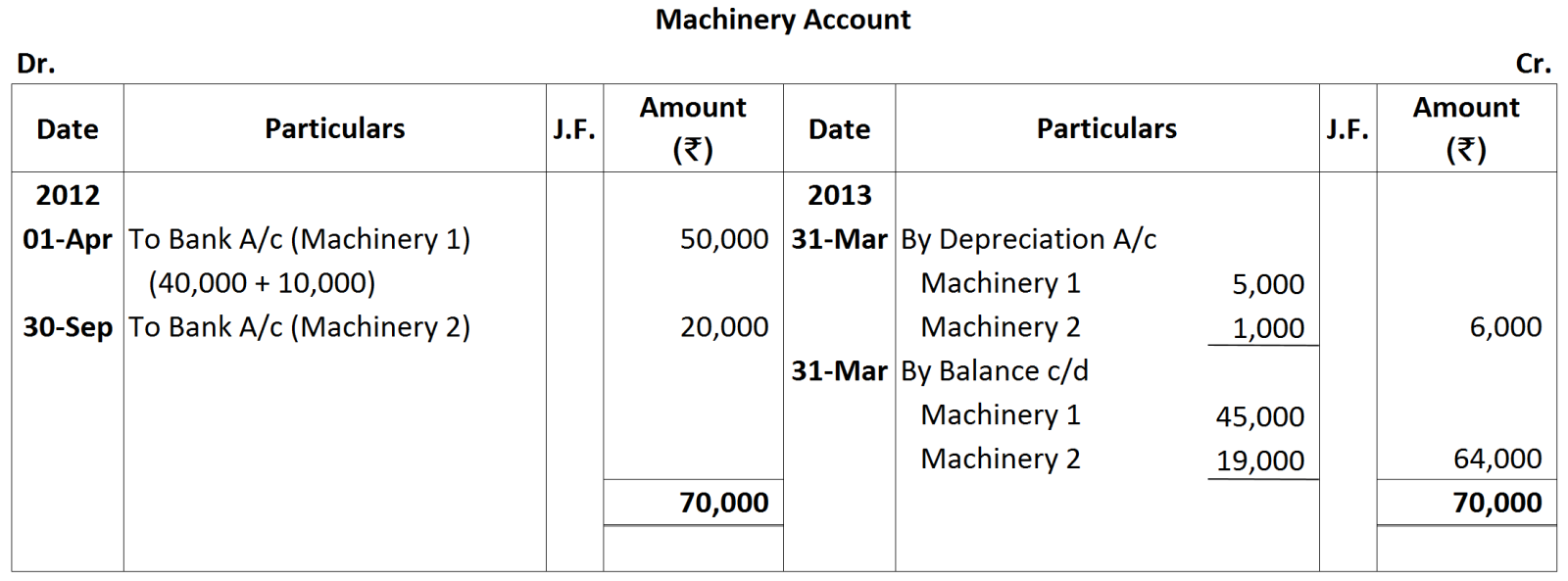
From the following transactions of a concern, prepare Machinery Account for the year ending 31st March, 2013:
2012  
April 1 Purchased a second-hand machinery for ₹ 40,000.
April 1 Spent ₹ 10,000 on repairs for making it serviceable.
Sept. 30 Purchased additional new machinery for ₹ 20,000.
Dec. 31 Repairs and renewals of machinery ₹ 2,000.
2013  
March 31 Depreciate the machinery at 10% p.a.
Answer

Note: Repair charges of ₹ 2,000 are categorised under revenue expenditure because these are incurred on December 31, 2012 but machinery has been purchased on September 30, 2012.
View full question & answer
Question 34 Marks
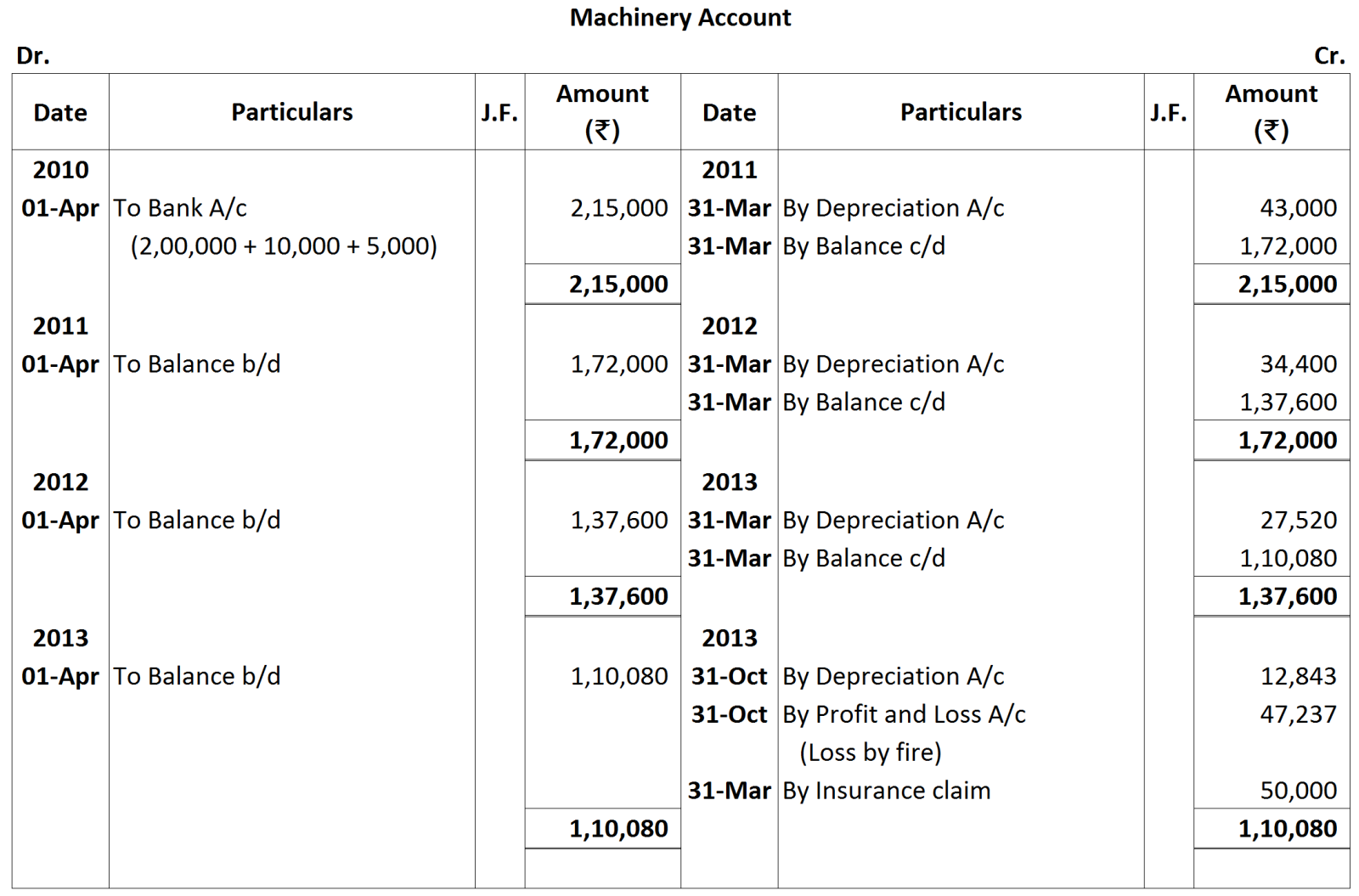
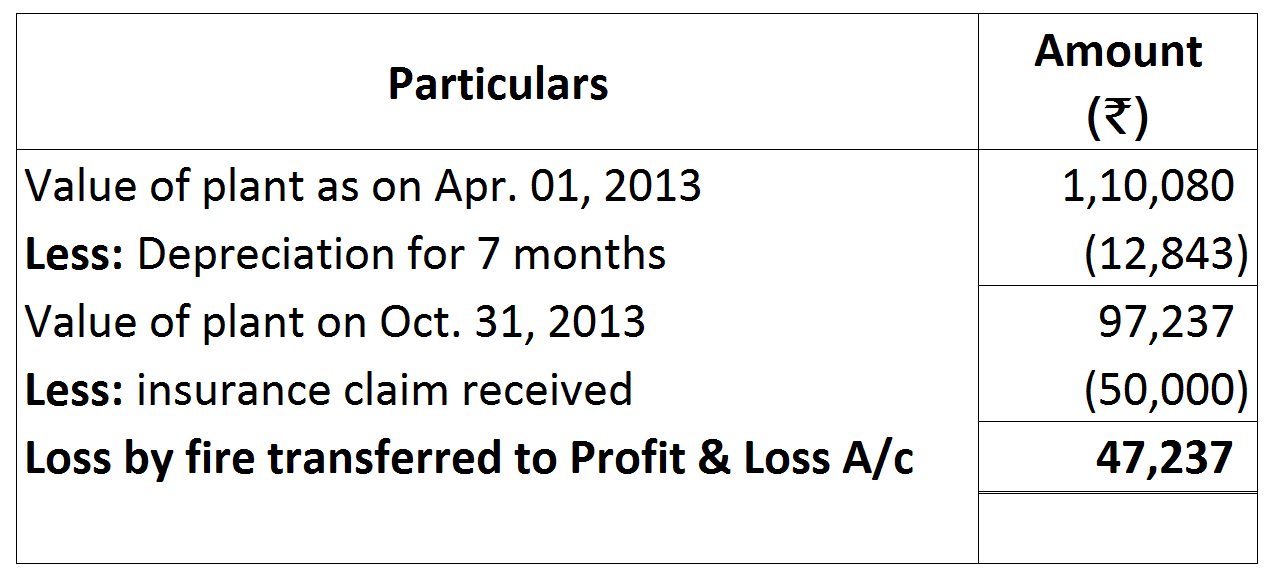
On April 01, 2010 Jain & Sons purchased a second hand plant costing ₹ 2,00,000 and spent ₹ 10,000 on its overhauling. It also spent ₹ 5,000 on transportation and installation of the plant. It was decided to provide for depreciation @ 20% on written down value. The plant was destroyed by fire on Oct. 31, 2013 and an insurance claim of ₹ 50,000 was admitted by the insurance company. Prepare plant account assuming that the company closes its books on March 31, every year.
Answer

Working Notes: Calculation of Loss by fire,
View full question & answer
Question 44 Marks
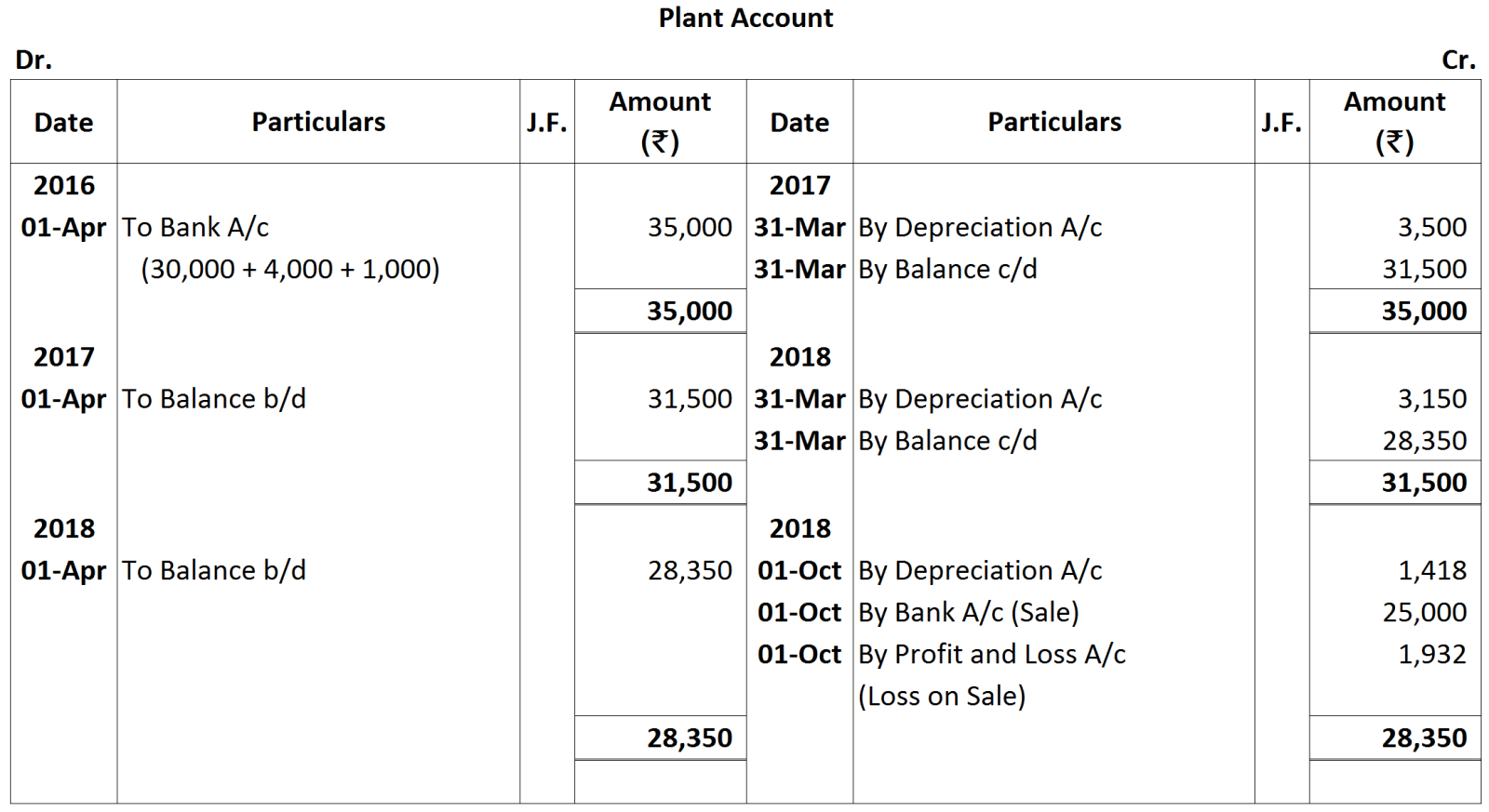
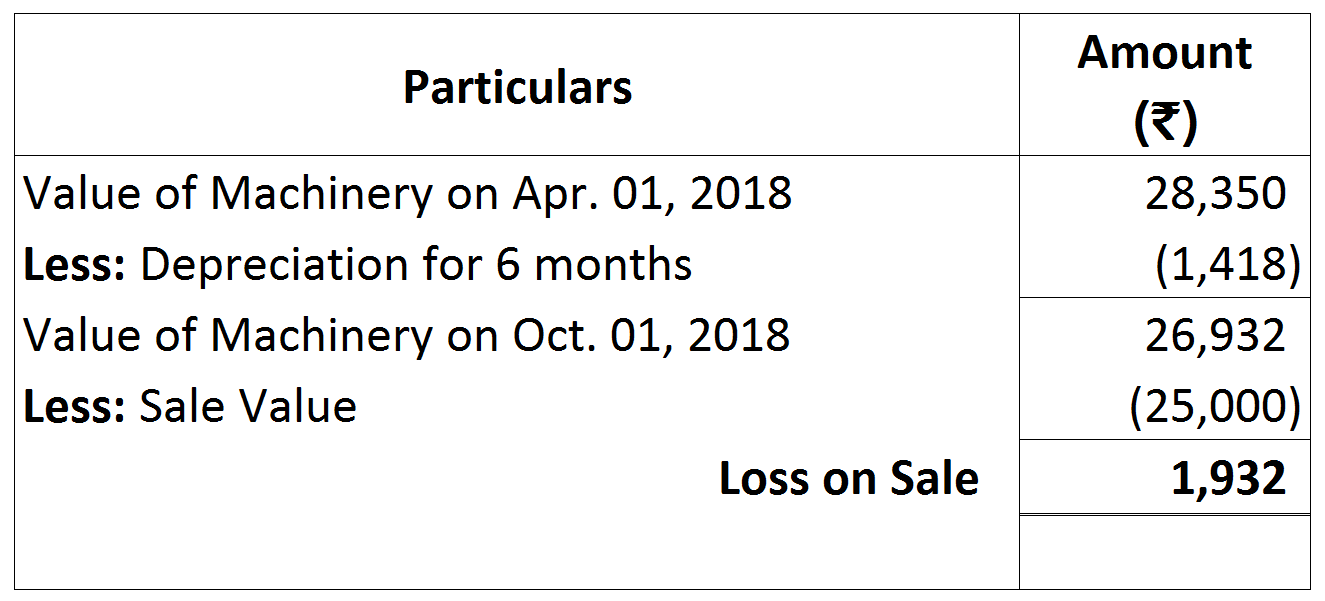
A Company purchased a second-hand machine on 1st April, 2016, for ₹ 30,000 and immediately spent ₹ 4,000 on its repair and ₹ 1,000 on its installation. On Oct. 1, 2018, the machine was sold for ₹ 25,000. Prepare Machine Account after charging depreciation @ 10% p.a. by diminishing balance method, assuming that the books are closed on 31st March every year. IGST was charged @12% on purchase and sale of machine.
Answer

Working Note: Calculation of Profit or Loss on Sale,
View full question & answer
Question 54 Marks
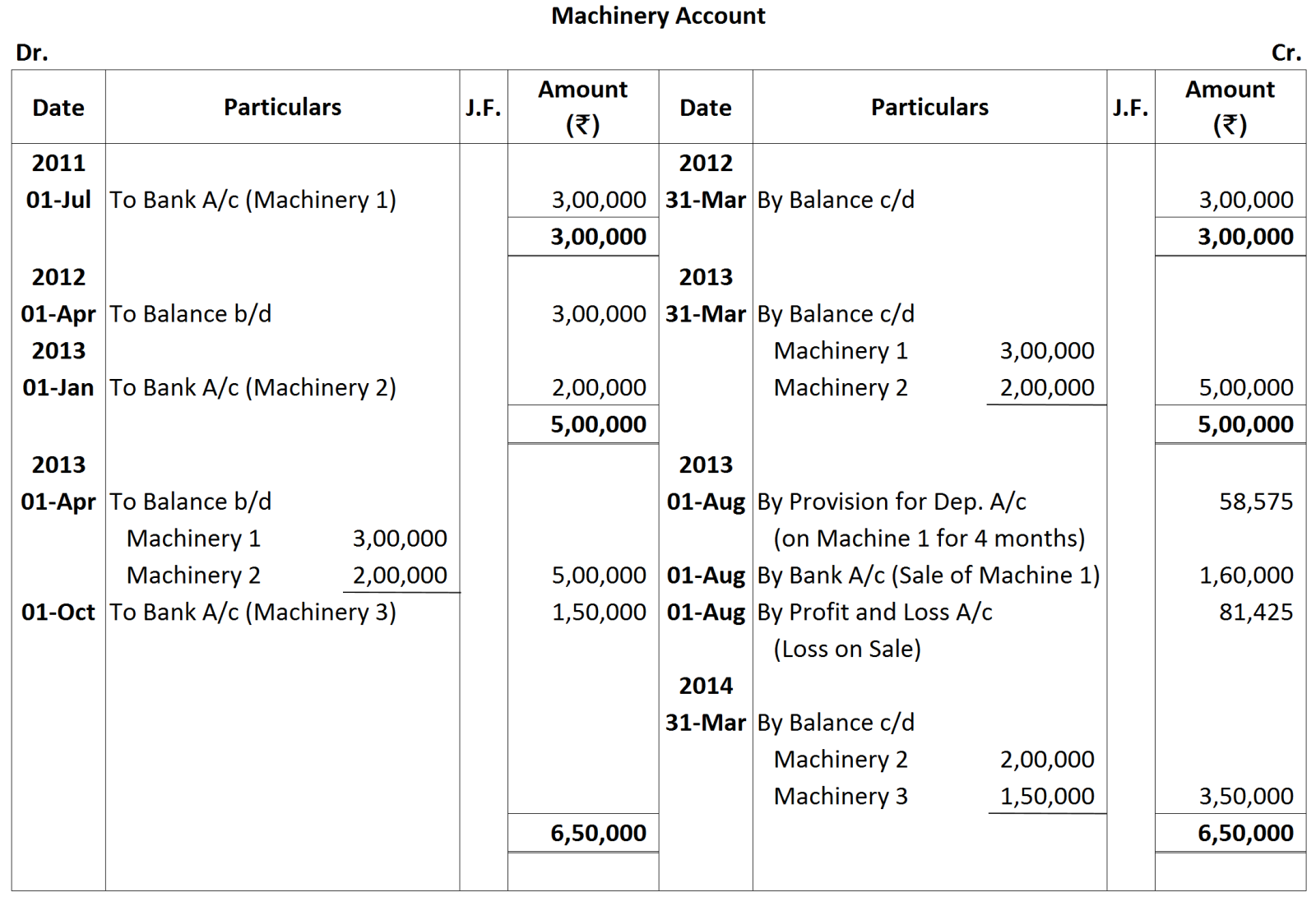
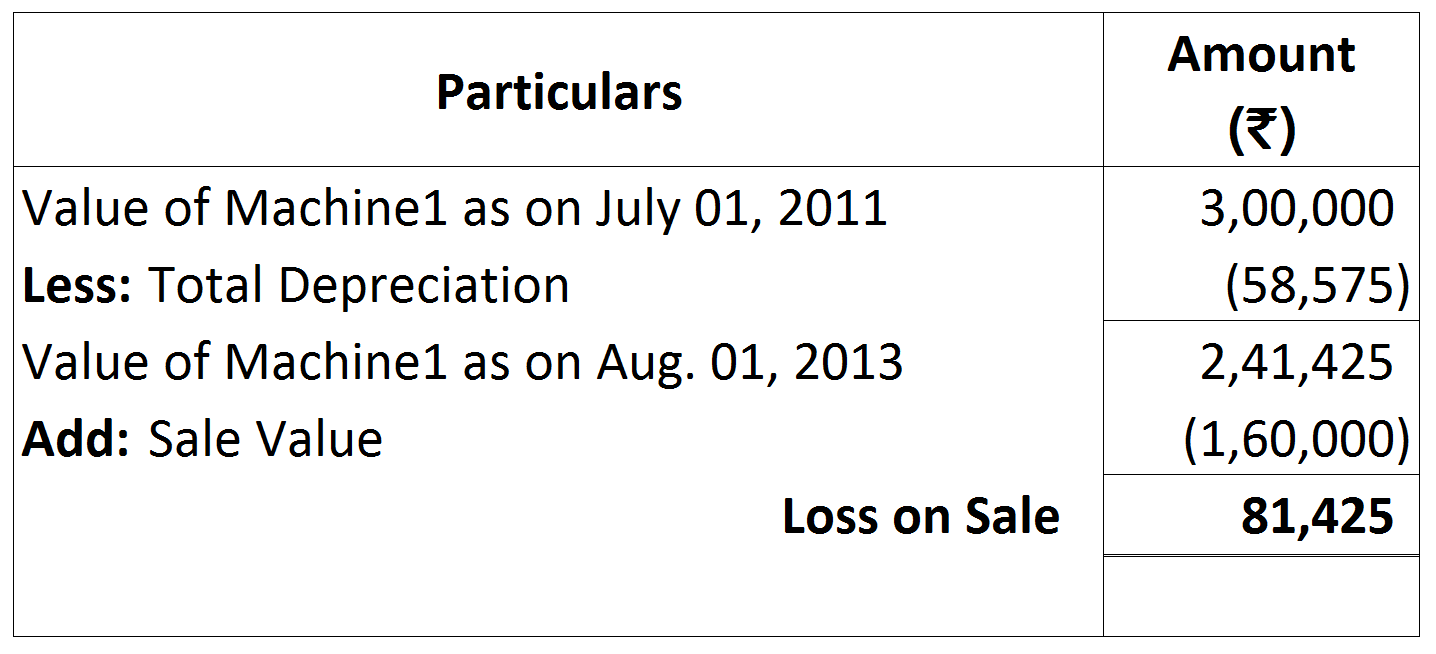
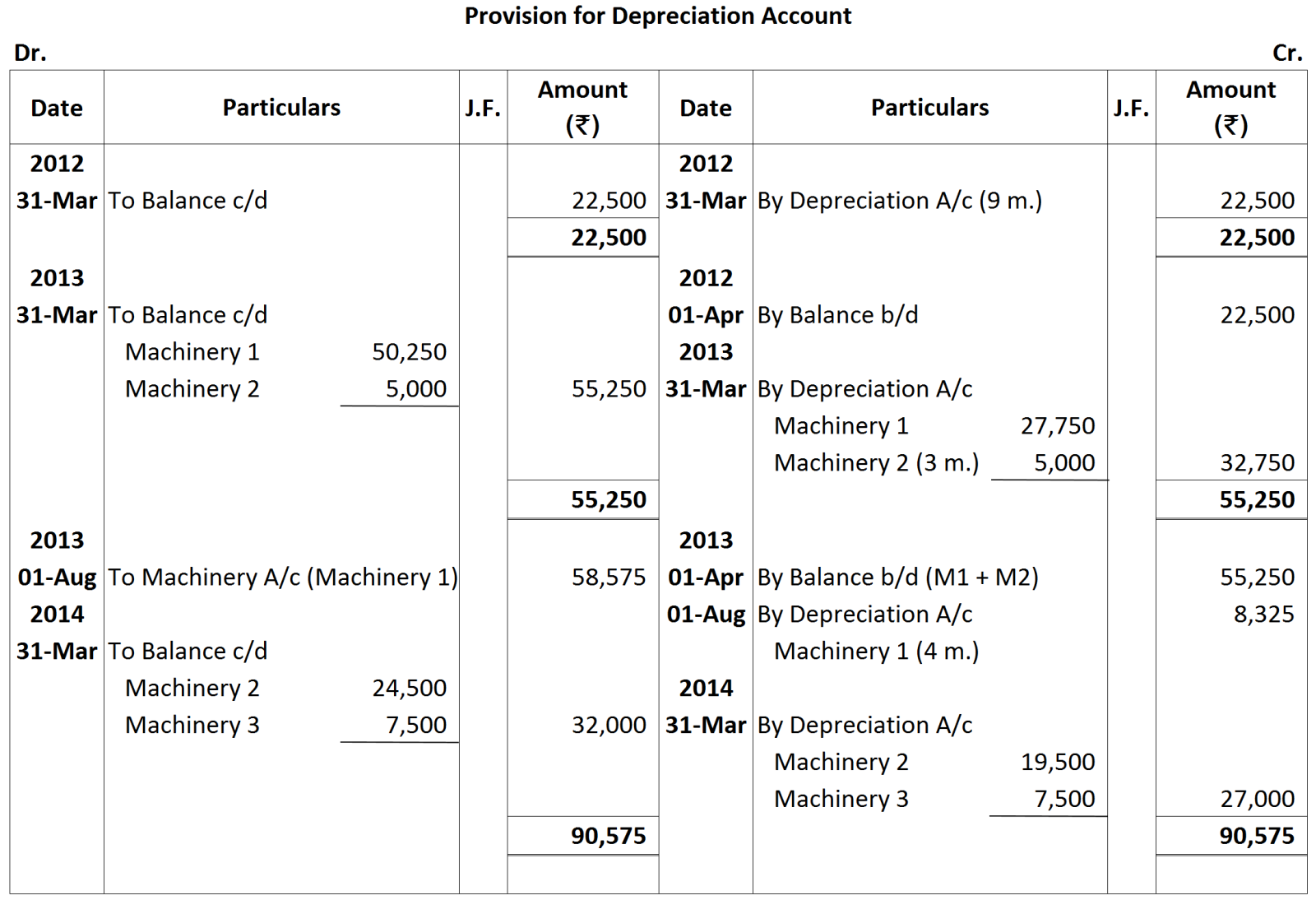
A Limited purchased a machine on 1st July 2011 for ₹ 3,00,000 and on 1st January 2013 bought another machinery for ₹ 2,00,000. On 1st August 2013 machine bought in 2011 was sold for ₹ 1,60,000. Another machine was bought for ₹ 1,50,000 on 1st October 2013. It was decided to provide depreciation @ 10% p.a. on written down value method assuming books are closed on 31st March each year. Prepare Machinery Account and Provision for depreciation account for 3 years.
Answer

Working Notes: Calculation of Profit or Loss on Sale,

View full question & answer
Question 64 Marks
State four merits of written down value method of providing depreciation.
Answer
Merits:
  1. Easy Calculation: It is easy to calculate the depreciation under this method, even if some new assets are purchased year after year. Different assets are grouped for the purpose of providing depreciation.
  2. Equal charge against income: In this method, the total burden on Profit & Loss Account in respect of depreciation and repairs put together remains almost equal year after year. This is so because in the initial years depreciation is more in comparison to repair charges whereas, in the later years, as the asset gets older, the amount of depreciation goes on decreasing while the expenses on repairs go on increasing, thus keeping the combined charge of depreciation and repairs almost uniform.
  3. No Undue pressure in later year: The efficiency and usefulness of a machine is more in the earlier years than in later years. Hence, the depreciation in first few years should be more in comparison to the later years. This is ensured by adopting the Diminishing Balance Method.
  4. Balance of asset is never written off to zero: This method ensures that the asset is never reduced to zero so that some depreciation, however small, is debited to Profit & Loss Account so long as the asset remains in use.
  5. Approved method by income Tax Authorities: This method of providing depreciation is permissible under Income Tax regulations.
View full question & answer
Question 74 Marks
Give four advantages of Straight Line Method of providing depreciation.
Answer
Advantages of Straight Line Method:
  1. It is a simple method of calculating the Depreciation.
  2. In this method, asset can be depreciated up to the estimated scrap value.
  3. In this method, it is easy to know the amount of Depreciation.
  4. Every year, the Profit and Loss Account is debited by the same amount of Depreciation, so there is same effect on the Profit and Loss Account every year.
View full question & answer
Question 84 Marks
Distinguish between “Straight Line Method' and 'Written Down Value Method' of providing depreciation.
Answer
 
Basis of Distinction
Straight Line or Original Cost Method
Witten Down Value Method
1.
Amount of depreciation.
Equal depraeciation charged every year.
Depreciation goes on decreasing year after year.
2.
Basis of calculation of depreciation.
Depreciation is charged on the original cost of the asset.
Depreciation is changed on the reducing balance of the asset.
3.
zero level.
The book value of the asset can be reduced to zero.
The book value of the asset can never be reduced to zero.
4.
Combined effect of depreciation and repairs on P & L A/c.
Combined burden on account of depreciation and repairs will be lighter in earlier years and heavier during the later years.
Combined burden on account of depreciation and repairs will be almost equal over different years.
View full question & answer
4 Marks Question - Account STD 11 Commerce Questions - Vidyadip