Question
Define diamagnetic, paramagnetic and ferromagnetic substance with examples. Explaining the meaning of domain explain ferromagnetism.
Answer

Diamagnetic Substances : Diamagnetic sub-stances are those which acquire feeble magnetisation in a direction opposite to that of magnetising field i.e. for these materials $\overrightarrow{ I }$ is always opposite to $\overrightarrow{ H }$. Therefore when these substances are brought close to a pole of a powerful magnet they are somewhat repelled away from the material. Due to this fact the susceptibility $(\chi)$ of these substances is negative.
Examples : Bismuth, antimony, gold, water, alcohol, quartz, copper, lead, zinc, tin, silicon, nitrogen, sodium-chloride etc.
Paramagnetic Substances : Paramagnetic sub-stances are those which, when placed in a magnetic field, acquire a feeble magnetisation in the same sense as the applied field. i.e. for these substances $\overrightarrow{ I }$ is always in the direction of $\overrightarrow{ H }$. Therefore, when these substances are brought close to any pole of a powerful magnet, they are attracted towards the magnet. Due to this fact the susceptibility of these substances is positive.
Examples : Platinum, aluminium chromium, manganese copper sulphate, solution of salts of iron and nickel, oxygen, crow glass, radium, copper chloride etc.
Ferromagnetic Substances : Those substances which when placed in a magnetic field are strongly magnetised in the direction of magnetising field are called ferromagnetic substances. For such substances $\overrightarrow{ I }$ is always in the direction of $\overrightarrow{ H}$ and $\overrightarrow{ I }$ is much greater than $\overrightarrow{H }$. Therefore when these substances are brought close to any pole of a magnet, they are strongly attracted by the magnet. Due to this fact the susceptibility \[(\chi\] = I/H) of ferromagnetic substances is positive and is very much greater than 1.
Examples : Iron, Cobalt, Nickel, Magnetite (Fe3O4) alloys like alnico etc.
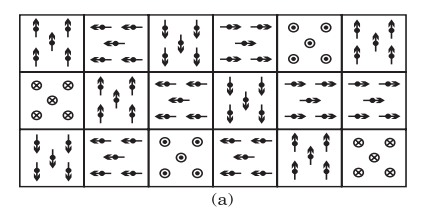
Explanation of Ferromagnetism : Like param-agnetic substance the atoms of ferromagnetic material also passess net magnetic moment and behave as a tiny magnetic dipole. The difference in paramagnetism and ferromagnetism is only that of intensify of magnetisation due to large magnetic moment in ferromagnetism substances. The atomic dipoles of ferromagnetic substance tend to align parallel to each other even in a weak magnetising field. The atomic dipoles are not independent of each other, in ferromagnetic substances but due to quantum mechanical mutual interaction the atoms in these substances form large number of small regions of size 10-4 cm to 1 cm containing 1017 to 1021 atomic dipoles. These regions are called domains. The atomic dipoles of one domain are aligned in the same direction but in different direction from the neighboring domain [Fig. (a)]. In this way each domain in the absence of any external magnetising field has net magnetic moment in a particular direction, but due to random orientation of different domains the resultant magnetic moment in the substance is zero. It is due to this fact that every piece of iron is not a magnet.
Image
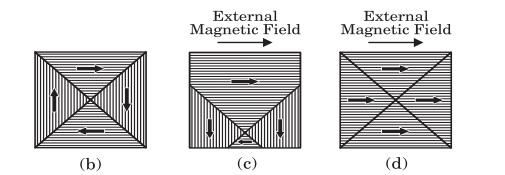
In Fig. (b) the probable directions of magnetic moment of four domains of a ferromagnetic substance are shown. When the ferromagnetic substance is placed in an external magnetising field the ferromagnetism can be increased in the following two ways :
Image
(i) By the displacement of the boundaries of the domains : When the external magnetising field is weak then the ferromagnetic substance is magnetised by this mechanism. In this mechanism the boundaries of the domains containing atomic magnetic dipoles oriented in the direction of external field increase in size, whereas those oriented in opposite direction to the field are reduced in size [Fig. (c)]. Here the ferromagnetic substance is magnetised strongly in the direction of external magn-etising field.
(ii) By the rotation of the domains : When the external magnetising field is strong then the ferromagnetic substance is magnetised by this mechanism. In this mechanism under the effect of strong magnetising field all the domains rotate until their magnetic momenta are aligned in the direction of external magnetic field [Fig. (d)]. Here the ferromagnetic substance is magnetised strongly in the direction of external magnetising field.

Need a full question paper?

Generate a complete, print-ready paper with questions like this in minutes — across 16+ boards, with answer keys.
Start Generating Free

Similar questions

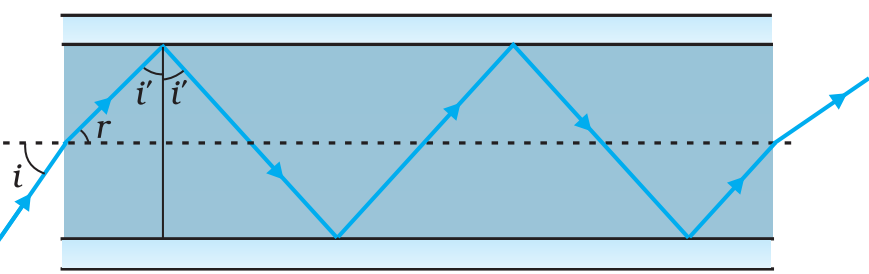
  1. a cross - section of a ‘light pipe’ made of a glass fibre of refractive. The outer covering of the pipe is made of a material of refractive. What is the range of the angles of the incident rays with the axis of the pipe for which total reflections inside the pipe take place, as shown in the figure.
  2. What is the answer if there is no outer covering of the pipe?

A converging lens of focal length 15cm and a converging mirror of focal length 10cm are placed 50cm apart. If a pin of length 2.0cm is placed 30cm from the lens farther away from the mirror, where will the final image form and what will be the size of the final image?
Suppose the space between the two inner shells of the previous problem is filled with a dielectric of dielectric coastant K. Find the capacitance of the system between A and B.
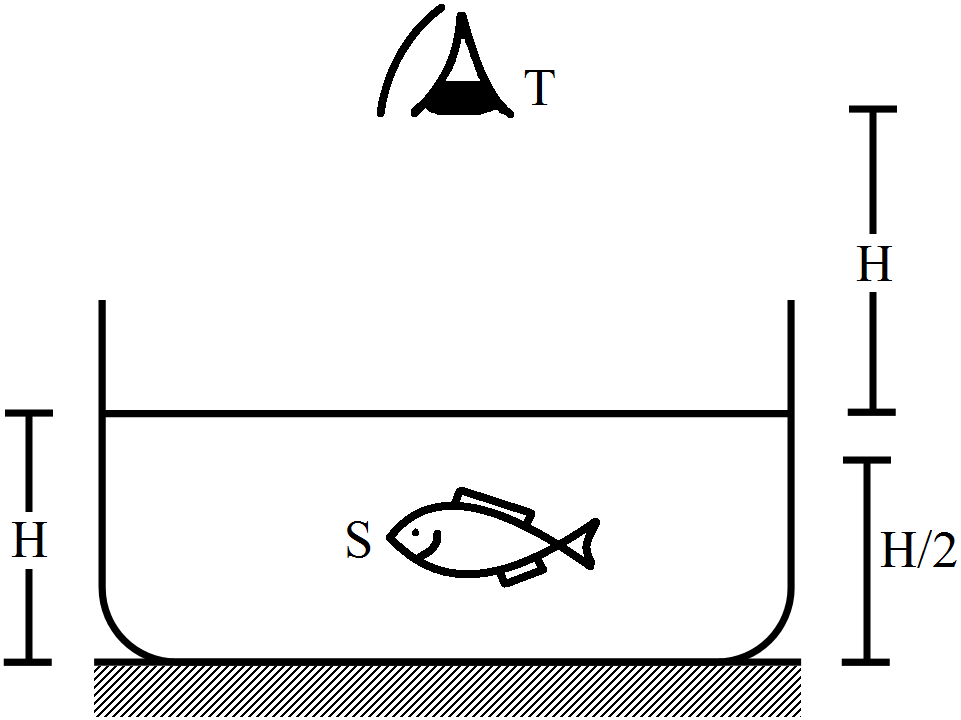
Consider the situation in figure. The bottom of the pot is a reflecting plane mirror, S is a small fish and T is a human eye. Refractive index of water is.
  1. At what distance(s) from itself will the fish see the image(s) of the eye?
  2. At what distance(s) from itself will the eye see the image(s) of the fish.

Seven rods A, B, C, D, E, F and G are joined as shown in figure. All the rods have equal cross-sectional area A and length l. The thermal conductivities of the rods are KA = Kc = K0, KB = KD = 2K0, K= 3K0, KF = 4K0, and KG = 5K0. The rod E is kept at a constant temperature T2 and the rod G is kept at a constant temperature T2(T2 > T1).

  1. Show that the rod F has a uniform temperature $\text{T}=\frac{(\text{T}_1+2\text{T}_2)}{3}.$
  2. Find the rate of heat flowing from the source which maintains the temperature T2.

A current i is passed through a silver strip of width d and area of cross-section A. The number of free electrons per unit volume is n.
  1. Find the drift velocity v of the electrons.
  2. If a magnetic field B exists in the region, as shown in the figure, what is the average magnetic force on the free electrons?
  3. Due to the magnetic force, the free electrons get accumulated on one side of the conductor along its length. This produces a transverse electric field in the conductor, which opposes the magnetic force on the electrons. Find the magnitude of the electric field which will stop further accumulation of electrons.
  4. What will be the potential difference developed across the width of the conductor due to the electron-accumulation? The appearance of a transverse emf, when a current-carrying wire is placed in a magnetic field, is called Hall effect.

A solenoid having inductance 4.0H and resistance $10\Omega$ is connected to a 4.0V battery at t = 0. Find
  1. The time constant.
  2. The time elapsed before the current reaches 0.63 of its steady-state value.
  3. The power delivered by the battery at this instant.
  4. The power dissipated in Joule heating at this instant.
Two charged conducting spheres of radii a and b are connected to each other by a wire. What is the ratio of electric fields at the surfaces of the two spheres? Use the result obtained to explain why charge density on the sharp and pointed ends of a conductor is higher than on its flatter portions.
Find the equation of the equipotentials for an infinite cylinder of radius r0, carrying charge of linear density $\lambda$.
equiconvex lens (of refractive index 1.50) in contact with a liquid layer on top of a plane mirror. A small needle with its tip on the principal axis is moved along the axis until its inverted image is found at the position of the needle. The distance of the needle from the lens is measured to be 45.0 cm. The liquid is removed and the experiment is repeated. The new distance is measured to be 30.0 cm. What is the refractive index of the liquid?