Question
Define ecological pyramids and describe with examples, pyramids of number and biomass.

Answer

If the first trophic level of the ecosystem is considered as the base and successively different trophic levels are shown into the picture, then it appears like a pyramid shaped diagram. These are called ecological pyramid
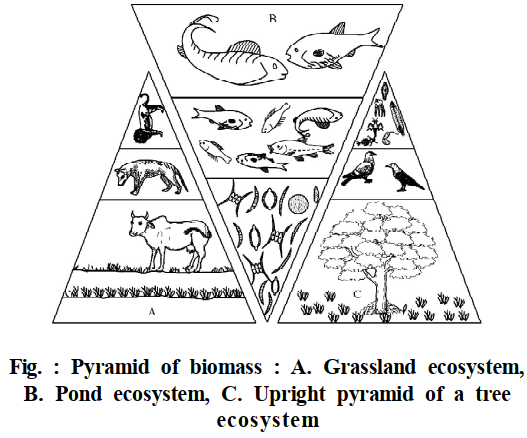
(i) Pyramid of Biomass : The total amount of dry weight of living organic matter in an ecosystem at any time is called biomass. Another ecological pyramid to represent the food chain and interrelationship of organisms at each trophic level in the ecosystem is pyramid of biomass.
The graphical representation showing the total biomass present sequence-wise per unit area of primary producers and consumers of different trophic levels in the ecosystem is called pyramid of biomass. Pyramid of biomass is a straight or upright pyramid in terrestrial ecosystem which shows that biomass is maximum at the level of producers and there is progressive decrease in biomass from lower to higher trophic levels. Pyramid of biomass is straight for grassland ecosystem, forest ecosysten and tree ecosystem.
But in aquatic ecosystem, pyramid of biomass is inverted which shows biomass at the level of producers is minimum and increases from lower to higher trophic levels. Biomass of phytoplankton is less than that of zooplanktons in which it is less than that of secondary consumers.
Image
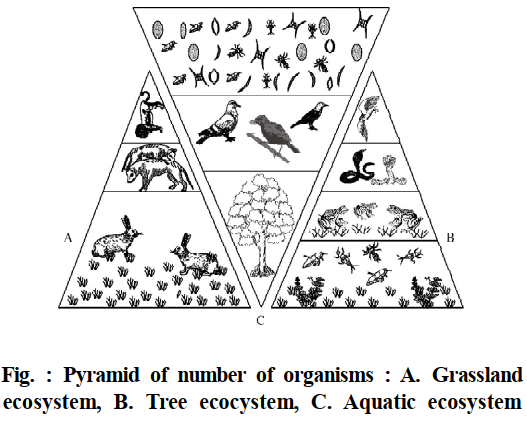
(ii) Pyramid of Numbers of Orgaisms: The graphical representation showing the arrangement of numbers of individuals of different trophic levels (Producers, primary, secondary and tertiary consumers) in an ecosystem is called the pyramid of numbers of organisms.
Food chain in grassland ecosystem and pond ecosystem, the pyramid of number is a straight pyramid. Here, the number of organisms decrease with each trophic level from producer level to the top carnivore level. In this the number of producers is maximum, then number of primary, secondary and tertiary consumers decrease respectively and thereby the number of top consumers is the least. In grassland ecosystem producers are mainly the grasses which are maximum in number but number of consumers at each trophic level continuously decrease. That is why pyramid of number is straight. In forest ecosytem the shape of pyramid of number is of a different type because the producers are mainly large sized trees but are less in numbers. There occurs continious decrease in the number of herbivorous consumers, yet it is straight.
Number of pyramid for pond ecosystem is upright. Phytoplanktons are main producers which are maximum in number and number of organisms decreases in food chain from producers to large fish.
Pyramid of numbers is inverted for large tree ecosystem because the number of organisms increases from producer level to consumer levels. Similarly in parasitic food chain pyramid of number is inverted because a single plant is sufficient for the growth of many parasites which are capable of providing nutrition to hyperparasites.
Image

Need a full question paper?

Generate a complete, print-ready paper with questions like this in minutes — across 16+ boards, with answer keys.
Start Generating Free

Similar questions