Question
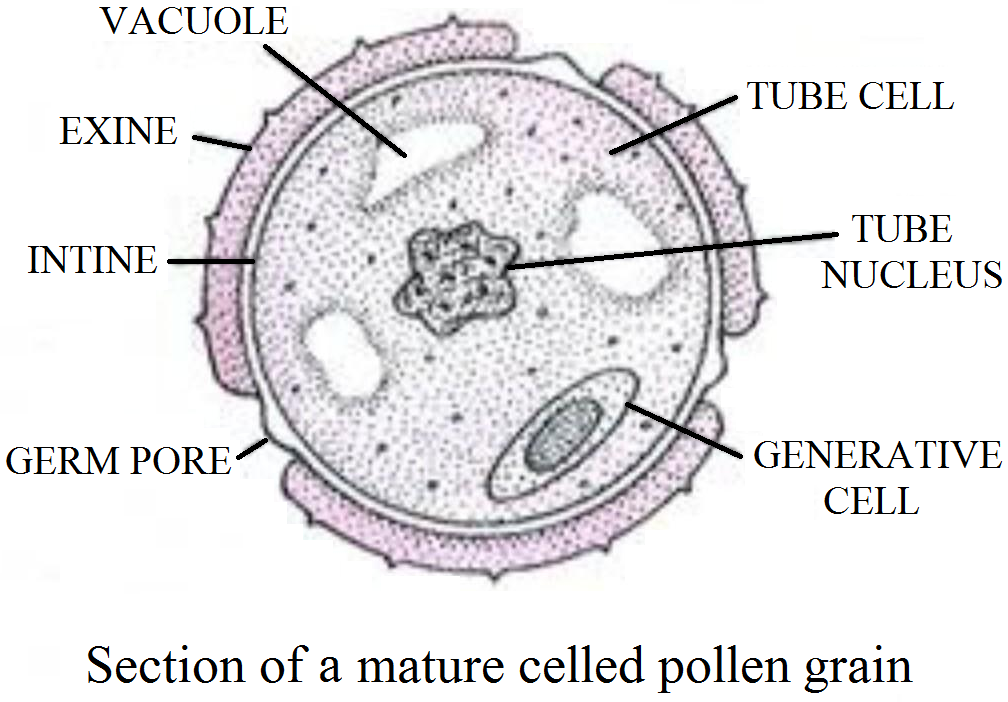
What develops into a microspore mother cell in a flower? Trace the development of this cell into a pollen grain which is ready for germination. Draw a labelled figure of a mature pollen grain.

Answer

Sporogenous cell divide and ultimately transformed into microspore mother cells. Microspore mother cells develop an internal layer of callose which breaks the plasmodesmal connections among themselves. The separated mother cells round off and undergo meiosis to produce tetrads of haploid microspores or pollen grains.

For the structure and development of pollen grain:

Pollen grains or microspores are generally spherical in outline. The wall of pollen grain is called sporoderm, which is made up of two layers-An outer thick exine and an inner thin intine. 

The exine is made up of sporopollenin which is biologically the most resistant substance and can withstand high temperature and strong acids and alkali. At one or more places, the exine is very thin or absent. These regions are called germ pores. 

Intine is continuous layer made up of cellulose and pectin. A mature pollen grain has two cells-a vegetative cell and a generative cell. The vegetative cell is bigger and has food reserve and a large irregular nucleus. The generative cell is small, spindle shaped and floats in the cytoplasm of vegetative cell. In dicots, pollen grains are with three germ pores, while in monocots, they are with single germinal furrow.
Need a full question paper?

Generate a complete, print-ready paper with questions like this in minutes — across 16+ boards, with answer keys.

Start Generating Free

Similar questions

What is the role of animal husbandary in human welfare? Explain with examples.
Explain the process of replication of a retrovirus after it gains entry into human body.
How does a chromosomal disorder differ from a Mendelian disorder?
  1. A primary succession start on a bare rock and reach a climax community
Why are colour blindness and thalassemia categorised as Mendelian disorders? Write the symptoms of these diseases seen in people suffering from them.
Explain the mechanism of sex determination in human being.
What essential features must be present in a cloning vector?
Read the following and answer any four questions from (i) to (v) given below:

Plants having foreign genes in their genome through genetic engineering are called transgenic plants. Genes can be incorporated either through a vector or through direct introduction of DNA. Bt cotton is a genetically modified organism which is pest resistant. It contain gene cry I Ac and cry II Ab of Bacillus thuringiensis. It is used to control lepidopterans, coleopterans and dipterans. Bt cotton can resist cotton bollworm and produce higher yields. Cry gene produces cry protein or Bt toxin. It is an endotoxin which remains as protoxin in plants and converted to active toxin after getting ingested by the insects. Alkaline pH of the insect gut solubilises the protein crystals, the activated toxin creates pores to the mid guts wall of the insects which cause them to death.

  1. Bt cotton crops are:
  1. Fungal resistant.
  2. Insect resistant.
  3. Drought resistant.
  4. All of these.
  1. Cotton bollwonns are killed by the protein encoded by the gene:
  1. cry I Ac
  2. cry I Ab
  3. cry I Ab
  4. Both (a) and (c).
  1. Which of the following is not an advantage of GM crops?
  1. GM plants enhance nutritional value of food.
  2. GM plants are more tolerant to abiotic stresses.
  3. GM plants have helped to reduce post harvest losses.
  4. GM plants can cause gene transfer to non-target plant species.
  1. Bacillus thuringiensis is a:
  1. Air borne bacteria.
  2. Soil borne bacteria.
  3. Soil borne fungus.
  4. Food borne bacteria.
  1. Assertion: Cotton bollworms are killed by ingesting the leaves of the transgenic plant.

Reason: Bt toxin binds with the midgut wall of the insect and make pores in them.

  1. Both assertion and reason are true and reason is the correct explanation of assertion.
  2. Both assertion and reason are true but reason is not the correct explanation of assertion.
  3. Assertion is true but reason is false.
  4. Both assertion and reason are false.
(A) Give short note on cell mediate immunity.###(b) What are the basic principles of immunology and their Applications.
The following is the illustration of the sequence of ovarian events (a – i) in a human female.

Explain the changes that occur in the uterus simultaneously in anticipation.