Question
Define escape speed and derive the expression for escape velocity on earth's surface.

Answer

  1. The minimum speed required for an object to reach infinity (i.e., to get escape from earth gravitational pull) is called escape velocity.
  2. $\frac{1}{2}\text{m}\Big(\text{v}_{\text{i}}^2\Big)_{\text{e}}=\frac{\text{GmM}_{\text{p}}}{\text{h}+\text{R}_{\text{p}}}$
$\begin{bmatrix}\text{where M}_{\text{p}}=\text{Mass of planet}\\\ \ \ \ \ \ \ \ \ \ \text{R}_{\text{p}}=\text{Radius of planet}\end{bmatrix}$
If the object is thrown from surface of a planet h = 0, we get
$(\text{v}_{\text{i}})_{\text{e}}=\sqrt{\frac{2\text{GM}_{\text{p}}}{\text{R}_{\text{p}}}}$
$\text{but }\text{g}=\frac{\text{GM}_{\text{p}}}{\text{R}_{\text{p}}}\text{ we get}$
$(\text{v}_{\text{i}})_{\text{e}}=\sqrt{2\text{gR}_{\text{p}}}$
  1. Depends on location as 'g' varies with location, as most of the celestial bodies are not perfectly spherical.

Need a full question paper?

Generate a complete, print-ready paper with questions like this in minutes — across 16+ boards, with answer keys.
Start Generating Free

Similar questions

Calculate the number of beats heard per second is there are three sources of sound of frequencies 400, 401 and 402 of equal intensity sounded together.
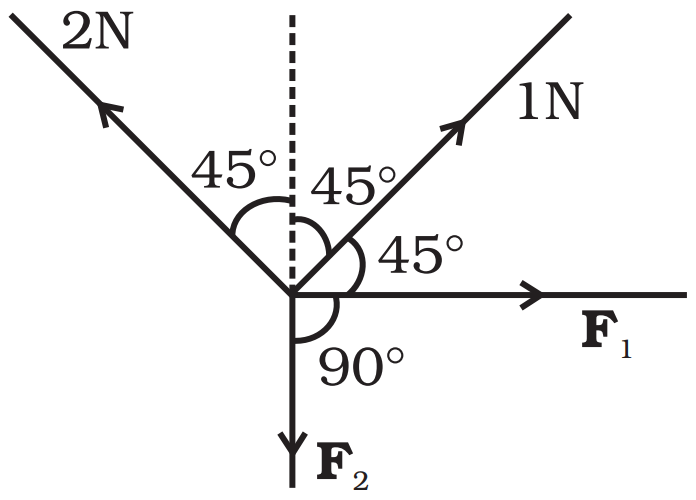
There are four forces acting at a point P produced by strings as shown in which is at rest. Find the forces $F_1$ and $F_2$.
Draw a graph to show the variation of P.E., K.E. and total energy of a simple harmonic oscillator with displacement.
An inductor-coil of resistance $10\Omega$ and induetanes 120mH is connected across a battery of emf 6V and Internal resistance $2\Omega.$ Find the charge which flows through the inductor in:
  1. 10ms
  2. 20ms
  3. 100 ms after the connections are made.
A stream of water flowing horizontally with a speed of $15ms^{-1}$ gushes out of a tube of cross-sectional area $10^{-2}m^2$, and hits a vertical wall nearby. What is the force exerted on the wall by the impact of water, assuming it does not rebound?
A current of $1.0A$ exists in a copper wire of cross-section $1.0mm^2$. Assuming one free electron per atom, calculate the drift speed of the free electrons in the wire. The density of copper is $9000kg/m^{-3}$.
Three equal masses m are placed at the three corners of an equilateral triangle of side a. Find the force exerted by this system on another particle of mass m placed at,
  1. The mid-point of a side,
  2. At the centre of the triangle.
A sitar wire is under a tension of 40N and the length between the bridges is 70cm. A 5m sample of the wire has a mass of 1.0g. Deduce the speed of transverse waves on the wire, frequency of the fundamental and the frequency of the first two harmonics.
State first law of thermodynamics. On the basis of this establish the relation between two molar specific heats for an ideal gas.
The $\text{K}_\alpha$ and $\text{K}_\beta$ X-rays of molybdenum have wavelengths 0.71A and 0.63A respectively. Find the wavelength of $\text{L}_\alpha$ X-ray of molybdenum.