Question
Define heat conduction and coefficient of thermal conductivity.

Answer

Heat conduction : The process of energy transfer from one part of a solid to another at lower temperature without actual movement of molecules in called heat conduction.
Coefficient of Thermal Conductivity : The flow of heat energy per second from opposites faces of unit positive when the opposite faces are at a temperature difference of one $\text K$ or $1^{\circ}\text C $ at a unit distance is called coefficient of thermal conductivity.

Need a full question paper?

Generate a complete, print-ready paper with questions like this in minutes — across 16+ boards, with answer keys.
Start Generating Free

Similar questions

A monkey climbs up a slippery pole for 3 seconds and subsequently slips for 3 seconds. Its velocity at time t is given by v(t) = 2t(3 - t); 0 < t < 3 and v(t) = -(t - 3)(6 - t) for 3 < t < 6s in m/s. It repeats this cycle till it reaches the height of 20m.
At what time is its velocity maximum?
If oil of density higher than that of water is used in place of water in a resonance tube, how does the frequency change?
What are isochronous vibrations?
When two bodies having temperatures T1 and T2 are brought in contact, then the temperature of this system may not be $\frac{(\text{T}_1+\text{T}_2)}{2}$ Explain why?
The length and breadth of a rectangle are measured as $(\text{a}\pm\Delta\text{a})$ and $(\text{b}\pm\Delta\text{b})$ respectively. Find:
  1. Relative error.
  2. Absolute error in the measurement of area.
You have learnt that a travelling wave in one dimension is represented by a function y = f(x, t) where x and t must appear in the combination x – v t or x + v t, i.e. y = f (x ± v t). Is the converse true? Examine if the following functions for y can possibly represent a travelling wave:
  1. (x – vt)2
  2. log[(x + vt)/x0]
  3. 1/(x + vt)
A book is lifted from the floor and is kept in an almirah. One person says that the potential energy of the book is increased by 20J and the other says it is increased by 30J. Is one of them necessarily wrong?
A disturbance pulse takes 0.2 second to travel across a long wire and return. Tension is created in the wire by continuously hanging a weight 100 times the total weight of the wire on a pulley. Find the total length of the wire. Here g = 9.8 m/s.
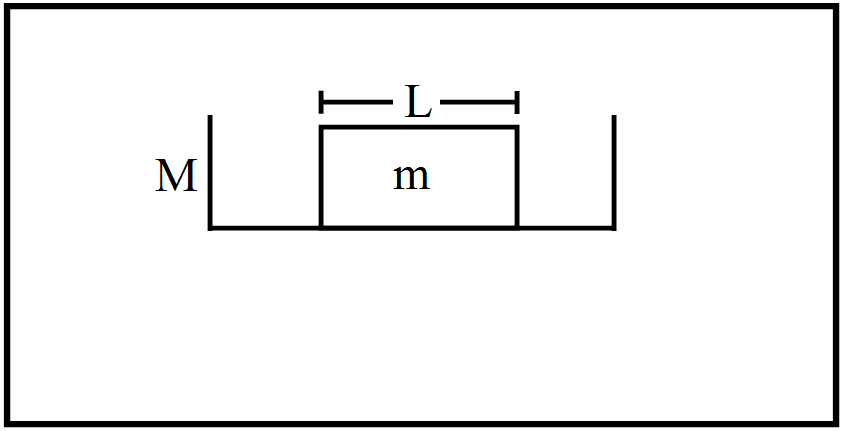
Consider a gravity-free hall in which a tray of mass M, carrying a cubical block of ice of mass m and edge L, is at rest in the middle. If the ice melts, by what distance does the centre of mass of "the tray plus the ice" system descend?

A current of 10A is established in a long wire along the positive z-axis. Find the magnetic field $\overrightarrow{\text{B}}$ at the point (1m, 0, 0).