Question
What are isochronous vibrations?

Answer

When the time period is independent of amplitude, the oscillation is called isochronous.

Need a full question paper?

Generate a complete, print-ready paper with questions like this in minutes — across 16+ boards, with answer keys.
Start Generating Free

Similar questions

Explain why:
The coolant in a chemical or a nuclear plant (i.e., the liquid used to prevent the different parts of a plant from getting too hot) should have high specific heat.
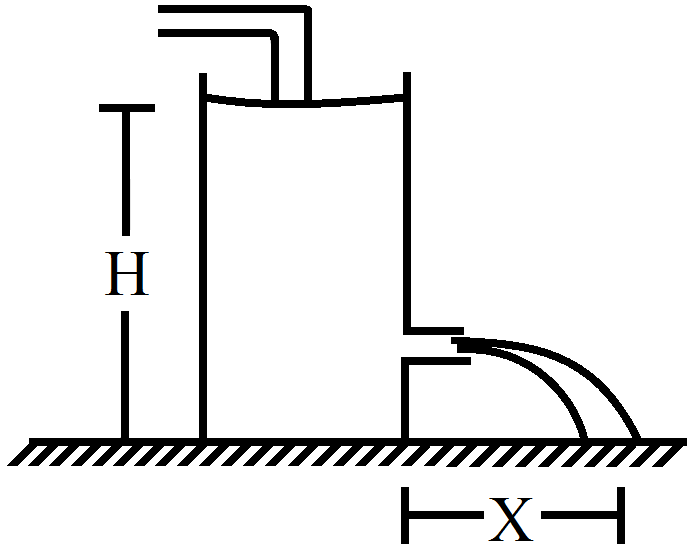
Water level is maintained in a cylindrical vessel upto a fixed height H. The vessel is kept on a horizontal plane. At what height above the bottom should a hole be made in the vessel so that the water stream coming out of the hole strikes the horizontal plane at the greatest distance from the vessel.

The electric current in a charging R-C circuit is given by $\text{i}=\text{i}_0\text{e}^{-\frac{\text{t}}{\text{RC}}}$ where $\text{i}_0,$ R and C are constant parameters of the circuit and t is time. Find the rate of change of current at
  1. t = 0.
  2. t = RC.
  3. t = 10RC.
As temperature increases, the viscosity of liquids decreases considerably. Will this decrease the resistance of an electrolyte as the temperature increases?
Why do the passengers fall in backward direction when a bus suddenly starts moving from the rest position?
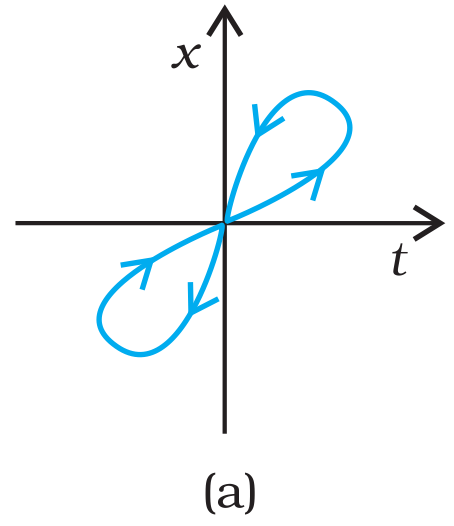
Look at the graphs carefully and state, with reasons, which of these cannot possibly represent one-dimensional motion of a particle.

A block of mass 0.2kg is suspended from the ceiling by a light string. A second block of mass 0.3kg is suspended from the first block through another string. Find the tensions in the two strings. Take g = 10m/s2.
Write the time period formula of a simple pendulum. Which factor affect the period?
What is the physical reason to take both +1 and -1 as the cosine maxima in beats formation?
A tennis ball of mass 'm' strikes a massive wall with a velocity V and traces back the same path. Calculate the change in momentum of the ball due to the wall.