Question 15 Marks
Describe the hybridisation in case of $PCl_5$ . Why are the axial bonds longer as compared to equatorial bonds?
AnswerFormation of $PCl_5 (sp^3d$ hybridisation):
The ground state and the excited state outer electronic configurations of phosphorus (Z = 15) are represented here.
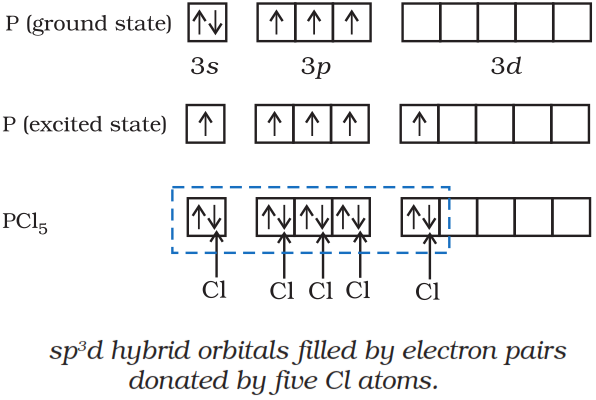
Now the five orbitals (i.e., one s, three p and one d orbital) are available for hybridisation to yield a set of five $sp^3d$ hybrid orbitals which are directed towards the five corners of a trigonal bipyramid as depicted in the figure.
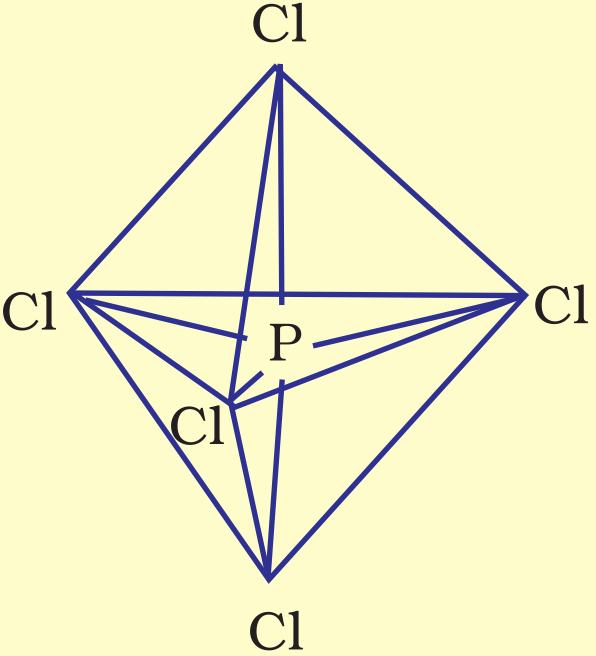
All the bond angles in trigonal bipyramidal geometry are not equivalent. In $PCl_5$ the five $sp^3d$ orbitals of phosphorus overlap with the singly occupied p orbitals of chlorine atoms to form five P-Cl sigma bonds. Three P-Cl bonds lie in one plane and make angle of $120°$ with each other; these bonds are termed as equatorial bonds. The remaining two P-Cl bonds, one lying above and the other lying below the equatorial plane, make an angle of $90°$ with the plane. These bonds are called axial bonds. As the axial bond pairs suffer more repulsive interaction from the equatorial bond pairs, therefore axial bonds have been found to be slightly longer and hence slightly weaker than the equatorial bonds. View full question & answer→Question 25 Marks
What is meant by the term bond order? Calculate the bond order of : $\text{N}_2,\text{O}_2,\text{O}_2^+$ and $\text{O}_2^-$
AnswerBond order of a molecule or an ion is a measure of the strength or stability of the bond. Numerically, it is half of the difference between number of electrons in bonding $(N_b)$ and in anti-bonding $(N_a)$ molecular orbitals. Bond order $=\frac{1}{2}(\text{N}_\text{b}-\text{N}_\text{a})$ If B.O. is zero or negative, the bond is highly unstable, i.e. the molecule does not exist. Higher bond order means high bond dissociation energy and greater stability. Greater the bond order, lesser is the bond length. M.O. configuration of $N_2$: $\text{KK}\sigma(2\text{s})^2\sigma^*(2\text{s})^2\pi(2\text{p}_\text{x})^2=\pi(2\text{p}_\text{y})\sigma(2\text{p}_\text{z})$ Bond order $=\frac{1}{2}(8-2)=3$ Thus, nitrogen molecule has three bonds, one sigma and two pi. the molecule is diamagnetic.M.O. comfiguration $O_2$:
$\text{KK}\sigma (2\text{s})^2\sigma^*(2s)^2\sigma(2\text{p}_\text{x})^2=\pi(2\text{p}_\text{y})^2$
thus, nitrogen molecule has three bonds, one sigma and two pi. the molecule is diamagnetic.$\text{KK}\sigma (2\text{s})^2\sigma^*(2\text{s})^2\sigma(2\text{p}_\text{z})^2\pi(2\text{p}_\text{x})^2$ $=\pi(2\text{p}_\text{y})^2\pi^*(2\text{p}_\text{x})^1=\pi^*(2\text{p}_\text{y})^1$
[Note : $\sigma(2\text{p}_\text{z})$ is filled first and then $\pi(2\text{p}_\text{x})$and $\pi(2\text{p}_\text{y})$molecular orbitals are filled.] Bond order$=\frac{(8-4)}{2}=2$The oxygen molrcule has two bonds (one sigma and one pi). The molecule is paramagnetic.
$\text{KK}\sigma(2\text{s})^2\sigma^*(2\text{s})^2\sigma(2\text{p}_\text{z})^2\pi(2\text{p}_\text{x})^2=\pi(2\text{p}_\text{y})^2\pi^*(2\text{p}_\text{x})^1$ Bond order $=\frac{8-3}{2}=2.5$ M.O. configuration of $\text{O}_2^-$: $\text{KK}\sigma(2\text{s})^2\sigma^*(2\text{s})^2\sigma(2\text{p}_\text{z})^2\pi(2\text{p}_\text{x})^2$ $=\pi(2\text{p}_\text{y})^2\pi^*(2\text{p}_\text{x})^2=\pi^*(2\text{p}_\text{y})^1$ Bond order $\frac{(8-5)}{2}=1.5$
View full question & answer→Question 35 Marks
Compare the relative stability of the following species and indicate their magnetic properties;$\text{O}_2,\text{O}_2^+,\text{O}^-_2$ (superoxide), $\text{O}^{2-}_2$ (peroxide)
AnswerThere are 16 electrons in a molecule of dioxygen, 8 from each oxygen atom. The electronic configuration of oxygen molecule can be written as: $[\sigma-(1\text{s})]^2[\sigma^*(1\text{s})]^2[\sigma(2\text{s})]^2[\sigma^*(2\text{s})]^2[\sigma(1\text{p}_\text{z})]^2[\ \pi^*(2\text{p}_\text{x})]^2[\pi^*(2\text{p}_\text{y})]^2[\pi^*(\text{p}_\text{x})]^1[\pi^*(2\text{p}_\text{y})]^1$ Since the 1s orbital of each oxygen atom is not involved in boding, the number of bonding electrons = 8 = $N_b$ and the number of anti-bonding orbitals = 4 = $N_a$. Bond order $=\frac{1}{2}(\text{N}_b-\text{N}_\text{a})$ $=\frac{1}{2}(8-4)$$= 2$
$\text{KK}[\sigma(2\text{s})]^2[\sigma^*(2\text{s})]^2[\sigma(2\text{p}_\text{z})]^2[\pi(2\text{p}_\text{x})]^2[\pi^(2\text{p}_\text{y})]^2[\pi^*2\text{p}_\text{x}]^1 $$\text{N}_\text{b}=8\\ \text{N}_\text{a}=3$
Bond order of $\text{O}^+_2=\frac{1}{2}(8-3)$$=2.5$
Electronic configuration of $\text{O}_2^-$ion will be:
$\text{KK}[\sigma(2\text{s})]^2[\sigma^*(2\text{s})]^2[\sigma(2\text{p}_\text{z})]^2[\pi(2\text{p}_\text{x})]^2[\pi^(2\text{p}_\text{y})]^2[\pi^*2\text{p}_\text{x}]^2[\pi^*(\text{p}_\text{y})]^1$$\text{N}_\text{b}=8\\\text{N}_\text{a}=5$
Bond order of $\text{O}^{2-}_2=\frac{1}{2}(8-6)$ $=1.5$Electronic configuration of $\text{O}^{2-}_2$ ion will be:
$\text{KK}[\sigma(2\text{s})]^2[\sigma^*(2\text{s})]^2[\sigma(2\text{p}_\text{z})]^2[\pi(2\text{p}_\text{x})]^2[\pi^(2\text{p}_\text{y})]^2[\pi^*2\text{p}_\text{x}]^2[\pi^*(\text{p}_\text{y})]^2$ $\text{N}_\text{b}=8\\\text{N}\text{a}=6$ Bond order of $\text{O}^{2-}_2=\frac{1}{2}(8-6)$ $=1$ c $\text{O}^+_2>\text{O}_2>\text{O}^-_2>\text{O}^{2-}2.$
View full question & answer→Question 45 Marks
What is meant by hybridisation of atomic orbitals? Describe the shapes of $sp, sp^2 , sp^3$ hybrid orbitals.
AnswerHybridization is defined as an intermixing of a set of atomic orbitals of slightly different energies, thereby forming a new set of orbitals having equivalent energies and shapes.
For example, one 2s-orbital hybridizes with two 2p-orbitals of carbon to form three new $0sp^2$ hybrid orbitals.
These hybrid orbitals have minimum repulsion between their electron pairs and thus, are more stable. Hybridization helps indicate the geometry of the molecule.
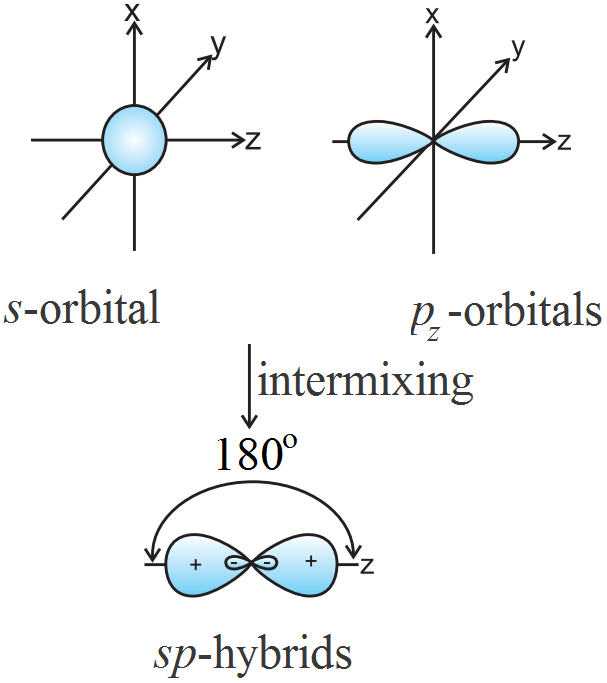
Shape of sp hybrid orbitals: sp hybrid orbitals have a linear shape. They are formed by the intermixing of s and p orbitals as:
Shape of $sp^2$ hybrid orbitals:
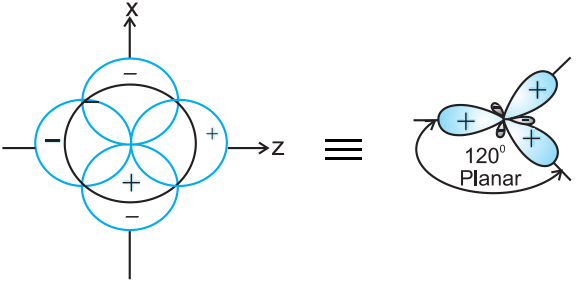
$sp^2$ hybrid orbitals are formed as a result of the intermixing of one s-orbital and two 2p-orbitals. The hybrid orbitals are oriented in a trigonal planar arrangement as:
Shape of $sp^3$ hybrid orbitals:
Four $sp^3$ hybrid orbitals are formed by intermixing one s-orbital with three p-orbitals. The four $sp^3$ hybrid orbitals are arranged in the form of a tetrahedron as:
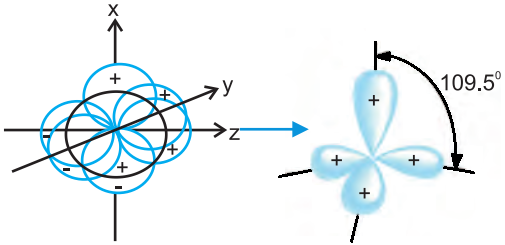
View full question & answer→Question 55 Marks
Draw diagrams showing the formation of a double bond and a triple bond between carbon atoms in $\mathrm{C}_2 \mathrm{H}_4$ and $\mathrm{C}_2 \mathrm{H}_2$ molecules.
Answer$\mathrm{C}_2 \mathrm{H}_4$ :
The electronic configuration of C -atom in the excited state is:
In the formation of an ethane molecule $\left(\mathrm{C}_2 \mathrm{H}_4\right)$, one $\mathrm{sp}^2$ hybrid orbital of carbon overlaps a $\mathrm{sp}^2$ hybridized orbital of another carbon atom, thereby forming a $\mathrm{C}-\mathrm{C}$ sigma bond.
The remaining two $\mathrm{sp}^2$ orbitals of each carbon atom form a $\mathrm{sp}^2$-s sigma bond with two hydrogen atoms. The unhybridized orbital of one carbon atom undergoes sidewise overlap with the orbital of a similar kind present on another carbon atom to form a weak $\pi$-bond.
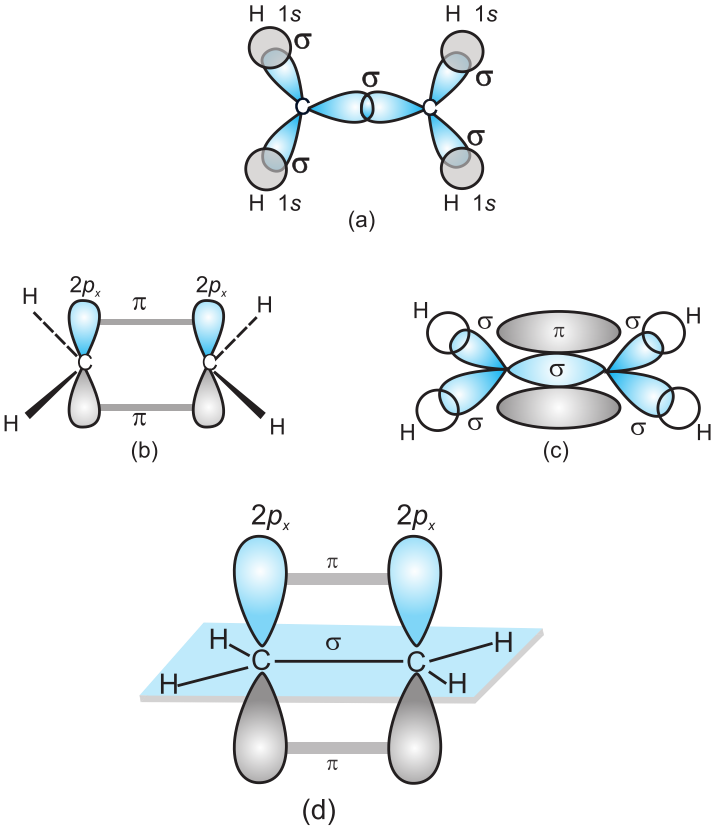
$\mathrm{C}_2 \mathrm{H}_2$ :
In the formation of $\mathrm{C}_2 \mathrm{H}_2$ molecule, each C -atom is sp hybridized with two 2 p -orbitals in an unhybridized state. One sp orbital of each carbon atom overlaps with the other along the internuclear axis forming a $\mathrm{C}-\mathrm{C}$ sigma bond. The second sp orbital of each C -atom overlaps a half-filled 1 s -orbital to form a $\sigma$ bond.
The two unhybridized $2 p$-orbitals of the first carbon undergo sidewise overlap with the $2 p$ orbital of another carbon atom, thereby forming two pi ( $\pi$ ) bonds between carbon atoms. Hence, the triple bond between two carbon atoms is made up of one sigma and two $\pi$-bonds.
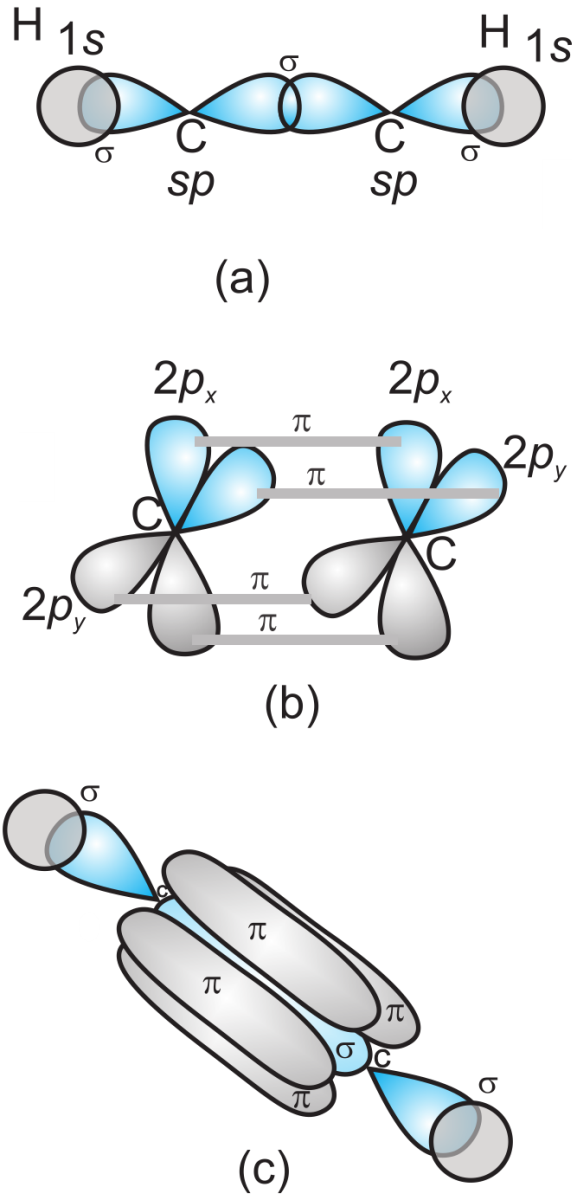
View full question & answer→Question 65 Marks
Write the significance/applications of dipole moment.
AnswerIn heteronuclear molecules, polarization arises due to a difference in the electronegativities of the constituents of atoms. As a result, one end of the molecule acquires a positive charge while the other end becomes negative. Hence, a molecule is said to possess a dipole.
The product of the magnitude of the charge and the distance between the centres of positive-negative charges is called the dipole moment $(\mu)$ of the molecule. It is a vector quantity and is represented by an arrow with its tail at the positive centre and head pointing towards a negative centre.
Dipole moment $(\mu)=$ charge $(\mathrm{Q}) \times$ distance of separation $(r)$
The SI unit of a dipole moment is 'esu'.
1 esu $=3.335 \times 10^{-30} \mathrm{Cm}$
Dipole moment is the measure of the polarity of a bond. It is used to differentiate between polar and non-polar bonds since all non-polar molecules (e.g. $\mathrm{H}_2, \mathrm{O}_2$ ) have zero dipole moments. It is also helpful in calculating the percentage ionic character of a molecule.
View full question & answer→Question 75 Marks
Define hydrogen bond. Is it weaker or stronger than the van der Waals forces?
Answer
A hydrogen bond is defined as an attractive force acting between the hydrogen attached to an electronegative atom of one molecule and an electronegative atom of a different molecule (may be of the same kind).
Due to a difference between electronegativities, the bond pair between hydrogen and the electronegative atom gets drifted far away from the hydrogen atom. As a result, a hydrogen atom becomes electropositive with respect to the other atom and acquires a positive charge. a positive charge.
$4^\delta-\text{X}^{\delta-}.......\text{H}^{\delta+}-\text{X}^{\delta-}.......\text{H}^{\delta+}-\text{X}^\delta$
The magnitude of H-bonding is maximum in the solid state and minimum in the gaseous state.
There are two types of H-bonds:
- Intermolecular H-bond e.g., $\mathrm{HF}, \mathrm{H}_2 \mathrm{O}$ etc.
- Intramolecular H-bond e.g., o-nitrophenol.
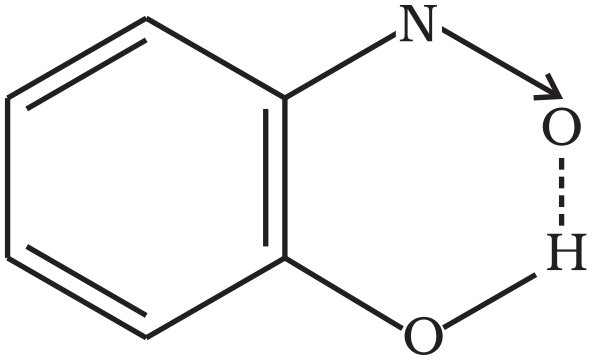
- Hydrogen bonds are stronger than Van der Walls forces since hydrogen bonds are regarded as an extreme form of dipole-dipole interaction.
View full question & answer→Question 85 Marks
Draw the Lewis structures for the following molecules and ions: $\text{H}_2\text{S},\ \text{SiCl}_4,\ \text{BeF}_2,\ \text{CO}^{2-}_3,\ \ \text{HCOOH}$
View full question & answer→Question 95 Marks
Write the favourable factors for the formation of ionic bond.
AnswerThe following factors facilitate the formation of an ionic bond between a metal and a non-metal:
- Ionization energy: Lesser the ionization energy, greater is the ease of formation of a cation.
- Electron affinity: High electron affinity favours formation of an anion.
- Lattice Energy: It is defined as the amount of energy released when cations and anions are brought close to each other from infinity to their respective equilibrium sites in the crystal lattice to form one mole of the ionic compound. The higher the magnitude of the lattice energy, the greater is the tendency of the formation of an ionic bond.
View full question & answer→Question 105 Marks
Define octet rule. Write its significance and limitations.
AnswerOctet rule: Atoms of elements combine with each other in order to complete their respective octets so as to acquire the stable gas configuration.Significance: It helps to explain why different atoms combine with each other to form ionic compounds or covalent compounds.
Limitations of Octet rule:
- According to Octet rule, atoms take part in chemical combination to achieve the configuration of nearest noble gas elements. However, some of noble gas elements like Xenon have formed compounds with fluorine and oxygen. For example: $\mathrm{XeF}_2, \mathrm{XeF}_4$ etc.
Therefore, validity of the octet rule has been challenged.
- This theory does not account for shape of molecules.
View full question & answer→Question 115 Marks
Explain the formation of a chemical bond.
AnswerA chemical bond is defined as an attractive force that holds the constituents (atoms, ions etc.) together in a chemical species.
Various theories have been suggested for the formation of chemical bonds such as the electronic theory, valence shell electron pair repulsion theory, valence bond theory, and molecular orbital theory.
A chemical bond formation is attributed to the tendency of a system to attain stability. It was observed that the inertness of noble gases was because of their fully filled outermost orbital’s. Hence, it was postulated that the elements having incomplete outermost shells are unstable (reactive). Atoms, therefore, combine with each other and complete their respective octets or duplets to attain the stable configuration of the nearest noble gases. This combination can occur either by sharing of electrons or by transferring one or more electrons from one atom to another. The chemical bond formed as a result of sharing of electrons between atoms is called a covalent bond. An ionic bond is formed as a result of the transference of electrons from one atom to another.
View full question & answer→Question 125 Marks
Explain the formation of $H_2$ molecule on the basis of valence bond theory.
AnswerLet $u s$ assume that two hydrogen atoms $\left(A\right.$ and $B$ ) with nuclei $\left(N_A\right.$ and $\left.N_B\right)$ and electrons ( $e_A$ and $e_B$ ) are taken to undergo a reaction to form a hydrogen molecule.
When $A$ and $B$ are at a large distance, there is no interaction between them. As they begin to approach each other, the attractive and repulsive forces start operating.
Attractive force arises between:
a. Nucleus of one atom and its own electron i.e., $\mathrm{N}_A-\mathrm{e}_{\mathrm{A}}$ and $\mathrm{N}_B-\mathrm{e}_{\mathrm{B}}$.
b. Nucleus of one atom and electron of another atom i.e., $N_A-e_B$ and $N_B-e_A$.
Repulsive force arises between:
a. Electrons of two atoms i.e., $e_A-e_B$.
b. Nuclei of two atoms i.e., $\mathrm{N}_{\mathrm{A}}-\mathrm{N}_{\mathrm{B}}$.
The force of attraction brings the two atoms together, whereas the force of repulsion tends to push them apart.
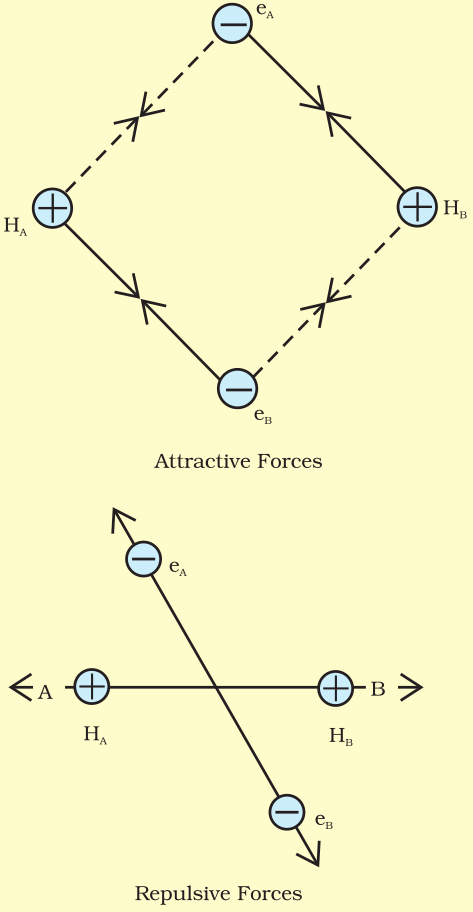
The magnitude of the attractive forces is more than that of the repulsive forces. Hence, the two atoms approach each other. As a result, the potential energy decreases. Finally, a state is reached when the attractive forces balance the repulsive forces and the system acquires minimum energy. This leads to the formation of a dihydrogen molecule. View full question & answer→Question 135 Marks
Apart from tetrahedral geometry, another possible geometry for $\mathrm{CH}_4$ is square planar with the four H atoms at the corners of the square and the C atom at its centre. Explain why $\mathrm{CH}_4$ is not square planar?
AnswerElectronic configuration of carbon atom:
${ }_6 \mathrm{C}: 1 \mathrm{~s}^2 2 \mathrm{~s}^2 2 \mathrm{p}^2$
In the excited state, the orbital picture of carbon can be represented as:
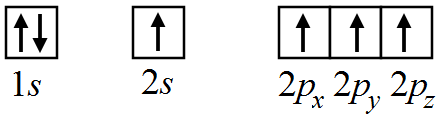
Hence, carbon atom undergoes $s p^3$ hybridization in $\mathrm{CH}_4$ molecule and takes a tetrahedral shape.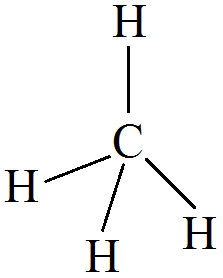
For a square planar shape, the hybridization of the central atom has to be $d s p^2$. However, an atom of carbon does not have $d$-orbitalsto undergo $d s p^2$ hybridization. Hence, the structure of $\mathrm{CH}_4$ cannot be square planar.
Moreover, with a bond angle of $90^{\circ}$ in square planar, the stability of $\mathrm{CH}_4$ will be very less because of the repulsion existing between the bond pairs. Hence, VSEPR theory also supports a tetrahedral structure for $\mathrm{CH}_4$. View full question & answer→Question 145 Marks
Explain with the help of suitable example polar covalent bond.
AnswerWhen two atoms with different electronegativity are linked to each other by covalent bond, the shared electron pair will not in the centre because of the difference in electronegativity. For example, in hydrogen fluoride molecule, fluoride has greater electronegativity than hydrogen. Thus, the shared electron pair is displaced more towards’ fluorine atom, the later will acquire a partial negative charge $(\delta^+)$. At the same time hydrogen atom will have a partial positive charge $(\delta^-)$. Such a covalent bond is known as polar covalent bond or simply polar bond.
It is represented as $\ \ \ \delta^+\ \ \ \ \delta^-\\\ \ \text{H}\ -\ \text{F}\$2.1)\ (4.0)$
View full question & answer→Question 155 Marks
Explain the important aspects of resonance with reference to the $\text{CO}^{2-}_3$− ion.
Answer
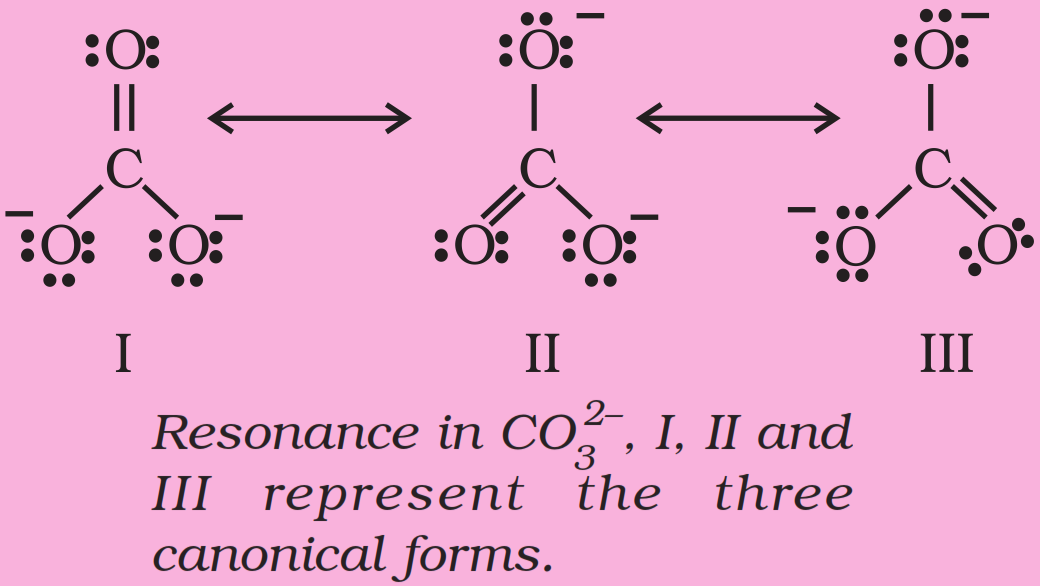 Resonance in $\text{CO}_3^{2-}$, I, II and III represent the three canonical forms.
- In these structures, the position of nuclei is same.
- All the three forms have almost equal energy.
- Same number of paired and impaired electrons, they differ only in their position.
View full question & answer→Question 165 Marks
Although both $\mathrm{CO}_2$ and $\mathrm{H}_2 \mathrm{O}$ are triatomic molecules, the shape of $\mathrm{H}_2 \mathrm{O}$ molecule is bent while that of $\mathrm{CO}_2$ is linear. Explain this on the basis of dipole moment.
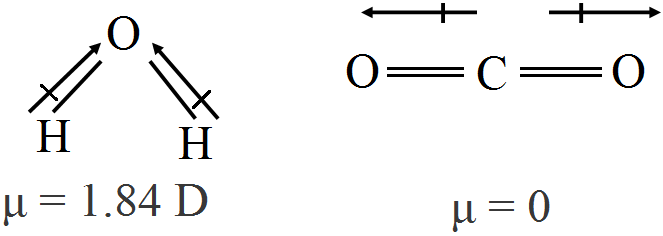
AnswerAccording to experimental results, the dipole moment of carbon dioxide is zero. This is possible only if the molecule is linear so that the dipole moments of $\mathrm{C}-\mathrm{O}$ bonds are equal and opposite to nullify each other.
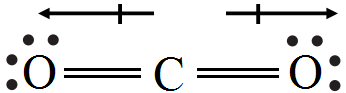
Resultant μ = 0 D
$\mathrm{H}_2 \mathrm{O}$, on the other hand, has a dipole moment value of 1.84 D (though it is a triatomic molecule as $\mathrm{CO}_2$ ). The value of the dipole moment suggests that the structure of $\mathrm{H}_2 \mathrm{O}$ molecule is bent where the dipole moment of $\mathrm{O}-\mathrm{H}$ bonds are unequal.
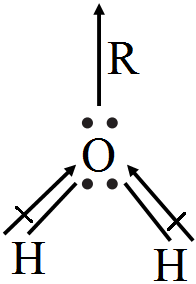
View full question & answer→Question 175 Marks
Which out of $\mathrm{NH}_3$ and $\mathrm{NF}_3$ has higher dipole moment and why?
AnswerBoth the molecules $\mathrm{NH}_3$ and $\mathrm{NF}_3$ have pyramidal shape with a lone pair of electron on nitrogen atom. Although fluorine is more electronegative than nitrogen, the resultant dipole moment of $\mathrm{NH}_3\left(4.90 \times 10^{-30} \mathrm{C} \mathrm{m}\right)$ is greater than that of $\mathrm{NF}_3$ ( $0.8 \times 103$ the orbital dipole due to lone pair is in the same direction as the resultant dipole moment of the $\mathrm{N}-\mathrm{H}$ bonds whereas in $\mathrm{NF}_3$ the orbital dipole is in the direction opposite to the resultant dipole moment of the three $\mathrm{N}-\mathrm{F}$ bonds. The orbital dipole because of lone pair decreases the effect of the resultant $\mathrm{N}-\mathrm{F}$ bond moment which results in low dipole moment of $\mathrm{NF}_3$ as represented below:
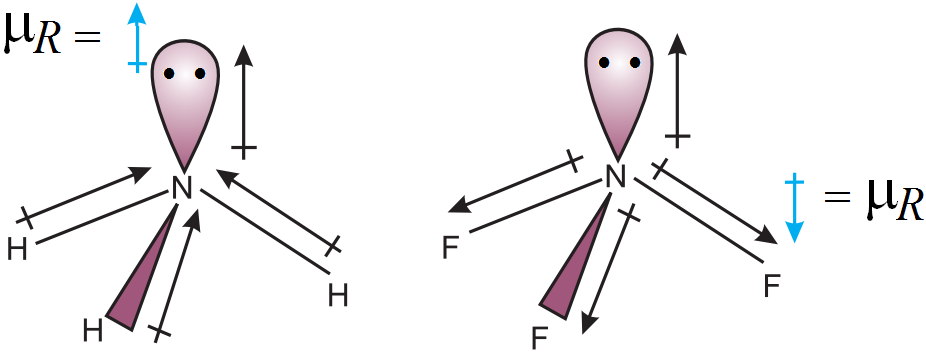
View full question & answer→Question 185 Marks
Although geometries of $\mathrm{NH}_3$ and $\mathrm{H}_2 \mathrm{O}$ molecules are distorted tetrahedral, bond angle in water is less than that of ammonia. Discuss.
AnswerThe molecular geometry of $\mathrm{NH}_3$ and $\mathrm{H}_2 \mathrm{O}$ can be shown as
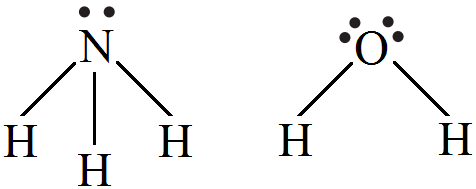
The central atom $(\mathrm{N})$ in $\mathrm{NH}_3$ has one lone pair and there are three bond pairs. In $\mathrm{H}_2 \mathrm{O}$, there are two lone pairs and two bond pairs.
The two lone pairs present in the oxygen atom of $\mathrm{H}_2 \mathrm{O}$ molecule repels the two bond pairs. This repulsion is stronger than the repulsion between the lone pair and the three bond pairs on the nitrogen atom.
Since the repulsions on the bond pairs in $\mathrm{H}_2 \mathrm{O}$ molecule are greater than that in $\mathrm{NH}_3$, the bond angle in water is less than that of ammonia. View full question & answer→Question 195 Marks
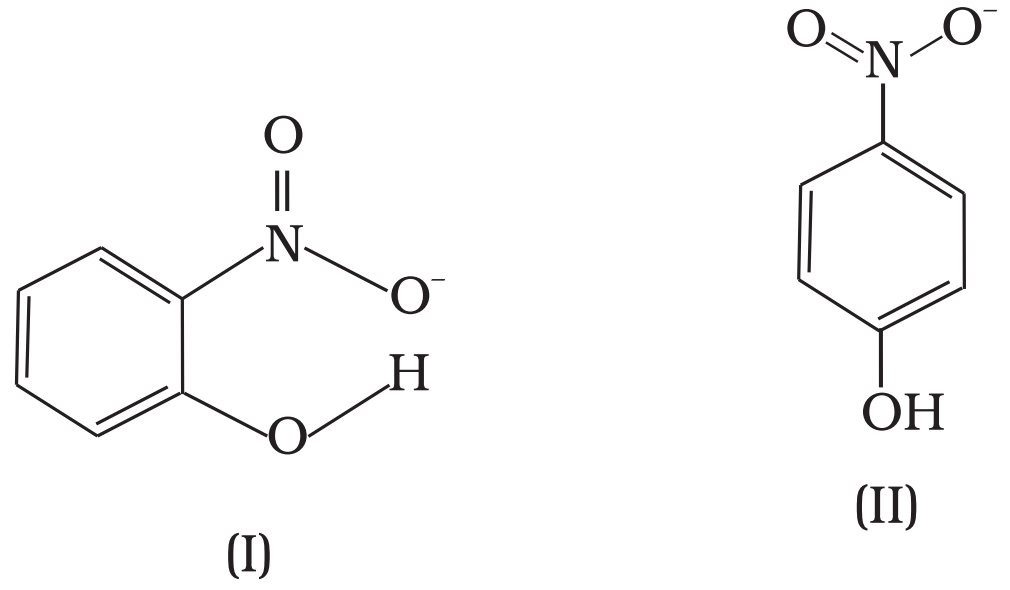
Structures of molecules of two compounds are given below:
-
Which of the two compounds will have intermolccular hydrogen bonding and which compound is expected to show intramolecular hydrogen bonding?
-
The melting point of a compound depends on. among other things, the extent of hydrogen bonding. On this basis explain which of the above two compounds will show higher melting point.
-
Solubility of compounds in water depends on power to form hydrogen bonds with water. Which of the above compounds will form hydrogen bond with water easily and be more soluble in it?
Answer
- Intramolecular hydrogen bonding is observed in compound (I) because $NO_2$ and $OH$ groups are nearer to each other. In compound (II) intermolecular hydrogen bonding is observed as different molecules are involved.
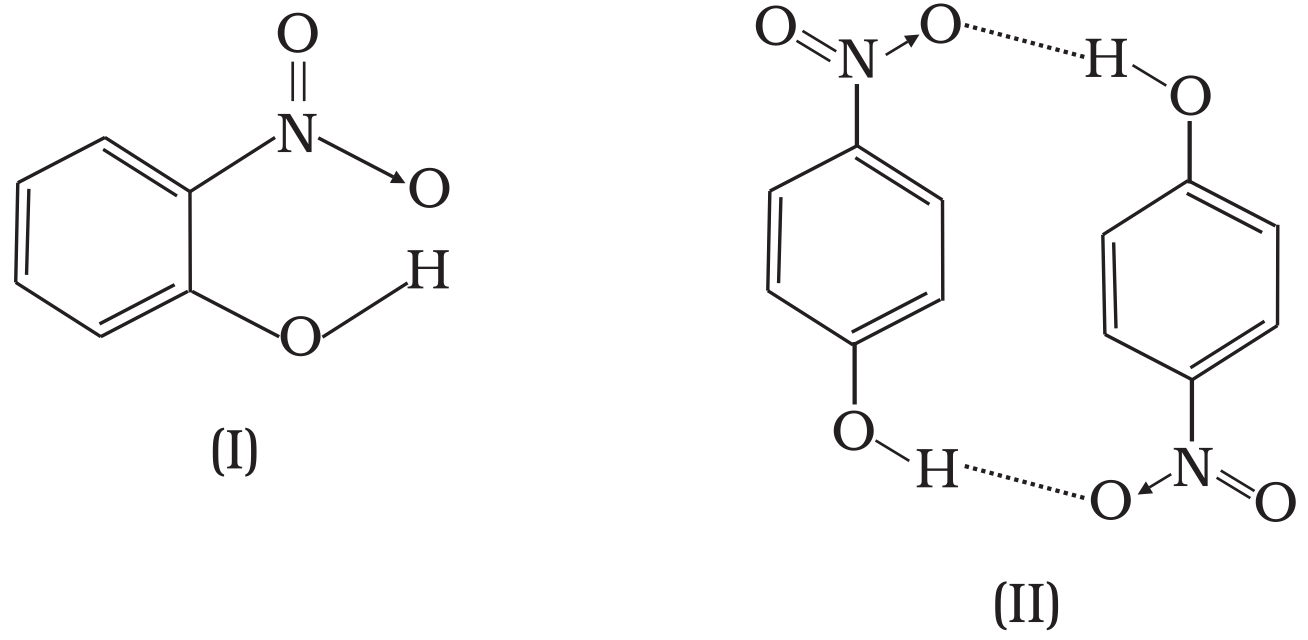
-
Compound (II) will have higher melting point as it is an associated species.
-
Compound (I) is less soluble than compound (II). Compound (II) easily forms hydrogen bonds with water.
View full question & answer→Question 205 Marks
Discuss the concept of hybridisation. What are its different types in a carbon atom.
AnswerHybridisation in order to explain the geometrical shapes of polyatomic like $\mathrm{CH}_4, \mathrm{NH}_3$ and $\mathrm{H}_2 \mathrm{O}$ eta. paliting introduced the cinceprct of the hybrid are used knows him the atomic.
-
The number of orbitials are in the energy and shape.
-
The hybrid orbitials are effectives are in some stable bonds than the pure atomic orbitals.
-
There hybrid orbitials the type in the some preferred have to the stable arrangement.
-
In corbon compound if, carbon is linked to carbon throught doble bond alkense, double carbon is $\text{sp}^2$ hybridised.
-
In corbon compound if, carbon is linked to carbon throught doble bond alkense, double carbon is $\text{sp}^3$ hybridised.
-
In corbon compound if, carbon is linked to carbon throught doble bond alkense, double carbon is sp hybridised.
View full question & answer→Question 215 Marks
Match the species in Column I with the type of hybrid orbitals in Column II.
| |
Column I
|
|
Column II
|
|
i.
|
$SF_4$
|
a.
|
$sp^3d^2$
|
|
ii.
|
$IF_5$
|
b.
|
$d^2sp$
|
|
iii.
|
$\text{NO}^{+}_{2}$ |
c.
|
$sp^3d$
|
|
iv.
|
$\text{NH}^{+}_{4}$ |
d.
|
$sp^3$
|
|
|
|
e.
|
$Sp$ |
Answer
| |
Column I
|
|
Column II
|
|
i.
|
$SF_4$
|
a.
|
$sp^3d$
|
|
ii.
|
$IF_5$
|
b.
|
$sp^3d^2$
|
|
iii.
|
$\text{NO}^{+}_{2}$ |
c.
|
$sp$ |
|
iv.
|
$\text{NH}^{+}_{4}$ |
d.
|
$sp^3$
|
Explanation:
- $SF_4$ = number of bd $(4)$ + number of $(1)$
$= sp^3d$ hybridisation.
- $IF_5$ = number of bd $(5)$ + number of $(0)$
$= sp^3d^2$ hybridisation.
- $\text{NO}^{+}_{2}$ = number of bp $(2)$ + number of $(0)$
$= sp$ hybridisation.
- $\text{NH}^{+}_{4}$ = number of bd $(4)$ + number of $(0)$
$= sp^3$ hybridisation. View full question & answer→Question 225 Marks
Match the species in Column I with the type of hybrid orbitals in Column II.
| |
Column I
|
|
Column II
|
|
i.
|
Tetrahedral |
a.
|
$\text{sp}^2$ |
|
ii.
|
Trigonal |
b.
|
$\text{sp}$ |
|
iii.
|
Linear |
c.
|
$\text{sp}^3$ |
Answer
| |
Column I
|
|
Column II
|
|
i.
|
Tetrahedral |
c. |
$\text{sp}^3$ |
|
ii.
|
Trigonal |
a. |
$\text{sp}^2$ |
|
iii.
|
Linear |
b. |
$\text{sp}$ |
Explanation:
-
$\text{sp}^3$ hybridisation – Tetrahedralshape.
-
$\text{sp}^2$ hybridisation – Trigonal shape.
-
$\text{sp}$ hybridization – Linear shape.
View full question & answer→Question 235 Marks
Group the following in linear and non-linear molecules: $\mathrm{H}_2 \mathrm{O}, \mathrm{HOCl}, \mathrm{BeCl}_2 \mathrm{Cl}_2 \mathrm{O}$
AnswerLinear molecules $\mathrm{HOCl}, \mathrm{BeCl}_2 \mathrm{CiO}^{-}$ion has linear shape. Linear shape results from $\mathrm{sp}^3$ - hybridisation of $\mathrm{Cl}^{-}$atom.
Three positions are occupied by lone pairs and one position by oxygen.
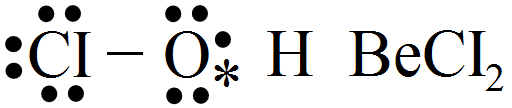
Has linear shape. Linear shape results from sp-hybridization of Be -atom. $\mathrm{Cl}, \mathrm{Be}, \mathrm{Cl}$.
Non-linear molecules: $\mathrm{H}_2 \mathrm{O}, \mathrm{Cl}_2 \mathrm{O} \mathrm{~H}_2 \mathrm{O}$ has V -shaped structure. It results from $\mathrm{sp}^3$ hybridisation of O atom.
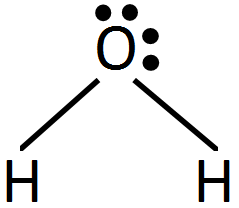
$\mathrm{Cl}_2 \mathrm{O}$ has V -shaped structure. The oxygen atom undergoes $\mathrm{sp}^3$ hybridization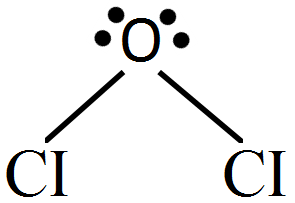
View full question & answer→Question 245 Marks
What is the type of hybridisation of carbon atoms marked with star.
- $\text{CH}_{3}=\text{CH}-\text{C}-\text{O}-\text{H}$
- $\text{CH}_{3}-\text{CH}_{2}-\text{OH}$
- $\text{CH}_{3}-\text{CH}_{2}-\text{C}-\text{H}$
- $\text{CH}_{3}-\text{CH}=\text{CH}-\text{CH}_{3}$
- $\text{CH}_{3}-\text{C}\equiv\text{CH}$
Comprehension given below is followed by some multiple choice questions. Each question has one correct option. Choose the correct option.
Molecular orbitals are formed by the overlap of atomic orbitals. Two atomic orbitals combine to form two molecular orbitals called bonding molecular orbital (BMO) and anti bonding molecular orbital (ABMO). Energy of anti bonding orbital is raised above the parent atomic orbitals that have combined and the energy of the bonding orbital is lowered than the parent atomic orbitals. Energies of various molecular orbitals for elements hydrogen to nitrogen increase in the order.
Different atomic orbitals of one atom combine with those atomic orbitals of the second atom which have comparable energies and proper orientation. Further, if the overlapping is head on, the molecular orbital is called ‘Sigma’, and if the overlap is lateral, the molecular orbital is called ‘pi’. The molecular orbitals are filled with electrons according to the same rules as followed for filling of atomic orbitals. However, the order for filling is not the same for all molecules or their ions. Bond order is one of the most important parameters to compare the strength of bonds. Answer
- $\text{CH}_{3}=\text{CH}-\text{C}-\text{O}-\text{H}$
Both the starred C atoms are $\text{sp}^2$ hybridised.
- $\text{CH}_{3}-\text{CH}_{2}-\text{OH}$
The starred C atom is $\text{sp}^3$ hybridised.
- $\text{CH}_{3}-\text{CH}_{2}-\text{C}-\text{H}$
The starred C atom is $\text{sp}^3$ hybridised.
- $\text{CH}_{3}-\text{CH}=\text{CH}-\text{CH}_{3}$
The starred C atom is $\text{sp}^2$ hybridised.
- $\text{CH}_{3}-\text{C}\equiv\text{CH}$
The starred C atom is $\text{sp}^2$ hybridised. View full question & answer→Question 255 Marks
What is the effect of the following processes on the bond order in $N^-$, and $O_2$?
-
$N_2 → N^+_2 + e^–$
-
$O_2 → O^+_2 + e^–$
Answer
|
Species
|
Total electrons
|
Configuration
|
Bond order
|
|
$N_2$
|
14
|
$\text{KK}\ \sigma2\text{s}^{2}\sigma^{*}2\text{s}^{2}\ \pi2\text{p}^{2}_\text{x}=\pi2\text{p}^{2}_{\text{y}}$
|
$\frac{8-2}{2}=3$
|
|
$N^+_2$
|
13
|
$\text{KK}\ \sigma2\text{s}^{2}\sigma^{*}2\text{s}^{2}\ \pi2\text{p}^{2}_\text{x}=\pi2\text{p}^{2}_{\text{y}}\ \sigma2\text{p}_\text{z}$
|
$\frac{7-2}{2}=2.5$
|
|
Bond order decreases from 3 to 2.5
|
|
$O_2$
|
16
|
$\text{KK}\ \sigma2\text{s}^{2}\sigma^{*}2\text{s}^{2}\ \pi2\text{p}^{2}_\text{x}\ \pi^{*}2\text{p}^{2}_\text{x}=\pi2\text{p}^{2}_{\text{y}}\ \sigma2\text{p}_\text{z}$
|
$\frac{8-4}{2}=2.0$
|
|
$O^+_2$
|
15
|
$\text{KK}\ \sigma2\text{s}^{2}\sigma^{*}2\text{s}^{2}\ \pi2\text{p}^{2}_\text{x}=\pi2\text{p}^{2}_{\text{y}}\ \sigma2\text{p}_\text{z}\ \pi^{*}2\text{p}^{2}_{\text{y}}$
|
$\frac{8-3}{2}=2.5$
|
|
Bond order decreases from 2 to 2.5
|
View full question & answer→Question 265 Marks
Match the species in Column I with the type of hybrid orbitals in Column II.
| |
Column I
|
|
Column II
|
|
i.
|
NO |
a.
|
1.5 |
|
ii.
|
CO |
b.
|
2.0 |
|
iii.
|
$\text{O}^{-}_{2}$ |
c.
|
2.5 |
|
iv.
|
$\text{O}_{2}$ |
d.
|
3.0 |
Answer
| |
Column I
|
|
Column II
|
|
i.
|
NO |
c. |
2.5 |
|
ii.
|
CO |
d. |
3.0 |
|
iii.
|
$\text{O}^{-}_{2}$ |
a. |
1.5 |
|
iv.
|
$\text{O}_{2}$ |
b. |
2.0 |
Explanation:
- $\text{NO}=\frac{1}{2}(10-5)=2.5$
- $\text{CO}=\frac{1}{2}(10-4)=3$
- $\text{O}^{-}_{2}=\frac{1}{2}(10-7)=1.5$
- $\text{O}_{2}=\frac{1}{2}(10-6)=2$
View full question & answer→Question 275 Marks
Match the species in Column I with the type of hybrid orbitals in Column II.
| |
Column I
|
|
Column II
|
|
i.
|
Hydrogen bond |
a.
|
C |
|
ii.
|
Resonance |
b.
|
LiF |
|
iii.
|
Ionic solid |
c.
|
$\mathrm{H}_2$ |
|
iv.
|
Covalent solid |
d.
|
HF |
| |
|
e. |
$\mathrm{O}_3$ |
Answer
| |
Column I
|
|
Column II
|
|
i.
|
Hydrogen bond
|
d.
|
HF
|
|
ii.
|
Resonance
|
e.
|
$\mathrm{O}_3$ |
|
iii.
|
Ionic solid
|
b.
|
LiF
|
|
iv.
|
Covalent solid
|
a.
|
C
|
Explanation:
-
H - F = hydrogen bond H - F.
-
$\mathrm{O}_3$ = Resonance.
-
LiF = lonic solid.
-
C = Covalent solid.
View full question & answer→Question 285 Marks
Use the molecular orbital energy level diagram to show that $N_2$ would be expected to have a triple bond, $F_2$ a single bond and $Ne_2$ no bond.
AnswerNitrogen molecule: Electron configuration of N-atom is total numbber of electrons present in $N_2$ molecule is 14, 7 from each N-atom. The electrons present of $N_2$ molecule.
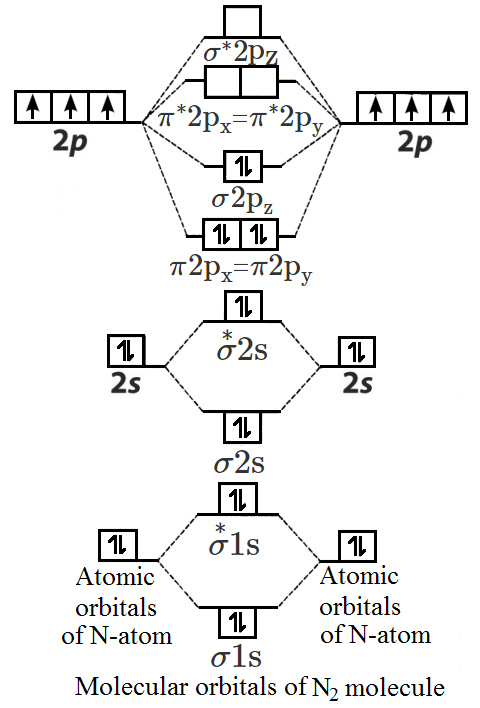
Bond order $=\frac{1}{2}(10-4)=3$
Fluorine molecule: Electron configuration of F-atom is 18, 9 from each F-atom.Thus number of electrons more than $O_2$ molecule. These two additional electrons will enter into the them so that so pairing of takes place in these of $F_2$ will be.
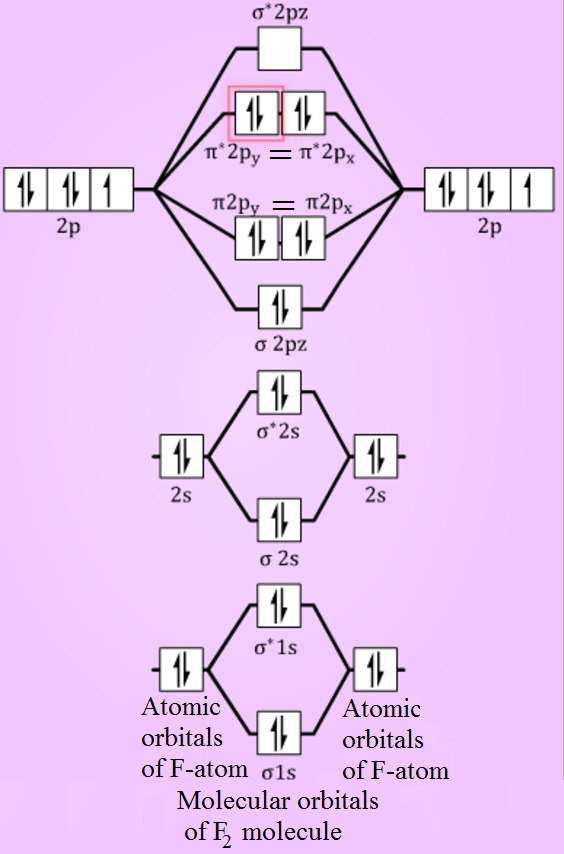
$Ne_2$: The total number of electrons in $Ne_2= 20$
The Electron configuration of $N_2$ molecule will be.
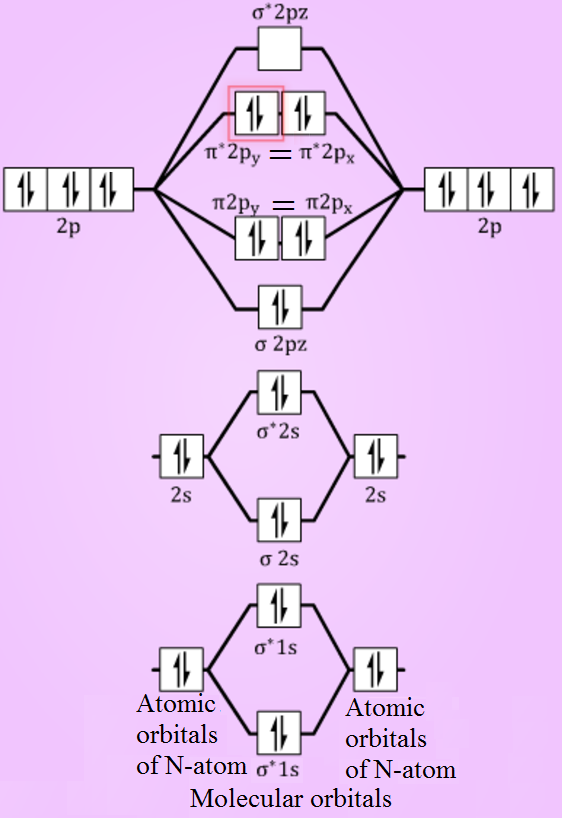
No bond is formed between two Ne atoms or in other words, $Ne_2$ does not exist. View full question & answer→Question 295 Marks
Arrange in properties:
- $HF, HCI, HBr, HI$ [Thermal stability]
- $LiF, LiCI, LiBr, Lil$ [Ionic character]
- $PH_3, PCI_3, PF_3,$ [Covalent character]
- $H_2O, NH_3, H_2S, HF$ [Polarity]
- $BeCl_2, BCI_3, CCI_4, PCI_3,$ [Bond angle]
Answer
- $HI < HBr <$ $\text{H}-\text{CI}$ $< HF$ because bond length decreases, bond dissociation energy increases
- $LiI < LiBr < LiCI < LiF$ because electronegativity of halogen increases, polarity increases.
-
$PF_3 < PCl_3 < PH_3$ because electronegativity of $F > Cl > H$
$\therefore$ covalent character increases.
-
$H_2S < NH_3 < H_2O < HF$ electronegativity of $S < N < O < F$
- $\text{PCl}_3<\text{CCl}_4<\text{BCl}_3<\text{BeCl}_2\\^{100^\circ \ \ \ \ \ \ \ \ \ \ \ \ 107.5^\circ\ \ \ \ \ \ \ \ \ 120^\circ\ \ \ \ \ \ \ \ \ \ \ \ \ \ 180^\circ}$
[Bond angle depends upon shape of molecules] View full question & answer→Question 305 Marks
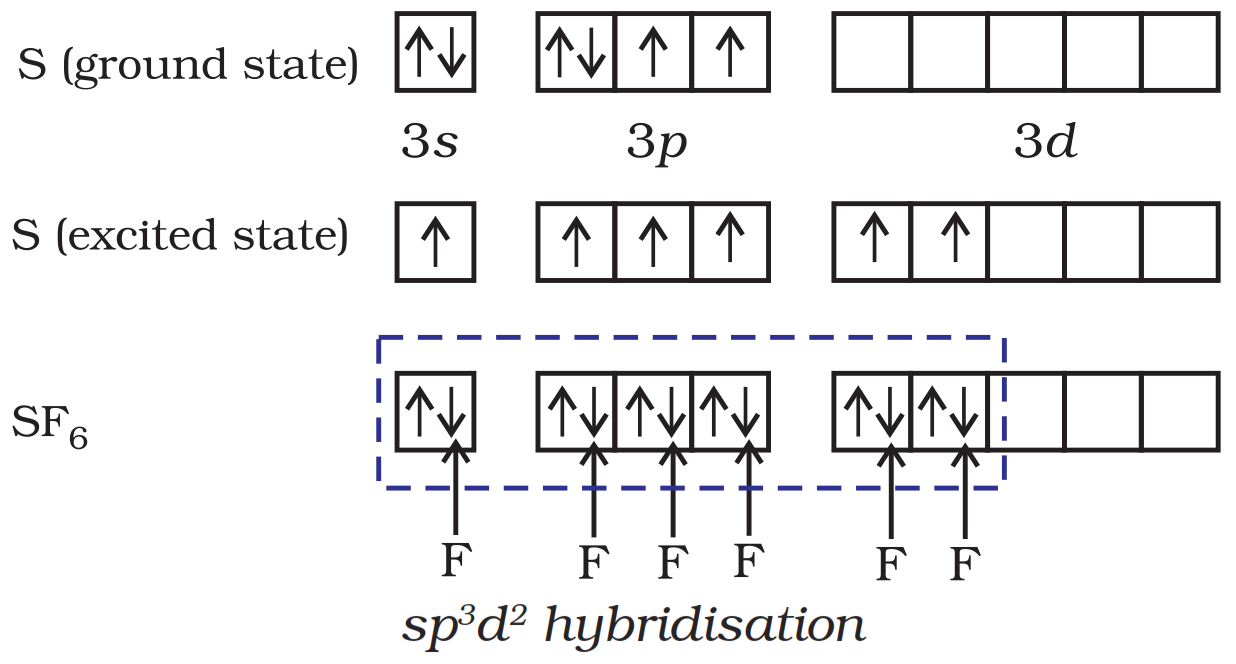
Describe hybridisation in the case of $PCl_5$ and $SF_6$. The axial bonds are longer as compared to equatorial bonds in $PCl_5$ whereas in $SF_6$ both axial bonds and equatorial bonds have the same bond length. Explain.
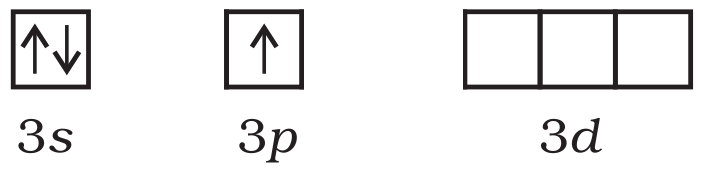
AnswerAtomic number of Phosphorous is 15.
The Ground state configuration is
& the excited state configuration is
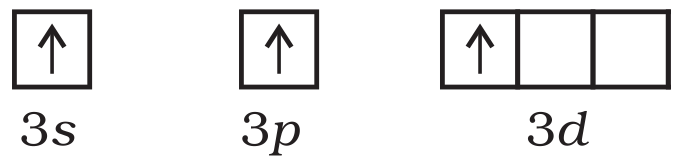
The 5 electrons present in valence shell form bond pairs with the electrons of five chlorine atoms. Phosphorus atom is sp3d hybridized in the excited state.
$PCl_5$
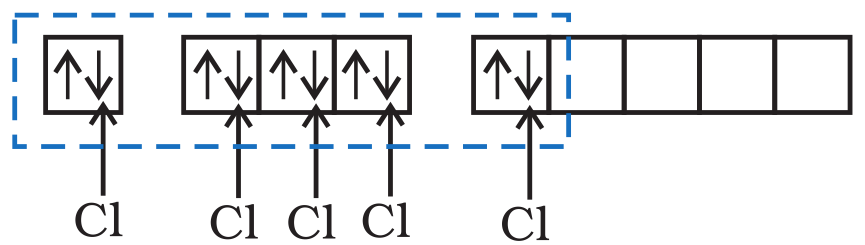
The geometry of $PCl_5$ is trigonal bipyramidal .The P atom lies in the centre of an equatorial triangle & three P-Cl bonds (equatorial bonds) are directed towards its three corners with $120°$ bond angle. The remaining two P-Cl bonds (axial bonds) lie above & below the plane of the triangle at bond angle $90°$.
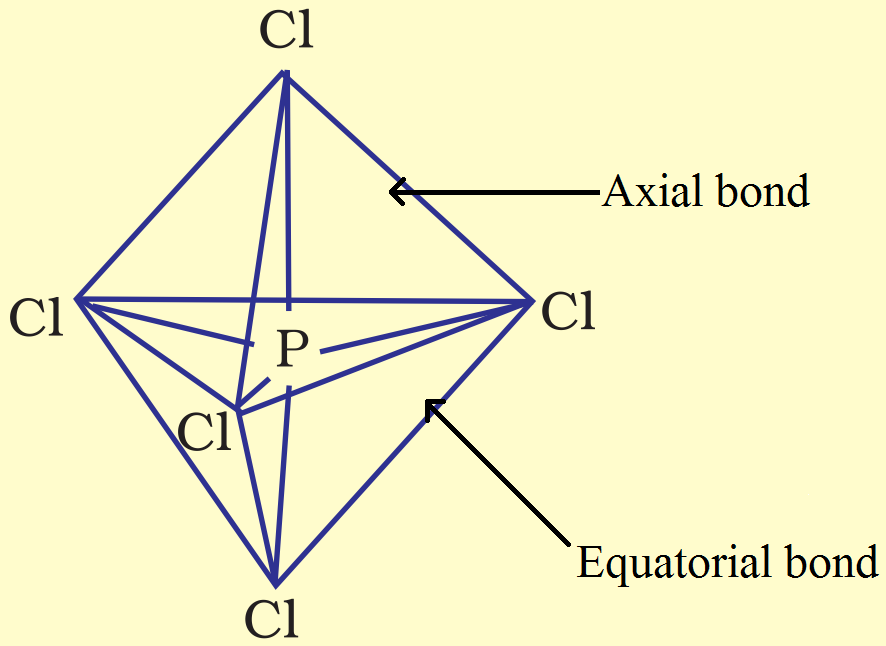
The axial bonds are longer than equatorial bonds because the axial Cl atoms suffer from more repulsion then the equatorial Cl atoms, as a result the axial Cl atoms tries to reside far away from the equatorial Cl atoms, & hence axial bond are longer than equatorial bonds.
View full question & answer→Question 315 Marks
- What is the total number of electrons in $\text{NO}^-_3$ and $\text{NH}^+_4?$
- Why is melting point of $MgO (2800^\circ C)$ higher than that of BaO (1920°C)?
- Why is solubility of MgCl, greater than that of $MgF_2$?
- Why are carbon-oxygen bond lengths in $Na_2CO_3$ equal?
- Why is $AlF_3$ high melting solid whereas $SiF_4$ is a gas?
Answer
- $\text{NO}^-_3$ has 7 + 24 + 1 = 32 elecetrons. $\text{NH}^+_4$ has 7 + 4 - 1 = 10 electrons.
- $\text{Mg}^{2+}$ is smaller in size than $\text{Ba}^{2+},$ therefore, MgO has higher lattice energy than BaO due to greater force of attraction between ions.
- $MgF_2$ has higher lattice energy than $MgCl_2$.
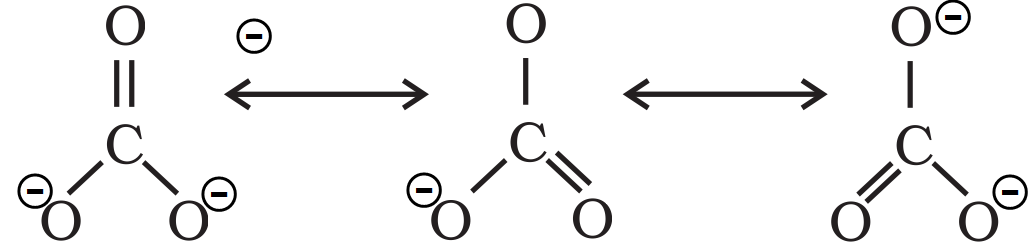
- It is due to resonance in $\text{CO}^{2-}_3$
- $AlF_3$ is ionic compound, therefore, it has high melting point. $SiF_4$ is covalent, therefore, it is gas.
View full question & answer→Question 325 Marks
How is molecular orbital different from atomic orbital? Give electronic configuration of:
- $\text{H}^+_2,$
- $\text{Li}_2$
- $\text{B}_2,$
- $\text{C}_2.$
Calculate their bond orders and predict their paramagnetic behaviour. AnswerAtomic orbitals are monocentric whereas molecular orbitals are polycentric.
Atomic orbitals are present in atoms whereas molecular orbitals are present in molecules.
- $\text{H}^+_2\text{(1)}\text{;}\ (\sigma\text{ls})^1$
$\text{B.O.}=\frac12(1-0)=\frac12,$ paramagnetic.
- $\text{Li}_2(6)\text{:}\ (\sigma\text{ls})^2(\sigma*\text{ls})^2\ (\sigma2\text{s})^2$
$\text{B.O.}=\frac12(4-2)=\frac22=1,{}{}$ diamagnetic
- $\text{B}_2(10)\text{:}\ (\sigma\text{ls})^2(\sigma*\text{ls})^2(\sigma2\text{s})^2(\sigma*2\text{s})^2$
$(\pi2\text{p}_\text{x}^1=\pi2\text{p}_\text{y}^1)$
$\text{B.O.}=\frac12(6-4)=1,$ paramagnetic
- $\text{C}_2(12)\text{:}\ (\sigma\text{ls})^2\ (\sigma*\text{ls})^2\ (\sigma2\text{s})^2\ (\sigma*2\text{s})^2\ (\pi2\text{p}_\text{x}^2=\pi2\text{p}_\text{y}^2)$
$\text{B.O.}=\frac12(8-4)=2,$ diamagnetic. View full question & answer→Question 335 Marks
Explain the non linear shape of $H_2S$ and non planar shape of $PCl_3$ using valence shell electron pair repulsion theory.
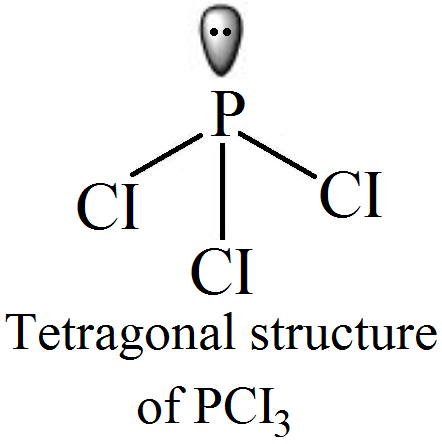
AnswerIn the molecule $PCl_3$, The electronic configuration of P atom is $1s^2, 2s^2, 2p^6, 3s^2, 3p^3$. The valency of $P$ is $5$. In $PCl3$,
$P$ has $3$ single bonds and $1$ lone pair (pair of unshared electrons). This suggests us to use $sp^3$ hybrid orbitals on phosphorus. Each chlorine atom (valence shell configuration $3s^23p^5$) has one singly occupied $3p$ orbital. The P–Cl bonds are formed by the overlap of a phosphorus $sp3$ hybrid orbital with singly occupied chlorine $3p$ orbital. Each Cl atom holds three lone pairs.
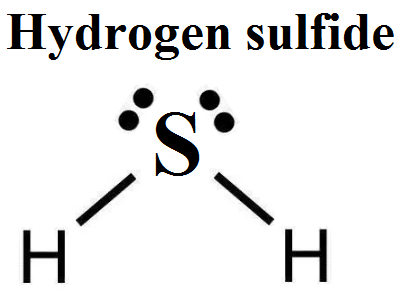
In $H_2S$ , S is the central atom, which has 6 valence electrons, out of which 2 electron are used by two hydrogen forming two bonds and two remaining pairs remain as lone pairs around the atom, Thus due to lone pair lone pair repulsion offered by the two pairs of electrons, it has a bent shape.
View full question & answer→Question 345 Marks
- Why is HF liquid but HCl, HBr, Hl are gases?
- Why is o-nitrophenol steam volatile whereas p-nitrophenol is not steam volatile?
- Arrange the following in decreasing order of their bond angle: $H_2O, NH_3, H_2S$
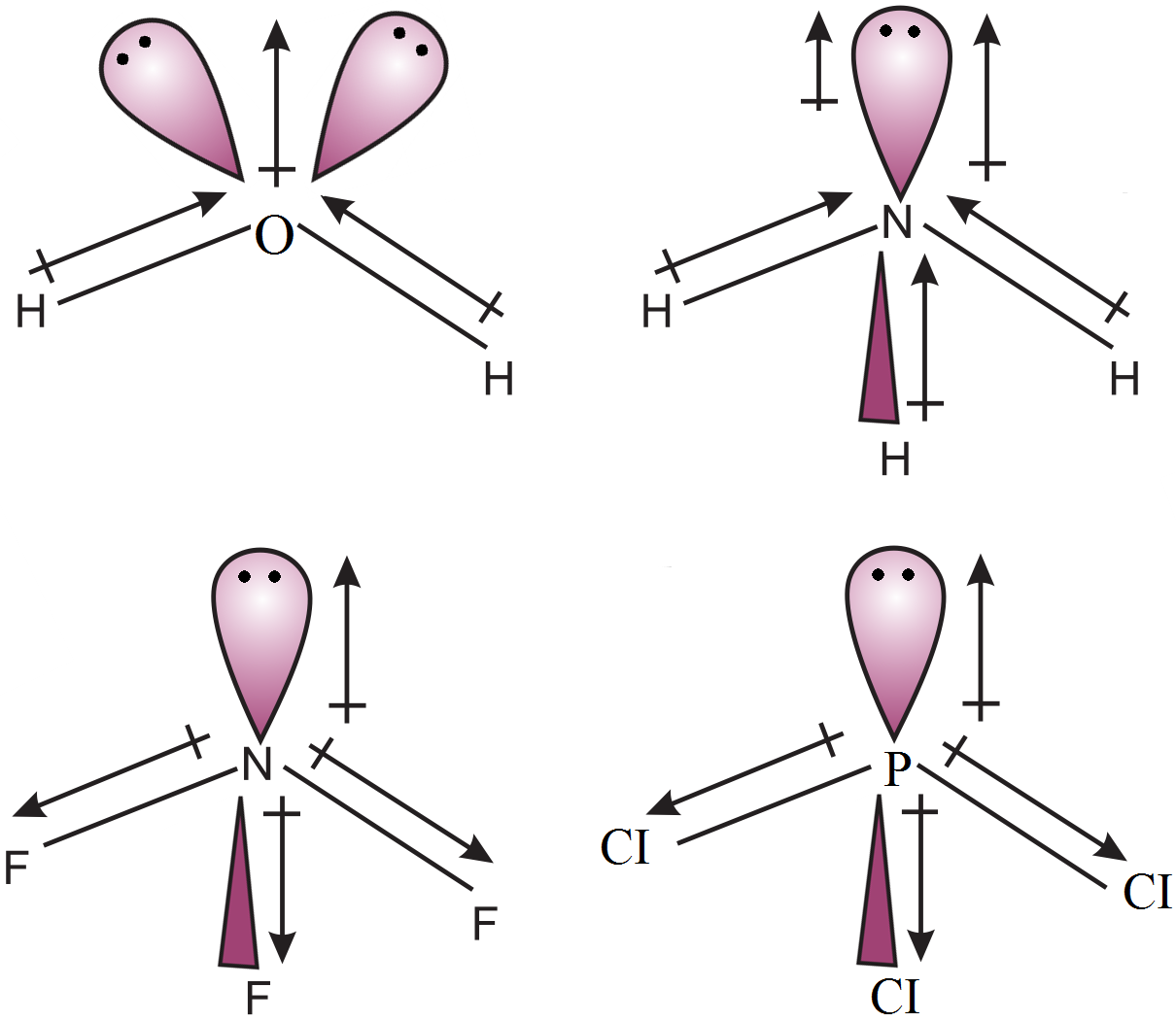
- Sketch the bond moments and resultant dipole moment of the following molecule:
$H_2O, NH_3, NF_3$ and $PCl_5$
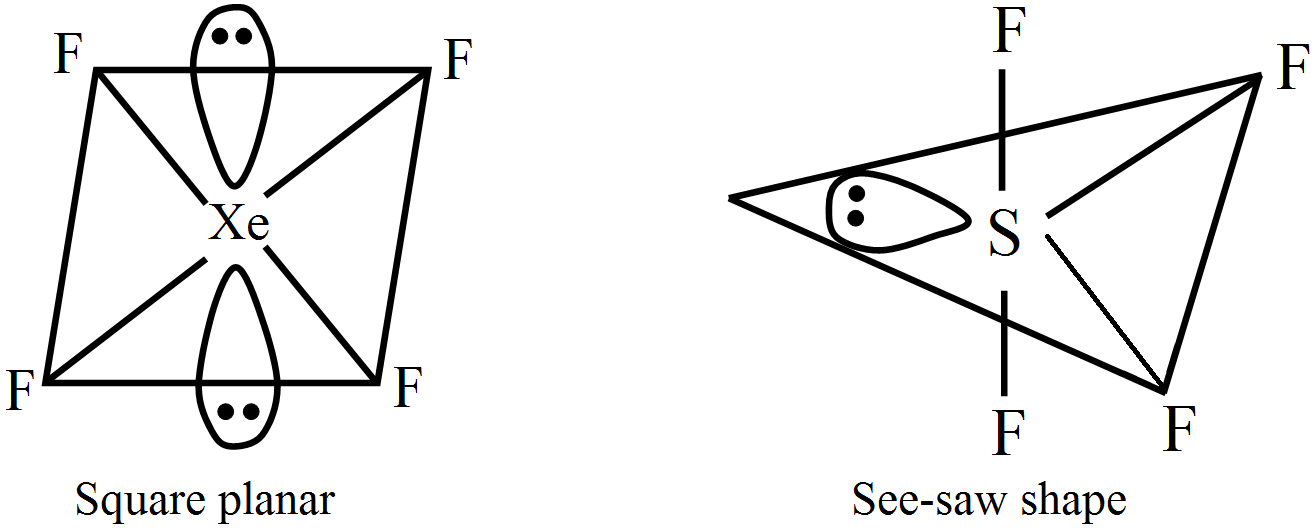
- Draw shape of the following molecules on the basis of VSEPR theory:
$XeF_4$ and $SF_4$. (At. No. of Xe = 54, At. No. of S = 16)Answer
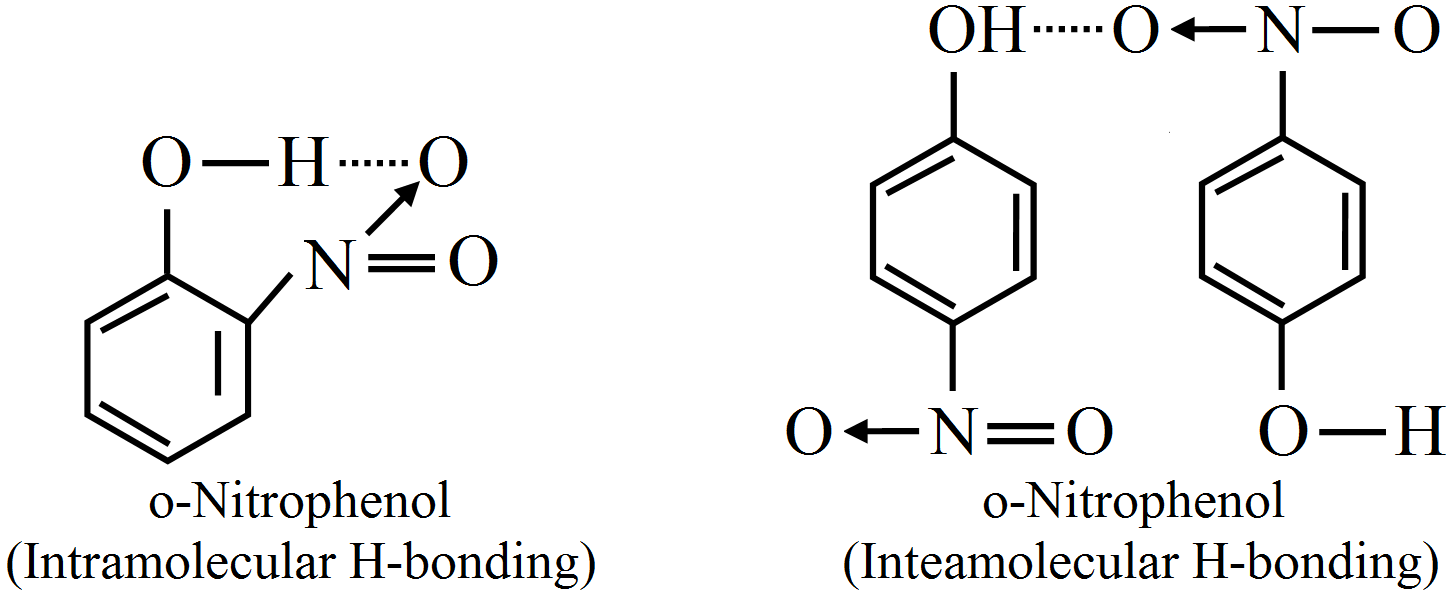
- H-bond is the force of attraction between hydrogen and electronegative atoms like F, N, O, e.g., HF is liquid because HF molecules are associated with intermolecular H-bonding whereas HCl, HBr, Hl do not have H-bonds.
- o-Nitrophenol has intramolecular H-bonding whereas p-nitrophenol has intermolecular H-bonding.
o-Nitrophenol is steam volatile due to weaker intramolecular H-bonding.
p-Nitrophenol is not steam volatile due to stronger intermolecular H-bonding.
-
- $NH_3 > H_2O > H_2S$
-
-
View full question & answer→Question 355 Marks
- Sketch the following molecular shapes and give the various bond angles in the structure linear, triangular planar, tetrahedral and octahedral.
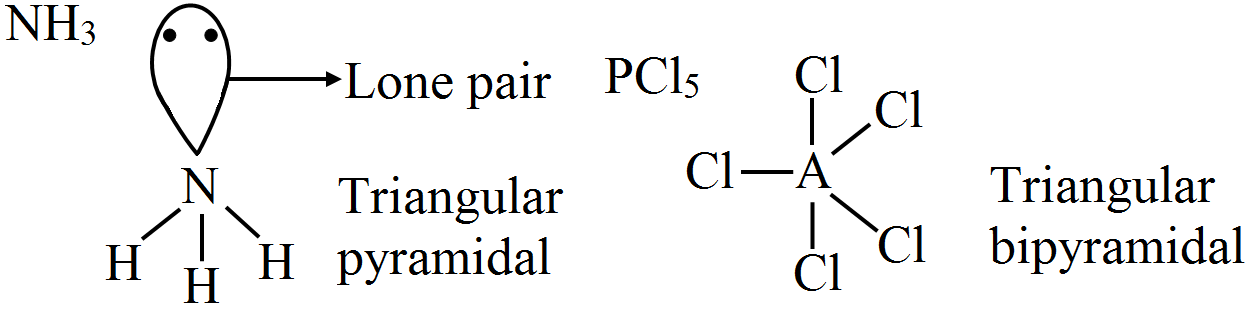
- What are the shapes of $\mathrm{PCl}_5, \mathrm{NH}_3, \mathrm{BCl}_3, \mathrm{SF}_6, \mathrm{H}_2 \mathrm{O}, \mathrm{CCl}_4, \mathrm{SF}_4, \mathrm{ClF}_3,\left[\mathrm{BrF}_5\right]^{-}, \mathrm{XeF}_4, \mathrm{XeF}_2$
Answer
-
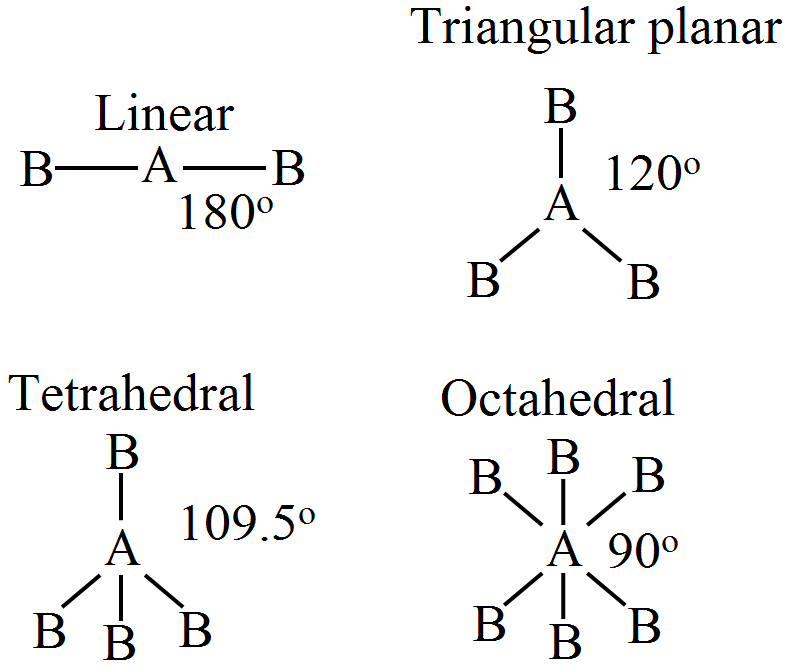
- The shape of the molecules are given below:
View full question & answer→Question 365 Marks
-
- Define electron gain enthalpy.
- Give the resonance structure of $O_3$.
- Give reason:
- $He_2$ molecule is not formed.
- Ethyl alcohol dissolves in $H_2O$
- HF is polar though it possesses covalent bond.
Answer
-
- It is defined as energy released when one mole of neutral gaseous atom gains one electron.
-
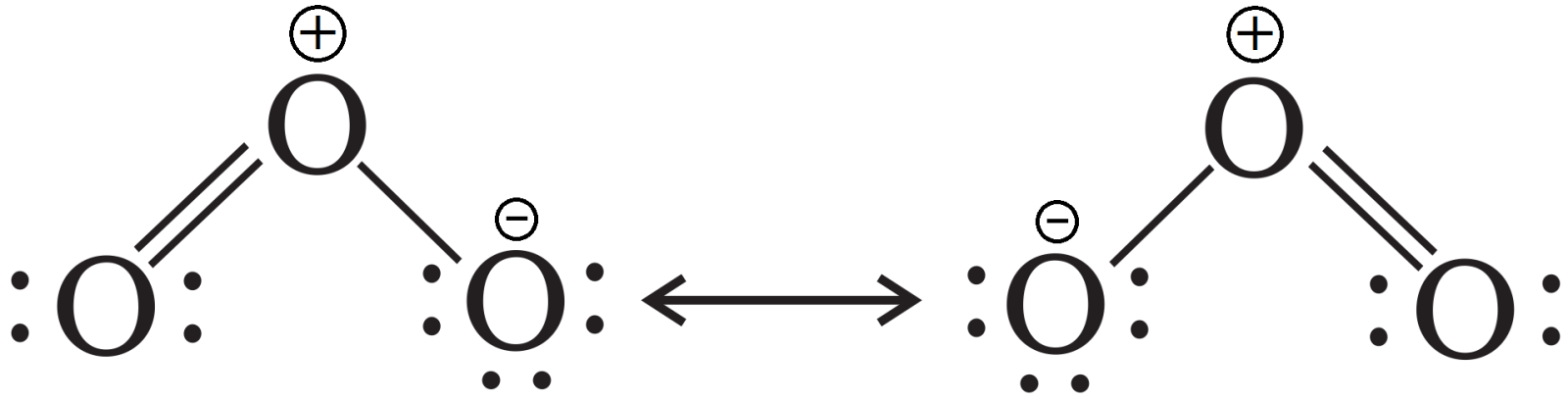
-
- Because its bond order is zero.
$\sigma\text{ls}^2,\ \sigma*\text{ls}^2,\ \text{B.O.}=\frac12(2-2)=0$
- Ethyl alcohol can form hydrogen bond with water.
- It is due to difference in electronegativity between H and F.
View full question & answer→Question 375 Marks
Explain why $\mathrm{CO}^{2-} 3$ ion cannot be represented by a single Lewis structure. How can it be best represented?
Answer
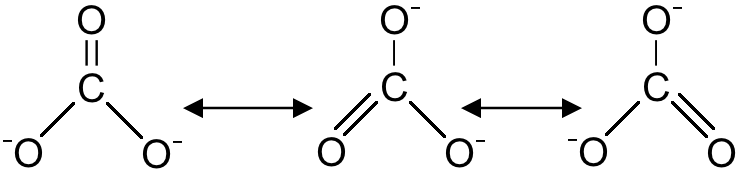
Carbonate ion can be represented by the following Lewis structure.
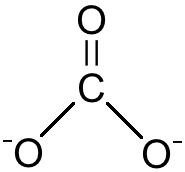
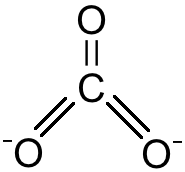
The calculated values of bond distances between carbon and oxygen in C = O and C-O are 1.22 and 1.43 respectively but the observed bond length is neither 1.22 nor 1.43 but somewhat between these two values. The other observation is that all the three bond lengths are equal. Hence, the above single structure cannot explain the characteristics of the carbonate ion. It is, thus, said that resonance exists in this ion and there is one hybrid form which can provide the exact explanation but its exact structure cannot be written on paper. Carbonate ion is actually a resonance hybrid of the following forms:
The resonance hybrid can be best represented as:
View full question & answer→Question 385 Marks
The energy of $\sigma 2 \mathrm{p}_{\mathrm{z}}$ molecular orbital is greater than $2 \mathrm{p}_{\mathrm{x}}$ and $2 \mathrm{p}_{\mathrm{y}}$ molecular orbitals in nitrogen molecule. Write the complete sequence of energy levels in the increasing order of energy in the molecule. Compare the relative stability and the magnetic behaviour of the following species:
$\mathrm{N}_2, \mathrm{~N}^{+}{ }_2, \mathrm{~N}_2^{-}, \mathrm{N}^{2+}{ }_2$
AnswerSequence of rnregy levels: $\sigma1\text{s}< \sigma^{*}1\text{s}^{2}< \sigma^{*}2\text{s}^{2}< \pi^{*}2\text{p}_{\text{x}}=\pi\ 2\text{p}_{\text{y}}<\sigma\ 2\text{p}_{\text{z}}$ For $\text{N}_2$ molccule the M.O. configuration is: $\sigma1\text{s}< \sigma^{*}1\text{s}^{2}< \sigma^{*}2\text{s}^{2}< \pi^{*}2\text{p}_{\text{y}}=\pi\ 2\text{p}_{\text{x}}<\sigma\ 2\text{p}_{\text{y}}$ $\text{B}.\text{O}.=\frac{1}{2}(10-4)=3$ $\text{N}^{+}_{2}=\sigma\ 1\text{s} \ \sigma^{*}1\text{s}^{2}\ \sigma^{*}2\text{s}^{2}\ \pi^{*}2\text{p}_{\text{y}}=\pi\ 2\text{p}_{\text{x}}\ \sigma\ 2\text{p}_{\text{y}}$ $\text{B}.\text{O}.=\frac{1}{2}(9-4)=2.5$ $\text{N}^{-}_{2}=\sigma\ 1\text{s} \ \sigma^{*}1\text{s}^{2}\ \sigma^{*}2\text{s}^{2}\ \pi^{*}2\text{p}_{\text{y}}=\pi\ 2\text{p}_{\text{x}}\ \sigma\ 2\text{p}_{\text{y}}$ $\text{B}.\text{O}.=\frac{1}{2}(9-4)=2.5$ $\text{N}^{2+}_{2}=\sigma\ 1\text{s} \ \sigma^{*}1\text{s}^{2}\ \sigma^{*}2\text{s}^{2}\ \pi^{*}2\text{p}_{\text{y}}= \sigma\ 2\text{p}_{\text{y}}$$\text{B}.\text{O}.=\frac{1}{2}(8-4)=2$
Stability order: $\text{N}^{2}>\text{N}^{-}_{2}>\text{N}^{+}_{2}>\text{N}^{2+}_{2}$
View full question & answer→Question 395 Marks
- What are two conditions for the formation of hydrogen bond?
- In which of the following compounds 'S' does not obey octet rule?
$\text{SF}_2,\text{SF}_4,\text{SF}_6,\text{SO}_2$
- Explain the term hybridisation taking $\text{CH}\equiv\text{CH}$ as an example.
Answer
- Presence of H-atom and presence of highly electronegative atom like N, F and O attached to hydrogen.
- $SF_4$ and $SF_6$ do not follow octet rule. They have 10 and 12 electrons after sharing. Whereas $SF_2$ and $SO_2$ follow octet rule.
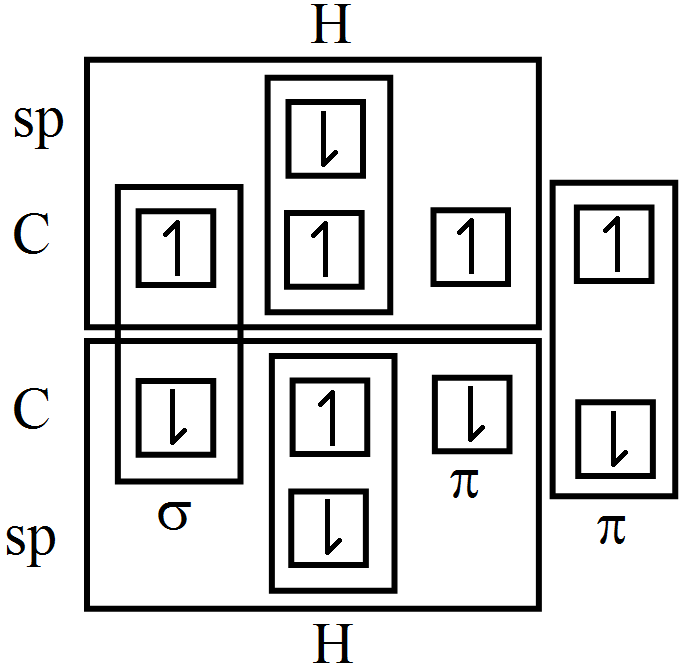
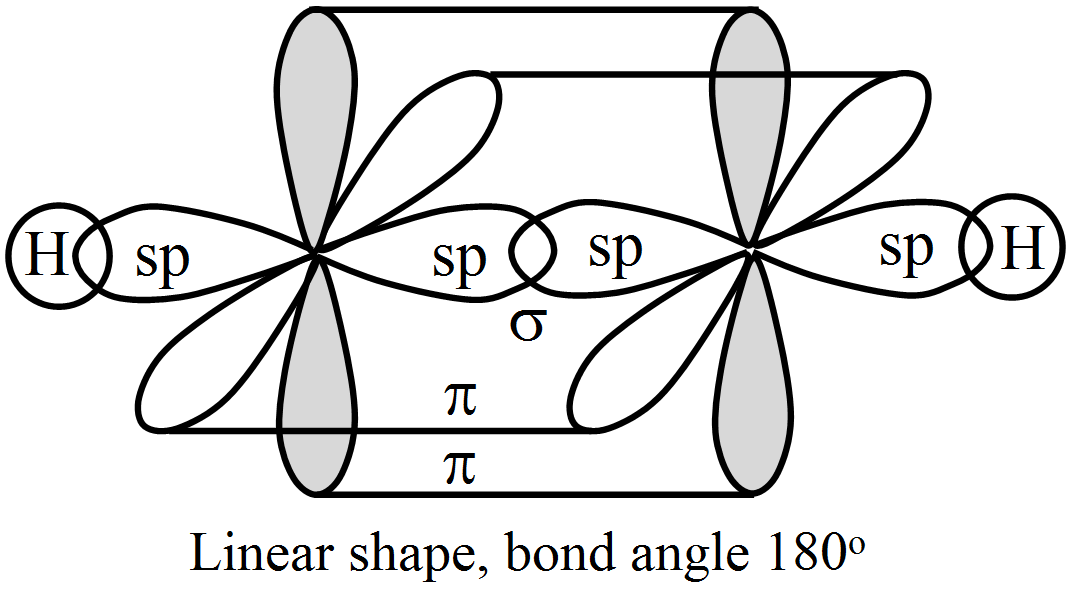
- In $\text{CH}\equiv\text{CH},$ each 'C' is sp hybridised.
View full question & answer→Question 405 Marks
Briefly describe the valence bond theory of covalent bond formation by taking an example of hydrogen. How can you interpret energy changes taking place in the formation of dihydrogen?
AnswerThe valence bond theory was put forward by Heitler and London in 1927. It was later improved and developed by L. Pauling and J.C. Slater in 1931. The valence bond theory is based on the knowledge of atomic orbitals and electronic configurations of elements, overlap criteria of atomic orbitals and stability of molecule. The main points of valence bond theory are:
-
Atoms do not lose their identity even after the formation of the molecule.
-
The bond is formed due to the interaction of only the valence electrons as the two atoms come close to each other. The inner electrons do not participate in the bond formation.
-
During the formation of bond, only the valence electrons from each bonded atom lose their identity. The other electrons remain unaffected.
-
The stability of bond is accounted by the fact that the formation of bond is accompanied by release of energy. The molecule has minimum energy at a certain distance between the atoms known as intemuclear distance. Larger the decrease in energy, stronger will be the bond formed.
Valence bond Treatment of Hydrogen Molecule:
Consider two hydrogen atoms A and B approaching each other havingnuclei H and H and the corresponding electrons e and e respectively. When atoms come closer to form molecules new forces begin to operate.
-
The force of attraction between nucleus of atom and electron of another atom.
- The force of repulsion between two nuclei of the atom and electron of two atoms.
- When two hydrogen atom start coming closer to each other, the electron cloud becomes distorted and new attractive and repulsive forces begin to operate as shown in figure ‘c’ .
- In figure ‘c’ dotted lines show attractive forces present in atom already and bold lines show the new attractive and repulsive forces.
- It has been found experimentally that the magnitude of net attractive forces is more than net repulsive forces. Thus stable hydrogen molecule is formed.
View full question & answer→Question 415 Marks
Explain the following observations:
- $CO_2$ and $SO_2$ are not isostructural.
- $BF_3$ and $NF_3$ are not isostructural.
- $\text{BH}^-_4$ and $\text{NH}^+_4$ are isostructural.
- $N_2$ has higher bond order than NO.
- In $NO^+$ and $N_2$, the bond order is same.
Answer
- $CO_2$ is linear due to sp hybridisation, $SO_2$ is bent molecule due to $sp^2$ hybridisation and one lone pair of electrons.
- $BF_3$ is planar due to $sp^2$ hybridisation, $NF_3$ is pyramidal due to $sp^3$ hybridisation and one lone pair of electrons.
- both are $sp^3$ hybridised, tetrahedral in shape, therefore, isolable, i.e., have same structure.
- $N_2$ has bond order 3 because
$\text{B.O.}=\frac12(\text{N}_\text{b}-\text{N}_\text{a})=\frac12(10-4)=3$
NO has 15 electrons, bond order is 2.5,
$\text{B.O.}=\frac12(10-5)=\frac52$
$N_2$ has one electron less in antibonding orbital than NO.
- $NO^+$ and $N_2$ have same number of bonding and antibonding electrons.
View full question & answer→Question 425 Marks
Assign reason for the following:
i. $BaSO _4$ is insoluble although ionic in nature.
ii. $ClF _3$ has only $90^{\circ}$ bond angles.
iii. $SO _2$ is angular but $SO _3$ is planar.
iv. $NH _3$ and $PH _3$ have same hybridization but different bond angle.
v. $CuSO _4 \cdot 5 H _2 O$ loses $4 H _2 O$ on heating but not the fifth molecule.
Answer
- $BaSO_4$ is insoluble in water because lattice energy is more than hydration energy (energy released when $\text{Ba}^{2+}$ and $\text{SO}^{2-}_4$ get attracted by water molecules)
- $ClF_3$ has three bonded pair which are at $90^\circ $ but lone pair of electrons are at equatorial position at angle $120^\circ $ so as to minimize repulsion.
- $SO_2$ has 1 lone pair, therefore, it is bent molecule, $SO_3$ does not have lone pair.
$\therefore$ $SO_2$ is planar.
- ' N ' is smaller in size and more electronegative than ' P ' therefore in $NH _3$ bond angle is $107^{\circ}$ but in $PH _3$ it is $94.5^{\circ}$. As the size of central atom increases, bond angle decreases.
$[\text{Cu}(\text{H}_2\text{O})_4]\text{SO}_4\dots\text{H}_2\text{O}\xrightarrow{\ \ \text{heat}\ \ }\text{CuSO}_4\dots\text{H}_2\text{O}+4\text{H}_2\text{O}$
- $CuSO_4.5H_2O$ loses $4$ molecules of water which are forming coordinate bond with $Cu^{2+}$ but does not lose $H_2O$ molecule, which is H-bonded.
View full question & answer→Question 435 Marks
What is meant by the term average bond enthalpy? Why there is difference in bond enthalpy of O–H bond in ethanol $\left(\mathrm{C}_2 \mathrm{H}_5 \mathrm{OH}\right)$ and water?
AnswerAverage bond enthalpy is obtained by dividing total bond dissociation enthalpy by the number of bonds broken. All the identical bonds ina molecule do not have there are two but breaking of first, the second some change bond is used by total bond dissociation by the number of bond broken.
Average bond enthalpy $=\frac{502+427}{2}=464$
The bond are differentent because of differentent around oxygen atom.
View full question & answer→Question 445 Marks
Distinguish between a sigma and a pi bond.
Answer
| Sr. No. |
Pi bond |
Sigma bond |
| 1 |
Pi bond is formed by lateral overlapping of orbitals. |
Sigma bond is formed by end to end overlapping of orbitals. |
| 2 |
It is comparatively weak bond. |
It is comparatively strong bond. |
| 3 |
There is only one overlapping orbital is p-p. |
The overlapping orbitals are s-s, s-p, p-p. |
| 4 |
Rotation around pi- bond is restricted. |
Rotation is possible around sigma bond. |
| 5 |
Electron cloud is not symmetrical about the line joining 2 nuclei. |
Electron cloud is symmetrical about the line joining 2 nuclei. |
| 6 |
It is having 2 electron clouds one above the plane of atomic nuclei and one below the plane of atomic nuclei. |
It is having 1 electron cloud and that is symmetrical about the inter-nuclear axis. |
View full question & answer→Question 455 Marks
Write Lewis structure of the following compounds and show formal charge on each atom. $\mathrm{HNO}_3, \mathrm{NO}_2, \mathrm{H}_2 \mathrm{SO}_4$.
Answer
Formal charge on an atom in a Lewis structure:
= total number of valence electrons in free atom – total number of non-bonding (lone pairs) electrons [total number of bonding or shared electrons]
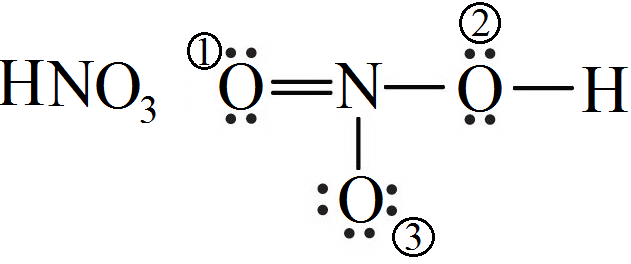
$\text{F}.\text{C}.\text{O}(1)=6-4-\frac{1}{2}(4)=0$
$\text{F}.\text{C}.\text{O}(2)=6-4-\frac{1}{2}(4)=0$
$\text{F}.\text{C}.\text{O}(3)=6-6-\frac{1}{2}(2)=-1$
$\text{F}.\text{C}.\text{O}(4)=5-0-\frac{1}{2}(8)=+1$
$\text{F}.\text{C}.\text{O}(6)=1-0-\frac{1}{2}(2)=0$
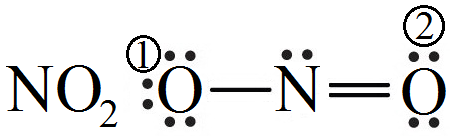
$\text{F}.\text{C}.\text{O}(1)=6-6-\frac{1}{2}(2)=-1$
$\text{F}.\text{C}.\text{O}(1)=6-4-\frac{1}{2}(4)=0$
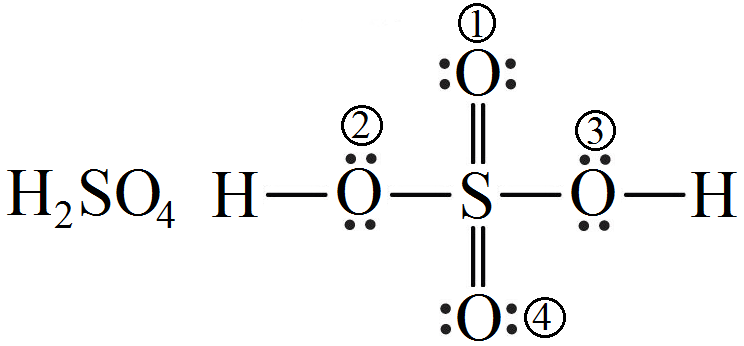
$\text{F}.\text{C}.\text{O}(1)=1-0-\frac{1}{2}(2)=0$
$\text{F}.\text{C}.\text{O}(1)=6-0-\frac{1}{2}(12)=0$ View full question & answer→Question 465 Marks
Give reasons for the following:
-
Covalent bonds are directional bonds while ionic bonds are non- directional.
-
Water molecule has bent structure whereas carbon dioxide molecule is linear.
-
Ethyne molecule is linear.
Answer
- Since the covalent bond depends on the overlapping of orbitals between different orbitals, the geometry of the molecule is different. The orientation of overlap is different. The orientation of overlap is the factor responsible for their directional nature.
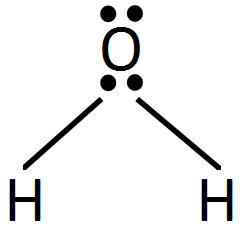
- Due to presence of two lone pairs of electrons on oxygen atom in HiO the repulsion between is more. $\mathrm{CO}_2$ undergoes sp hybridization resulting in linear shape $(\mathrm{O}=\mathrm{C}=\mathrm{O})$ while $\mathrm{H}_2 \mathrm{O}$ undergoes $\mathrm{sp}^3$ hybridisation resulting in distorted tetrahedral or bent structure.
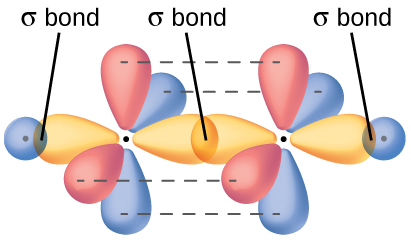
- In ethyne molecule carbon undergoes sp hybridization with two unhybridised orbitals. One sp hybrid orbital of one carbon atom overlaps axially with sp hybrid orbital of the other carbon atom to form C – C sigma bond while the other hybridized orbital of each carbon atom overlaps axially with S orbitals of hydrogen atoms forming. Unhybridised orbitals form n-bonds.
View full question & answer→