Question
Define ionisation enthalpy. Discuss the factors affecting ionisation enthalpy of the elements and its trends in the periodic table.

Answer

Ionization energy is defined as the energy required to remove an electron from the outermost shell of an isolated gaseous atom. Ionization energy depends on the following factors:
  1. Atomic radius: Smaller the atomic radius, the higher is the atomic energy. This is because the Coulombic attractive forces on the negatively charged valence electrons by the positively charged nucleus is much higher in the case of smaller atom-the force of attraction decreases with the increase in atomic radius, i.e separation between the electrons and the nucleus in accordance with the inverse square law.
  2. Nuclear charge: the higher the positive charge of the nucleus, stronger is it's attraction for the electrons, and hence the harder it is to remove the electrons.
  3. Orbital penetration: It's easier to remove electrons from p orbitals than from s orbitals, because the s orbitals penetrate towards the nucleus more closely than the p orbitals, thus making the electrons in the s orbital feel greater nuclear attraction.
  4. Electron pairing: within a subshell, paired electrons are easier to remove than unpaired ones. This is because repulsion between electrons in the same orbital is higher than repulsion between electrons in different orbitals.
  5. Shielding or screening effect of the inner orbitals: Due to the electrons present in the inner orbitals, the electrons in the outermost orbitals feel lesser attraction for the nucleus than expected. In other words, the inner electron orbitals effectively screen or shield the outermost electrons from the nucleus, due to which the ionization energy decreases.

Need a full question paper?

Generate a complete, print-ready paper with questions like this in minutes — across 16+ boards, with answer keys.
Start Generating Free

Similar questions

Molecular hydrides are classified as electron deficient, electron precise and electron rich compounds. Explain each type with two examples.
Consider the following species:
$N^{3–}, O^{2–}, F^–, Na^+, Mg^{2+}$ and $Al^{3+}$​​​​​​​
  1. What is common in them?
  2. Arrange them in the order of increasing ionic radii.
Lifetimes of the molecules in the excited states are often measured by using pulsed radiation source of duration nearly in the nano second range. If the radiation source has the duration of 2 ns and the number of photons emitted during the pulse source is $2.5 \times 10^{15}$, calculate the energy of the source.
How do you account for the strong reducing power of lithium in aqueous solution?
Classify the following substances into oxidising and reducing agents:
  1. Carbon.
  2. Ozone.
  3. Nascent hydrogen.
  4. Nitric acid.
  5. Chlorine.
For any gaseous reaction how will you write the equilibrium constant $\left( K _{ p }\right)$ ? What is the relationship between $K_p$ and $K_{ c }$ ? Derive it.
Consider the reaction of water with $F_2$ and suggest, in terms of oxidation and reduction, which species are oxidised/ reduced.
Explain the structure of triple bond with diagram.
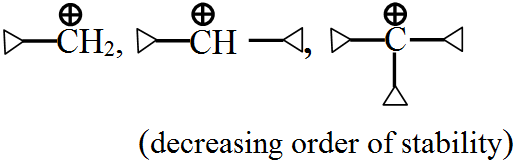
  1. Arrange the following according to given property
$\text{CH}_3\stackrel{\oplus \ \ \ }{\text{CH}}_2,\text{C}_6\text{H}_5-\stackrel{\oplus\ \ \ \ }{\text{CH}}_2,(\text{CH}_3)_3\stackrel{\oplus \ \ \ \ }{\text{CH}},$
$\text{CH}_2=\text{CH}-\stackrel{\oplus\ \ \ \ }{\text{CH}}_2$ (decreasing order of stability)
  1. $\text{HC}\equiv\text{C}^{\ominus},\text{Ch}_2=\stackrel{\ominus\ \ \ \ \ \ }{\text{CH}_2},\text{CH}_3-\stackrel{\ominus\ \ \ \ \ }{\text{CH}_2},\stackrel{\ominus \ \ \ \ \ }{\text{CH}_3}$ (increasing order of stabillity)
  2. $\text{C}_6\text{H}_5\stackrel{\bf. \ \ \ \ }{\text{CHCH}_3},\text{C}_6\text{H}_5\text{CH}_2\stackrel{\bf.\ \ \ \ \ }{\text{CH}_2},\text{C}_6\text{H}_5\stackrel{\bf.}{\text{C}}_3(\text{CH}_3)_2$ (increasing order of stabillity)
  3. $\text{CH}_3-\stackrel{\oplus \ \ \ \ }{\text{CH}}-\text{O}-\text{CH}_3,\text{CH}_3-\stackrel{\oplus \ \ \ \ }{\text{CH}},-\text{OCH}_3,$
${\ \ \ \ \ \ \ \ \ \ \ \ \ \ \ \ \ \ \ \ \text{O}}\\{\ \ \ \ \ \ \ \\ \ \ \ \ \ \ \ \ \ \ \ \ \ \\ \|}\\\ \text{CH}_3-\stackrel{\oplus \ \ \ \ }{\text{CH}}\text{C}-\text{OCH}_3$ (decreasing order of stability)
  1.  
The ejection of the photoelectron from the silver metal in the photoelectric effect experiment can be stopped by applying the voltage of $0.35V$ when the radiation $256.7nm$ is used. Calculate the work function for silver metal.