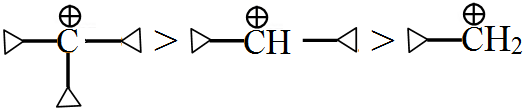
Question
  1. Arrange the following according to given property
$\text{CH}_3\stackrel{\oplus \ \ \ }{\text{CH}}_2,\text{C}_6\text{H}_5-\stackrel{\oplus\ \ \ \ }{\text{CH}}_2,(\text{CH}_3)_3\stackrel{\oplus \ \ \ \ }{\text{CH}},$
$\text{CH}_2=\text{CH}-\stackrel{\oplus\ \ \ \ }{\text{CH}}_2$ (decreasing order of stability)
  1. $\text{HC}\equiv\text{C}^{\ominus},\text{Ch}_2=\stackrel{\ominus\ \ \ \ \ \ }{\text{CH}_2},\text{CH}_3-\stackrel{\ominus\ \ \ \ \ }{\text{CH}_2},\stackrel{\ominus \ \ \ \ \ }{\text{CH}_3}$ (increasing order of stabillity)
  2. $\text{C}_6\text{H}_5\stackrel{\bf. \ \ \ \ }{\text{CHCH}_3},\text{C}_6\text{H}_5\text{CH}_2\stackrel{\bf.\ \ \ \ \ }{\text{CH}_2},\text{C}_6\text{H}_5\stackrel{\bf.}{\text{C}}_3(\text{CH}_3)_2$ (increasing order of stabillity)
  3. $\text{CH}_3-\stackrel{\oplus \ \ \ \ }{\text{CH}}-\text{O}-\text{CH}_3,\text{CH}_3-\stackrel{\oplus \ \ \ \ }{\text{CH}},-\text{OCH}_3,$
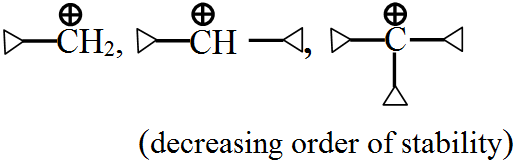
${\ \ \ \ \ \ \ \ \ \ \ \ \ \ \ \ \ \ \ \ \text{O}}\\{\ \ \ \ \ \ \ \\ \ \ \ \ \ \ \ \ \ \ \ \ \ \\ \|}\\\ \text{CH}_3-\stackrel{\oplus \ \ \ \ }{\text{CH}}\text{C}-\text{OCH}_3$ (decreasing order of stability)
  1.  

Answer

  1. $\text{C}_6\text{H}_5\stackrel{\oplus \ \ \ }{\text{CH}}_2>\text{C}\text{H}_2=\text{CH}-\stackrel{\oplus\ \ \ \ }{\text{CH}}_2>(\text{CH}_3)_3\stackrel{\oplus \ \ \ \ }{\text{C}}>\text{CH}_3-\stackrel{\oplus \ \ \ \ }{\text{CH}_2}$
  2. $\stackrel{\ominus \ \ \ \ \ }{\text{CH}_3}<\text{CH}_3-\stackrel{\ominus \ \ \ \ \ }{\text{CH}_2}<\text{CH}_2=\stackrel{\ominus \ \ \ \ \ }{\text{CH}}<\text{HC}\equiv\stackrel{\ominus \ \ \ \ \ }{\text{C}}$
  3. $\text{C}_6\text{H}_5\stackrel{\bf. \ \ \ \ }{\text{CH}_2}<\text{C}_6\text{H}_5\stackrel{\bf.\ \ \ \ \ }{\text{CHCH}_3}<\text{C}_6\text{H}_5\stackrel{\bf.}{\text{C}}_3(\text{CH}_3)_2$
  4. $\text{CH}_3-\stackrel{\oplus \ \ \ \ }{\text{CH}}-\text{O}-\text{CH}_3>\text{CH}_3-\stackrel{\oplus \ \ \ \ }{\text{CH}}>\text{CH}_3>\stackrel{\oplus \ \ \ \ }{\text{CH}}$
${\ \ \ \ \ \ \ \ \ \ \ \ \ \ \ \ \ \ \ \ \text{O}}\\{\ \ \ \ \ \ \ \\ \ \ \ \ \ \ \ \ \ \ \ \ \ \\ \|}\\\ >\text{CH}_3-\stackrel{\oplus \ \ \ \ }{\text{CH}}\text{C}-\text{OCH}_3$
  1.  

Need a full question paper?

Generate a complete, print-ready paper with questions like this in minutes — across 16+ boards, with answer keys.

Start Generating Free

Similar questions

Give reasons for the following:
  1. Covalent bonds are directional bonds while ionic bonds are non- directional.
  2. Water molecule has bent structure whereas carbon dioxide molecule is linear.
  3. Ethyne molecule is linear.
In the Solvay process, can we obtain sodium carbonate directly by treating the solution containing $\left(\mathrm{NH}_4\right)_2 \mathrm{CO} 3$ with sodium chloride? Explain.
Explain the half reaction method (ionelectron method) to balance the redox reaction with example.
1. What is the general molecular formula of saturated monohydric alcohols?
2. Write structural formulae for compounds named as-
a. 1-Bromoheptane
b. 5-Bromoheptanoic acid
Write short note on ionisation constant and ionic product of water.
Explain IUPAC system of nomenclature of elements with example.
For any gaseous reaction how will you write the equilibrium constant $\left( K _{ p }\right)$ ? What is the relationship between $K_p$ and $K_{ c }$ ? Derive it.
Explain why $\mathrm{CO}^{2-} 3$ ion cannot be represented by a single Lewis structure. How can it be best represented?
What does atomic radius and ionic radius really mean to you?
Calcium carbonate reacts with aqueous HCl to give $\mathrm{CaCl}_2$ and $\mathrm{CO}_2$ according to the reaction, $\mathrm{CaCO}_{3(\mathrm{~s})}+2 \mathrm{HCl}_{(\mathrm{aq})} \rightarrow$ $\mathrm{CaCl}_{2(\mathrm{aq})}+\mathrm{CO}_{2(g)}+\mathrm{H}_2 \mathrm{O}_{(l)}$
What mass of $\mathrm{CaCO}_3$ is required to react completely with 25 mL of 0.75 M HCl ?