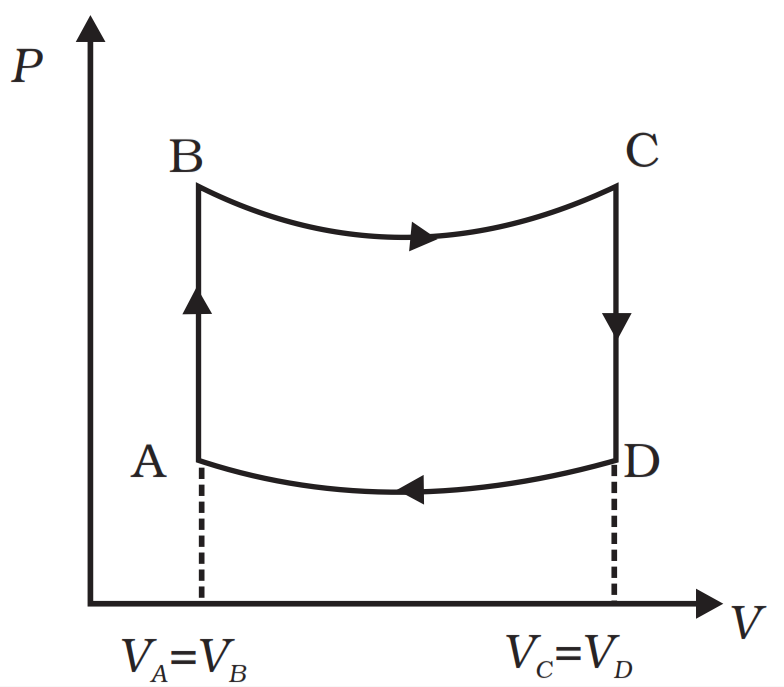
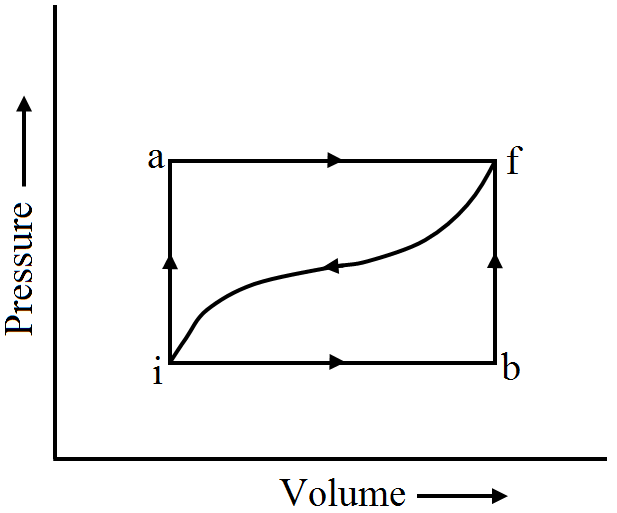
- According to the first law of thermodynamics, the total heat energy change dQ is the sum of the internal energy change dU and work done dW,
i.e. dQ = dU + dW
Limitations of the first law of thermodynamics:
- The first law does not indicate the direction in which the heat change can occur.
- The first law does not give any idea about the extent of heat change.
- The first law of thermodynamics gives no information about the source of heat, i.e. whether it is a hot or cold body.
The relation between two specific heats of a gas, i.e. Cp and Cv is given by Cp - Cv = R where, R is the molar gas constant and is equal to 8.31J mole-1K-1.
Cp > Cv because a part of the energy supplied in the isobaric process goes to increase the volume of the gas and the remaining increases the temperature.
- According to first law of thermodynamics,
dQ = dU + dW
Differentiating w.r.t., time (t)
$\frac{\text{dQ}}{\text{dt}}=\frac{\text{dU}}{\text{dt}}+\frac{\text{dW}}{\text{dt}}$
$100\text{W}=\frac{\text{dU}}{\text{dt}}+75$
$[\because$ Given, system performs work at a rate of 75J/ sec.$]$
$\frac{\text{dU}}{\text{dt}}\rightarrow$ Rate of change of internal energy
$\frac{\text{dU}}{\text{dt}}=100-75=25\text{W}$
Alternate Answer
- For a small change in volume, work done is given by dW = PdV.
We know, PV = nRT
For T = Constant
$\text{dW}=\text{nRt}\cdot\frac{\text{dV}}{\text{V}}$
$\therefore\text{P}=\frac{\text{nRT}}{\text{V}}$
Net work done under isothermal condition to change the volume from Yi to Vf is,
$\text{W}=\int\limits^{\text{V}_\text{f}}_{\text{V}_\text{i}}\text{dW}$
$=\text{nRT}\int\limits^{\text{V}_\text{f}}_{\text{V}_\text{i}}\frac{\text{dV}}{\text{V}}=\text{nRT}|\log_\text{e}\text{V}|^{\text{V}_\text{f}}_{\text{V}_\text{i}}$
$=\text{nRT }\log_\text{e}\Big(\frac{\text{V}_\text{f}}{\text{V}_\text{i}}\Big)$
$\therefore\text{W}=2.3026\text{ nRT }\log_{10}\Big(\frac{\text{V}_\text{f}}{\text{V}_\text{i}}\Big)$
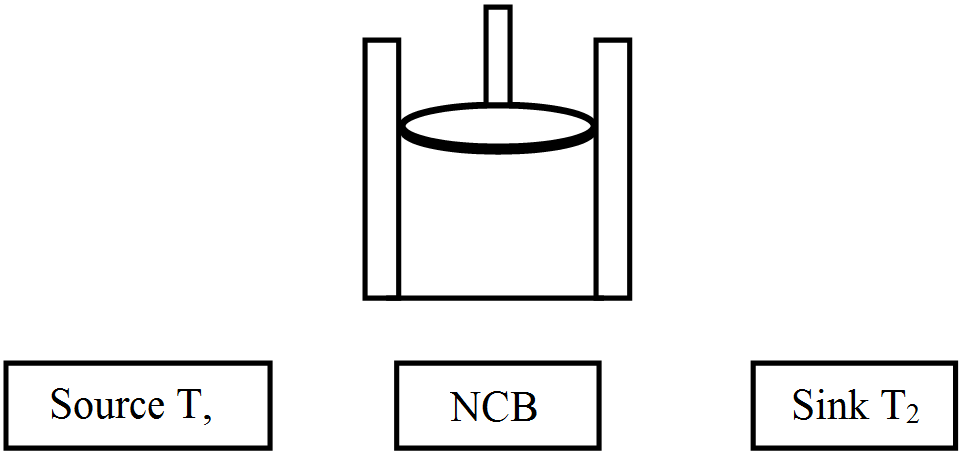
- Work done by a steam energy,
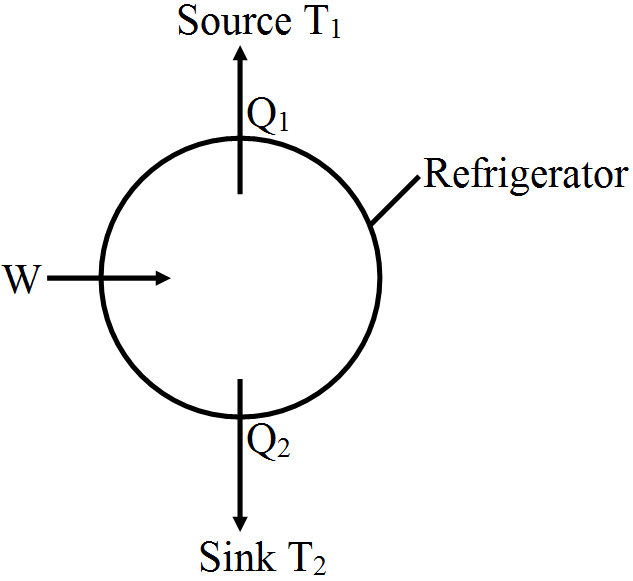
W = 5.4 × 10⁸J, Q1 = 3.6 × 10⁹J
Efficiency of the engine, $\eta=?,\text{Q}_2=?$
$\eta=\frac{\text{W}}{\text{Q}_1}=\frac{5.4\times10^8\text{J}} {3.6\times10^9\text{J}}$
$=\frac{54}{36}\times10^{-1}=\frac{3}{20}=0.15$ or 15%
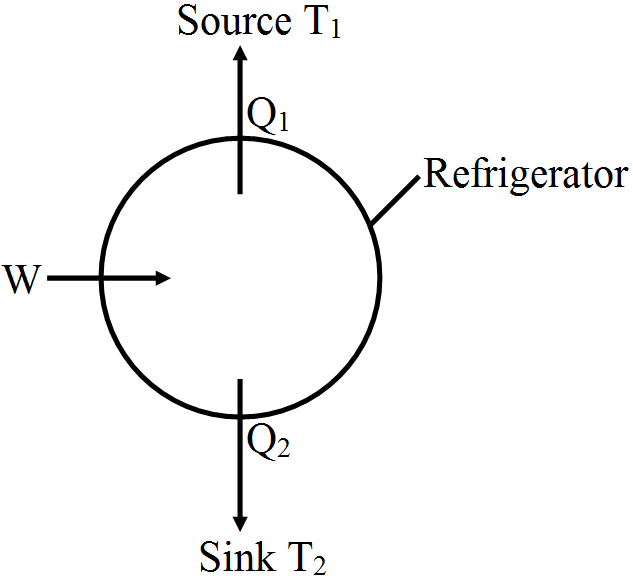
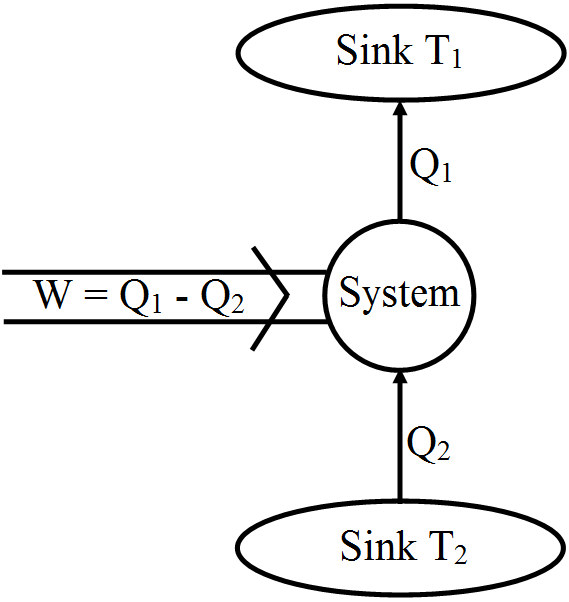
Heat wasted per minute,
$\text{Q}_2=\text{Q}_1-\text{W}$
$\text{Q}_2=3.6\times10^9\text{J}-5.4\times10^8\text{J}$
$=36\times10^8\text{J}-5.4\times10^8\text{J}$
$=10^8(36-5.4)\text{J}=30.6\times10^9\text{J}$
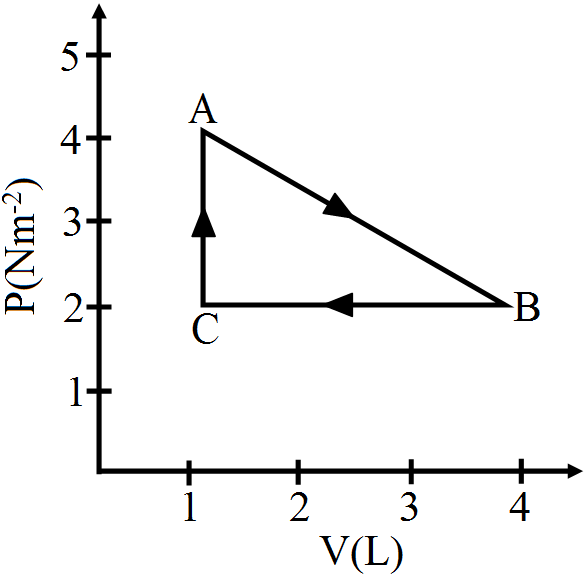
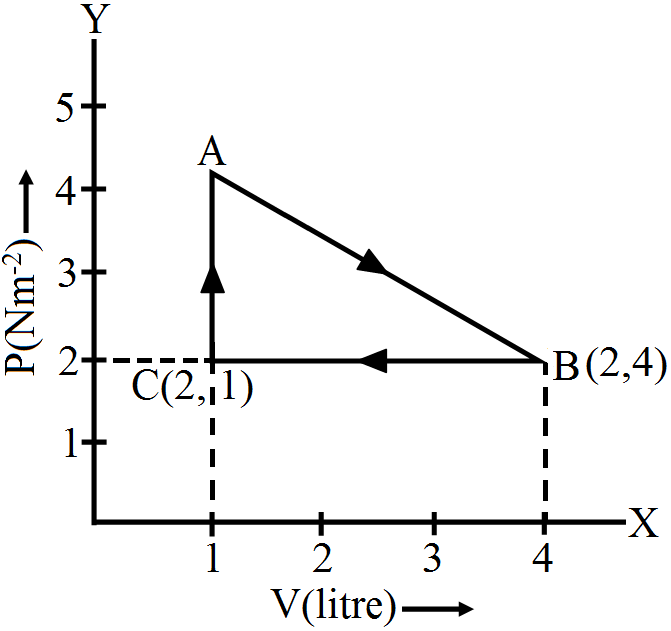
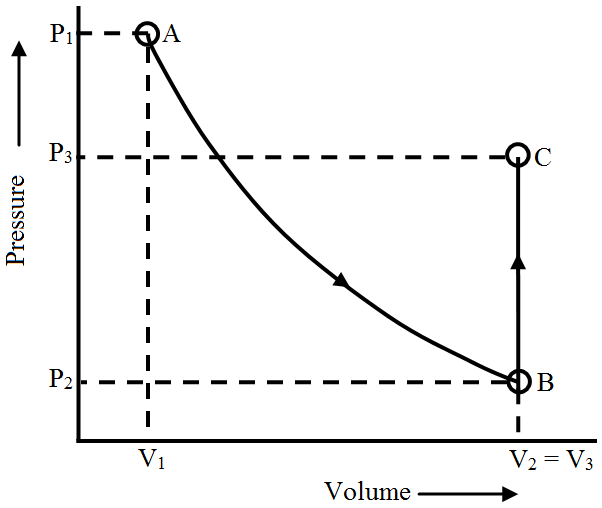
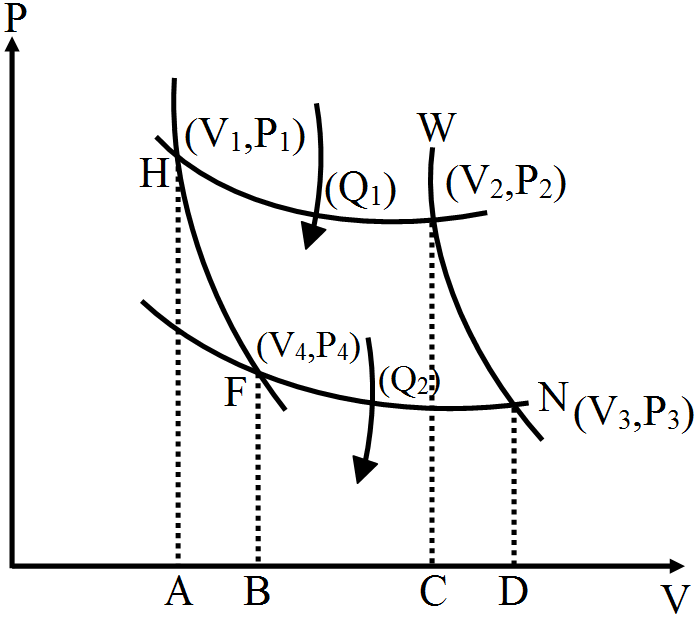
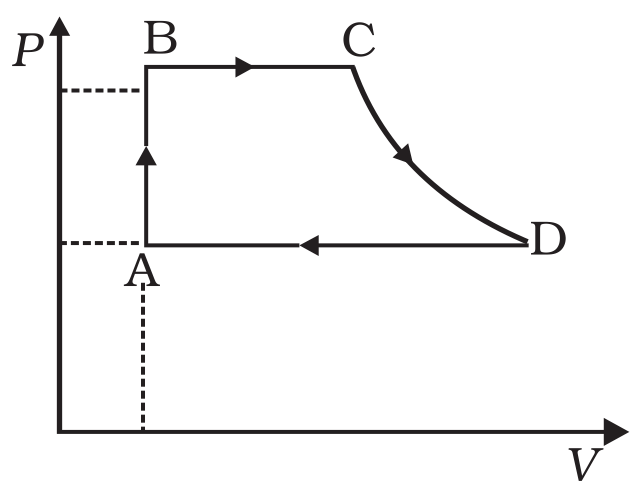
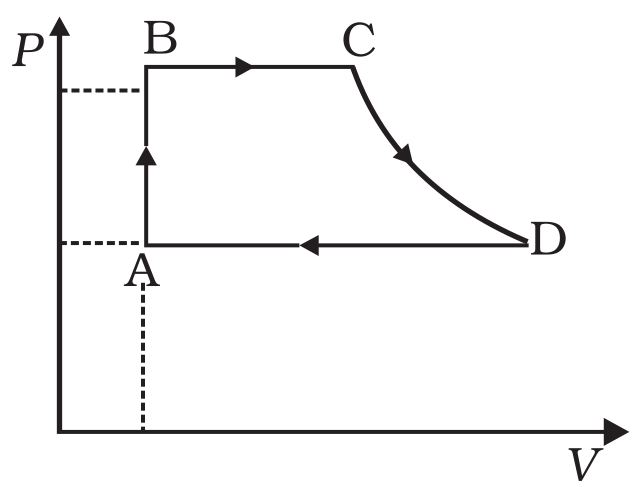 AB : constant volume
 By
By