Question
Define magnetic elements of earth's magnetic field. Establish the relation between them.
On suspending a magnet at an angle of 30° with magnetic meridian it makes an angle of 45° with horizontal. Calculate the correct value of angle of dip.
Answer

Magnetic Elements of Earth's Magnetic Field : (i) Angle Declination, (ii) Angle of dip, (iii) Horizontal component of Earth's Magnetic field.
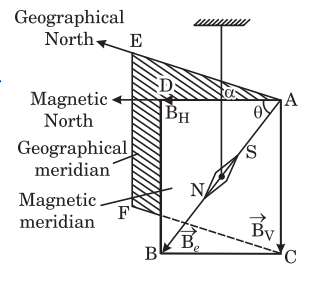
Horizontal Component of earth's magnetic field : The knowledge of declination and inclination at a place on the earth's surface completely specifies the direction of the earth's magnetic field. It is along the axis of the needle suspended freely through its centre of gravity lying in magnetic meridian from south pole towards north pole and is denoted by $\overrightarrow{ B _e}$. It can be resolved into two mutually perpendicular components. The component of earth's magnetic field in the horizontal direction in the magnetic meridian is called horizontal component of earth's magnetic field which is directed towards the magnetic south. It is denoted by $\overrightarrow{ B _{ H }}$.
In adjoining figure all the three elements of earth's magnetic field are shown. Starting from the geographical meridian OLMR the magnetic meridian OPOR is drawn at an angle equal to angle of declination. In the magnetic meridian horizontal direction is drawn-specifying magnetic north. The intensity of magnetic field $\overrightarrow{ B _e}$ is at an angle equal to angle of dip $\theta$ from this direction.
Image
Hence the horizontal component $B _{ H }$ may be expressed as follows :
$B _{ H }= B _{ e } \cdot \cos \theta$
Relation between the elements: From the knowledge of $\alpha$ and $\theta$ the direction of earth's magnetic field $\overrightarrow{ B _e}$ can be specified and from the knowledge of BH and $\theta$ the magnitude of the earth's magnetic field $\left|\overrightarrow{ B }_e\right|=$ $B _e$, can be calculated by the use of above equation.
Hence from the knowledge of all the three elements $\alpha,$ Q and H both the magnitude and direction of the earth's magnetic field can be determined i.e. complete information about earth's magnetic field at any place can be obtained due to which these three quantities are called fundamental quantities of earth's magnetic field or elements of the earth's magnetic field.
Magnitude and direction of $\overrightarrow{ B _e}$ can also be calculated as follows :
From the figure given above :
Horizontal component of earth's magnetic field :
$B_{H}=B_e \cos \theta$ ... (1)
and Vertical component of earth's magnetic field :
$B _{ V }= B _e \sin \theta$ ...(2)
On squaring equations (1) and (2) and then adding them, we get
$B _{ H }^2+ B _{ V }^2= B _e^2 \cos ^2 \theta+ B _e^2 \cos ^2 \theta$
$= B _e^2\left(\cos ^2 \theta+\sin ^2 \theta\right)$
But $\cos ^2 \theta+\sin ^2 \theta=1$
Hence $B _{ H }^2+ B _{ V }^2= B _e^2$
$\Rightarrow \quad B _e=\sqrt{ B _{ H }^2+ B _{ V }^2}$ ...(3)
On dividing equation (2) by (1), we get
$\frac{ B _{ V }}{ B _{ H }}=\tan \theta$ ...(4)
Solution of Numerical Question : If $B _{ H }$ and $B _{ V }$ be the be the horizontal and vertical components earth's magnetic field in the magnetic meridian then the true value of angle of dip $\theta$ is given by :
$\tan \theta=\frac{B_V}{B_H}$ ...(1)
Image
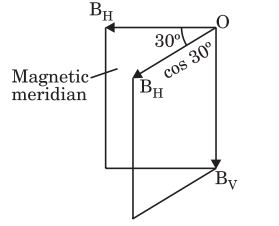
But the adjoining figure lies in a vertical plane at 30° from the magnetic meridian, the horizontal component is given by: BH' = BH cos 30° while the vertical con component is still BV. Hence the apparent value of the angle of dip $\theta^{\prime}$ in this plane is given by :
$\tan \theta^{\prime}=\frac{ B _{ V }}{ B _{ H }{ }^{\prime}}$, where $\theta^{\prime}$ is given to be equal to $45^{\circ}$
$\therefore \quad \tan 45^{\circ}=\frac{ B _{ V }}{ B _{ H } \cos 30^{\circ}}$ ...(2)
On dividing equation (1) by equation (2), we get
$\frac{\tan \theta}{\tan 45^{\circ}}=\cos 30^{\circ}$
$\Rightarrow \quad \tan \theta=\tan 45^{\circ} \times \cos 30^{\circ}$
or $\tan \theta=1 \times 0.8660=0.8660$
$\Rightarrow \quad \theta=\tan ^{-1}(0.8660)$

Need a full question paper?

Generate a complete, print-ready paper with questions like this in minutes — across 16+ boards, with answer keys.

Start Generating Free

Similar questions

A professor reads a greeting card received on his 50th birthday with +2.5D glasses keeping the card 25cm away. Ten years later, he reads his farewell letter with the same glasses but he has to keep the letter 50cm away. What power of lens should he now use?
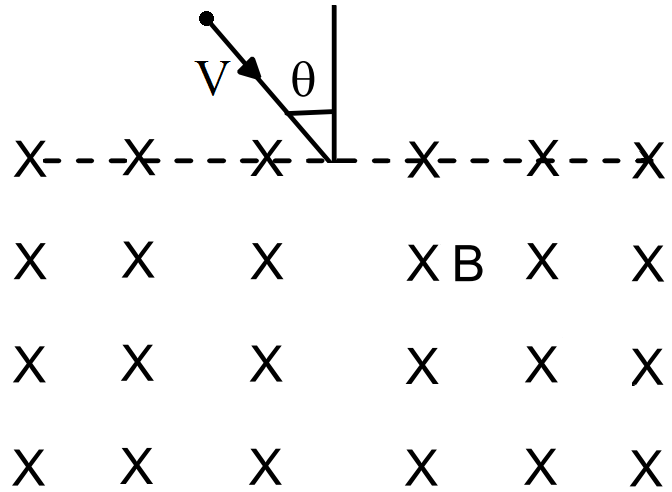
A particle of mass m and positive charge q, moving with a uniform velocity v, enters a magnetic field B, as shown,
  1. Find the radius of the circular arc it describes in the magnetic field.
  2. Find the angle subtended by the arc at the centre.
  3. How long does the particle stay inside the magnetic field?
  4. Solve the three parts of the above problem if the charge q on the particle is negative.


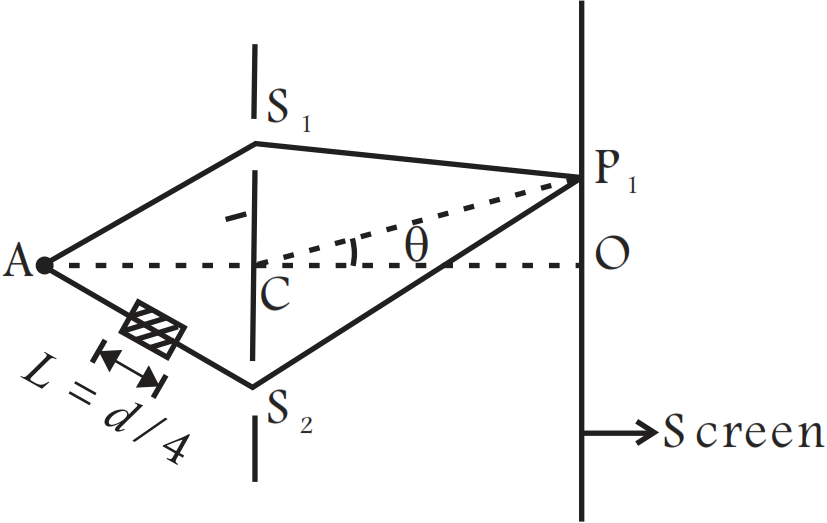
$\ce{AC = CO = D, S_1C = S_2C = d < < D}$
A small transparent slab containing material of $\mu = 1.5$ is placed along $AS_2 ($Fig$)$. What will be the distance from $O$ of the principal maxima and of the first minima on either side of the principal maxima obtained in the absence of the glass slab.
A bar magnet of length $1\ cm$ and cross $-$ sectional area $1.0\ cm^2$ produces a magnetic field of $1.5 \times 10. T$ at a point in end-on position at a distance $15\ cm$ away from the centre.
  1. Find the magnetic moment $M$ of the magnet.
  2. Find the magnetization $I$ of the magnet.
  3. Find the magnetic field $B$ at the centre of the magnet.
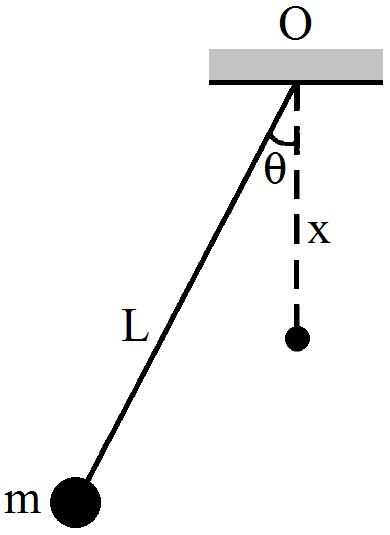
A simple pendulum of length $L$ having a bob of mass m is deflected from its rest position by an angle $\theta$ and released $($figure$)$. The string hits a peg which is fixed at a distance $x$ below the point of suspension and the bob starts going in a circle centred at the peg.
  1. Assuming that initially the bob has a height less than the peg, show that the maximum height reached by the bob equals its initial height.
  2. If the pendulum is released with $\theta=90^\circ$ and $\text{x}=\frac{\text{L}}{2}$ find the maximum height reached by the bob above its lowest position before the string becomes slack.
  3. Find the minimum value of $\frac{\text{x}}{\text{L}}$ for which the bob goes in a complete circle about the peg when the pendulum is released from $\theta=90^\circ.$
A car accelerates on a horizontal road due to the force exerted by:
  1. The engine of the car.
  2. The driver of the car.
  3. The earth.
  4. The road.
How many wavelengths are emitted by atomic hydrogen in visible range $(380\ nm-780\ nm)?$ In the range $50] nm$ to $100\ nm?$
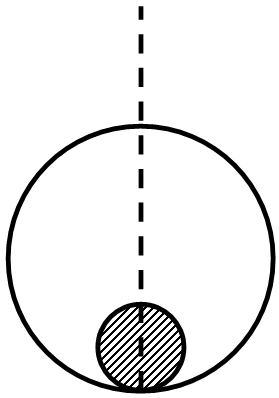
A solid sphere of mass m and radius r is placed inside a hollow thin spherical shell of mass M and radius R as shown in A particle of mass m' is placed on the line joining the two centres at a distance x from the point of contact of the sphere and the shell. Find the magnitude of the resultant gravitational force on this particle due to the sphere and the shell if,
  1. r < x < 2r.
  2. 2r < x < 2R.
  3. x > 2R.

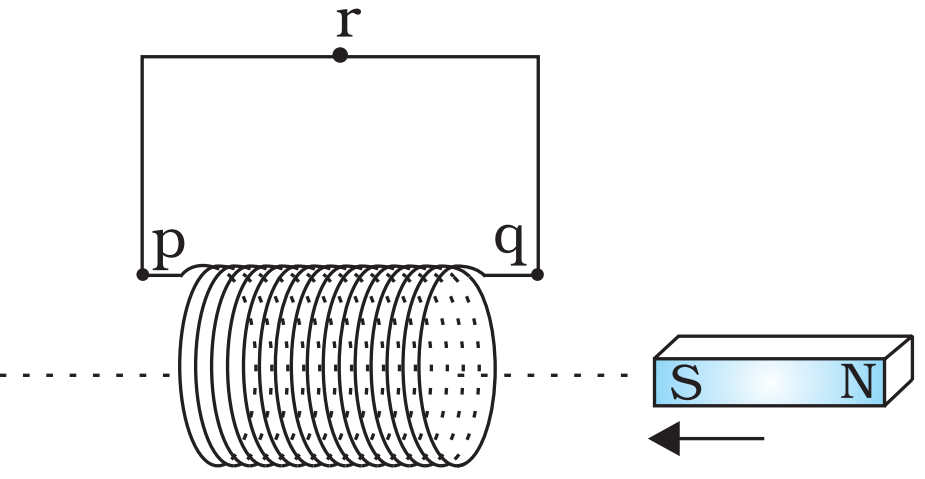
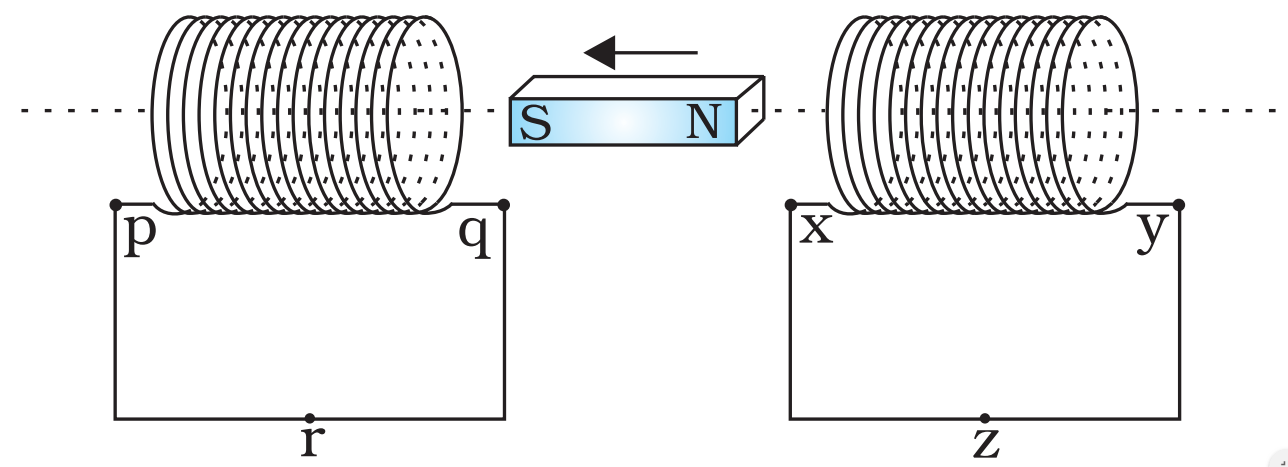
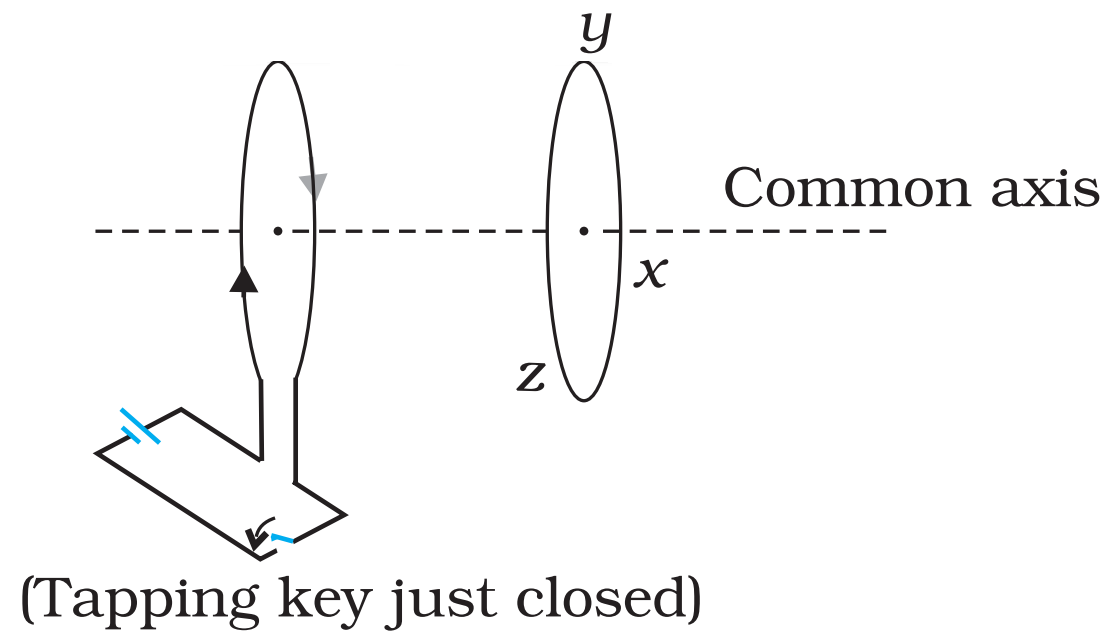
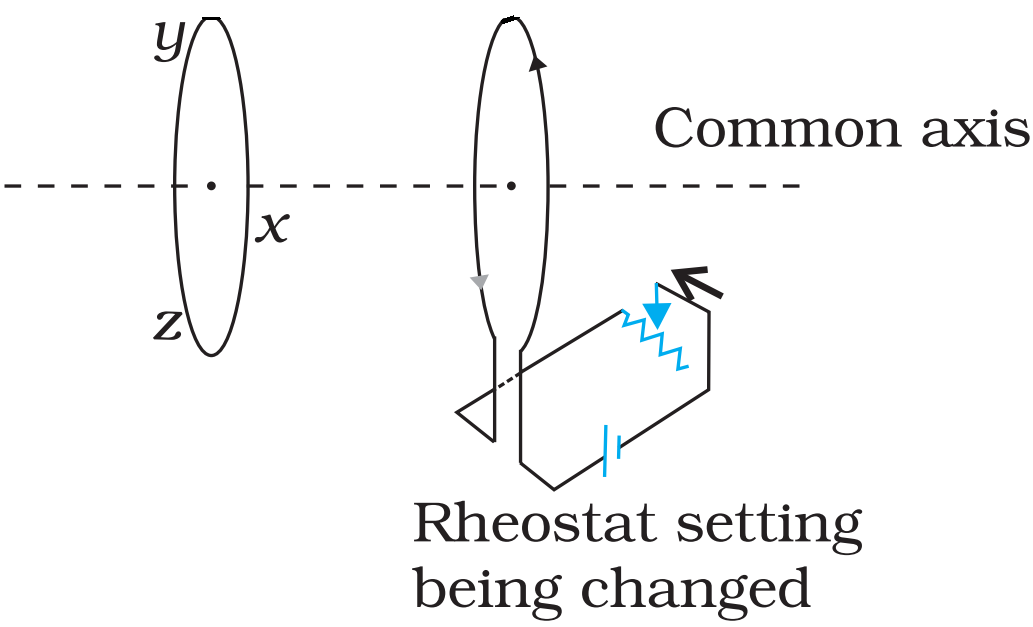
Predict the direction of induced current in the situations described by the following Figs. (a) to (f).
  1.  
  1.  
  1.  
  1.  
  1.  
  1.  
One end of a $10\ cm$ long silk thread is fixed to a large vertical surface of a charged nonconducting plate and the other end is fastened to a small ball having a mass of $10g$ and a charge of $4.0 \times 10^{-5}C.$ In equilibrium, the thread makes an angle of $60^\circ$ with the vertical. Find the surface charge density on the plate.