Define diamagnetic, paramagnetic and ferromagnetic substance with examples. Explaining the meaning of domain explain ferromagnetism.
Answer
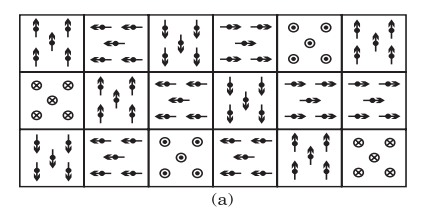
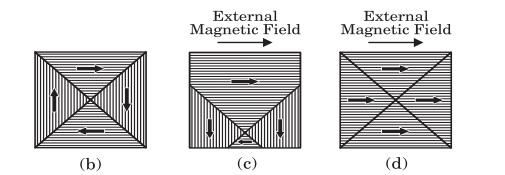
Diamagnetic Substances : Diamagnetic sub-stances are those which acquire feeble magnetisation in a direction opposite to that of magnetising field i.e. for these materials $\overrightarrow{ I }$ is always opposite to $\overrightarrow{ H }$. Therefore when these substances are brought close to a pole of a powerful magnet they are somewhat repelled away from the material. Due to this fact the susceptibility $(\chi)$ of these substances is negative. Examples : Bismuth, antimony, gold, water, alcohol, quartz, copper, lead, zinc, tin, silicon, nitrogen, sodium-chloride etc. Paramagnetic Substances : Paramagnetic sub-stances are those which, when placed in a magnetic field, acquire a feeble magnetisation in the same sense as the applied field. i.e. for these substances $\overrightarrow{ I }$ is always in the direction of $\overrightarrow{ H }$. Therefore, when these substances are brought close to any pole of a powerful magnet, they are attracted towards the magnet. Due to this fact the susceptibility of these substances is positive. Examples : Platinum, aluminium chromium, manganese copper sulphate, solution of salts of iron and nickel, oxygen, crow glass, radium, copper chloride etc. Ferromagnetic Substances : Those substances which when placed in a magnetic field are strongly magnetised in the direction of magnetising field are called ferromagnetic substances. For such substances $\overrightarrow{ I }$ is always in the direction of $\overrightarrow{ H}$ and $\overrightarrow{ I }$ is much greater than $\overrightarrow{H }$. Therefore when these substances are brought close to any pole of a magnet, they are strongly attracted by the magnet. Due to this fact the susceptibility \[(\chi\] = I/H) of ferromagnetic substances is positive and is very much greater than 1. Examples : Iron, Cobalt, Nickel, Magnetite (Fe3O4) alloys like alnico etc. Explanation of Ferromagnetism : Like param-agnetic substance the atoms of ferromagnetic material also passess net magnetic moment and behave as a tiny magnetic dipole. The difference in paramagnetism and ferromagnetism is only that of intensify of magnetisation due to large magnetic moment in ferromagnetism substances. The atomic dipoles of ferromagnetic substance tend to align parallel to each other even in a weak magnetising field. The atomic dipoles are not independent of each other, in ferromagnetic substances but due to quantum mechanical mutual interaction the atoms in these substances form large number of small regions of size 10-4 cm to 1 cm containing 1017 to 1021 atomic dipoles. These regions are called domains. The atomic dipoles of one domain are aligned in the same direction but in different direction from the neighboring domain [Fig. (a)]. In this way each domain in the absence of any external magnetising field has net magnetic moment in a particular direction, but due to random orientation of different domains the resultant magnetic moment in the substance is zero. It is due to this fact that every piece of iron is not a magnet. In Fig. (b) the probable directions of magnetic moment of four domains of a ferromagnetic substance are shown. When the ferromagnetic substance is placed in an external magnetising field the ferromagnetism can be increased in the following two ways : (i) By the displacement of the boundaries of the domains : When the external magnetising field is weak then the ferromagnetic substance is magnetised by this mechanism. In this mechanism the boundaries of the domains containing atomic magnetic dipoles oriented in the direction of external field increase in size, whereas those oriented in opposite direction to the field are reduced in size [Fig. (c)]. Here the ferromagnetic substance is magnetised strongly in the direction of external magn-etising field. (ii) By the rotation of the domains : When the external magnetising field is strong then the ferromagnetic substance is magnetised by this mechanism. In this mechanism under the effect of strong magnetising field all the domains rotate until their magnetic momenta are aligned in the direction of external magnetic field [Fig. (d)]. Here the ferromagnetic substance is magnetised strongly in the direction of external magnetising field.
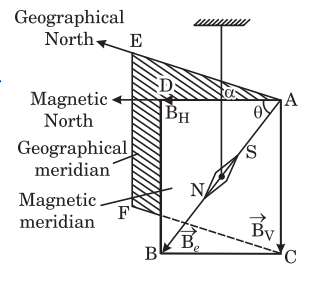
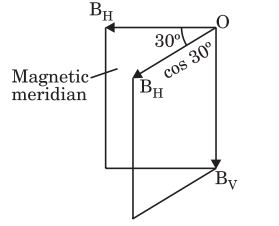
Define magnetic elements of earth's magnetic field. Establish the relation between them. On suspending a magnet at an angle of 30° with magnetic meridian it makes an angle of 45° with horizontal. Calculate the correct value of angle of dip.