Question
Define magnetic susceptibility of a material. Name two elements, one having positive susceptibility and the other having negative susceptibility. What does negative susceptibility signify

Answer

Magnetic susceptibility of a material is defined as the ratio of the intensity of magnetisation (i) induced in the material to the magnetisation force (H) applied on it. Magnetic susceptibility is represented as: Substances such as copper, lead, etc. have negative susceptibility. These substances are called diamagnetic substances. Substances such as aluminium, calcium, etc. have positive susceptibility. These substances are called paramagnetic substances. Substances with negative susceptibility signify that they are repelled by magnets.

Need a full question paper?

Generate a complete, print-ready paper with questions like this in minutes — across 16+ boards, with answer keys.
Start Generating Free

Similar questions

  1. States law of Malus.
  2. Draw a graph showing the variation of intensity (I) of polarised light transmitted by an with angle $(\theta)$between polariser and analyser.
  3. What is the value of refractive index of a medium of polarising angle 60o?
Find the expression for the capacitance of a parallel plate capacitor of plate area A and plate separation d when (I) a dielectric slab of thickness t and (II) a metallic slab of thickness t, where (t < d) are introduced one by one between the plates of the capacitor. In which case would the capacitance be more and why?
Rate of change of electric field in the region between the plates of capacitor is $1.5 \times 10^{12} Vm ^{-1} s^{ 1 }$. If circular plate of capacitor has a radius of 55 mm , then find the magnitude of displacement current.
  1. Show using a proper diagram how unpolarised light can be linearly polarised by reflection from a transparent glass surface.
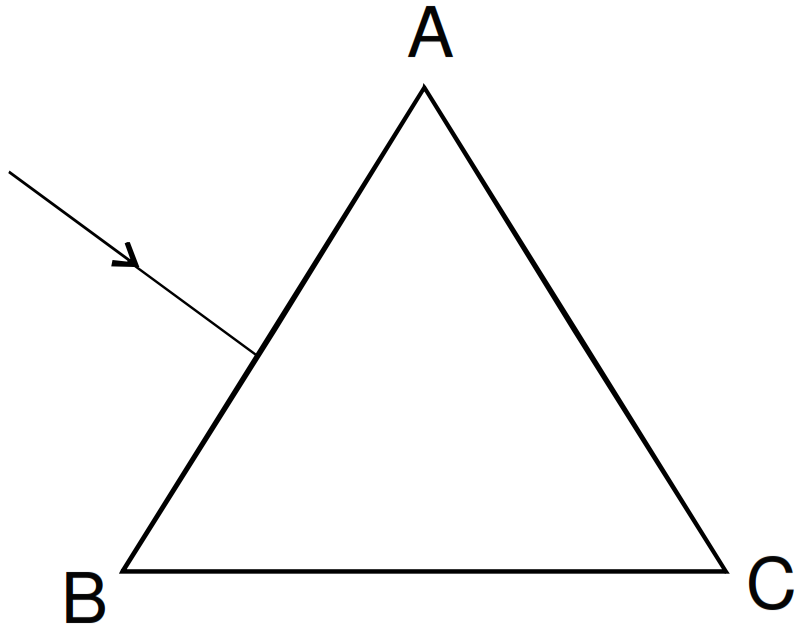
  2. The figure shows a ray of light falling normally on the face AB of an equilateral glass prism having refractive index $\frac{3}{2},$ placed in water of refractive index $\frac{4}{3}.$ Will this ray suffer total internal reflection on striking the face AC? Justify your answer.

Show that the ratio of the magnetic dipole moment to the angular momentum (l = mvr) is a universal constant for hydrogen-like atoms and ions. Find its value.
Consider a 10cm long piece of a wire which carries a current of 10A. Find the magnitude of the magnetic field due to the piece at a point which makes an equilateral triangle with the ends of the piece.
Two particles of masses m1 and m2 are joined by a light rigid rod of length r. The system rotates at an angular speed co about an axis through the centre of mass of the system and perpendicular to the rod. Show that the angular momentum of the system is $\text{L}=\mu\text{r}^2\omega$ where $\mu$ is the reduced mass of the system defined as $\mu=\frac{\text{m}_1\text{m}_2}{\text{m}_1+\text{m}_2}.$
Draw a schematic diagram of the experimental arrangement used by Davisson and Germer to establish the wave nature of electrons. Explain briefly how the de-Broglie relation was experimentally verified in case  of electrons.
Write the name of main parts of electromagnetic spectrum with their wavelength range.
Radiation from hydrogen discharge tube falls on a cesium plate. Find the maximum possible kinetic energy of the photoelectrons. Work function of cesium is 1.9eV.