Question
Define magnetic susceptibility of a material. Name two elements, one having positive susceptibility and the other having negative susceptibility. What does negative susceptibility signify

Answer

Magnetic susceptibility of a material is defined as the ratio of the intensity of magnetisation (i) induced in the material to the magnetisation force (H) applied on it. Magnetic susceptibility is represented as: Substances such as copper, lead, etc. have negative susceptibility. These substances are called diamagnetic substances. Substances such as aluminium, calcium, etc. have positive susceptibility. These substances are called paramagnetic substances. Substances with negative susceptibility signify that they are repelled by magnets.

Need a full question paper?

Generate a complete, print-ready paper with questions like this in minutes — across 16+ boards, with answer keys.
Start Generating Free

Similar questions

The work function for the following metals is given:
Na: 2.75 eV; K: 2.30 eV; Mo: 4.17 eV; Ni: 5.15 eV. Which of these metals will not give photoelectric emission for a radiation of wavelength 3300 Å from a He-Cd laser placed 1 m away from the photocell? What happens if the laser is brought nearer and placed 50 cm away?
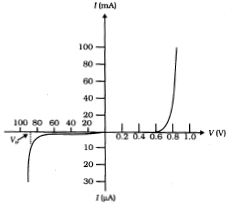
The figure below shows the $\text{V-I}$ characteristic of a semiconductor diode.
  1. Identify the semiconductor diode used.
  2. Draw the circuit diagram to obtain the given characteristic of this device.
  3. Briefly, explain how this diode can be used as a voltage regulator.
  1. Define the term ‘conductivity’ of a metallic wire. Write its SI unit.
  2. Using the concept of free electrons in a conductor, derive the expression for the conductivity of a wire in terms of number density and relaxation time. Hence obtain the relation between current density and the applied electric field E.
The gravitational force acting on a particle of 1g due to a similar particle is equal to $6.67 \times 10^{-17}N.$ Calculate the separation between the particles.
A positive point charge (+ q) is kept in the vicinity of an uncharged conducting plate. Sketch electric field lines originating from the point on to the surface of the plate.
Derive the expression for the electric field at the surface of a charged conductor.
Calculate the change in internal energy of a gas kept in a rigid container when 100J of heat is supplied to it.
Prove that the power dissipated in an ideal resistor connected to an ac source is $\frac{\text{V}^2_{\text{eff}}}{\text{R}}.$
Write a short-note on p-type semiconductors.
Plot a graph showing the variation of photoelectric current with intensity of light. The work function for the following metals is given:
Na : 2.75 eV and Mo : 4.175 eV.
Which of these will not give photoelectron emission from a radiation of wavelength 3300 Å from a laser beam? What happens if the source of laser beam is brought closer?
Explain how the groups of different energy levels can be made in -semi-conductors like Si and Ge crystals with band diagram