Question
Write a short-note on p-type semiconductors.

Answer


Image
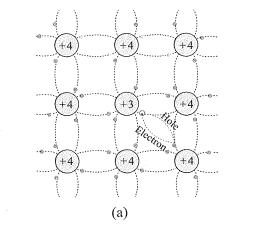
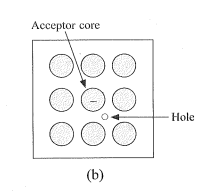
As shown in Fig., to prepare this type of semiconductors, in pure $S i$ or $G e$, trivalent impurity like $A /, B , I n$ etc. are added. (In the outer most orbit, there are 3 electrons in such atoms, so they are called tri-valent.)
Image
The dopant has one valence electron less than the $S i$ and $G e$ atoms, and therefore, this atom can form covalent bonds with neighbouring three $S i$ atoms but does not have any electron to offer to the fourth $S i$ atom.
So, a vacancy (empty space) or hole is created in the bond between the fourth neighbour and the trivalent atom, as shown in the Fig.
Since the neighbouring Si atom in the lattice wants an electron in place of a hole, an electron in the outer orbit of an atom in the neighbourhood may jump to fill this vacancy, leaving a vacancy or hole at its own site.
Thus the hole is available for conduction. Hole has the tendency to attract/accept an electron. Hence, such impurities are called acceptor impurities.
Apart from this, at room temperature, some covalent bonds break and pair of electron and a hole is created.
Thus, for such a material, the holes are majority carriers and electrons are minority carriers.
Since, the holes behave as a positive charge due to deficiency of negatively charged electrons, from the first letter of the word positive, such extrinsic semiconductors doped with trivalent impurity are called $p$-type semiconductors.
For $p$-type semiconductors. $n_h \gg n_e$.

Need a full question paper?

Generate a complete, print-ready paper with questions like this in minutes — across 16+ boards, with answer keys.
Start Generating Free

Similar questions

Find the ratio of the linear momenta of two particles of masses 1.0kg and 4.0kg if their kinetic energies are equal.
Two identically charged particles are fastened to the two ends of a spring of spring constant $100\ Nm^{-1}$ and natural length 10cm. The system rests on a smooth horizontal table. If the charge on each particle is $2.0 \times 10^{-8}C$, find the extension in the length of the spring. Assume that the extension is small as compared to the natural length. Justify this assumption after you solve the problem.
A bulb rated 60W at 220V is connected across a household supply of alternating voltage of 220V. Calculate the maximum instantaneous current through the filament.
The. wire ABC shown in figure forms an equilateral triangle. Find the magnetic field B at the centre O of the triangle assuming the wire to be uniform.
Three light rays red (R), green (G) and blue (B) are incident on a right-angled prism ‘abc’ at face ‘ab’. The refractive indices of the material of the prism for red, green and blue wavelengths are 1.39, 1.44 and 1.47 respectively. Out of the three which colour ray will emerge out of face ‘ac’? Justify your answer. Trace the path of these rays after passing through face ‘ab’.
A 40cm wire having a mass of 3.2g is stretched between two fixed supports 40.05cm apart. In its fundamental mode, the wire vibrates at 220Hz. If the area of cross-section of the wire is $1.0mm^2$, find its Young's modulus.
Can two equipotential surfaces cut each other?
A spy report about a suspected car reads as follows. "The car moved 2.00km towards east, made a perpendicular left turn, ran for 500m, made a perpendicular right turn, ran for 4.00km and stopped". Find the displacement of the car.
The given figure shows a network of resistances $R_1, R_2, R_3$ and $R_4.$​​​​​​​

Using Kirchhoff's laws, establish the balance condition for the network.
Find the radius and energy of a $He^+$ ion in the states $(a) n = 1, (b) n = 4$ and $(c) n = 10.$