Question
Define magnifying power of a telescope. Write its expression.
A small telescope has an objective lens of focal length 150 cm and an eye piece of focal length 5 cm. If this telescope is used to view a 100m high tower 3 km away, find the height of the final image when it is formed 25 cm away from the eye piece.

Answer

  1. Magnifying power is the ratio of the angle subtended at the eye by the image to the angle subtended at the unaided eye by the object.

Expression

$\text{m} = \beta\big/\alpha = \text{f}_{o}\big/\text{f}_{e}$

or $\text{m} = \text{f}_{o} /_{ \text{f}_{e}}\bigg(1 + \frac{\text{f}_{e}}{\text{D}}\bigg)$

  1. Using, the lens equation for objective lens,:

$\frac{1}{\text{f}_{o}} =\frac{1}{\text{v}_{o}}-\frac{1}{\text{u}_{o}}$

$ => \frac{1}{150} = \frac{1}{\text{v}_{o}} - \frac{1}{-3\times10^{5}}$

$ => \frac{1}{\text{v}_{o}} =\frac{1}{150} -\frac{1}{-3\times10^{5}} = \frac{2000-1}{3\times10^{5}}$

$ =>\text{v}_{o} = \frac{3\times10^{5}}{1999}\text{cm}$

$\approx 150 \text{cm}$

Hence, magnification due to the objective lens

$\text{m}_{o} =\frac{\text{v}_{o}}{\text{u}_{o}} = \frac{150\times10^{-2}\text{m}}{3000\text{m}}$

$\approx\frac{10^{-2}}{20} = .05\times10^{-2}$

Using lens formula for eyepiece

$\frac{1}{\text{f}_{e}} =\frac{1}{\text{v}_{e}} - \frac{1}{\text{u}_{e}}$

$ = > \frac{1}{5} = \frac{1}{-25} -\frac{1}{\text{u}_{e}}$

$ = > \frac{1}{\text{u}_{e}} =\frac{1}{-25} - \frac{1}{5} = \frac{-1-5}{25}$


$ = >\text{u}_{e} =\frac{-25}{6}\text{cm}$

$\therefore\text{ Magnification due to eyepiece} \text{ m}_{e} =\frac{-25}{-\frac{25}{6}}= 6 $

Hence, total magnification $ = > \text{m} = \text{m}_{e}\times\text{m}_{o}$

$\text{m} = 6 \times5\times10^{-4} = 30 \times10^{-4}$

Hence, size of final image

$ = 30 \times10^{-4}\times100 \text{m}$

$ = 30 \text{ cm}.$
Need a full question paper?

Generate a complete, print-ready paper with questions like this in minutes — across 16+ boards, with answer keys.

Start Generating Free

Similar questions

Three rods of lengths 20cm each and area of cross section 1cm2 are joined to form a triangle ABC. The conductivities of the rods are $\text{K}_\text{AB}=50\text{Js}^{-1}\text{m}^{-1}{^{\circ}}\text{C}^{-1},\ \text{K}_\text{BC}=200\text{Js}^{-1}\text{m}^{-1}{^{\circ}}\text{C}^{-1}$ and $\text{K}_\text{AC}=400\text{Js}^{-1}\text{m}^{-1}{^{\circ}\text{C}}^{-1}.$ The junctions A, B and C are maintained at 40°C, 80°C and 80°C respectively. Find the rate of heat flowing through the rods AB, AC and BC.
Draw a schematic sketch of a cyclotron. Explain briefly how it works and how it is used to accelerate the charged particles.
  1. Show that time period of ions in a cyclotron is independent of both the speed and radius of circular path.
  2. What is resonance condition? How is it used to accelerate the charged particles?
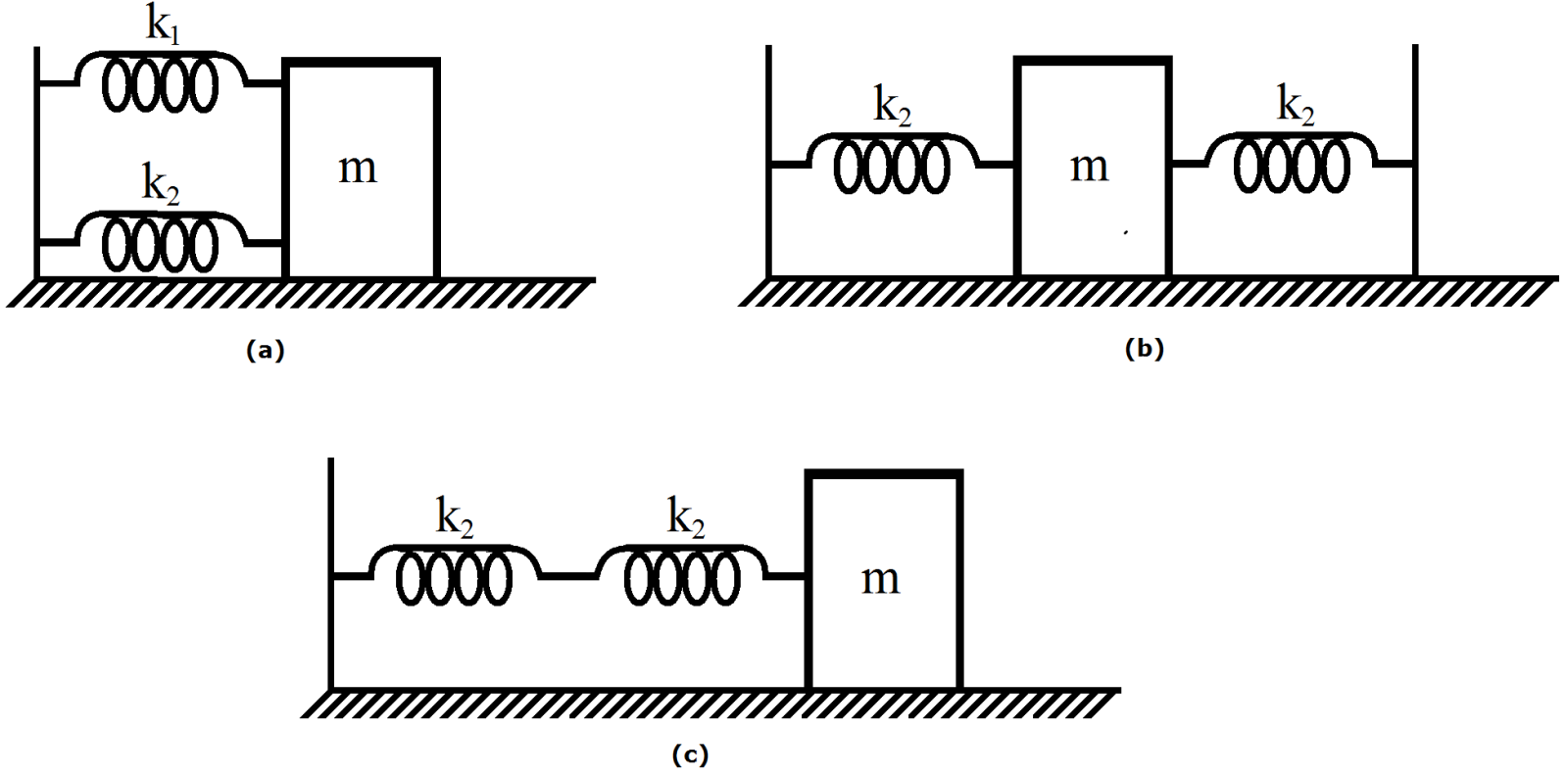
Find the time period of the oscillation of mass m in figure What is the equivalent spring constant of the pair of springs in each case?

A mercury lamp is a convenient source for studying frequency dependence of photoelectric emission, since it gives a number of spectral lines ranging from the UV to the red end of the visible spectrum. In our experiment with rubidium photo-cell, the following lines from a mercury source were used:
$\lambda_1=3650\ \mathring{\text{A}},\ \lambda_2=4047\ \mathring{\text{A}},\ \lambda_3=4358\ \mathring{\text{A}},\ \lambda_4=5461\ \mathring{\text{A}},\ \lambda_5=6907\ \mathring{\text{A}},$
The stopping voltages, respectively, were measured to be:
V01 = 1.28 V, V02 = 0.95 V, V03 = 0.74 V, V04 = 0.16 V, V05 = 0 V
Determine the value of Planck’s constant h, the threshold frequency and work function for the material.
[Note: You will notice that to get h from the data, you will need to know e (which you can take to be 1.6 × 10–19 C). Experiments of this kind on Na, Li, K, etc. were performed by Millikan, who, using his own value of e (from the oil-drop experiment) confirmed Einstein’s photoelectric equation and at the same time gave an independent estimate of the value of h.]
$\text{ }^{212}_{33}\text{Bi}$ can disintegrate either by emitting an $\alpha$-particle of by emitting a $\beta^-$-particle.
  1. Write the two equations showing the products of the decays.
  2. The probabilities of disintegration $\alpha$ and $\beta$ -decays are in the ratio $\frac{7}{13}.$ The overall half-life of 212Bi is one hour. If 1g of pure 212Bi is taken at 12.00 noon, what will be the composition of this sample at 1P.m. the same day?
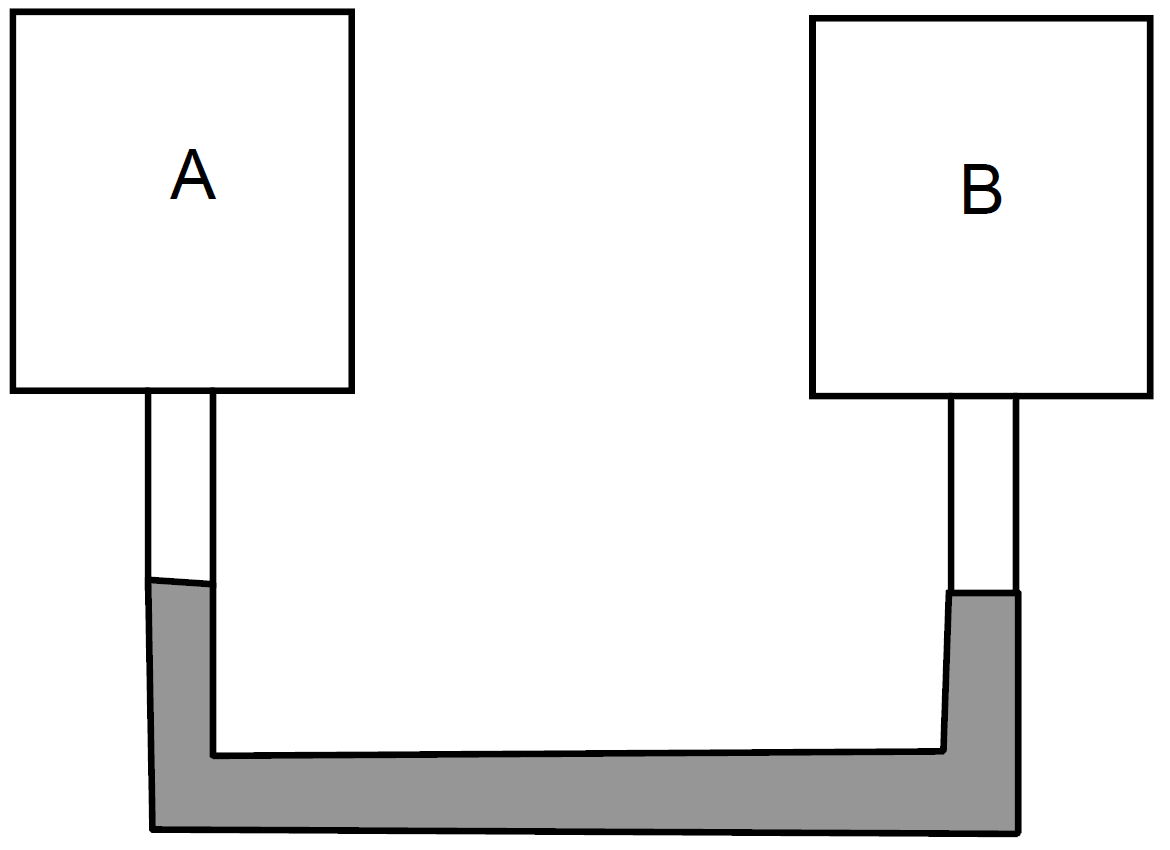
Figure shows two rigid vessels A and B, each of volume 200cm3, containing an ideal gas (Cv = 12.5JK-1mol-1). The vessels are connected to a manometer tube containing mercury. The pressure in both the vessels is 75cm of mercury and the temperature is 300K.
  1. Find the number of moles of the gas in each vessel.
  2. 5.0J of heat is supplied to the gas in vessel A and 10J to the gas in vessel B. Assuming there's no appreciable transfer of heat from A to B, calculate the difference in the heights of mercury in the two sides of the manometer. Gas constant, R = 8.3JK-1mol-1.

A wire of length 10cm translates in a direction making an angle of 60° with its length. The plane of motion is perpendicular to a uniform magnetic field of 1.0T that exists in the space. Find the emf induced between the ends of the rod if the speed of translation is 20cm/s-1.
4 × 10²³ tritium atoms are contained in a vessel. The half-life of decay tritium nuclei is 12.3y. Find:
  1. The activity of the sample.
  2. The number of decay in the next 10 hours.
  3. The number of decays in the next 6.15y.
Compare three magnetic substances on the basis of following properties :
(i) Behaviour in magnetic field
(ii) Main reason for magnet formation
(iii) Behaviour in non-uniform magnetic field
(iv) Behaviour on bringing magnetic pole near
(v) Magnitude of $\mu_r$
(vi) Number of field lines passing through substance in magnetic field
(vii) Direction of magnetisation.
Write Einstein's photoelectric equation and explain any two observations related to the photoelectric effect.