Question
Define mean value and root mean square value of alternating current.

Answer

Mean Value : Alternating voltage and alternating current both vary in magnitude with time and change the direction periodically. During one of the half cycles these have positive value whereas in the next half negative value. Thus the mean value of alternating voltage and alternating current each for a complete cycle is zero. Because of this an ordinary voltmeter or ammeter gives no deflection in alternating current circuit.
But for any half cycle the mean value of alternating voltage or alternating current is not zero, which can be shown as follows:
The mean value of alternating current for first positive half cycle is expressed as follows:
$I_{m}=\frac{\int_{0}^{T/2}Idt}{T/2}=\frac{\int_{0}^{T/2}(I_{0}sin \omega t)dt}{T/2}$
or $I_{m}=\frac{\int_{0}^{T/2}I_{0}sin(\frac{2\pi}{T}).tdt}
{T/2} = \frac{2I_{0}}{T}\frac{[-cos\frac{2\pi}{T}.t]_{0}^{T/2}}{\frac{2\pi}{T}}$
or $I_{m}=-\frac{2I_{0}}{T}\times\frac{T}{2\pi}[cos \pi-cos0]=-\frac{I_{0}}{\pi}[-1-1]$
or $I_{m}=+(\frac{2I_{0}}{\pi})$
or $I_{m}=+\frac{2I_{0}}{3.14}\Rightarrow I_{m}=+0.637~I_{0}$
Similarly, for next negative half cycle the average value of alternating current will be :
$I_{m}=-(\frac{2I_{0}}{\pi})$ or $I_{m}=-0.637~I_{0}$
Thus the mean value of alternating current for one complete cycle is:
$I_{m}=(+\frac{2I_{0}}{\pi})+(-\frac{2I_{0}}{\pi})=0$
Root Mean Square Value : Although the mean value of alternating voltage and alternating current both for one complete cycle is zero, the mean value of their square for one complete cycle is not zero. Therefore, rest mean square value of these is very important for alternating current circuits.
Root mean square value of alternating current is defined as follows:
"The square root of the mean value of the square of alternating current for its one complete cycle is called its root mean square value." It is denoted by $I_{rms}$ and is calculated as follows:
Mean value of $I^{2}$ for one complete cycle is given by:
$\overline{ I ^2}=\frac{\int_0^{ T } I ^2 \cdot d t}{T} \Rightarrow \overline{ I ^2}=\frac{\int_0^{ T }\left( I _0 \sin \omega t\right)^2 \cdot d t}{T}$
$\Rightarrow \quad \overline{ I ^2}=\frac{\int_0^{ T } I _0^2 \sin ^2 \omega t \cdot d t}{T}=\frac{\int_0^{ T } I _0^2 \sin ^2\left(\frac{2 \pi}{T}\right) \cdot t \cdot d t}{T}$
$\Rightarrow \quad \overline{ I ^2}=\frac{\int_0^{ T } I _0^2 2 \sin ^2\left(\frac{2 \pi}{T}\right) \cdot t \cdot d t}{2 T}$
or $\overline{ I ^2}=\frac{ I _0^2}{2 T} \int_0^{ T }\left[1-\cos 2 \times\left(\frac{2 \pi}{T}\right) \cdot t\right] d t$
$\Rightarrow \quad \overline{ I ^2}=\frac{ I _0^2}{2 T}\left[\int_0^{ T } d t-\int_0^{ T } \cos \left(\frac{4 \pi}{T}\right) \cdot t \cdot d t\right]$
$\Rightarrow \quad \overline{ I ^2}=\frac{ I _0^2}{2 T}\left[\frac{\{t\}_0^{ T }-\left[\sin \left(\frac{4 \pi}{T}\right) \cdot t\right]_0^{ T }}{\frac{4 \pi}{T}}\right]$
$\Rightarrow \quad \overline{ I ^2}=\frac{ I _0^2}{2 T}\left[\{ T \}-\left\{\frac{ T }{4 \pi}\left(\sin 4 \pi-\sin 0^0\right)\right\}\right]$
$\Rightarrow \quad \overline{ I ^2}=\frac{ I _0^2}{2 T} \times T -\frac{ I _0^2}{2 T} \times 0 \Rightarrow \overline{ I ^2}=\frac{ I _0^2}{2}$
But according to the definition of root mean square value of alternating current it is given by :
$I _{r m s}=\sqrt{\overline{\overline{ I ^2}}} \Rightarrow I _{r m s}=\sqrt{\left(\frac{ I _0^2}{2}\right)}$
or $I _{r m s}=\frac{ I _0}{\sqrt{2}}$
or $I_{r m s}=\frac{I_0}{1.414} \Rightarrow I_{r m s}=0.707 I_0$

Need a full question paper?

Generate a complete, print-ready paper with questions like this in minutes — across 16+ boards, with answer keys.
Start Generating Free

Similar questions

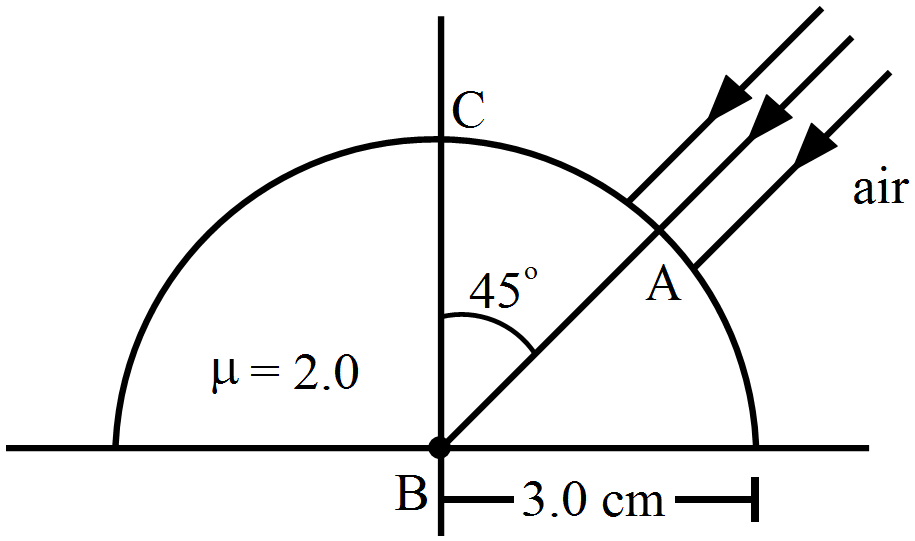
Figure shows a transparent hemisphere of radius 3.0cm made of a material of refractive index 2.0.
  1. A narrow beam of parallel rays is incident on the hemisphere as shown in the figure. Are the rays totally reflected at the plane surface?
  2. Find the image formed by the refraction at the first surface.
  3. Find the image formed by the reflection or by the refraction at the plane surface.
  4. Trace qualitatively the final rays as they come out of the hemisphere.
A neutron beam of energy $E$ scatters from atoms on a surface with a spacing $d = 0.1\ nm.$ The first maximum of intensity in the reflected beam occurs at $\theta = 30^\circ.$ What is the kinetic energy $E$ of the beam in $eV?$
Use the mirror equation to deduce that:
  1. an object placed between f and 2f of a concave mirror produces a real image beyond 2f.
  2. a convex mirror always produces a virtual image independent of the location of the object.
  3. the virtual image produced by a convex mirror is always diminished in size and is located between the focus and the pole.
A person standing on the floor of an elevator drops a coin. The coin reaches the floor of the elevator in a time $t_1$ if the elevator is stationary and in time $t_2$ if it is moving uniformly. Then$:$
Given the resistances of $1\ \Omega,\ 2\ \Omega,\ 3\ \Omega,$ how will be combine them to get an equivalent resistance of,
  1. $(11/3)\ \Omega$
  2. $(11/5)\ \Omega$
  3. $6\ \Omega$
  4. $(6/11)\ \Omega?$
A uniform rod of mass m and length l is struck at an end by a force F perpendicular to the rod for a short time interval t. Calculate:
  1. The speed of the centre of mass.
  2. The angular speed of the rod about the centre of mass.
  3. The kinetic energy of the rod.
  4. The angular momentum of the rod about the centre of mass after the force has stopped to act. Assume that t is so small that the rod does not appreciably change its direction while the force acts.
Suppose the space between the two inner shells of the previous problem is filled with a dielectric of dielectric coastant K. Find the capacitance of the system between A and B.
What are energy bands? How are these formed? Distinguish between a conductor, an insulator and a semiconductor on the basis of energy band diagram.
A $5\ mm$ high pin is placed at a distance of $15\ cm$ from a convex lens of focal length $10\ cm$. A second lens of focal length $5\ cm$ is placed $40\ cm$ from the first lens and $55\ cm$ from the pin. Find
  1. The position of the final image.
  2. Its nature.
  3. Its size.
Doubly$-$ionised helium ions are projected with a speed of $10\ km/s^{-1}$ in a direction perpendicular to a uniform magnetic field of magnitude $1.0T.$ Find
  1. The force acting on an ion.
  2. The radius of the circle in which it circulates.
  3. The time taken by an ion to complete the circle.