Question
Suppose the space between the two inner shells of the previous problem is filled with a dielectric of dielectric coastant K. Find the capacitance of the system between A and B.

Answer

Here we should consider two spherical capacitor of capacitance
cab and cbc in series
$\text{Cab}=\frac{4\pi\epsilon_0\text{abk}}{(\text{b}-\text{a})}$
$\text{Cbc}=\frac{4\pi\epsilon_0\text{bc}}{(\text{c}-\text{b})}$
$\frac{1}{\text{C}}=\frac{1}{\text{Cab}}+\frac{1}{\text{Cbc}}$
$=\frac{(\text{b}-\text{a})}{4\pi\epsilon_0\text{abk}}+\frac{(\text{c}-\text{b})}{4\pi\epsilon_0\text{bc}}$
$=\frac{\text{c}(\text{b}-\text{a})+\text{ka}(\text{c}-\text{b})}{\text{k}4\pi\epsilon_0\text{abc}}$
$\text{C}=\frac{\text{k}4\pi\epsilon_0\text{abc}}{\text{c}(\text{b}-\text{a})+\text{ka}(\text{c}-\text{b})}$

Need a full question paper?

Generate a complete, print-ready paper with questions like this in minutes — across 16+ boards, with answer keys.
Start Generating Free

Similar questions

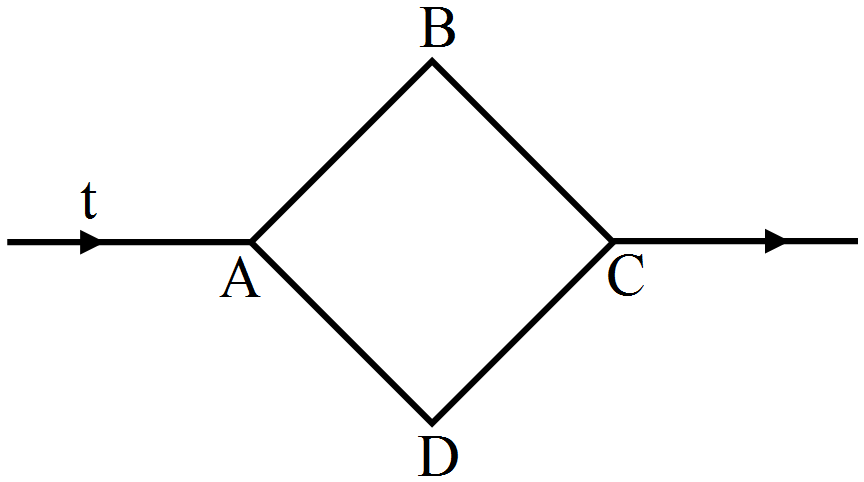
Figure shows a square loop ABCD with edgelength a. The resistance of the wire ABC is r and that of ADC is 2r. Find the magnetic field B at the centre of the loop assuming uniform wires.
The magnitude $F$ of the force between two straight parallel current carrying conductors kept at a distance $d$ apart in air is given by:
$\text{F}=\frac{\mu_0\text{I}_1\text{I}_2}{2\pi\text{d}}$
Where $I_1$ and $I_2$ are the currents flowing through the two wires.
Use this expression, and the sign convention that the:
“Force of attraction is assigned a negative sign and Force of repulsion is assigned a positive sign”.
Draw graphs showing dependence of $F$ on:
  1. $I_1 I_2$ when $d$ is kept constant.
  2. $d$ when the product $I_1 I_2$ is maintained at a constant positive value.
  3. $d$ when the product $I_1 I_2$ is maintained at a constant negative value.
  1. For what kinetic energy of a neutron will the associated de Broglie wavelength be $1.40 \times 10^{–10} m$?
  2. Also find the de Broglie wavelength of a neutron, in thermal equilibrium with matter, having an average kinetic energy of $(3/2) kT at 300 K.$
The position, velocity and acceleration of a particle executing simple harmonic motion are found to have magnitudes $2\ cm, 1\ m/s$ and $10\ m/s^2$ at a certain instant. Find the amplitude and the time period of the motion.
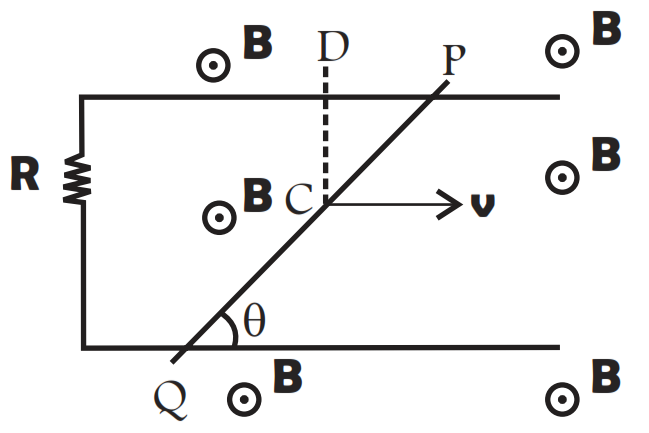
Find the current in the wire for the configuration shown in Fig. Wire $PQ$ has negligible resistance. $B,$ the magnetic field is coming out of the paper. $\theta$ is a fixed angle made by $PQ$ travelling smoothly over two conducting parallel wires seperated by $a$ distance $d$.
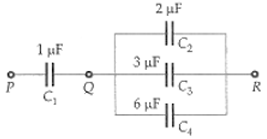
In Fig. the energy stored in $C _4$ is 27 J . Calculate the total energy stored in the system.
Image
A current of $1.0A$ exists in a copper wire of cross$-$section $1.0\ mm^2$. Assuming one free electron per atom, calculate the drift speed of the free electrons in the wire. The density of copper is $9000\ kg/m^{-3}.$
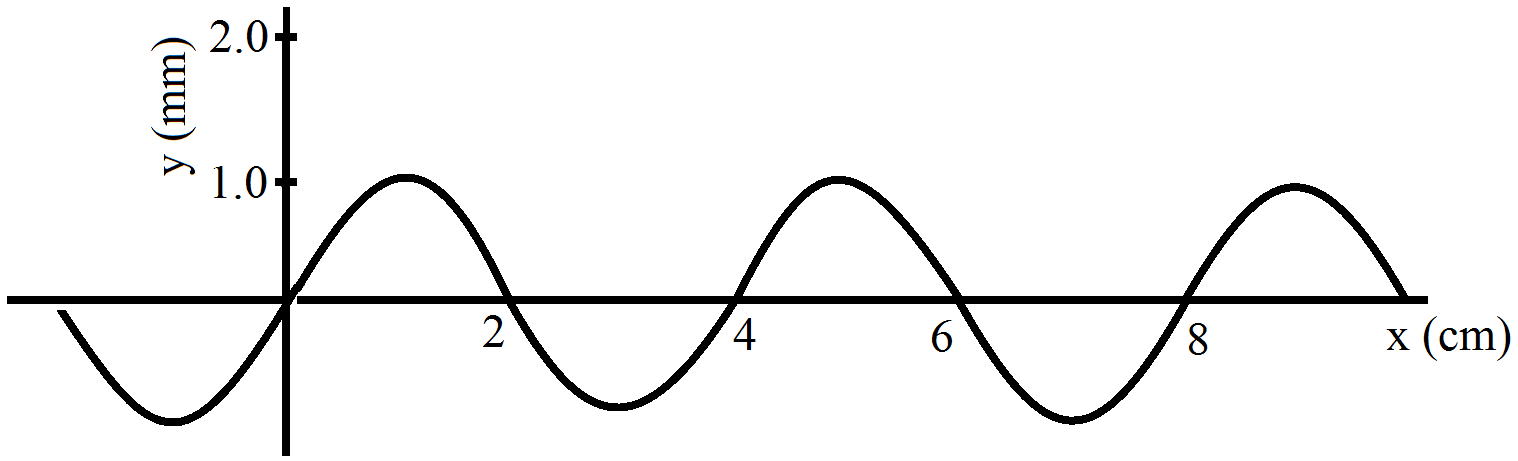
Figure shows a plot of the transverse displacements of the particles of a string at t = 0 through which a travelling wave is passing in the positive x-direction. The wave speed is 20cm/s. Find-
  1. The amplitude
  2. The wavelength
  3. The wave number
  4. The frequency of the wave.
A satellite is projected vertically upwards from an earth station. At what height above the earth's surface will the force on the satellite due to the earth be reduced to half its value at the earth station? (Radius of the earth is 6400km.)
In a Young's double slit interference experiment the fringe pattern is observed on a screen placed at a distance D from the slits. The slits are separated by a distance d and are illuminated by monochromatic light of wavelength $\lambda$. Find the distance from the central point where the intensity falls to,
  1. Half the maximum.
  2. One fourth of the maximum.