Question
Define mean value and root mean square value of alternating current.

Answer

Mean Value : Alternating voltage and alternating current both vary in magnitude with time and change the direction periodically. During one of the half cycles these have positive value whereas in the next half negative value. Thus the mean value of alternating voltage and alternating current each for a complete cycle is zero. Because of this an ordinary voltmeter or ammeter gives no deflection in alternating current circuit.
But for any half cycle the mean value of alternating voltage or alternating current is not zero, which can be shown as follows:
The mean value of alternating current for first positive half cycle is expressed as follows:
$I_{m}=\frac{\int_{0}^{T/2}Idt}{T/2}=\frac{\int_{0}^{T/2}(I_{0}sin \omega t)dt}{T/2}$
or $I_{m}=\frac{\int_{0}^{T/2}I_{0}sin(\frac{2\pi}{T}).tdt}
{T/2} = \frac{2I_{0}}{T}\frac{[-cos\frac{2\pi}{T}.t]_{0}^{T/2}}{\frac{2\pi}{T}}$
or $I_{m}=-\frac{2I_{0}}{T}\times\frac{T}{2\pi}[cos \pi-cos0]=-\frac{I_{0}}{\pi}[-1-1]$
or $I_{m}=+(\frac{2I_{0}}{\pi})$
or $I_{m}=+\frac{2I_{0}}{3.14}\Rightarrow I_{m}=+0.637~I_{0}$
Similarly, for next negative half cycle the average value of alternating current will be :
$I_{m}=-(\frac{2I_{0}}{\pi})$ or $I_{m}=-0.637~I_{0}$
Thus the mean value of alternating current for one complete cycle is:
$I_{m}=(+\frac{2I_{0}}{\pi})+(-\frac{2I_{0}}{\pi})=0$
Root Mean Square Value : Although the mean value of alternating voltage and alternating current both for one complete cycle is zero, the mean value of their square for one complete cycle is not zero. Therefore, rest mean square value of these is very important for alternating current circuits.
Root mean square value of alternating current is defined as follows:
"The square root of the mean value of the square of alternating current for its one complete cycle is called its root mean square value." It is denoted by $I_{rms}$ and is calculated as follows:
Mean value of $I^{2}$ for one complete cycle is given by:
$\overline{ I ^2}=\frac{\int_0^{ T } I ^2 \cdot d t}{T} \Rightarrow \overline{ I ^2}=\frac{\int_0^{ T }\left( I _0 \sin \omega t\right)^2 \cdot d t}{T}$
$\Rightarrow \quad \overline{ I ^2}=\frac{\int_0^{ T } I _0^2 \sin ^2 \omega t \cdot d t}{T}=\frac{\int_0^{ T } I _0^2 \sin ^2\left(\frac{2 \pi}{T}\right) \cdot t \cdot d t}{T}$
$\Rightarrow \quad \overline{ I ^2}=\frac{\int_0^{ T } I _0^2 2 \sin ^2\left(\frac{2 \pi}{T}\right) \cdot t \cdot d t}{2 T}$
or $\overline{ I ^2}=\frac{ I _0^2}{2 T} \int_0^{ T }\left[1-\cos 2 \times\left(\frac{2 \pi}{T}\right) \cdot t\right] d t$
$\Rightarrow \quad \overline{ I ^2}=\frac{ I _0^2}{2 T}\left[\int_0^{ T } d t-\int_0^{ T } \cos \left(\frac{4 \pi}{T}\right) \cdot t \cdot d t\right]$
$\Rightarrow \quad \overline{ I ^2}=\frac{ I _0^2}{2 T}\left[\frac{\{t\}_0^{ T }-\left[\sin \left(\frac{4 \pi}{T}\right) \cdot t\right]_0^{ T }}{\frac{4 \pi}{T}}\right]$
$\Rightarrow \quad \overline{ I ^2}=\frac{ I _0^2}{2 T}\left[\{ T \}-\left\{\frac{ T }{4 \pi}\left(\sin 4 \pi-\sin 0^0\right)\right\}\right]$
$\Rightarrow \quad \overline{ I ^2}=\frac{ I _0^2}{2 T} \times T -\frac{ I _0^2}{2 T} \times 0 \Rightarrow \overline{ I ^2}=\frac{ I _0^2}{2}$
But according to the definition of root mean square value of alternating current it is given by :
$I _{r m s}=\sqrt{\overline{\overline{ I ^2}}} \Rightarrow I _{r m s}=\sqrt{\left(\frac{ I _0^2}{2}\right)}$
or $I _{r m s}=\frac{ I _0}{\sqrt{2}}$
or $I_{r m s}=\frac{I_0}{1.414} \Rightarrow I_{r m s}=0.707 I_0$

Need a full question paper?

Generate a complete, print-ready paper with questions like this in minutes — across 16+ boards, with answer keys.
Start Generating Free

Similar questions

A particle of mass m and charge q is released from the origin in a region in which the electric field and magnetic field are given by
$\overrightarrow{\text{B}}=-\text{B}_0\overrightarrow{\text{j}}$ and $\overrightarrow{\text{E}}=\text{E}_0\overrightarrow{\text{k}}.$ Find the speed of the particle as a function of its z-coordinate.
A permanent magnet in the shape of a thin cylinder of length 10 cm has M = 106A/m. Calculate the magnetisation current IM.
Obtain the answers to (a) and (b) in Exercise 7.15 if the circuit is connected to a 110V, 12kHz supply? Hence, explain the statement that a capacitor is a conductor at very high frequencies. Compare this behaviour with that of a capacitor in a dc circuit after the steady state.
i. An ac source generating a voltage $V = V _0 \sin \omega t$ is connected to a capacitor of capacitance C . Find the expression of the current I flowing through it. Plot a graph of $V$ and I versus $\omega t$ to show that the current is $\frac{\pi}{2}$ ahead of the voltage.
ii. A resistor of $200 \Omega$ and a capacitor of $15 \mu F$ are connected in series to a $220 V, 50 Hz$ ac source. Calculate the current in the circuit and the rms voltage across the resistor and the capacitor. Why the algebraic sum of these voltages is more than the source voltage?
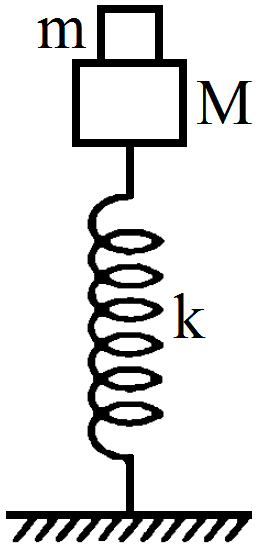
A small block of mass m is kept on a bigger block of mass M which is attached to a vertical spring of spring constant k as shown in the figure. The system oscillates vertically.
  1. Find the resultant force on the smaller block when it is displaced through a distance x above its equilibrium position.
  2. Find the normal force on the smaller block at this position. When is this force smallest in magnitude?
  3. What can be the maximum amplitude with which the two blocks may oscillate together?

The inverse square law in electrostatics is $|\text{F}|=\frac{\text{e}^2}{(4\pi\in_0)\text{r}^2}$ for the force between an electron and a proton. The $\Big(\frac{1}{\text{r}}\Big)$ dependence of |F| can be understood in quantum theory as being due to the fact that the 'particle' of light (photon) is massless. If photons had a mass mp, force would be modified to $|\text{F}|=\frac{\text{e}^2}{(4\pi\in_0)\text{r}^2}\Big[\frac{1}{\text{r}^2}+\frac{\lambda}{\text{r}}\Big].\text{e}\times\text{p}(-\lambda\text{r})$ where $\lambda=\frac{\text{m}_\text{p}\text{c}}{\text{h}}$ and $\text{h}=\frac{\text{h}}{2\pi}$. Estimate the change in the ground state energy of a H-atom if mp were 10-6 times the mass of an electron.
i. Using Huygens's construction of secondary wavelets explains how a diffraction pattern is obtained on a screen due to a narrow slit on which a monochromatic beam of light is incident normally.
ii. Show that the angular width of first diffraction fringe is half that of the central fringe.
iii. Explain why the maxima at $\theta=\left(n+\frac{1}{2}\right) \frac{\lambda}{a}$ a become weaker and weaker with increasing n.
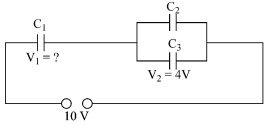
Define capacitor. Obtain the relation of equivalence in series combination of capacitors by making a circuit diagram. Write the value of voltage $V_1$ in the given circuit.
Image
A parallel-plate capacitor of capacitance $5\mu\text{F}$ is connected to a battery of emf 6V. The separation between the plates is 2mm:
  1. Find the charge on the positive plate.
  2. Find the electric field between the plates.
  3. A dielectric slab of thickness 1mm and dielectric constant 5 is inserted into the gap to occupy the lower half of it. Find the capacitance of the new combination.
  4. How much charge has flown through the battery after the slab is inserted?
Derive the lens formula,  $\frac{1}{\text{f}} = \frac{1}{\text{v}} - \frac{1}{\text{u}}$ for a concave lens, using the necessary ray diagram.
Two lenses of powers 10 D and – 5 D are placed in contact.
  1. Calculate the power of the new lens.
  2. Where should an object be held from the lens, so as to obtain a virtual image of magnification 2?