Question
Define molar specific heat. Write its units.

Answer

Molar specific heat is defined as the amount of heat required to raise the temperature of one mole of a gas through 1K at constant volume or at constant pressure.
If the volume is constant, it is called the molar specific heat at constant volume. Similarly, if the pressure is constant, it is called the molar specific heat at constant pressure. It is expressed in J mol-1K-1 or J mol-1°C-1.
Need a full question paper?

Generate a complete, print-ready paper with questions like this in minutes — across 16+ boards, with answer keys.

Start Generating Free

Similar questions

In a glass capillary tube, water rises upto a height of 10.0 cm while mercury fall down by 5.0 cm in the same capillary. If the angles of contact for mercury glass is $60^{\circ}$ and water glass is $0^{\circ}$, then find the ratio of surface tension of mercury and water.
A curved road of diameter 1.8km is banked, so that no friction is required at a speed of 30ms-1. What is the banking angle?
A ship is moving at a speed of 56km/ h-1. One second later, it is moving at a speed of 58km/ h-1. What is its acceleration?
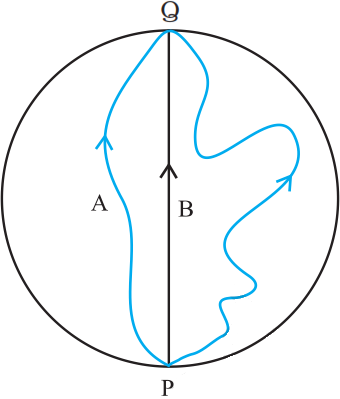
Three girls skating on a circular ice ground of radius 200m start from a point P on the edge of the ground and reach a point Q diametrically opposite to P following different paths as shown in Fig. What is the magnitude of the displacement vector for each? For which girl is this equal to the actual length of path skate?

A clock with an iron pendulum keeps the correct time at $20^{\circ} C$. How much will it lose or gain if the temperature changes to $40^{\circ} C$ ? Coefficient of cubical expansion of iron $=36 \times 10^{-6}{ }^{\circ} C ^{-1}$.
A body covers half of its journey with a speed of 40m/s and other half with a speed of 60m/s. What is the average speed during the whole journey?
A body travels uniformly a distance of $(13.8 \pm 0.2)\text{m}$ in a time $(4.0 \pm 0.3) \text{s}.$ What is the velocity of the body within error limits?
Calculate the power required by a force to turn a rigid body by some angle $(\theta).$
A block of mass 100g is moved with a speed of 5.0m/s at the highest point in a closed circular tube of radius 10cm kept in a vertical plane. The cross-section of the tube is such that the block just fits in it. The block makes several oscillations inside the tube and finally stops at the lowest point. Find the work done by the tube on the block during the process.
One kilogram molecule of a gas at 400k expands isothermally until its volume is doubled. Find the amount of work done and heat produced.