Questions · Page 1 of 2

3 Marks Question

Take a timed test

50 questions · self-marked practice — reveal the answer and mark yourself.

Question 13 Marks
A steam engine delivers 5.4 × 10⁸J of work per minute and services 3.6 × 10⁹J of heat per minute from its boiler. What is the efficiency of the engine? How much heat is wasted per minute?
Answer
Work done by the steam engine per minute, W = 5.4 × 10⁸J

Heat supplied from the boiler, H = 3.6 × 10⁹J

Efficiency of the engine = output energy/Input energy

$\therefore$ n = W/H

= 5.4 × 10⁸/3.6 × 109

Hence, the percentage efficiency of the engine is 15%.

Amount of heat wasted = 3.6 × 10⁹ - 5.4 × 108

= 30.6 × 108 = 3.06 × 10⁹J

Therefore, the amount of heat wasted per minute is 3.06 × 10⁹J.
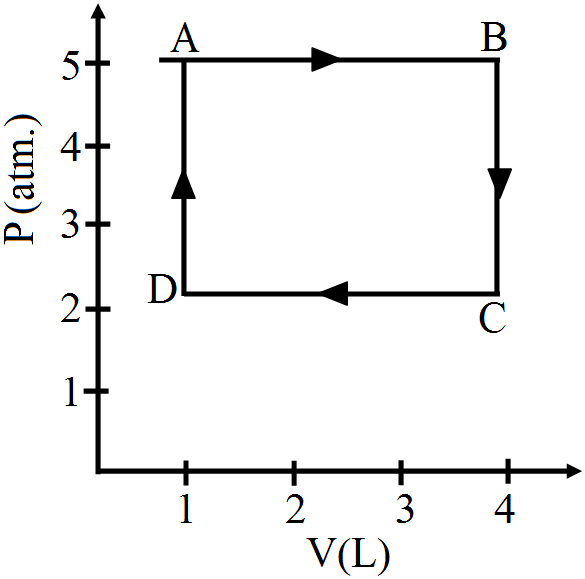
View full question & answer
Question 23 Marks
An electric heater supplies heat to a system at a rate of 100W. If system performs work at a rate of 75 joules per second. At what rate is the internal energy increasing?
Answer
Heat is supplied to the system at a rate of 100W.

$\therefore$ Heat supplied, Q = 100J/s

The system performs at a rate of 75J/s.

$\therefore$ Work done, W = 75J/s

From the first law of thermodynamics, we have:

Q = U + W

Where,

U = Internal energy

$\therefore$ U = Q - W

= 100 - 75

= 25J/s

= 25W

Therefore, the internal energy of the given electric heater increases at a rate of 25W.

View full question & answer
Question 33 Marks
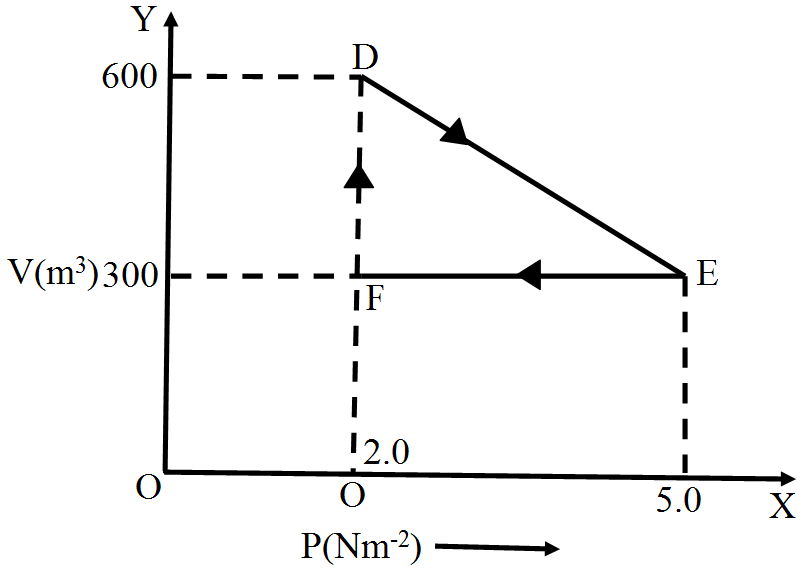
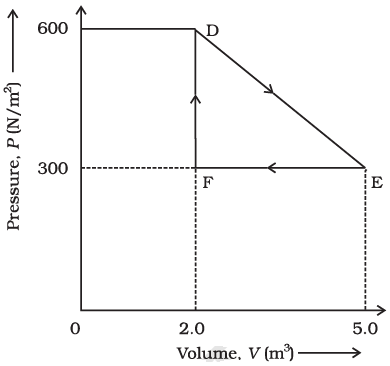
A thermodynamic system is taken from an original state to an intermediate state by the linear process shown in Fig.

Its volume is then reduced to the original value from E to F by an isobaric process. Calculate the total work done by the gas from D to E to F.

Answer
Total work done by the gas from D to E to F = Area of $\Delta\text{DEF}$
Area of $\Delta\text{DEF} =$ (1/2)DE × EF
Where,
DF = Change in pressure
= 600N/m2 - 300N/m2
= 300N/m2
FE = Change in volume
= 5.0m3 - 2.0m3
= 3.0m3
Area of $\Delta\text{DEF} =$ (1/2) × 300 × 3 = 450J
Therefore, the total work done by the gas from D to E to F is 450J.
View full question & answer
Question 43 Marks
Explain why:
Two bodies at different temperatures T1 and T2 if brought in thermal contact do not necessarily settle to the mean temperature (T1 + T2 )/2.
Answer
When two bodies at different temperatures T1 and T2 are brought in thermal contact, heat flows from the body at the higher temperature to the body at the lower temperature till equilibrium is achieved, i.e., the temperatures of both the bodies become equal. The equilibrium temperature is equal to the mean temperature (T1 + T2)/2 only when the thermal capacities of both the bodies are equal.
View full question & answer
Question 53 Marks
A refrigerator is to maintain eatables kept inside at 9°C. If room temperature is 36°C, calculate the coefficient of performance.
Answer
Temperature inside the refrigerator, T1 = 9°C = 282K
Room temperature, T2 = 36°C = 309K
Coefficient of performance = T1/T2 - T1
= 282/309 - 282
= 282/27
= 10.44
Therefore, the coefficient of performance of the given refrigerator is 10.44.
View full question & answer
Question 63 Marks
The temperature of 3kg krypton gas is raised from -29°C to 89°C.

  1. If this is done at constant volume, compute the heat added, the work done, and the change in internal energy.
  2. Repeat if the heating process is at constant pressure.

For Kr$\text{C}_\upsilon=0.0357\text{cal/gm}^\circ\text{C}$ and $\text{C}_\text{P}=0.0595\text{cal/gm}^\circ\text{C.}$

Answer
  1. According to first law of thermodynamics,

$\Delta\text{Q}=\Delta\text{U}+\Delta\text{W}$

At constant volume, $\Delta\text{W}=0$ so $\Delta\text{Q}=\Delta\text{U}$

  1. So heat added $\Delta\text{Q}=\Delta\text{U}=\text{mc}_\upsilon\Delta\text{T}$

$=(3\times10^3)0.0357\times100$

$=10710\text{cal}=1071\text{ kcal}$

  1. Work done $\Delta\text{W}=0$
  2. Change in internal energy $=10.71\times4.184=44.8\text{KJ}$
  1.  
  1. At constant pressure, $\Delta\text{Q}=\text{mC}_\text{P}\Delta\text{T}$

$=(3\times10^3)0.0595\times10$

  1. Change in the internal energy will be the same i.e.,

$\Delta\text{U}=10.71\text{ kcal}$

Work done $\Delta\text{W}=\Delta\text{Q}-\Delta\text{U}$

$=17.85-10.71=7.14\text{ kcal}$

$=7.14\times4.184\text{kJ}=29.9\text{kJ}$

  1. The change in internal energy is the same as in isochoric process = 44.8kJ.
View full question & answer
Question 73 Marks
In a perfect Carnot's engine, the temperature of the source and the sink are 500K and 375K respectively. If the engine consumes 6 × 10⁵ cal per cycle, find (i) the efficiency of the engine, (ii) work done per cycle, and (iii) the heat rejected to the sink per cycle.
Answer
  1. $\eta=\Big(1-\frac{\text{T}_2}{\text{T}_1}\Big)\times100$

$=\Big(1-\frac{375}{500}\Big)\times100=25\%$

  1. $\eta=\frac{\text{W}}{\text{Q}_1};$

$\text{W}=\eta\text{ Q}_1;\text{Q}_1=6000\times10^3\text{cal}$

$\text{W}=\frac{25}{100}\times600\times10^3\text{cal}$

$=150\times10^3\text{cal}=150\times10^3\times4.2\text{J}$

$=6.8\times10^5\text{J(approx.)}$

  1. $\text{W}=\text{Q}_1-\text{Q}_2;\text{Q}_2=\text{Q}_1-\text{W}$

$=600\times10^3-150\times10^3$

$=45\times10^4$

View full question & answer
Question 83 Marks
Prove for an adiabatic process:
  1. $\text{TV}^{\gamma-1}=\text{constant}.$
  2. $\text{P}^{1-\gamma}\text{T}^\gamma=\text{constant.}$
Answer
  1. We know $\text{PV}^{\gamma}=$ constant for adiabatic process.

Also, $\text{PV}=\text{nRT}$

$\therefore\text{P}=\frac{\text{nRT}}{\text{V}}$

Replacing P, we have $\frac{\text{nRT}}{\text{RT}}.\text{V}^{\gamma}=$ constant (or) $\text{TV}^{\gamma-1}=$ constant.

  1. From PV = nRT, we have $\text{V}=\frac{\text{nRT}}{\text{P}}$

Replacing V, we have, $\text{P}\Big(\frac{\text{nRT}}{\text{P}}\Big)^{\gamma}=$ constant.

$\therefore\text{T}^{\gamma}\text{P}^{1-\gamma}=$ constant.

View full question & answer
Question 93 Marks
Show that an adiabatic curve is always steaper than an isothermal curve.
Answer
For Isothermal process, since PV = constant

$\frac{\text{dP}}{\text{P}}=\frac{\text{dV}}{\text{V}}$

But for an adiabatic process, since

$\text{PV}^\gamma=\text{constant},\frac{\text{dP}}{\text{P}}=-\gamma\frac{\text{dV}}{\text{V}}$

So P-V graph is steaper for adiabatic process.

View full question & answer
Question 103 Marks
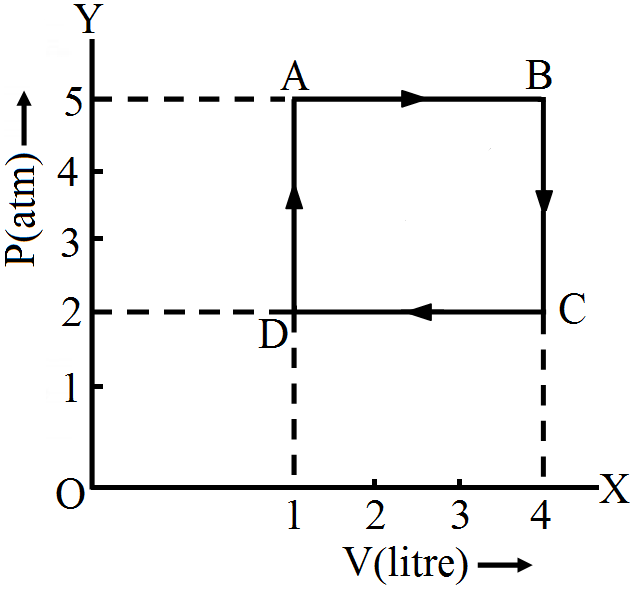
One mole of an ideal gas undergoes a cyclic change ABCD. From the given diagram, calculate the net work done in the process. 1 atmosphere = 10° dyne cm-2.

Answer
In a cyclic change, work done is equal to area of the loop ABCD.

As the loop is traced in clockwise direction, work done is positive.
W = area ABCD = DC × DA
Now, DC = 4 - 1 = 3 litre = 3 × 103 cm3
DA = 5 - 2 = 3 atm = 3 × 10⁶ dyne cm-2
$\therefore$ W = DC × DA
= 3 × 103 × 3 × 106 = 9 × 109 erg.
View full question & answer
Question 113 Marks
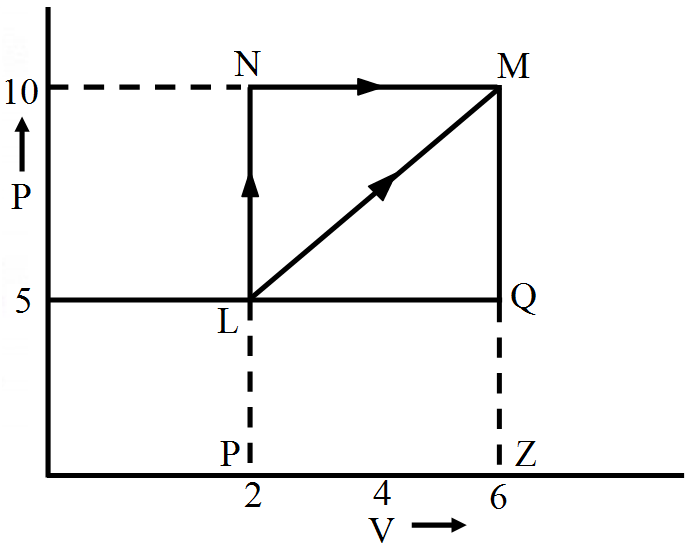
An ideal gas changes its state from L to M by two path LNM and LM.

  1. Is the work done same for two paths?
  2. The internal energy of gas at L is 20J and the amount of heat needed to change its state through LM is 400J. What is the internal energy of gas at M?
Answer
  1. $\text{W}_{\text{LN}}=\text{PdV}=0$

$\text{W}_{\text{NM}}=\text{P}[\text{V}_\text{M}-\text{V}_\text{M}]=10[6-2]=40\text{J}$

$\text{W}_\text{LMN}=\text{W}_{\text{NM}}=0+40=40\text{J}$

Along LM WLM = Area under the curve LM

= Area of $\Delta\text{LMQ}+$ Area of rectangle LQZP.

$=\frac12\times\text{LQ}\times\text{MQ}+\text{LP}\times\text{PZ}$

$=\frac12\times4\times5+5\times4$

$=10+20=30\text{J}$

So work done is less along LM.

  1. $\text{U}_\text{L}=20\text{J}$

$\Delta\text{Q}=400\text{J}$

$\text{dQ}=\text{dU}+\text{dW}$

$=(\text{U}_\text{M}-\text{U}_\text{L})+\Delta\text{W}_{\text{LM}}$

$\text{U}_\text{M}=\text{dQ}+\text{U}_\text{L}-\Delta\text{W}_\text{LM}$

$=400+20-30$

$=390\text{J}$

View full question & answer
Question 123 Marks
  1. Describe a Carnot's cycle.
  2. A thermodynamic system is taken from an original state to an intermediate state by the linear process shown in below figure. Its volume is then reduced to the original value from E to F by an isobaric process. Calculate the work done by the gas from D to E to F.

Answer
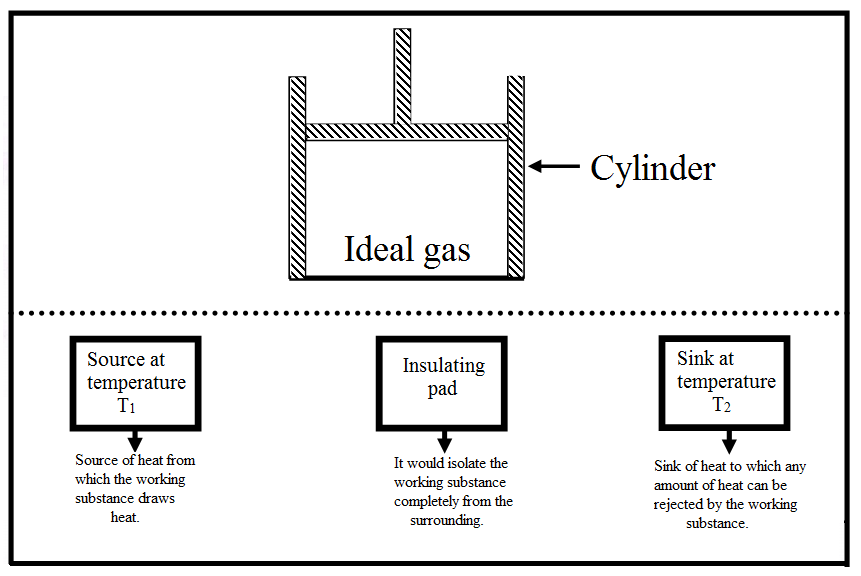
  1. Sadi Carnot devised an ideal cycle of operation of heat engine, which came to be known as Carnot cycle which is a set of four devices- a source at a high temperature (say T1), a sink at a low temperature (say T2), a non-conducting base and a cylinder with a working substance (a perfect gas) frictionless piston made of conducting base and non-conducting walls and piston.

  1. Change in pressure, dP = 5.0 - 2.0 atm = 3.0 × 10⁵ Nm-2

Change in volume dV = 600 - 300 = 300 cc = 300 × 10-6 m3

Work done by the gas from D to E to F

= Area of $\Delta\text{DEF}$

$=\frac{1}{2}\times\text{dP}\times\text{dV}$

$=\frac12\times3.0\times10^5\times300\times10^{-6}\text{m}^3$

$=45\times10^6\times10^{-6}=45\text{J}$

View full question & answer
Question 133 Marks
State first law of thermodynamics. What are its limitations? Why Cp > Cv?
Answer
According to first law of thermodynamics, the total heat energy change dQ is the sum of internal energy change dU and work done dW.

i.e. dQ = dU + DW

Limitations:

First law do not tell us,

  1. The quick or slow nature of a process.
  2. Whether the process is possible or not. Cp > Cv because for constant pressure process, both volume and temperature are altered and for constant volume process only temperature varies.
View full question & answer
Question 143 Marks
The volume of an ideal gas is V at a pressure P. On increasing the pressure by $\Delta\text{P},$ the change in volume of the gas is $(\Delta\text{V}_1)$ under isothermal conditions and $(\Delta\text{V}_2)$ under adiabatic conditions. Is $\Delta\text{V}_1>\Delta\text{V}_2$ or vice-versa and why?
Answer
Under isothermal condition, $\text{K}_\text{i}=\frac{\Delta\text{P}}{\frac{\Delta\text{V}_1}{\text{V}}}=\text{p}\ ...(\text{i)}$
Under adiabatic condition, $\text{K}_\text{a}=\frac{\Delta\text{P}}{\Delta\text{V}_2\text{V}}=\gamma\text{P}\ ...(2)$
Dividing (ii) by (i), we get ,
$\frac{\Delta\text{}V_1}{\Delta\text{V}_2}\gamma$ As $\gamma>1,$
$(\Delta\text{V}_1)>(\Delta\text{V}_2).$
View full question & answer
Question 153 Marks
One mole of an ideal gas requires 207J heat to raise the temperature by 10K when heated at constant pressure. Find the amount of heat required to heat the same gas to raise the temperature by same 10K under constant volume conditions. Given R = 8.3J mol-1 K-1.
Answer
Here heat required to raise temperature of 1 mole of gas through 10K under constant pressure conditions $\Delta\text{Q}=207\ \text{J}$
$\therefore\ \text{C}_\text{p}=\frac{\Delta\text{Q}}{\pi.\Delta\text{T}}$
$=\frac{207}{1\times10}$
$=20.7\ \text{J}\ \text{mol}^{-1}\text{K}^{-1}$
$\therefore\ \text{C}_\text{v}=\text{C}_\text{p}-\text{R}$
$=20.7-8.3$
$=12.4\ \text{J}\ \text{mol}^{-1}\text{K}^{-1}$
$\therefore$ Amount of heat required to raise the temperature of gas through 10K under constant volume condition:
$\Delta\text{Q}'=\mu.\text{C}_\text{v}.\Delta\text{T}$
$=1\times12.4\times10=124\ \text{J}\ \text{mol}^{-1}\text{K}^{-1}$
View full question & answer
Question 163 Marks
What are reversible and irreversible processes? Explain giving one example of each.
Answer
Reversible Process: It is a process which can be made to proceed in two opposite directions with same ease, so that the system and surroundings pass through exactly the same intermediate state as in the direct process.
e.g., An ideal gas allowed to expand slowly and then compressed slowly so as to reach its initial state.
Irreversible Process: It is a process which can't be made to proceed in the reverse direction with the same ease and the system does not pass through the same intermediate states as in direct processes.
e.g., Decay of organic matter, rusting of iron.
View full question & answer
Question 173 Marks
A certain gas at atmospheric pressure is compressed adiabatically so that its volume becomes half of its original volume. Calculate the resulting pressure in Nm-2. Take $\gamma=1.4$ for air.
Answer
Let the original volume,
V1 = V
$\therefore$ Final valume,
$\text{V}_2=\frac{\text{V}}{2}$
Initial pressure,
P1 = 0.76 metre of Hg column.
Let P2 be the fanal pressure after compression.
As the change is adiabatic,
$\therefore\text{P}_1\text{V}_1^\gamma=\text{P}_2\text{V}_2^\gamma$
$\text{P}_2=\text{P}_1\Big(\frac{\text{V}_1}{\text{V}_2}\Big)^\gamma=\text{P}_1\bigg(\frac{\text{V}}{\frac{\text{V}}2{}}\bigg)^{1.4}$
$\text{P}_2=0.76\times(2)^{1.4}$
$\text{P}_2=2.00$ metre of Hg column,
As $\text{P}=\text{h}\rho\text{g}$
$\therefore\text{P}_22.00\times(13.6\times10^3)\times9.8\text{ Nm}^{-2}$
$\text{P}_2=2.672\times10^5\text{Nm}^{-2}$
View full question & answer
Question 183 Marks
Obtain an expression for work done by a gas in an isothermal expansion.
Answer
For a small change in volume, work done is given by,
dW = P dV
We know, PV = nRT
$\therefore\text{P}=\frac{\text{nRT}}{\text{V}}$
For T = constant, $\text{dW}=\text{nRT}\frac{\text{dV}}{\text{d}}$
Net work done under isothermal condition to change the volume from Vi to Vf is,
$\text{W}=\int\limits^{\text{V}_\text{f}}_{\text{V}_\text{i}}\text{dW}=\text{nRT}\int\limits^{\text{V}_\text{f}}_{\text{V}_\text{i}}\text{}\frac{\text{dV}}{\text{V}}$
$=\text{nRT}\Big|\log_\text{e}\text{V}\Big|^{\text{V}_\text{f}}_{\text{V}_\text{i}}$
$=\text{nRT}\log_\text{e}\Big(\frac{\text{V}_\text{f}}{\text{ V}_\text{i}}\Big)$
$\therefore\text{W}=2.3026\text{ nRT }\log_{10}\Big(\frac{\text{V}_\text{f}}{\text{V}_\text{i}}\Big)$
Where n is the number of moles. If Pf and Pi are the pressures, we can also write,
$\text{W}=2.3026\text{ nRT }\log_{10}\Big(\frac{\text{P}_\text{i}}{\text{P}_\text{f}}\Big)$
View full question & answer
Question 193 Marks
A refrigerator has to transfer an average of 263J of heat per second from temperature -10°C to 25°C. Calculate the average power consumed assuming ideal reversible cycle and no other losses.
Answer
Here, $\text{T}_1=25+273$
$=298\text{K}$
$\text{T}_2=-10+273$
$=263\text{K}$
$\text{Q}_2=263\ \text{J}\text{s}^{-1}$
Since, $\frac{\text{Q}_1}{\text{Q}_2}=\frac{\text{T}_1}{\text{T}_2}$
$\Rightarrow\text{Q}=\frac{\text{T}_1}{\text{T}_2}\times\text{Q}_2$
$=\frac{298}{263}\times263=29 8\ \text{J}\text{s}^{-1}$
$\therefore$ Averege power consumed $=\text{Q}_1-\text{Q}_2$
$=(298-263)\ \text{J}\text{s}^{-1}=35\ \text{W}.$
View full question & answer
Question 203 Marks
An ideal gas is taken through a cyclic thermodynamic process through four steps. The amount of heat involved in these steps are Q1 = 5960J, Q2 = -5585J. Q3 = -2980J and Q4 = 3645 respectively. The corresponding quantities of work involved are W1= 200J, W2 = -825J, W3 = -1100J and W4 respectively. Find the value of W4. What is the efficiency of the cycle?
Answer
As the process is cyclic, therefore, $\Delta\text{U}=0$
According to first law of thermodynamics $\Delta\text{Q}=\Delta\text{U}+\Delta\text{W}=\Delta\text{W}$
$\Delta\text{W}=\Delta\text{Q}$ or $\text{W}_1+\text{W}_2+\text{W}_3+\text{W}_4$ $=\text{Q}_1+\text{Q}_2+\text{Q}_3+\text{Q}_4$
$\text{W}_4(\text{Q}_1+\text{Q}_2+\text{Q}_3+\text{Q}_4)-(\text{W}_1+\text{W}_2+\text{W}_3)$
$=(5960-5585-2980+3645)\\-(-200-825-1100)$
$=1040-275=765\text{J}$
$\text{Effeciency}=\frac{\text{Net work done}}{\text{total heat absorbed}}$ $=\frac{\text{W}_1+\text{W}_2+\text{W}_3+\text{W}_4}{\text{Q}_1+\text{Q}_4}$
$\eta=\frac{2200-825-1100+765}{5960+3645}=\frac{1040}{9605}=0.1083$
$\eta=0.1083\times100\%=10.83\%$
View full question & answer
Question 213 Marks
What is meant by the term 'Molar specific heat of a gas? The molar specific heat of hydrogen in the temperature range of about 250K to 750K is about $\Big(\frac52\Big)\text{R}.$ At lower temperatures, the value of molar specific heat of hydrogen decreases to the value typical of monoatomic gases $\Big(\frac32\Big)\text{R}$ while at higher temperatures, it tends to the value $\Big(\frac72\Big)\text{R.}$ Explain.
Answer
Molar specific heat capacity of a gas refers to the amount of energy required for 1 mole of a substance to raise its temperature by 1K. In the temperature beyond 70K, rotational motion of H2 gas starts. So at 250K < T < 750K, the number of degrees of freedom becomes five- 2 rotational and 3 translational.
$\therefore\text{C}_\text{V}=\frac{\text{f}}{2}\text{R}$ becomes $\text{C}_\text{V}=\frac52\text{R}$
For lower temperatures only translational degrees of freedom will exist and no rotational freedom.
$\therefore\text{C}_\text{V}=\frac{3}{2}\text{R}$
At higher temperature vibrational motion of H2 also starts. So at T > 7.50K, number of degrees of freedom are $\text{C}_\text{V}=\frac72\text{R}$
View full question & answer
Question 223 Marks
Calculate the fall in temperature when a gas initially at 72°C is expanded suddenly to eight times its original volume. Given y $=\frac53.(\therefore\text{V}_2=8\text{x}\text{ c.c.})$
Answer
Let, V1 = x c.c.;
T1 = 273 + 72 = 345K;
$\gamma=\frac53;$
T2 = ?
Using the relation $\text{T}_1\text{V}^{\gamma-1}_1=\text{T}_2\text{V}^{\gamma-1}_2$
$\therefore\text{T}_2=\text{T}_1\Big(\frac{\text{V}_1}{\text{V}_2}\Big)^{\gamma-1}$
$=345\times\Big(\frac{\text{x}}{8\text{x}}\Big)^\frac23$
$=345\times\Big(\frac18\Big)^\frac23$
Taking $\log$ both sides, we get
$\log\text{T}_2=\log\ 345-\frac23\log8$
$=2.5378-\frac23(0.9031)$
$=2.5378-0.6020$
$=1.9358$
$\text{T}_2=86.26\text{ K}$
$\therefore$ Fall in temperature = 345 - 86.26 = 258.74K.
View full question & answer
Question 233 Marks
One mole of an ideal gas is taken in a Carnot engine working between 27°C and 227°C. The useful work done in one cycle is 600J. Calculate the ratio of the volume of the gas at the end and beginning of the isothermal expansion. Given R = 8.31J mole-1 K-1.
Answer
Here, T2 = 27°C = (27 + 273)K = 300K
T1 = 227°C = (227 + 273)K = 500K
W = 600J, R = 8.31J mole-1K-1
As $\text{W}=2.303\text{R}(\text{T}_1-\text{T}_2)\log_{10}\frac{\text{V}_2}{\text{V}_1}$
$\therefore\log_{10}\frac{\text{V}_2}{\text{V}_1}=\frac{\text{W}}{2.303\text{R(T}_1-\text{T}_2)}$ $=\frac{600}{2.303\times8.31(500-300)}=0.1568$
$=\frac{\text{V}_2}{\text{V}_1}=\text{antilog}(0.1568)=1.435$
View full question & answer
Question 243 Marks
Define molar specific heat. Write its units.
Answer
Molar specific heat is defined as the amount of heat required to raise the temperature of one mole of a gas through 1K at constant volume or at constant pressure.
If the volume is constant, it is called the molar specific heat at constant volume. Similarly, if the pressure is constant, it is called the molar specific heat at constant pressure. It is expressed in J mol-1K-1 or J mol-1°C-1.
View full question & answer
Question 253 Marks
The heat of combustion of ethane gas is 373 kcal. Per mole. Assuming that 50% of heat is lost, how many litres of ethane measured at STP must be burnt to convert 50g of water at 10°C to steam at 100°C? One mole of gas occupies 22.4 litres at STP. Take latent heat of steam = 2.25 × 10⁶J/g-1.
Answer
Total heat energy required to convert 50g of water at 10°C to steam at 100°C,
$=\text{cm}\Delta\text{T}+\text{mL}$
$=1000\times50\times(100-10)+\frac{50\times2.25\times10^6}{4.2}$
$=4.5\times10^6+26.79\times10^6$
$=31.29\times10^6\text{ cal}$
As 50% of heat is lost,
$\therefore$ Total heat product = 2 × 31.29 × 106cal
Heat of combustion = 373 × 103cal/ mole
$\therefore$ No. of mole of ethane to be burnt,
$=\frac{2\times31.29\times10^6}{373\times10^3}\text{mole}$
Volume of ethane,
$=\frac{2\times31.29\times10^6}{373\times10^3}$
$=3758.2\text{ liters}$
View full question & answer
Question 263 Marks
Consider that an ideal gas (n moles) is expanding in a process given by p = f(V), which passes through a point (V0, p0). Show that the gas is absorbing heat at (P0, V0), if the slope of the curve p = f(V) is larger than the slope of the adiabat passing through (P0, V0).
Answer
Slope of p = f(V), curve at (V0, p0) = f(V0)
Slope of adiabat at (V0, p0)
$=\text{K}(-\gamma)\text{V}_0^{-1-\gamma}=-\gamma\frac{\text{p}_0}{\text{V}_0}$
Now, heat absorbed in the proccess p = f(V)
dQ = dU + dW = nCVdt + pdV
Since, $\text{T}=\Big(\frac{1}{\text{nR}}\Big)\text{pV}=\Big(\frac1{\text{nR}}\Big)\text{V f(V)}$
$\therefore\text{dT}=\Big(\frac{1}{\text{nR}}\Big)[\text{f(V)}+\text{V f}'\text{(V)}]\text{dV}$
Thus, $\frac{\text{dQ}}{\text{dV}}\bigg|_{\text{V}=\text{V}_0}=\frac{\text{C}_\text{V}}{\text{R}}[\text{f(V}_0)+\text{f}'\text{(V)}]+\text{f}(\text{V}_0)$
$=\Big[\frac{1}{\gamma+1}+1\Big]\text{f}(\text{V}_0)+\frac{\text{V}_0\text{f}'\text{(V}_0)}{\gamma-1}$
$=\frac{\gamma}{\gamma-1}\text{p}_0+\frac{\text{V}_0}{\gamma-1}\text{f}'(\text{V}_0)$
Heat is absorbed when $\frac{\text{dQ}}{\text{dV}}>0$ when gas expands, that is when,
$\gamma\text{p}_0+\text{V}_0\text{f}'(\text{V}_0)>0$
$\text{f}'(\text{V}_0)>-\gamma\frac{\text{p}_0}{\text{V}_0}$
View full question & answer
Question 273 Marks
How many grams of ice at -14°C are needed to cool 200 grams of water from 25°C to 10°C? Take specific heat of ice = 0.5 cal/ g/ °C and latent heat of ice = 80 cal/ g.
Answer
Heat extracted from water $\text{Q}_1=\text{cm}\Delta\text{T}$
$=1\times200(25-10)=3000\text{ cal}$
Heat absorbed by m gram of ice (at -14°C) to convert it to water at 10°C,
$\text{Q}_2=(\text{cm}\Delta\text{T})_{\text{ice}}+\text{mL}+(\text{cm}\Delta\text{T})_{\text{water}}$
$=0.5\text{ m}\times14+\text{m}\times80+1\times\text{m}\times10$
$\text{Q}_2=97\text{m cal}$ As $\text{Q}_2=\text{Q}_1,$
$\therefore\text{97m}=3000$
$\Rightarrow\text{m}=31\text{g}$
View full question & answer
Question 283 Marks
Prove that for an adiabatic process $\text{PV}^\gamma=\text{constant},$ where the symbols have their usual meanings.
Answer
For an adiabatic process, dQ = 0
dU = nCvdT for a process, where there is a temperature change by dT.
From gas equation,
PV = nRT
Differentiating both sides, we have,
PdV + VdP = nRdT
$\text{dT}=\frac{\text{PdV}+\text{VdP}}{\text{nR}}\dots(\text{ii})$
From first law of thermodynamics,
0 = nCVdT + PdV ...(ii)
Putting dT from (i) in (ii), we have,
$\text{nC}_\text{V}\Big(\frac{\text{PdV}+\text{VdP}}{\text{nR}}\Big)+\text{PdV}=0$
$\text{C}_\text{V}(\text{PdV}+\text{VdP})+\text{RP dV}=0$
$\text{C}_\text{V}(\text{PdV}+\text{VdP})+(\text{C}_\text{P}-\text{C}_\text{V})\text{PdV}=0$
$[\because\text{R}=\text{C}_\text{P}-\text{C}_\text{V}]$
$\text{C}_\text{V}\text{VdP}+\text{C}_\text{P}\text{PdV}=0$ or $\frac{\text{dP}}{\text{P}}+\frac{\text{dV}}{\text{P}}\gamma=0$
$\Big[\because\frac{\text{C}_\text{P}}{\text{C}_\text{V}}=\gamma\Big]$
Integrating, we get,
$\int\frac{\text{dP}}{\text{P}}+\gamma\int\frac{\text{dV}}{\text{V}}=\text{constant}$
$\log\text{P}+\gamma\log\text{V}=\text{constant}$
$\log\text{PV}^\gamma=\text{constant}$
$\text{PV}^\gamma=\text{constant}$
This is the equation for an adiabatic change in an ideal gas.
View full question & answer
Question 293 Marks
0.75g of petroleum was burnt in a bomb calorimeter which contains 2kg of water and has a water equivalent 500 grams. The rise in temp. was 3°C. Determine the calorific value of petroleum.
Answer
Heat absorbed by water,
$\text{Q}_1=\text{cm}\Delta\text{T}=1\times2000\times3$
$=6\times10^3\text{cal}$
Heat absorbed by calorimeter,
$\text{Q}_2=\text{W}\times\Delta\text{T}=500\times3$
$=1.5\times10^3\text{cal}$
Total heat produced
= Q1 + Q2 = 7.5 × 10³ cal
Calorific value of fuel
$=\frac{7.5\times10^3}{0.75}=10^4\text{cal/g}$
View full question & answer
Question 303 Marks
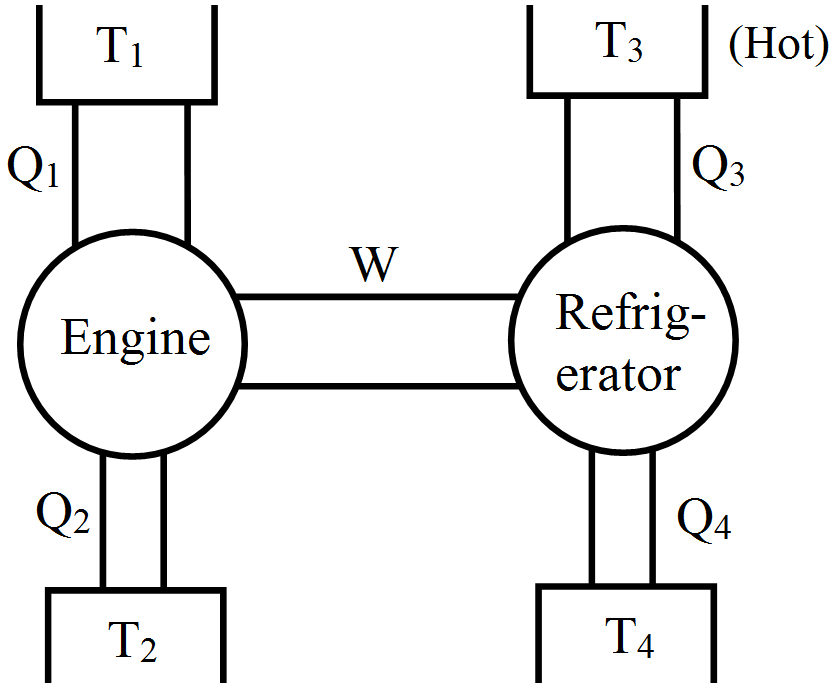
An ideal engine works between temperatures T1 and T2. It derives an ideal refrigerator that works between temperatures T3 and T4. Find the ratio $\frac{\text{Q}_3}{\text{Q}_1}$ in terms of T1, T2, T3 and T4.

Answer
W = work done by engine = Q1 - Q2
and W = work done supplied to refrigerator = Q3 - Q4
$\Rightarrow\text{Q}_1-\text{Q}_2=\text{Q}_3-\text{Q}_4$
Dividing by Q1$1-\frac{\text{Q}_2}{\text{Q}_1}=\frac{\text{Q}_3}{\text{Q}_1}-\frac{\text{Q}_4}{\text{Q}_1}$
$\Rightarrow\frac{\text{Q}_3}{\text{Q}_1}=1-\frac{\text{Q}_2}{\text{Q}_1}+\frac{\text{Q}_4}{\text{Q}_1}$
$=1-\frac{\text{T}_2}{\text{T}_1}+\frac{\text{T}_4}{\text{T}_1}$
$=\frac{\text{T}_1-\text{T}_2+\text{T}_4}{\text{T}_1}$
View full question & answer
Question 313 Marks
Two Carnot engines A and B are operated in series. The first one A receives heat at 800K and rejects to a reservoir at temperature T K The second engine B receives the heat rejected by the first engine and in turn rejects to a heat reservoir at 300K. Calculate the temperature T K for the following cases.
  1. When the outputs of the two engines are equal.
  2. When the efficiencies of the two engines are equal.
Answer
For engine A, T1 = 800K, T2 = T K

Effieciency, $\eta_\text{A}=1-\frac{\text{T}_2}{\text{T}_1}=1-\frac{\text{T}}{800}$

Also, $\frac{\text{Q}_2}{\text{Q}_1}=\frac{\text{T}_2}{\text{T}_1}=\frac{\text{T}}{800}$

Work output, $\text{W}_\text{A}=\text{Q}_1-\text{Q}_2=\eta_\text{A}\times\text{Q}_1$ $\Big[\because\eta_\text{A}=1-\frac{\text{Q}_2}{\text{Q}_1}\Big]$

Or $\text{W}_\text{a}=\Big(1-\frac{\text{T}}{800}\Big)\text{Q}_1$

For engine B, $\text{T}'_1=\text{T K},\text{ T}_2'=300\text{K}$

Efficiency, $\eta_\text{B}=1-\frac{\text{T}_2'}{\text{T}_1'}=1-\frac{300}{\text{T}}$

Work output, $\text{W}_\text{B}=\text{Q}'_1-\text{Q}_2'=\eta_\text{B}\times\text{Q}'_1=\Big(1-\frac{300}{\text{T}}\Big)\text{Q}'_1$

Since, the engine B absorbs the heat rejected by the engine A, so

$\text{Q}_1'=\text{Q}_2\therefore\text{W}_\text{B}=\Big(1-\frac{300}{\text{T}}\Big)\text{Q}_2$

  1. When output of the two engins are equal,

$\text{W}_\text{A}=\text{W}_\text{B}$

$\Big(1-\frac{\text{T}}{800}\Big)\text{Q}_1=\Big(1-\frac{300}{\text{T}}\Big)\text{Q}_2$

$\Big(1-\frac{\text{T}}{800}\Big)=\Big(1-\frac{300}{\text{T}}\Big)\frac{\text{Q}_2}{\text{Q}_1}=\Big(1-\frac{300}{\text{T}}\Big)\frac{\text{T}}{800}$

On solving, we get T = 550K

  1. When the efficiencies are equal, $\eta_\text{A}=\eta_\text{B}$

$1-\frac{\text{T}}{800}=1-\frac{300}{\text{T}}$

$\text{T}^2=24\times10^4$

$\therefore\text{T}=489.9\text{K}$

View full question & answer
Question 323 Marks
An electric heater supplies heat to a system at a rate of 100W. If system performs work at a rate of 75 joules per second. At what rate is the internal energy increasing?
Answer
Heat is supplied to the system at a rate of 100W.
$\therefore$ Heat supplied, Q = 100J/s
The system performs at a rate of 75J/s.
$\therefore$ Work done, W = 75J/s
From the first law of thermodynamics, we have:
Q = U + W
Where,
U = Internal energy
$\therefore$ U = Q - W
= 100 - 75
= 25J/s
= 25W
Therefore, the internal energy of the given electric heater increases at a rate of 25W.
View full question & answer
Question 333 Marks
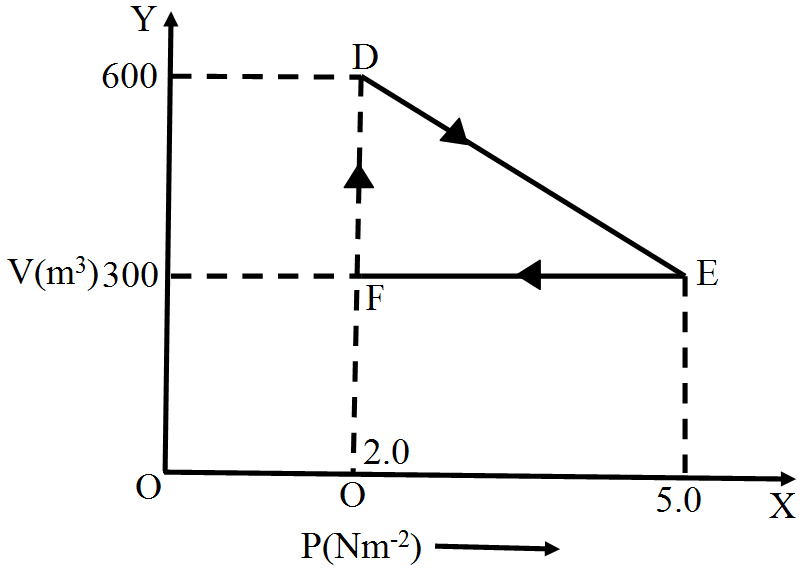
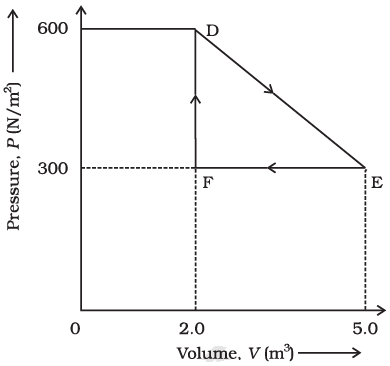
A thermodynamic system is taken from an original state to an intermediate state by the linear process shown in Fig.

Its volume is then reduced to the original value from E to F by an isobaric process. Calculate the total work done by the gas from D to E to F.

Answer
Total work done by the gas from D to E to F = Area of $\Delta\text{DEF}$
Area of $\Delta\text{DEF} =$ (1/2)DE × EF
Where,
DF = Change in pressure
= 600N/m2 - 300N/m2
= 300N/m2
FE = Change in volume
= 5.0m3 - 2.0m3
= 3.0m3
Area of $\Delta\text{DEF} =$ (1/2) × 300 × 3 = 450J
Therefore, the total work done by the gas from D to E to F is 450J.
View full question & answer
Question 343 Marks
Calculate the specific heat capacity at constant volume for a gas. Given specific heat capacity at constant pressure is 6.85cal mole-1 K-2, R = 8.31J mole-1 K-1 and J = 4.18J cal-1.
Answer
We know that,
$\text{C}_\text{p}-\text{C}_\text{V}=\frac{\text{R}}{\text{J}}$
$6.85-\text{C}_\text{V}=\frac{8.31}{4.18}$
$\Rightarrow6.85-\text{C}_\text{V}=1.988$
$\Rightarrow \text{C}_\text{V}=6.85-1.988$
$\Rightarrow\text{C}_\text{V}=4.862\text{ cal mole}^{-1}\text{K}^{-1}$
View full question & answer
Question 353 Marks
Explain why:
Two bodies at different temperatures T1 and T2 if brought in thermal contact do not necessarily settle to the mean temperature (T1 + T2 )/2.
Answer
When two bodies at different temperatures T1 and T2 are brought in thermal contact, heat flows from the body at the higher temperature to the body at the lower temperature till equilibrium is achieved, i.e., the temperatures of both the bodies become equal. The equilibrium temperature is equal to the mean temperature (T1 + T2)/2 only when the thermal capacities of both the bodies are equal.
View full question & answer
Question 363 Marks
What is the coefficient of performance $(\beta)$ of a Carnot refrigerator working between 30°C and 0°C?
Answer
Here $\text{T}_2=0^\circ\text{C}=273\text{K}$
$\text{T}_1=30^\circ\text{C}$
$=273+30=303\text{K}$
$\beta=?$
Using the relation, $\beta=\frac{\text{T}_2}{\text{T}_1\text{T}_2},$ we get
$\beta=\frac{273}{303-273}$
$=\frac{273}{30}=9.1.$
View full question & answer
Question 373 Marks
Distinguish between a cyclic process and a non-cyclic process.
Answer
A cyclic process is that in which the system returns to its initial state after under going a series of changes. A non-cyclic process is that in which the system does not return to its initial state.
View full question & answer
Question 383 Marks
An ideal refrigerator is working between the temperature of ice and temperature of atmosphere at 300K. Find the energy which has been supplied to it to freeze 2kg of water at 0°C. Given that latent heat of ice 3.33 × 10⁵J/ kg.
Answer
Here, T1 = 300K, T2 = 0°C = 273K
Heat etracted, Q2 = mL1 = 2kg × 3.33 × 105J/ kg
= 6.66 × 105J
As, $\beta=\frac{\text{Q}_2}{\text{W}}=\frac{\text{T}_2}{\text{T}_1-\text{T}_2}$
$\therefore\text{W}=\frac{\text{Q}_2(\text{T}_1-\text{T}_2)}{\text{T}_2}$
$=\frac{6.66\times10^5\times(300-273}{273}$
$=65868\text{J}\simeq6.5\times10^4\text{J}$
View full question & answer
Question 393 Marks
A steam engine delivers 5.4 × 10⁸J of work per minute and services 3.6 × 10⁹J of heat per minute from its boiler. What is the efficiency of the engine? How much heat is wasted per minute?
Answer
Work done by the steam engine per minute, W = 5.4 × 10⁸J
Heat supplied from the boiler, H = 3.6 × 10⁹J
Efficiency of the engine = output energy/Input energy
$\therefore$ n = W/H
= 5.4 × 10⁸/3.6 × 109
Hence, the percentage efficiency of the engine is 15%.
Amount of heat wasted = 3.6 × 10⁹ - 5.4 × 108
= 30.6 × 108 = 3.06 × 10⁹J
Therefore, the amount of heat wasted per minute is 3.06 × 10⁹J.
View full question & answer
Question 403 Marks
Is it possible to increase the temperature of a gas without adding heat to it? Explain.
Answer
Yes, it is possible to increase the temperature of a gas without adding heat to it, during adiabatic compression the temperature of a gas increases while no heat is given to it. For an adiabatic compression, no heat is given or taken out in adiabatic process.
Therefore,$\Delta\text{Q}=0$
According to the first law of thermodynamics,
$\Delta\text{Q}=\Delta\text{U}+\Delta\text{W}$
$\Delta\text{U}=-\Delta\text{W}(\Delta\text{Q}=0)$
In compression work is done on the gas, i.e. work done is negativ. Therefore, $\Delta\text{U}=$ positive.
Hence, internal energy of the gas increases due to which its temperature increases.
View full question & answer
Question 413 Marks
A car tyre contains air at a pressure of 4 atm and its temperature is 27°C. The tyre suddenly bursts. Calculate the resulting temperature. $(\gamma=1.4)$
Answer
P1 = 4atm, P2 = 1atm, T1 -27°C = 300K and $\gamma=1.4$
The sudden burst of tyre is an adiabatic process, in which ,
$\text{P}^{1-\gamma}_1\text{T}^\gamma_2=\text{P}^{1-\gamma}_2\text{T}^{\gamma}_2$
$\therefore\text{T}_2=\text{T}_1\Big(\frac{\text{P}_1}{\text{P}_2}\Big)^{\frac{1-\gamma}{\gamma}}=\text{T}_1\Big(\frac{\text{P}_2}{\text{P}_1}\Big)^{\frac{\gamma-1}{\gamma}}$
$=300\Big(\frac{4}{1}\Big)^{\frac{1.4-1}{1.4}}=201.9$
$=202\text{K}$ or $-71^\circ\text{C}.$
View full question & answer
Question 423 Marks
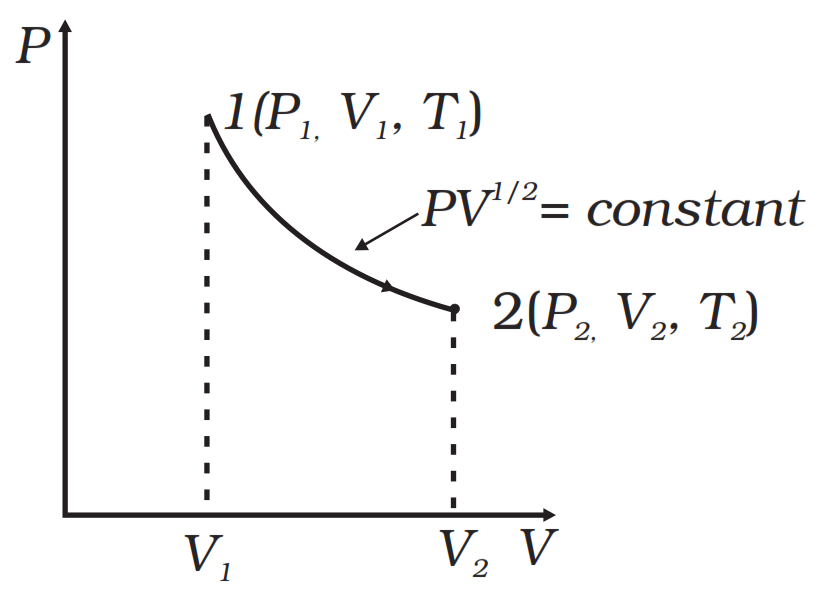
Consider a P-V diagram in which the path followed by one mole of perfect gas in a cylindrical container is shown in Fig.

Given the internal energy for one mole of gas at temperature T is (3/2) RT, find the heat  supplied to the gas when it is taken from state (1) to (2)  with V2 = 2V1.
Answer
$\therefore\ \text{PV}=$ constant = K (given) or $\text{P}_1\text{V}_1^\frac{1}{2}=\text{P}_2\text{V}_2^\frac{1}{2}= \text{K}\ \text{and}\ \text{P}=\frac{\text{K}}{\text{V}^\frac{1}{2}}$
Given that internal energy U of gas is
$\text{U}=\Big(\frac{3}{2}\Big)\text{RT}$
$\Delta\text{U}=\frac{3}{2}\text{RdT}=\frac{3}{2}\text{R}(\text{T}_2-\text{T}_1)$
$\therefore\ \text{T}_2=\sqrt2\text{T}_1,$ from part (b)
$\Delta\text{U}=\frac{3}{2}\text{R}\big[\sqrt2\text{T}_1-\text{T}_1\big]=\frac{3}{2}\text{R}\text{T}_1\big(\sqrt2-1\big)$
Form part (a) $\text{dW}=2\text{P}_1\text{V}^\frac{1}{2}\big(\sqrt{\text{V}_2}-\sqrt{\text{V}_1}\big)$
$\because\ \text{V}_2=2\text{V}_1$ (given)
so, $\sqrt{\text{V}_2}=\sqrt2\sqrt{\text{V}_1}$$$ then 
$\text{dW}=2\text{P}_1\text{V}_1^\frac{1}{2}\big(\sqrt2\sqrt{\text{V}_1}-\sqrt{\text{V}_1}\big)$
$=2\text{P}_1\text{V}_1\sqrt{\text{V}_1}\big[\sqrt2-1\big]$
$\text{dW}=2\text{P}_1\text{V}_1\big(\sqrt2-1\big)$
$\text{dW}=2\text{n}\text{R}\text{T}_1\big(\sqrt2-1\big)$ $\big(\therefore\ \text{P}_1\text{V}_1=\text{n}\text{R}\text{T}_1\big)$
$\therefore\ \text{n}=1\therefore\ \text{dW}=2\text{R}\text{T}_1\big(\sqrt2-1\big)$
$\therefore\ \text{dQ}=\text{dW}+\text{dU}=2\text{R}\text{T}_1\big(\sqrt2-1\big)+\frac{3}{2}\text{R}\text{T}_1\big(\sqrt2-1\big)$
$=\big(\sqrt2-1\big)\text{R}\text{T}_1\Big[2+\frac{3}{2}\Big]$
$\text{dQ}=-\big(\sqrt2-1\big)\text{RT} .$
View full question & answer
Question 433 Marks
Find the value of Cv and Cp for nitrogen (given R = 8.3J mole-1 K-1, also for a diatomic gas, $\text{C}_\text{V}=\frac52\text{R}.$
Answer
As nirogen is a diatomic molecule,
$\therefore\ \text{C}_\text{V}=\frac{5}{2}\text{R}$
$=\frac{5}{2}\times8.3\ \text{J}\ \text{mol}\ ^{-1}\text{K}^{-1}$
$=20.75\ \text{J}\ \text{mol}^{-1}\text{K}^{-1}$
But $\text{C}_\text{P}-\text{C}_\text{V}=\text{R}$
$\therefore\text{C}_\text{P}=\text{C}_\text{V}+\text{R}$
$=(20.75+8.3)\ \text{J}\ \text{mol}^{-1}\text{K}^{-1}$
$=29.05\ \text{J}\ \text{mol}^{-1}\text{K}^{-1}$
View full question & answer
Question 443 Marks
Derive an expression for the work done in an isothermal process.
Answer
For a small change in volume, work done is given by,
DW =P dV
We, know, PV = nRT
$\Rightarrow\text{P}=\frac{\text{nRT}}{\text{V}}$
For T = costant, $\text{dW}=\text{nRT}=\frac{\text{dV}}{\text{V}}$
Net work done under isothermal condition to change the valume from Vi to Vf is,
$\text{W}=\int\limits^{\text{V}_\text{f}}_{\text{V}_\text{i}}\text{dW}=\text{nRT}\int\limits^{\text{V}_\text{f}}_{\text{V}_\text{i}}\frac{\text{dV}}{\text{V}}$
$=\text{nRT}\Big|\log_\text{e}\text{V}\Big|^{\text{V}_\text{f}}_{\text{V}_\text{i}}$
$\text{W}=\text{nRT}\log_\text{e}\Big(\frac{\text{V}_\text{f}}{\text{V}_\text{i}}\Big)$
$\therefore\text{W}=2.3026\text{ nRT }\log_{10}\Big(\frac{\text{V}_\text{f}}{\text{v}_i}\Big)$
Where n is the number of moles. If Pf and Pi are the pressures, we can also write,
$\text{W}=2.3026\text{ nRT }\log_{10}\Big(\frac{\text{P}_\text{i}}{\text{P}_\text{i}}\Big)$
View full question & answer
Question 453 Marks
A refrigerator is to maintain eatables kept inside at 9°C. If room temperature is 36°C, calculate the coefficient of performance.
Answer
Temperature inside the refrigerator, T1 = 9°C = 282K
Room temperature, T2 = 36°C = 309K
Coefficient of performance = T1/T2 - T1
= 282/309 - 282
= 282/27
= 10.44
Therefore, the coefficient of performance of the given refrigerator is 10.44.
View full question & answer
Question 463 Marks
State the first law of thermodynamics. List the sign conventions used in the energy dealt by the law.
Answer
According to the first law of thermodynamics, the total heat energy change dQ is the sum of the internal energy change dU and work done dW, i.e., dQ = dU + dW.
Heat energy given to the system is +ve, taken out is -ve. Internal energy change is +ve with increase in temperature. Work done is +ve if volume increases and -ve if volume decreases.
View full question & answer
Question 473 Marks
State first law of thermodynamics. Why Cp > Cv? Prove Cp - Cv = R.
Answer
First Law of Thermodynamics: It is based on the law of conservation of energy. The total heat energy change in any system is the sum of the internal energy change and the work done, i.e. dQ = dU + dW.
where dU is the internal energy change and dW = PdV is the work done by/ on the system. Cp is greater because under constant pressure process, the energy also does work.
Poof of Cp - Cv = R
Suppose one mole of a gas is heated at constant volume so that its temperature rises by dT.
Heat supplied = 1 × CV × dT = CVsdT ...(i)
Since the volume is constant, the gas will not perform external work in accordance with the first law of thermodynamics and the heat supplied will be just equal to the increase in the internal energy of the gas.
$\therefore$ dU = CVdT ...(ii)
Let the gas be heated at constant pressure to increase its temperature by dT, and dQ be the amount of heat supplied, therefore,
dQ = 1 × CP × dT = CPdT ...(iii)
The heat supplied at a constant pressure increases the temperature by dT, hence increases its internal energy by dU = CvdT as well as enables the gas to perform work dW.
dW = PDV ...(iv)
From the first law of thermodynamics, we have,
dQ = dU + dW
Substituting the values, we get,
CPdT = CVdT + PdV
But PV = RT (For one mole of an ideal gas)
or PdV = RdT,
$\therefore\text{C}_\text{P}\text{dt}=\text{C}_\text{P}\text{dT}+\text{RdT}$
CP - CV = R ...(v)
This is the relationship between two principal specific heats of the gas when Cp, Cv and R are measured in the units of either heat or of work.
View full question & answer
Question 483 Marks
Temperatures of the hot and cold reservoirs of a Carnot engine is raised by equal amounts. How the efficiency of the Carnot engine affected?
Answer
Let the initial temperatures of hot and cold reservoirs were T1 and T2. The efficiency of the Carnot engine is given by,
So, intially $\eta=\frac{\text{T}_1-\text{T}_2}{\text{T}_1}\dots\text{(i)}$
As given the temperature of both the reservoirs is raised by equal amout t so $\text{T}'_1=\text{T}+\text{t}$ and $\text{T}'_2=\text{T}_2+\text{t}.$
The final efficiency of the Carnot engine will be
$\eta'=\frac{\text{T}'_1-\text{T}_2'}{\text{T}'_1}$ $=\frac{(\text{T}_1+\text{t})-(\text{T}_2'+\text{t})}{\text{(T}_1+\text{t)}}$
$=\frac{\text{T}_1-\text{T}_2}{(\text{T}_1+\text{t})}\dots\text{(ii)}$
Dividing equation (ii) by equation (i), we have
$\frac{\eta'}{\eta}=\frac{\Big(\frac{\text{T}_1-\text{T}_2}{\text{T}_1+\text{t}}\Big)}{\Big(\frac{\text{T}_1-\text{T}_2}{\text{T}_1}\Big){}}=\frac{\text{T}_1}{\text{T}_1+\text{t}}\dots\text{(iii)}$
As $\eta'<\eta,$ i.e. the effieciency of Cornot engine decreases.
View full question & answer
Question 493 Marks
A perfect Carnot engine utilizes an ideal gas. The source temperature is 500K and sink temperature is 375K. If the engine takes 600K cal per cycle from the source, compute:
  1. The efficiency of the engine.
  2. Work done per cycle.
  3. Heat rejected to the sink per cycle.
Answer
Here T1 = 500K

T2 = 375K

Q1 = Heat absorbed per cycle = 600 kcal

  1.  

$\therefore$ Using the relation,

$\eta=1-\frac{\text{T}_2}{\text{T}_1},$ we get

$\eta=\frac{\text{T}_1-\text{T}_2}{\text{T}_1}$

$=\frac{500-375}{500}$

$=\frac{125}{500}=0.25$

$\eta\%=0.25\times100$

$=25\%$

  1. Let W = work done per cycle

$\therefore$ Using the relation

$\eta=\frac{\text{W}}{\text{Q}_1},$ we get

$\text{W}=\eta\text{Q}_1=0.25\times600\text{ kcal}=150\text{ kcal}$

$=150\times10^3\times4.2\text{J}$

$=6.3\times10^5\text{J}$

  1. Let Q2 = Heat rejected to the sink

$\therefore$ Using the relation

$\text{W}=\text{Q}_1-\text{Q}_2,$ we get

$\text{Q}_2=\text{Q}_1-\text{W}$

$=600-150=450\text{ kcal}$

View full question & answer
Question 503 Marks
A Carnot's engine whose sink is at a temperature of 300K has an efficiency of 40%. By how much should the temperature of the source be increased so as to increase the efficiency to 60%?
Answer
Let T be the temperature of the source.
$\frac{40}{100}=\frac{\text{T}-300}{\text{T}}$ or $\frac25=\frac{\text{T}-300}{\text{T}}$
T = 500K
Let the temperature be increased by $\theta,$ therefore
$\frac{60}{100}=\frac{(\text{T}+\theta)-300}{(\text{T}+\theta)}$
$\frac35=\frac{500+\theta-300}{500+\theta}$
$\theta=\frac{500}2=250\text{K}$
View full question & answer
3 Marks Question - Physics STD 11 Science Questions - Vidyadip